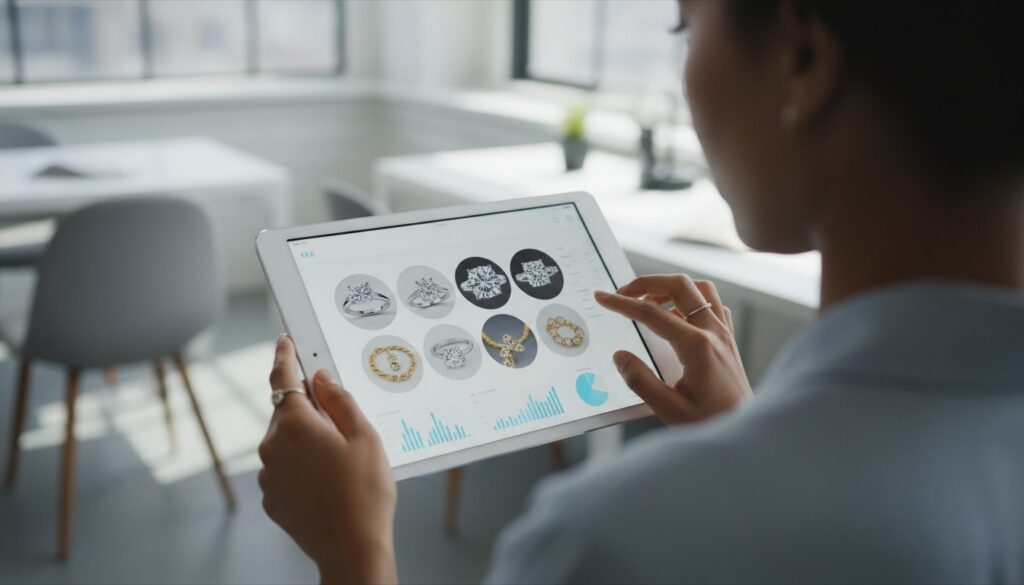
With the global online jewelry market projected to reach $85.7 billion in 2026, a static PDF is no longer a viable sales tool. If you still spend hours manually resizing hundreds of product photos or sending line sheets with outdated prices, you’re losing ground in an industry where mobile commerce now accounts for over 60% of transactions. To stay competitive, you must create digital catalog for jewelry business operations that function as a live extension of your inventory, not a frozen snapshot in time.
We understand the logistical headache of managing complex variations across metal types and stone sizes while trying to maintain a professional B2B presence. You need a system that eliminates manual labor and ensures your sales channels are always accurate. This article teaches you how to transform your inventory into a high-converting digital catalog that synchronizes with your live stock in real time. We will explore how to automate your PIM data for instant PDF generation and professional presentations that empower you to scale your brand with expert precision.
Key Takeaways
- Understand why transitioning from static PDFs to a live-synced PIM system is essential for maintaining price accuracy and protecting your margins.
- Discover the step-by-step workflow to create digital catalog for jewelry business success by centralizing your complex inventory and automating media uploads.
- Learn how to manage deep SKU variations, such as metal colors and stone types, within a professional interface that doesn’t require a graphic designer.
- Master the shift toward data-driven catalogs that provide real-time inventory updates to ensure your B2B presentations are always reliable.
- Explore how centralized operational hubs allow you to synchronize your catalog updates across websites and global marketplaces with a single click.
Why Your Jewelry Business Needs a Digital Catalog in 2026
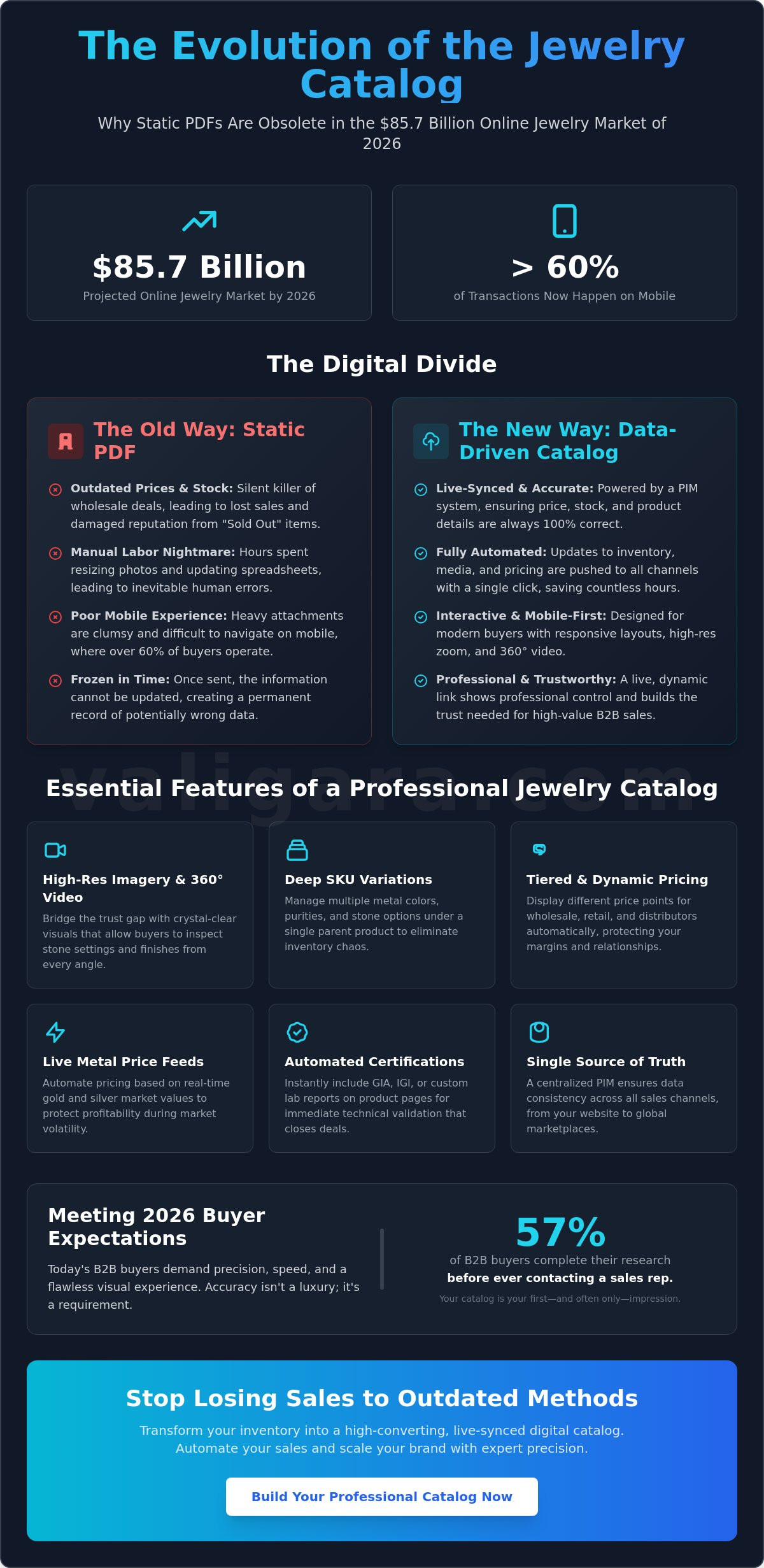
A digital jewelry catalog is no longer a simple collection of images. It is a centralized, interactive showcase that acts as the core intelligence of your enterprise. As the global online jewelry market reaches a projected $85.7 billion in 2026, traditional methods of presenting inventory are failing. If you want to create digital catalog for jewelry business growth, you must move beyond the static file. You need a Product Information Management (PIM) system that synchronizes every detail in real time across all sales channels.
The stakes are high for modern wholesalers. Research suggests that 57% of B2B buyers complete their research journey before ever contacting a sales representative. If your pricing is outdated or your items are incorrectly labeled, you lose the deal before it even starts. Outdated pricing is a silent killer of wholesale relationships. In an era where online shopping has become the primary procurement method for retailers, manual errors suggest a lack of professional control. Precision is the currency of luxury retail.
The Death of the Static PDF
Traditional PDFs are now a liability for high-value jewelry items. They are heavy, difficult to navigate on mobile devices, and impossible to update once they leave your outbox. There is nothing more damaging to a brand’s reputation than a buyer selecting a “Sold Out” item from an old attachment. Dynamic links are the modern alternative. They ensure your catalog is always current, providing better email deliverability and a frictionless user experience that reflects your brand’s sophistication.
Meeting the 2026 Buyer Expectations
Today’s buyers demand a visual-first experience. With mobile commerce accounting for over 60% of online jewelry transactions, your catalog must be perfectly responsive. Buyers at trade shows or in transit don’t have time for slow-loading attachments or clumsy layouts. They expect high-resolution zoom capabilities and 360-degree video to bridge the trust gap inherent in high-value online sales. They also require instant access to technical specifications, including carat weight, metal purity, and lab certifications. Accuracy isn’t a luxury; it’s a requirement for scaling a specialized brand with precision and ease.
Essential Features of a Professional Jewelry Catalog
A high-performance catalog in 2026 is a sophisticated data interface, not just a digital lookbook. To create digital catalog for jewelry business growth, your system must handle the granular technicalities of luxury retail with absolute precision. High-resolution imagery is the baseline, but professional buyers now expect integrated 360-degree video to inspect stone settings and metal finishes from every angle. This visual depth is essential for bridging the trust gap in high-value transactions where the buyer cannot physically handle the piece.
Beyond visuals, your catalog must support deep SKU variations. A single design often exists in multiple metal colors, purities, and stone configurations. Managing these as separate, disconnected entries is a recipe for inventory chaos. A professional system links these variations to a single parent product, allowing buyers to toggle between 14K yellow gold and platinum versions without leaving the page. The automated inclusion of GIA, IGI, or custom lab certifications directly on the product page provides the immediate technical validation that closes wholesale deals.
Efficiency also requires tiered pricing structures. Your catalog should serve as a versatile sales tool that displays different price points for wholesale partners, retail customers, and exclusive distributors. This level of control ensures you’re always presenting the right margin to the right audience without maintaining multiple document versions. Precision in these settings prevents the accidental disclosure of wholesale rates to retail clients, protecting your professional relationships.
Managing Complex Jewelry Data
Generic e-commerce platforms often fail because they don’t understand jewelry-specific attributes like stone clarity, total carat weight, or metal fineness. Your jewelry PIM acts as the Single Source of Truth, centralizing this complex data so it remains consistent across all channels. Integrating live gold and silver feeds is a critical 2026 requirement. This automation ensures your pricing reflects current market values, protecting your profitability during periods of market volatility. Utilizing specialized jewelry inventory management allows you to automate these updates, removing the risk of human error in your pricing logic.
Branding and Customization
Luxury brand consistency is non-negotiable. Your digital catalog must reflect your brand’s unique aesthetic through custom templates that go beyond generic layouts. When you create digital catalog for jewelry business scalability, you need features like white-labeling for high-volume wholesale partners. This allows you to provide a curated, exclusive browsing experience that strengthens the business relationship. The final step in a professional workflow is the integration of “Buy Now” buttons. These should link directly to your Vite eCommerce site, allowing a seamless transition from product discovery to order fulfillment. This direct path to purchase transforms your catalog from a passive document into an active, revenue-generating engine.
Static vs. Interactive vs. Data-Driven Catalogs
Choosing the right architecture for your catalog determines whether it becomes a growth engine or a technical bottleneck. Most entrepreneurs view this as a design choice, but it’s actually a data management decision. In 2026, the gap between a static document and a data-driven interface is the difference between a manual workflow and a scalable global enterprise. To create digital catalog for jewelry business sustainability, you must understand how these formats handle your live inventory and pricing.
Static PDFs are the traditional baseline. They are excellent for high-fidelity printing and physical lookbooks, but they are fundamentally frozen. Once a PDF is sent, its data begins to decay. If a diamond sells or gold prices fluctuate, your document becomes a liability. Interactive flipbooks attempt to solve the engagement problem by adding page-turn effects and clickable links. While visually stunning, they often remain disconnected from your live stock. Many providers offer flipbooks as the ultimate solution, yet these tools still require manual data entry, creating a “lipstick on a pig” scenario where the interface is modern but the backend is obsolete.
Data-driven PIM catalogs are the gold standard. These aren’t just documents; they’re dynamic views of your centralized Product Information Management system. When you update a stone’s clarity or a ring’s price in your PIM, the change propagates instantly across your catalog. This ensures your B2B partners always see accurate, real-time data without you lifting a finger.
The Workflow Comparison
The efficiency gains of automation are undeniable. A manual design process for a 100-page catalog can easily consume 10 hours of labor, including photo placement and spec entry. In contrast, an automated system generates the same catalog in 10 minutes by pulling data directly from your inventory. This speed is critical when managing accuracy across multi-channel environments like eBay, Etsy, and Amazon. While manual updates fail at scale, a data-driven system allows you to manage 50,000 unique jewelry pieces with the same ease as 50. You don’t just save time; you eliminate the human error that kills wholesale deals.
Which One Should You Choose?
Your choice should align with your specific business model. If you need to provide a quick, one-off client quote for a bespoke piece, a simple PDF generated from your PIM is perfectly adequate. However, wholesalers require data-driven portals for bulk ordering. These portals allow partners to browse your full collection with their specific tiered pricing already applied. The most effective strategy is a hybrid approach. By using a centralized PIM, you can maintain a live B2B portal while simultaneously generating professional, on-brand PDFs for offline use. This ensures your brand remains sophisticated and reliable, regardless of how the buyer chooses to browse.
Step-by-Step: Building a Scalable Catalog Without a Designer
Transitioning from manual spreadsheets to an automated sales tool requires a shift in strategy. You don’t need a graphic design degree to create digital catalog for jewelry business success; you need a structured data workflow. By following a logical implementation path, you can build a professional, high-converting showcase that scales with your growth. This process moves you from the chaos of fragmented files to the precision of a centralized operational hub.
- Step 1: Centralize your jewelry inventory. Start by consolidating your product data into a dedicated PIM system. This includes technical specs like metal fineness, stone clarity, and total carat weight.
- Step 2: Automate media and documentation. Link your high-resolution 360-degree videos and lab certificates (GIA, IGI) directly to your SKUs. Automation ensures the right certificate always matches the right diamond.
- Step 3: Define pricing rules and wholesale tiers. Establish your logic for different buyer segments. Your system should automatically calculate margins for retail, wholesale, and distributor levels without manual entry.
- Step 4: Select a professional jewelry template. Choose a layout that emphasizes luxury aesthetics. Your template must be mobile-responsive to accommodate the 60% of buyers browsing on smartphones.
- Step 5: Generate and distribute. Produce your catalog as a dynamic link or a professional PDF. Distribute these via private portals to maintain exclusivity with your B2B partners.
Step 1: The Foundation of Data
The first step is often the most daunting, but it’s simplified by leveraging your existing work. You can import your current listings directly from marketplaces like Etsy, eBay, or Amazon to populate your system instantly. Once imported, organize your collections by metal type, gemstone category, or specific price points to help buyers navigate your inventory with ease. A Jewelry PIM is the high-performance engine that powers every automated update in your catalog. By centralizing this data, you ensure that a change in a stone’s status on your website is reflected in your catalog within seconds. To see this in action, explore professional jewelry catalog automation and reclaim your time.
Step 2: Distribution and Tracking
Modern distribution goes beyond the email attachment. You can use QR codes on physical jewelry tags at trade shows to link buyers directly to a digital catalog page with live pricing and technical specs. This bridges the gap between the physical product and your digital ecosystem. Furthermore, advanced systems allow you to track buyer engagement. You’ll know exactly who opened your catalog and which specific collections they spent the most time viewing. Integrating these insights with your Jewelry CRM enables your sales team to perform high-precision follow-ups based on actual buyer interest rather than guesswork.
Automate Your Sales with Valigara’s Catalog Solutions
Valigara serves as the specialized brain for your jewelry enterprise. While generic e-commerce platforms force you into rigid templates designed for simple consumer goods, our ecosystem is built specifically for the complexities of high-value jewelry. When you create digital catalog for jewelry business operations through Valigara, you gain a centralized operational hub. One click propagates updates across your private B2B portals, your Vite website, and global marketplaces like Amazon or Etsy. This level of control ensures that your brand remains consistent and your operations stay lean.
Our diamond and gemstone management tools allow you to handle technical specifications that general tools simply ignore. From tracking specific stone parcels to managing laboratory certificates, every detail is integrated into your workflow. This precision extends to our PDF generation engine. You don’t just get a document; you get a professional presentation tailored for the luxury trade. These catalogs feature high-resolution visuals and accurate technical data that build immediate buyer rapport. Seamless integration with our Jewelry CRM and marketing automation tools means your sales team can act on engagement data the moment a buyer interacts with your collection.
The Valigara Advantage
General e-commerce tools often fail jewelry manufacturers because they lack the niche industry terminology and structural logic required for jewelry-specific attributes. By using a platform that understands stone clarity, metal fineness, and total carat weight, you eliminate the friction of manual data entry. Industry professionals report that transitioning to specialized automation can reduce the time spent on content production by 40-60%. This efficiency allows you to focus on global scaling rather than administrative maintenance. With multi-currency and multi-language support, your catalog becomes a tool for international expansion, ensuring your brand speaks the language of every market you enter.
Take the Next Step in Jewelry Automation
Implementing a high-performance catalog system is the foundation for a streamlined global enterprise. You can start by utilizing Valigara’s PDF catalog generator to transform your existing inventory data into a professional sales asset within minutes. To ensure your profitability remains protected against market volatility, integrate your catalog with real-time gold feed sync. This automation guarantees that your wholesale and retail pricing always reflects the current value of your materials. It’s time to move beyond manual workflows and embrace the precision of a results-driven platform.
Scale your jewelry business with Valigara’s professional catalog tools
Future-Proof Your Jewelry Enterprise
The transition from manual line sheets to a data-driven ecosystem is the definitive step toward professional scalability. By centralizing your inventory through a specialized PIM, you ensure your pricing and availability remain accurate across every global channel. You no longer need to waste hours on manual updates; instead, you can create digital catalog for jewelry business success that functions as a live extension of your operation. This shift moves your brand away from the limitations of static files and toward a dynamic, results-driven showcase.
Since 2009, Valigara has served as a seasoned partner for luxury brands, providing the core intelligence needed to manage complex diamond and gemstone inventories with expert precision. Our platform integrates directly with Amazon, Etsy, and eBay, ensuring your multi-channel presence is always synchronized and reliable. This level of automation doesn’t just save time; it empowers you to focus on the traditional craftsmanship and strategic growth that define your trade. Take control of your inventory and present your collections with the technical accuracy they deserve.
Book a Demo to See Valigara’s Jewelry Catalog Generator in Action
Your business is ready to transition from manual workflows to the streamlined efficiency of a global enterprise.
Frequently Asked Questions
What is the best way to create a jewelry catalog for wholesale?
The most efficient method for wholesale is utilizing a centralized Product Information Management (PIM) system. This approach replaces manual design with data-driven automation, allowing you to establish tiered pricing for different buyer segments. By linking your catalog directly to your wholesale inventory, you ensure that every line sheet or presentation reflects accurate stock levels and current market valuations.
Can I create a jewelry catalog if I don’t have design skills?
You don’t need graphic design expertise to produce high-end sales materials. Modern jewelry-specific software provides sophisticated templates designed to highlight luxury aesthetics and technical specifications. You simply manage the product data and high-resolution media in your PIM, and the system generates a professional layout. This transition from manual design to automated production allows you to focus on scaling your brand with expert precision.
How do I ensure my digital catalog shows real-time inventory?
Real-time accuracy is achieved by connecting your catalog to a centralized operational hub. When you create digital catalog for jewelry business operations, the system should pull data directly from your live inventory. If a piece sells on Etsy, Amazon, or your private website, the catalog updates automatically. This eliminates the risk of presenting sold-out items to high-value B2B partners.
Is a PDF catalog still relevant in 2026?
PDFs remain relevant as versatile, portable sales tools, provided they aren’t static files. In 2026, a professional PDF is a dynamic export generated from your live PIM data. This hybrid approach allows you to offer the convenience of an offline document while ensuring the information was accurate at the moment of generation. It remains a staple for trade show presentations and formal wholesale quotes.
How can I include GIA certificates in my digital jewelry catalog?
You can automate the inclusion of GIA, IGI, or custom lab certificates by linking them to your gemstone inventory within a specialized PIM. This ensures that every diamond or gemstone SKU in your catalog includes a direct link to its technical validation. Providing instant access to these documents builds immediate trust and streamlines the decision-making process for professional buyers looking for verified quality.
What is the difference between a jewelry PIM and a digital catalog?
A jewelry PIM is the centralized database that serves as the core intelligence of your business, storing all technical specs, media, and certificates. A digital catalog is the visual output or interface that presents this data to your customers. Think of the PIM as the engine and the catalog as the body of the vehicle; one powers the data while the other drives the sales experience.
Can I use my Etsy or eBay listings to create a catalog?
Absolutely. You can leverage your existing marketplace data to populate your digital ecosystem. By importing listings from platforms like Etsy or eBay into a centralized jewelry PIM, you can create digital catalog for jewelry business growth without the burden of manual data entry. This process allows you to consolidate fragmented marketplace information into a cohesive, professional presentation for your B2B partners.
How do I handle price fluctuations in my jewelry catalog?
Managing price volatility requires an automated gold feed sync. This feature links your inventory pricing to live market rates for precious metals, ensuring your catalog reflects current values without manual intervention. By setting pricing rules within your PIM, your system calculates the correct margin for every SKU, protecting your profitability during periods of rapid market fluctuation.