
What if the hours you spend manually updating gemstone variations across Etsy, eBay, and Amazon are the single greatest threat to your brand’s scalability? You’ve likely felt the sting of inventory inaccuracies leading to overselling, or the frustration of managing complex metal specs in a spreadsheet that’s one keystroke away from disaster. With the global jewelry market projected to reach $394.74 billion in 2026, the margin for administrative error has never been thinner. You need to know how to make my jewelry business more efficient to keep pace with tightening regulations, such as the July 8, 2026, CPSC eFiling mandate for children’s products.
It’s clear that manual data entry is a tax on your growth that you can no longer afford to pay. This guide promises a clear path to transition from fragmented workflows to a high-output, automated enterprise by eliminating the operational bottlenecks that drain your resources. We’ll examine how to establish a centralized single source of truth for your product data and implement real-time inventory synchronization across all channels. By the end, you’ll understand how to reduce manual labor costs and reclaim the time needed to focus on the high-value artistry that defines your brand.
Key Takeaways
- Audit your current jewelry operations to identify repetitive manual tasks and calculate the true cost of the “Data Duplication Tax” on your bottom line.
- Discover how to make my jewelry business more efficient by implementing a specialized Jewelry PIM to manage complex gemstone and metal variations from a single source of truth.
- Transition from basic cross-listing to a centralized distribution model that ensures real-time inventory synchronization across all global sales channels.
- Leverage marketing automation to streamline high-touch workflows, including the instant generation of PDF catalogs for B2B and wholesale clients.
- Adopt an all-in-one industry framework to replace disconnected software tools with a unified intelligence hub designed specifically for high-value jewelry retail.
Identifying the Efficiency Leaks in Your Jewelry Operations
Scaling a jewelry brand requires more than just high-quality craftsmanship. It demands a rigorous audit of your backend operations. Many owners ask how to make my jewelry business more efficient, yet they continue to tolerate invisible leaks in their daily workflow. These leaks usually manifest as repetitive manual tasks that eat into your creative time and profit margins. If you’re still entering the same SKU details on Etsy, then eBay, and finally Amazon, you’re paying a heavy price for operational friction. Relying on generic spreadsheets is the primary bottleneck here. While a spreadsheet works for simple items, it fails to capture the complexity of jewelry variations. Mismanaging metal weights or stone clarity across different tabs inevitably leads to overselling and damaged marketplace reputations.
The Manual Entry Trap
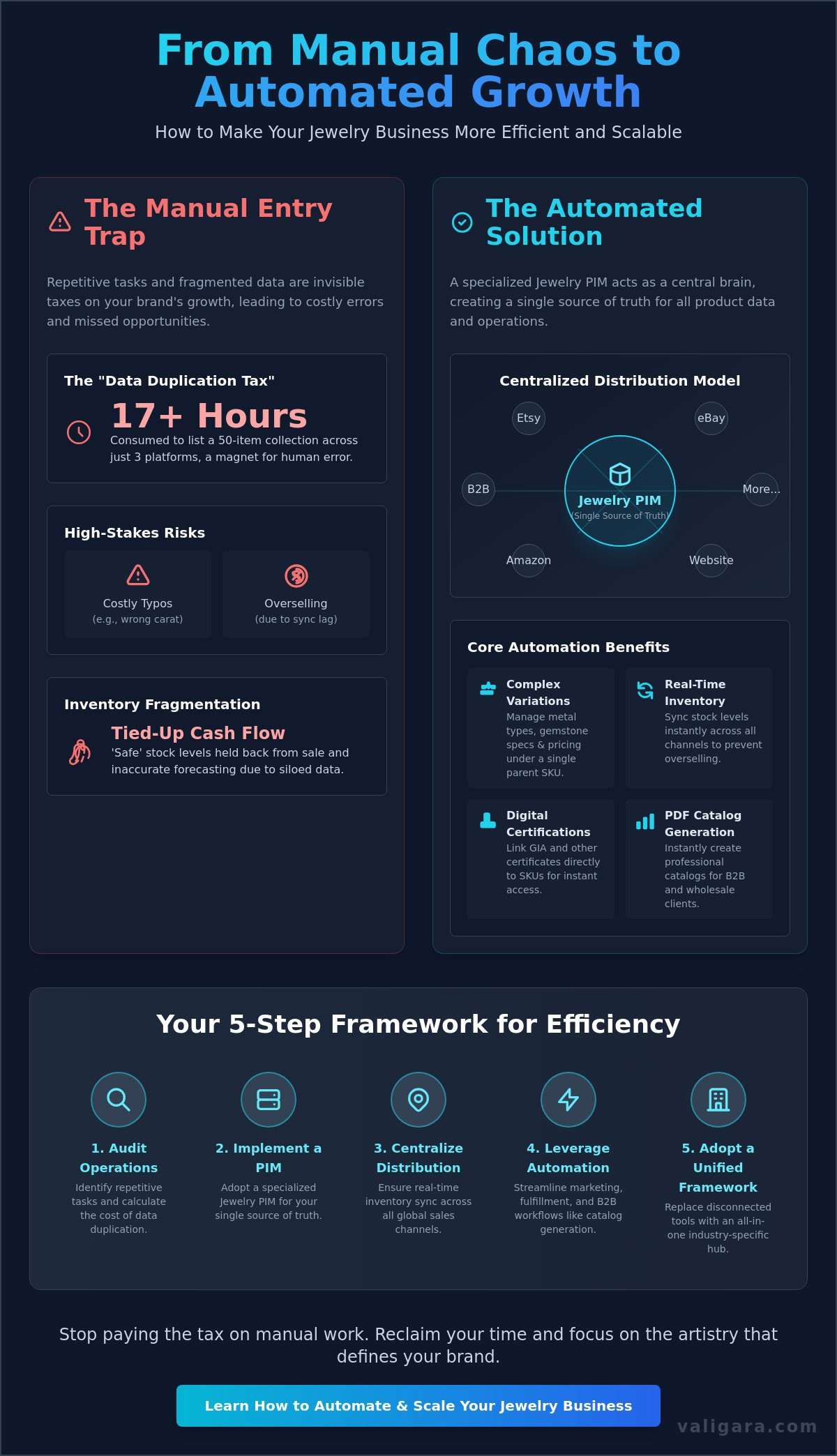
Analyze the time your team spends on manual listings. If it takes 20 minutes to list one piece across three platforms, a 50-item collection consumes nearly 17 hours of labor. This manual approach is a magnet for human error. A single typo in a high-value description, like misstating a diamond’s carat weight or gemstone origin, can lead to costly returns or legal disputes. The Data Duplication Tax is the primary obstacle to jewelry scalability. Implementing Business Process Automation principles allows you to move away from these high-risk, low-value activities. By automating the technical specifications of your inventory, you ensure that your brand maintains its luxury standards across every global touchpoint.
Inventory Fragmentation Risks
Fragmented data creates a false sense of security. Many retailers keep ‘safe’ stock levels, holding back inventory to avoid overselling on multiple platforms. This practice ties up your cash flow in products that aren’t visible to buyers. During peak seasons, manual stock updates simply cannot keep pace with high-velocity sales. When your data is scattered across different logins, accurate sales forecasting becomes impossible. You can’t predict which gemstone variations will trend if you can’t see your total sales volume in a single view. To truly understand how to make my jewelry business more efficient, you must first eliminate the silos that keep your inventory data hostage. A fragmented system isn’t just an inconvenience; it’s a barrier to the global enterprise you’re trying to build.
Centralizing Product Data with a Jewelry-Specific PIM
A generic e-commerce platform isn’t enough for the specialized needs of a luxury brand. While platforms like Shopify offer basic SKU fields, they lack the structural depth to handle technical jewelry attributes. To solve the problem of how to make my jewelry business more efficient, you must implement a Jewelry Product Information Management (PIM) system. This acts as your business’s central brain. It stores every granular detail, from metal purity to gemstone clarity, in one location. This single source of truth ensures that when you update a product description, the changes reflect instantly across all marketplaces. It eliminates the listing inconsistencies that confuse buyers and erode trust in your brand.
The shift toward AI in the Jewelry Industry and advanced automation has made manual data management obsolete. A specialized PIM handles the heavy lifting of digitizing GIA and other gemstone certifications. Instead of hunting through physical folders or disconnected cloud drives, you can link digital certificates directly to the relevant SKU. This creates a seamless flow of information from your vault to the customer’s screen, ensuring precision at every step of the sales process. It’s about moving from a state of constant data correction to one of authoritative control.
Managing Complex Variations
Handling variations is often where manual systems break down. Managing 14k gold, 18k gold, and platinum versions of the same design shouldn’t require fifty different spreadsheets. A jewelry-specific PIM allows you to manage these variants under a single parent SKU. If you are searching for how to make my jewelry business more efficient, look at how you handle pricing updates. A specialized system automates these changes by syncing with real-time gold and diamond market feeds. This ensures your margins stay protected even as commodity prices fluctuate. By using a centralized dashboard, you maintain consistent branding across Etsy, eBay, and your own site without redundant labor. Exploring a dedicated Jewelry PIM is the logical next step for any scaling strategy.
Gemstone and Diamond Data
Technical specifications are the lifeblood of jewelry sales. You need to manage carats, clarity, cut, and color with absolute accuracy. Manual entry for these details is a high-risk activity that often leads to expensive mistakes. Utilizing centralized diamond and gemstone management within a PIM reduces technical errors by 90%. This system automates the attachment of digital certificates to your listings, providing immediate value to the buyer. Key benefits include:
- Instant synchronization of 4C data across all sales channels.
- Automatic linking of GIA, IGI, or HRD certificates to specific items.
- Reduced risk of mislabeling high-value stones.
This level of precision is something general-purpose tools simply cannot match. This specialized approach allows you to focus on growth rather than damage control.
Automating Multi-Channel Sales and Inventory Sync
The transition from “cross-listing” to “centralized distribution” represents a fundamental shift in how high-growth brands operate. In the early stages of a brand, manually posting a new collection to Etsy and then duplicating it on eBay might seem sustainable. However, as you scale, this fragmented approach becomes a liability. True growth requires a single interface where you can manage eBay, Etsy, Amazon, and your own website simultaneously. This is the core of how to make my jewelry business more efficient. By treating your PIM as the central intelligence hub, you push data outward to multiple channels rather than pulling it across them manually. This ensures your brand voice and technical specifications remain identical across every global touchpoint.
Maintaining high marketplace seller ratings depends entirely on your ability to fulfill promises. If a one-of-a-kind emerald pendant sells on your website, it must vanish from Amazon immediately. Real-time stock synchronization is the only way to prevent the “Out of Stock” nightmare that leads to negative reviews and account suspensions. Managing a profitable and efficient jewelry operation requires a system that moves as fast as the market does. Automation doesn’t just save time; it protects your hard-earned reputation by ensuring that every listed item is actually available for purchase.
Omnichannel Inventory Control
Real-time sync works by creating a constant feedback loop between your sales channels and your central inventory. When a transaction occurs on one platform, the system instantly recalculates available stock across all others. For high-value pieces, you can set buffer stock levels to prevent overselling during high-traffic periods. This is especially critical for one-of-a-kind items. Automation allows you to list these unique pieces globally without the risk of a double-sale, maximizing your exposure while minimizing operational risk.
Marketplace-Specific Optimization
Every marketplace has its own set of data requirements and categorization rules. Automating the mapping of your PIM data to these specific requirements is a major factor in how to make my jewelry business more efficient. Instead of manually adjusting carats or metal types for each site’s unique fields, the system translates your data automatically. This capability allows you to bulk edit listings for seasonal promotions or adjust pricing for holiday sales without opening a single browser tab. You can reduce the time-to-market for new collections from weeks to just minutes, keeping your brand agile in a competitive landscape.
To see how these efficiency principles translate to other high-demand sectors like tech accessories and lifestyle gadgets, you can explore E-commerce Product Sales for examples of optimized digital retail at ElectroGadget.
Optimizing Jewelry Marketing and Fulfillment Workflows
Efficiency doesn’t stop once a product is listed. Realizing how to make my jewelry business more efficient requires a deep look at the post-click experience. Integrating CRM data allows you to personalize high-value interactions that define the luxury market. High-net-worth clients expect a bespoke experience, not a generic mass email. For instance, brands like Slapta meilė, which focus on unique gifts and historical storytelling, rely on these efficiencies to maintain their premium brand promise. By segmenting your audience based on purchase history and gemstone preferences, you can trigger automated follow-up sequences. These can include anniversary reminders or specific gemstone care instructions. This level of precision builds long-term loyalty without adding to your daily administrative burden. With digital platforms anticipated to account for 25% of all diamond jewelry sales by the end of 2026, your digital marketing must be as polished as your physical showroom.
B2B and Wholesale Efficiency
Wholesale operations are often the most manual part of a jewelry brand. Generating individual quotes or updating line sheets takes hours of tedious labor. You can eliminate these bottlenecks by using specialized B2B sales tools. Instead of manually editing layouts, you can create professional, up-to-date PDF catalogs in seconds directly from your centralized PIM. This ensures your wholesale clients always see accurate stock levels and correct pricing. Managing multiple wholesale tiers and custom pricing within one system is a core component of how to make my jewelry business more efficient. It allows you to scale your B2B reach without hiring more administrative staff.
Post-Purchase and Loyalty
The fulfillment stage is a critical touchpoint for luxury retail. Accuracy here is non-negotiable. Streamlining the process with barcode and tag printing ensures that the correct piece reaches the correct customer every time. This precision drastically reduces the high cost of returns associated with shipping errors. By using jewelry CRM data to populate your fulfillment records, you can also reduce return rates through more accurate, data-rich product descriptions that manage customer expectations from the start. It turns a logistical necessity into a brand-building opportunity.
Analytics provide the final piece of the efficiency puzzle. You need to identify which sales channels are your most profitable, not just which ones have the highest volume. Measuring the time-to-fulfillment and the return rate per channel helps you allocate resources effectively. It’s about working smarter by letting data guide your strategy. Automation provides the intelligence you need to make these decisions with quiet confidence. To see how these tools can transform your daily operations, optimize your fulfillment workflow with our integrated solutions.
Scaling for 2026: The Valigara Efficiency Framework
Transitioning to a streamlined, global enterprise requires a partner that understands the specific nuances of luxury retail and high-tech automation. Valigara acts as the Expert Insider, providing the specialized brain your operation needs to scale without the friction of manual oversight. Understanding how to make my jewelry business more efficient isn’t just about saving time; it’s about reclaiming your focus for design and brand growth. In the 2026 market, investing in specialized software is no longer an administrative expense. It’s the primary driver of profit margin expansion. By eliminating the technical debt of fragmented systems, you position your brand to capture the projected growth in the luxury jewelry segment with precision and ease.
The roadmap from manual chaos to automated precision begins with a shift in perspective. You must move away from the “Frankenstein” approach of stitching together generic tools that don’t speak the language of gemstones and carats. A unified framework allows you to manage the entire lifecycle of a piece, from its arrival as a loose stone to its final sale on a global marketplace. This logical flow mirrors the software’s own functionality, creating a clear path from a specific industry problem to an automated, high-output solution.
The All-in-One Advantage
Generic eCommerce platforms are designed for simple products, not the technical complexity of high-value jewelry. A specialized framework outperforms these tools by integrating PIM, CRM, and multi-channel automation into a single hub. This all-in-one approach replaces five or more disconnected software subscriptions, reducing both your monthly overhead and the risk of data silos. Industry professionals who transition to this model often report a 50% reduction in operational labor costs. The value of personal onboarding and industry-specific support ensures that your team isn’t just using software, but mastering a tool built for their specific trade.
Future-Proofing Your Business
As you look toward global expansion, your system must handle more than just inventory. It needs to support multi-currency transactions and multi-language listings to reach international buyers effectively. Leveraging Valigara Insights allows you to move from reactive selling to data-driven inventory purchasing. You can identify which metal variations or gemstone cuts are trending in specific regions, ensuring your capital is always tied up in high-velocity stock. This intelligence is the foundation of a modern, resilient brand. To stop the cycle of manual data entry and start your journey toward a professional, automated jewelry enterprise, how to make my jewelry business more efficient starts with a single, centralized decision. Transition to a professional, automated jewelry enterprise today.
Modernize Your Jewelry Operations for 2026
The transition from manual workflows to a high-output, automated enterprise is no longer a luxury; it’s a strategic necessity. By eliminating the “Data Duplication Tax” and centralizing your product data within an industry-specific PIM, you protect your margins and your brand reputation. Real-time multi-channel sync prevents the nightmare of overselling while marketing automation nurtures high-net-worth client relationships. Mastering how to make my jewelry business more efficient allows you to focus on the craftsmanship that defines your brand while the software handles the technical complexity of global distribution.
Valigara has been a seasoned partner in this space, trusted by jewelry manufacturers since 2009 to manage complex inventories with quiet confidence. It’s time to replace disconnected tools with a specialized brain designed for the unique demands of luxury retail. Scale your jewelry business with Valigara’s automation tools and reclaim the time you need to lead your brand into a profitable future. The path to a streamlined, global enterprise is ready for you to take the first step with precision and ease.
Frequently Asked Questions
What is the most efficient way to manage jewelry inventory across multiple channels?
The most efficient method is using a centralized distribution model powered by a jewelry-specific PIM. Instead of logging into individual marketplaces separately, you manage all technical data from a single hub that pushes updates to Etsy, eBay, and Amazon simultaneously. This eliminates the “Data Duplication Tax” and ensures that stock levels remain accurate across every global touchpoint in real-time.
Can standard eCommerce software like Shopify handle complex jewelry data?
Standard platforms generally lack the specialized fields required for high-value jewelry, such as gemstone carats, metal purity variations, or GIA certifications. While they work for basic retail, scaling a specialized brand requires a system that understands industry-specific nomenclature. Using a dedicated PIM alongside your store is the best strategy for those asking how to make my jewelry business more efficient.
How do I automate price updates for gold and diamond jewelry?
You can automate these updates by integrating your inventory with real-time gold and diamond market feeds. This allows your system to recalculate prices across all sales channels instantly when commodity values fluctuate. By using a Gold Feed Sync, you protect your profit margins without the need for manual spreadsheet calculations or constant site monitoring during volatile market shifts.
What is a Jewelry PIM and why does my business need one?
A Jewelry PIM (Product Information Management) is the central intelligence hub for your business’s product data. It stores every technical specification, from stone clarity to metal weight, ensuring a single source of truth for your entire operation. Your business needs one to eliminate the inconsistencies and human errors that occur when managing complex jewelry attributes across multiple disconnected platforms.
How much time can I save by automating my jewelry listings?
Automating your listings can reduce manual labor costs and operational overhead by up to 50%. Instead of spending hours duplicating SKUs across various marketplaces, you can launch entire collections globally in minutes. This shift allows your team to move away from administrative bottlenecks and focus on high-value tasks like creative design and strategic brand growth.
Is it possible to sync GIA certificates automatically with my online store?
Yes, specialized jewelry management software allows you to digitize and link GIA, IGI, or HRD certificates directly to specific product listings. This automation ensures that technical documentation is always available to the buyer at the point of sale. It enhances trust and reduces the time spent manually searching for or emailing certificates to customers during the post-purchase fulfillment process.
How do I manage one-of-a-kind jewelry pieces on multiple marketplaces?
Managing unique items requires real-time inventory synchronization that instantly delists a product across all channels the moment it sells on one. This prevents the risk of overselling a piece that cannot be replicated. Implementing this level of control is a key part of how to make my jewelry business more efficient while maintaining high seller ratings on platforms like eBay and Amazon.
What are the best B2B tools for jewelry wholesalers in 2026?
The most effective B2B tools include automated PDF catalog generation and specialized wholesale management modules. These tools allow you to create up-to-date line sheets in seconds and manage custom pricing tiers for different clients from a centralized dashboard. This eliminates manual quote generation and ensures that your wholesale partners always have access to accurate stock levels and professional technical data.