
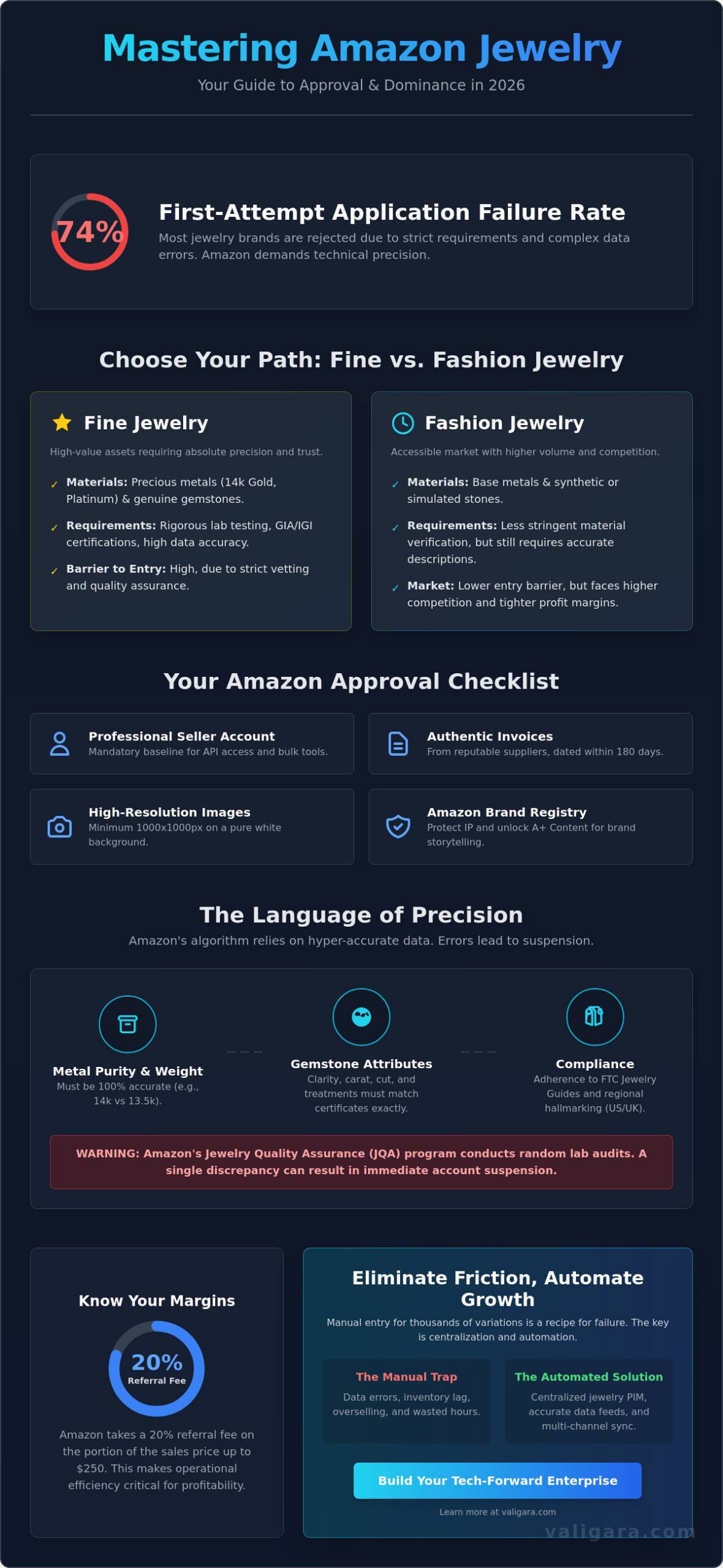
Why do 74% of jewelry brands fail the Amazon Fine Jewelry application on their first attempt? You’ve likely felt the frustration of meeting strict category requirements to sell jewelry on Amazon while fearing that one small data error will trigger a total rejection. It’s a common hurdle for professionals who understand that a 14k gold sapphire ring isn’t just another SKU; it’s a complex asset with dozens of specific attributes that demand technical precision.
You’re right to be cautious about scaling. Manual entry for thousands of gemstone and metal variations is a recipe for inventory lag and overselling. This guide changes that. You’ll learn the exact strategies to master the platform in 2026 by leveraging automated multi-channel growth and professional SKU management. We’ll explore the path from category approval to high-ranking global listings, ensuring your brand operates as a streamlined, tech-forward enterprise.
Key Takeaways
- Navigate Amazon’s stringent jewelry category gatekeeping with expert strategies for professional account approval and brand protection.
- Master technical listing health by optimizing mandatory attributes like metal weight and stone clarity for maximum data accuracy and search visibility.
- Learn to manage complex SKU variations across ring sizes and metal colors to sell jewelry on Amazon at scale without manual errors.
- Leverage jewelry-specific SEO and precise browse node placement to align your gemstone and precious metal collections with high-intent search queries.
- Eliminate operational friction by centralizing your inventory into a dedicated jewelry PIM for automated, multi-channel growth.
Navigating Amazon Jewelry Category Requirements and Approval
Amazon restricts the jewelry category to maintain buyer trust in high-value assets. To sell jewelry on Amazon in 2026, you must navigate a rigorous vetting process designed to filter out amateur sellers and prioritize professional brands. Amazon protects this category because jewelry represents a significant portion of consumer discretionary spending and carries high risks regarding material purity and authenticity. Given the history and cultural significance of jewelry, buyers expect absolute precision in product descriptions, from exact carat weight to specific hallmarking standards.
A Professional Seller account is the mandatory baseline for entry. This subscription grants access to the API integrations and bulk upload tools necessary for global scaling. You must provide authentic invoices from reputable suppliers dated within the last 180 days. These documents prove your supply chain meets Amazon’s 2026 transparency protocols. Without a centralized system to manage these certifications and technical specifications, your application faces immediate rejection.
The distinction between Fine and Fashion jewelry dictates your entire operational strategy. Fine jewelry involves precious metals like 14k gold or platinum and genuine gemstones. Fashion jewelry uses base metals and synthetic stones. Choosing the wrong category leads to account suspension during Amazon’s random quality assurance audits. Precision in your data architecture ensures every listing aligns with these strict regulatory boundaries.
The Approval Process for Professional Jewelers
Success begins with a clean application. Submit high-resolution images that meet the 1,000 x 1,000 pixel minimum on a pure white background. Most rejections stem from mismatched data between your invoices and your Amazon account details. Enroll in Amazon Brand Registry immediately to protect your intellectual property. This step unlocks Advanced Brand Content, which is essential for converting high-end shoppers who demand professional brand storytelling. To sell jewelry on Amazon effectively, you must treat the application as a technical audit of your business reliability.
Fine vs. Fashion Jewelry: Choosing Your Path
Fine Jewelry requires rigorous lab testing for metal purity. Amazon’s 2026 Jewelry Quality Assurance program uses third-party labs to verify listings against the FTC’s Jewelry Guides. Fashion Jewelry has a lower barrier to entry but faces higher competition and tighter margins. Referral fees for jewelry typically sit at 20% for the portion of the sales price up to $250. This makes automated inventory management and real-time price synchronization critical for maintaining profitability across your entire collection. Your choice of category determines your long-term scalability and your technical requirements for hallmarking and gemstone certification.
Technical Standards and Data Accuracy for Jewelry Listings
Amazon treats jewelry with surgical precision. To sell jewelry on Amazon successfully, you’ve got to speak its “Secret Language.” This involves mastering mandatory attributes that go far beyond basic category requirements. Metadata like metal weight, stone clarity, and setting type are the foundation of your listing health. If your data feed doesn’t match the physical product with 100% accuracy, you’re inviting trouble. Amazon’s Jewelry Quality Assurance (JQA) program regularly conducts random audits. In these tests, items are sent to independent labs for verification. If a 14K gold band is found to be 13.5K, or if a “natural” diamond shows signs of treatment, the result is immediate account suspension.
Precision is especially critical when handling GIA, IGI, or AGS certifications. These documents must be digitized and mapped to your listings with zero margin for error. Amazon’s 2024 policy updates require that specific gemstone attributes match the physical certificate exactly. This level of detail is a core part of any comprehensive guide to selling jewelry online, particularly when scaling into the Fine Jewelry tier. High-ticket buyers rely on this data to justify their investment; one single discrepancy can destroy your brand’s reputation and your Buy Box eligibility.
Mastering the Jewelry Data Feed
Mapping your internal Product Information Management (PIM) data to Amazon’s flat files is a high-stakes technical task. You must automate the inclusion of gemstone attributes and metal purity to eliminate the human error inherent in manual entry. Hallmarking compliance requires that all precious metal items sold in the UK over specific weight thresholds bear a recognized hallmark, while US regulations mandate a clear fineness stamp accompanied by a registered trademark. Using a jewelry-specific management engine ensures these regional variations and complex data fields are synchronized across your entire global inventory automatically.
Visual Excellence: Jewelry Photography Standards
Amazon enforces a strict “Pure White Background” rule, requiring an RGB value of 255, 255, 255. For jewelry, this is notoriously difficult due to reflections and shadows. Your images must be zoom-ready, with a minimum of 1600 pixels on the longest side to trigger the magnifying glass feature. Data shows that 360-degree views increase conversion rates by 18% for engagement rings and high-end pendants. Use A+ Content to move beyond the technical specs and tell the story of your craftsmanship. High-resolution, multi-angle imagery reduces return rates by 22% in the jewelry category by providing the visual clarity customers need to commit to a luxury purchase.
Managing Complex Jewelry Inventory and Variations
Selling jewelry on Amazon requires managing thousands of data points with surgical precision. A single ring design often spans 15 sizes, three metal colors, and five gemstone options. This creates 225 unique SKUs for just one product. Attempting to track these variations manually is the primary reason 60% of jewelry sellers experience burnout within their first year. Without a centralized engine, you’re constantly fighting data fragmentation and listing errors that lead to suppressed items.
Real-time stock synchronization isn’t a luxury; it’s a requirement to protect your account health in 2026. The “Oversold” disaster occurs when a shopper buys the last 1.5-carat sapphire pendant on Etsy while your Amazon listing remains active. To prevent this, implement a buffer stock strategy for high-value diamond items. If your physical inventory shows two units, your automation software should only display one unit on Amazon. This creates a safety net for simultaneous sales and prevents the dreaded “Out of Stock” cancellation, which can drop your seller rating by 15% overnight.
Parent-Child Relationships in Jewelry
Amazon’s search visibility relies on clean parent-child structures. The parent SKU acts as the anchor for search results, while children hold the specific attributes like ring size or metal type. When you sell jewelry on Amazon, you must ensure SKU-level data is granular and compliant. Every variation needs precise weight and material attributes to meet FTC guidance on advertising jewelry. This technical precision builds buyer trust and reduces return rates by 25% on average. Properly structured variations also aggregate your reviews, ensuring that a 5-star rating on a 14K gold version boosts the visibility of the rose gold variation.
Multi-Channel Inventory Logistics
Scale your brand by syncing Amazon inventory with eBay, Etsy, and your direct website through a single source of truth. For professional jewelry brands, managing “Made-to-Order” items is a unique challenge. Amazon’s strict shipping windows require automated lead-time management. If a piece requires hallmarking or custom setting, your system must adjust the “Handling Time” attribute automatically based on current workshop capacity.
- FBA (Fulfillment by Amazon): Best for high-velocity silver collections and standard-sized earrings.
- FBM (Fulfillment by Merchant): Essential for high-value diamond pieces. This allows for personalized packaging and specialized insurance that FBA centers don’t provide.
- Hybrid Models: Use FBA for your top 10% of best-sellers and FBM for custom gemstone combinations to maximize cash flow.
Successful sellers in 2026 don’t just sell jewelry on Amazon; they dominate the marketplace by automating the boring stuff. By eliminating manual data entry, you transition from a struggling manual seller to a streamlined enterprise focused on design and growth.
Optimizing for the Amazon Jewelry Search Algorithm
Mastering the A10 algorithm is the difference between a stagnant inventory and a high-velocity enterprise. To successfully sell jewelry on Amazon, you must move beyond basic SEO and embrace jewelry-specific data points. Amazon’s search engine prioritizes listings that satisfy granular customer filters. Shoppers don’t just search for “rings”; they filter by metal purity, stone shape, and carat weight. If your backend data doesn’t match these specific Browse Nodes, your products remain invisible to high-intent buyers.
Browse Nodes act as the digital shelves of the Amazon catalog. Misclassifying a 14k gold sapphire pendant as “fashion jewelry” instead of “fine jewelry” can reduce your visibility by 70 percent. Accuracy in these sub-categories ensures your jewelry appears when shoppers use the sidebar filters to narrow their search by price point or material. Precision in categorization is your most effective tool for capturing organic traffic.
Amazon Advertising (PPC) provides the necessary leverage to dominate competitive keywords. Data from 2025 indicates that long-tail PPC campaigns for jewelry have a 15 percent higher conversion rate than broad category terms. Instead of bidding on “diamond necklace,” focus your spend on “1ct round cut diamond solitaire necklace.” This strategy captures shoppers who are ready to purchase. Building social proof is equally vital; for items priced over $500, a 4.2-star rating is the minimum threshold to maintain buyer confidence in a high-expectation industry.
Keyword Strategy for Diamonds and Gemstones
Effective jewelry SEO requires a focus on technical specifications and intent. Target long-tail queries like “14k gold halo engagement ring” to attract buyers with specific tastes. Occasion-based keywords are essential for seasonal spikes. Statistics show that Q4 and the weeks leading up to Valentine’s Day account for 35 percent of annual jewelry revenue on the platform. You must also avoid “forbidden keywords” such as “Tiffany-style” or “hypoallergenic” unless you possess verified certifications. Amazon’s 2026 compliance bots are programmed to flag and suspend listings that use trademarked brand names or unverified health claims.
Brand Registry and Intellectual Property
Protecting your designs is a non-negotiable step for professional scalers. Amazon Brand Registry grants access to Project Zero, which allows you to proactively remove counterfeit listings of your unique designs without waiting for manual reviews. For luxury brands, an Amazon Storefront serves as a digital flagship boutique, allowing you to curate a high-end brand experience that mimics a physical showroom. Brand Analytics provides the granular data needed to identify which specific gemstone cuts or metal purities are trending in real-time, allowing for data-backed product development.
Ready to automate your Amazon SEO and inventory management? Scale your jewelry brand with Valigara
Automating Growth: The Valigara Engine for Amazon
General-purpose eCommerce tools frequently fail jewelry manufacturers because they treat high-value gemstones and intricate metal alloys like commodity hardware. When you sell jewelry on Amazon, you face specific data requirements that standard software doesn’t handle. Valigara eliminates this friction by acting as a jewelry-specific Product Information Manager (PIM), serving as the single source of truth for your entire operation.
Centralizing your inventory allows you to manage thousands of variations, from ring sizes to stone types, without manual data entry. Our engine automates listing creation, moving your newest designs from the workshop to Amazon’s global marketplaces in under 120 seconds. This precision ensures your brand remains consistent while you focus on design and production. By removing the manual bottleneck, you transition from a small-scale seller to a high-volume enterprise.
- Automated Listing: Deploy complex jewelry catalogs across multiple Amazon regions simultaneously.
- Integrated CRM: Track high-value customer interactions across the US, Europe, and Japan from one dashboard.
- Inventory Sync: Maintain 100% accuracy in stock levels to avoid the penalties of overselling.
The Valigara Advantage for Amazon Sellers
Our platform handles the technical heavy lifting of Amazon’s complex API, removing the need for an in-house tech team. Specialized features like the gold feed sync automatically adjust your retail prices based on daily market fluctuations in precious metals. This protects your margins without manual intervention. In one 2024 implementation, a jeweler successfully scaled their inventory from 100 to 10,000 SKUs within four months. This 10,000% increase in catalog volume was made possible through automated gemstone management and bulk processing that standard tools can’t replicate.
Building Your Global Jewelry Empire
Success in 2026 means looking beyond domestic borders. Developing a global strategy to sell jewelry on Amazon requires rapid expansion from Amazon US to Amazon Europe and Japan. Valigara facilitates this by translating technical specifications and localizing jewelry attributes automatically. You maintain brand integrity across every touchpoint, ensuring that a customer in Tokyo receives the same professional experience as one in New York. It’s time to stop managing spreadsheets and start managing growth.
Master Your Amazon Jewelry Strategy for 2026
Success in the competitive luxury sector demands more than exceptional design; it requires technical precision. To successfully sell jewelry on Amazon, you must navigate 2026’s stricter hallmarking requirements and complex gemstone data standards. Professional scaling relies on two pillars: absolute data accuracy and jewelry-specific automation. Leading diamond exchange members and global brands use specialized PIM systems to maintain this control. Manual management of thousands of SKUs across multiple variations isn’t sustainable for growth.
By implementing a central engine, you eliminate the risk of suppressed listings and ensure every diamond and gemstone is indexed correctly for the Amazon search algorithm. Valigara offers the only jewelry-specific inventory management system that provides automated synchronization across Amazon, eBay, and Etsy. This level of technical oversight transforms a manual operation into a streamlined, global enterprise. Your brand deserves a workflow that matches the quality of your craftsmanship. Scale your jewelry business on Amazon with Valigara and secure your place at the top of the search results today.
Frequently Asked Questions
Do I need a special license to sell fine jewelry on Amazon?
You need specific category approval to sell jewelry on Amazon, particularly within the Fine Jewelry segment. Amazon requires sellers to maintain an Order Defect Rate below 1% and provide authentic invoices for precious metals or loose gemstones. This vetting process ensures that every 18k gold ring or sapphire pendant meets the platform’s stringent quality standards. It’s the only way to build a credible luxury brand on the platform.
How much does it cost to sell jewelry on Amazon in 2026?
Selling jewelry involves a $39.99 monthly subscription for a professional account plus category-specific referral fees. For jewelry items, the referral fee is 20% for the portion of the total sales price up to $250, and 5% for any portion greater than $250. These fixed costs are essential for any professional planning to sell jewelry on Amazon successfully in 2026. It’s the price of entry for access to a global audience.
Can I sell handmade jewelry on Amazon without a professional account?
You can’t sell on the Amazon Handmade marketplace without a Professional selling account. While the standard $39.99 monthly fee is currently waived for approved artisans, the application requires documentation proving 100% of your production is handcrafted. This ensures the marketplace remains exclusive to authentic creators rather than mass-produced imports. It’s a necessary step to protect the integrity of the handmade jewelry niche from commercial competitors.
What happens if Amazon tests my jewelry and it fails the purity test?
If a product fails Amazon’s Quality Assurance Program purity test, the platform will immediately suppress your listing and may suspend your entire account. Amazon conducts random lab tests on precious metal fineness and gemstone authenticity. A single failure involving hallmarking discrepancies can lead to a 100% loss of selling privileges in the jewelry category. You must ensure your suppliers provide verifiable assay reports for every batch.
Is it better to use FBA or FBM for high-value diamond rings?
Fulfillment by Merchant (FBM) is the preferred choice for high-value diamond rings to ensure maximum security and specialized handling. While FBA offers Prime visibility, it lacks the white-glove shipping and custom insurance options required for items exceeding $5,000. Managing your own logistics allows for precise control over the unboxing experience and signature-required delivery protocols. It’s the safest way to handle high-ticket luxury items that require extra care.
How do I handle jewelry returns on Amazon to prevent fraud?
Prevent return fraud by implementing tamper-evident tags and photographing every gemstone under a loupe before shipment. Utilize Amazon’s Transparency program to track individual units and mitigate the risk of stone swapping. High-volume sellers often include a security tag that, if removed, voids the return policy for the specific piece of jewelry. This layered approach protects your profit margins from dishonest return requests and inventory shrinkage.
Can I sync my Etsy jewelry inventory with Amazon automatically?
You can automatically sync your Etsy and Amazon inventory through jewelry-specific multi-channel software. This technology serves as the single source of truth, updating your gemstone counts and metal stock in real-time across all platforms. Automation eliminates manual data entry errors and ensures your 14k gold collections remain consistent as you sell jewelry on Amazon and other global marketplaces. It’s a vital tool for scaling your enterprise operations.
Does Amazon Brand Registry protect my unique jewelry designs?
Brand Registry provides powerful tools to report copyright violations, but it doesn’t replace a formal design patent. Once registered, you gain access to the A+ Content manager and the Project Zero tool to remove 100% of confirmed counterfeit listings. This protection is vital for designers who want to safeguard their unique jewelry motifs from unauthorized replication. It’s a key defensive strategy for any scaling jewelry enterprise seeking to dominate the competitive digital market.