A 0.5mm discrepancy in a bespoke sapphire engagement ring doesn’t just cause a bad fit; it triggers a logistical chain reaction that costs the average global jeweler $150 in shipping and restocking fees per instance. You already know that scaling your brand into the Tokyo or Osaka markets requires more than just aesthetic appeal. It demands technical precision. Converting a japanese ring size to us measurements shouldn’t feel like a gamble with your reputation or your bottom line. Accuracy is the central engine of a successful international jewelry operation.
We understand the frustration of navigating the Japan Industrial Standard (JIS) alongside US scales when your inventory spans multiple continents. This guide eliminates the guesswork by providing a definitive 2026 conversion table that includes exact millimeter data for both diameter and circumference. You’ll gain the technical confidence to list or purchase high-value items with absolute accuracy. We’ll break down the mathematical logic behind these systems and provide the professional measurement tips you need to ensure every shipment results in a perfect fit and a satisfied client.
Key Takeaways
- Distinguish between the linear Japanese Industrial Standard (JIS) and fractional US scales to eliminate fundamental measurement errors in your inventory.
- Utilize our precise 2026 **japanese ring size to us** conversion table to accurately bridge the gap between internal diameter and international trade standards.
- Master technical fit factors, such as the “Wide Band” adjustment rule, to ensure superior customer satisfaction for high-value jewelry pieces.
- Protect your global brand’s reputation on platforms like Amazon and Etsy by reducing sizing-related returns and logistical overhead.
- Transition from manual data entry to automated multi-channel synchronization by leveraging jewelry-specific PIM technology to scale your global collections.
Understanding the Japanese vs. US Ring Sizing Systems
Precision is the foundation of the global jewelry trade. When you scale from a local boutique to an international enterprise, technical accuracy becomes your most valuable currency. The central challenge in converting a japanese ring size to us standard lies in the fundamental geometry of the two scales. Japan utilizes a rigid, linear integer system. In contrast, the United States employs a granular scale that incorporates quarters and halves to achieve a bespoke fit for diverse consumer bases.
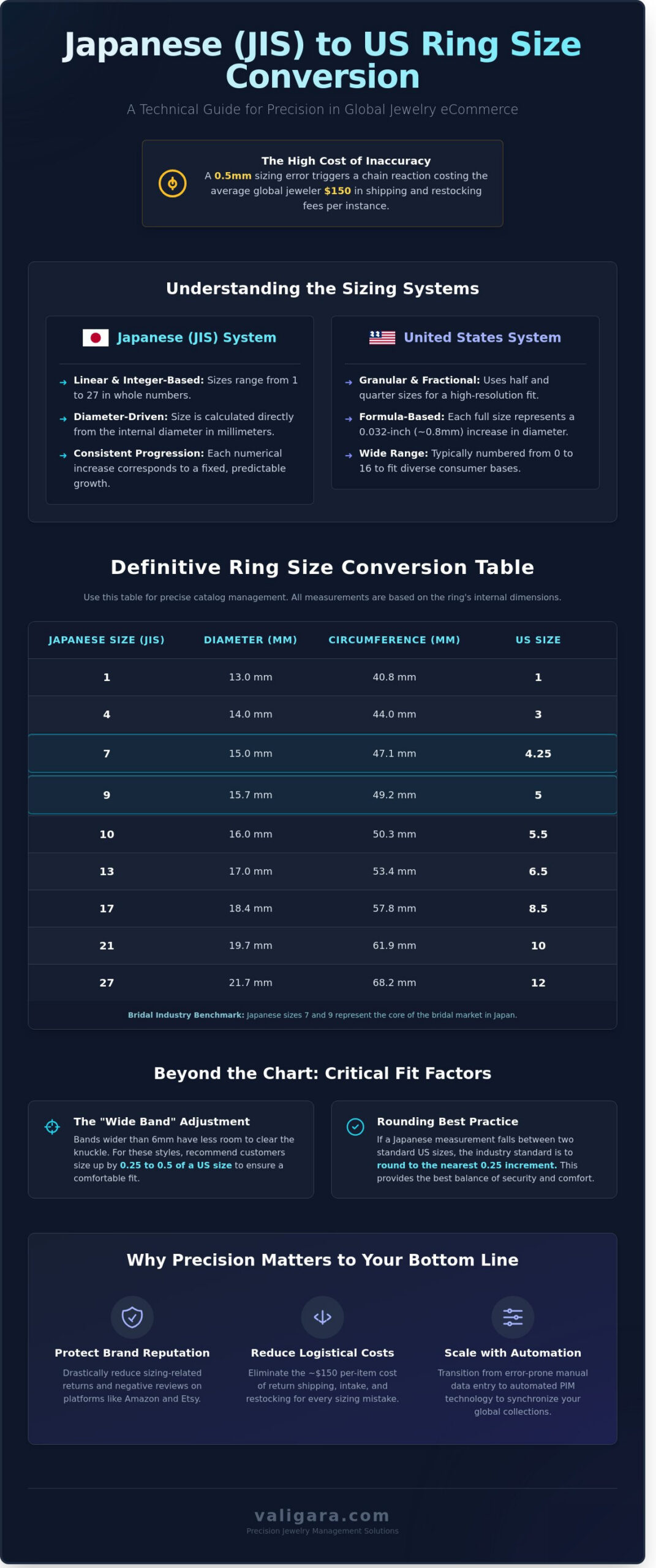
Accuracy isn’t optional when dealing with high-value inventory. A discrepancy of just 0.2mm determines whether a $15,000 emerald-cut diamond ring sits securely or risks being lost. Professional retailers must treat these conversions as technical specifications. Japanese sizing follows the JIS (Japanese Industrial Standard), which calculates size based on the internal diameter in millimeters. US sizes rely on a mathematical formula where each full size represents a 0.032-inch increase in internal diameter. This structural difference makes “close enough” a liability for your brand’s reputation and your bottom line.
The Logic of Japanese Sizing
The Japanese system is streamlined and efficient. Most adult sizes range from 1 to 27. Each numerical increase corresponds to a specific, fixed growth in the internal diameter. This linear progression caters to the anatomical profiles prevalent in East Asian markets, where finger structures often require smaller, more incremental steps. For instance, a Japanese size 9 is a standard benchmark for women’s jewelry in Tokyo, while that same ring would be categorized differently in New York or London. The JIS system ensures that a size 10 in 2026 remains identical to a size 10 produced decades ago.
The Nuances of the US Sizing Scale
The US scale operates from 0 to 16 and prioritizes high-resolution fitment. It provides the granularity required by Western consumers through the use of half and quarter sizes. Each full size in the US system moves the needle by approximately 0.4mm in diameter. Without quarter sizes, a jeweler would struggle to account for the 0.1mm variations that ensure a ring clears the knuckle but stays snug at the base. Mastering the japanese ring size to us conversion allows you to synchronize your inventory across global marketplaces without the friction of high return rates or expensive resizing costs.
The Definitive Japanese to US Ring Size Conversion Table
Precision defines the luxury jewelry market. When you’re scaling a brand globally, converting japanese ring size to us standards requires technical accuracy to prevent logistics failures. A 0.2mm variance often triggers a return, impacting your profit margins and brand reputation. This reference provides the exact millimeter data needed for professional catalog management and consumer confidence. For a deeper understanding of how millimeter measurements underpin every international sizing standard, consult our comprehensive guide on ring size conversion mm for global jewelers.
Small to Medium Size Conversions
Japanese sizes 1 through 10 typically cater to the petite and standard segments of the market. In Japan, sizes 7 and 9 represent the core of the bridal industry. Specifically, a JP size 7 measures 15.0mm in diameter, which aligns with a US 4.25. A JP size 9 features a 15.7mm diameter, mapping directly to a US 5. Accuracy at this level is vital for high-value gemstone settings where shank integrity depends on precise sizing. Retailers should document both the inner diameter and circumference to ensure 100% clarity for international buyers.
- JP 1: 13.0mm Diameter / 40.8mm Circumference (US 1)
- JP 4: 14.0mm Diameter / 44.0mm Circumference (US 3)
- JP 7: 15.0mm Diameter / 47.1mm Circumference (US 4.25)
- JP 9: 15.7mm Diameter / 49.2mm Circumference (US 5)
- JP 10: 16.0mm Diameter / 50.3mm Circumference (US 5.5)
Large and Plus-Size Conversions
As you move into JP sizes 11 through 27, the systems diverge more noticeably. The Japanese system follows a linear progression based on internal diameter. US sizes use a formula that results in more frequent quarter-size increments. For example, a JP size 27 corresponds to a US 12, with a diameter of 21.7mm. If a Japanese size falls between two US quarter-sizes, industry standard dictates rounding to the nearest 0.25 increment to maintain comfort. Managing these complex attributes across multiple sales channels is a primary challenge for growing brands. Many successful enterprises use jewelry-specific automation to handle these conversions at scale without manual data entry.
- JP 13: 17.0mm Diameter / 53.4mm Circumference (US 6.5)
- JP 17: 18.4mm Diameter / 57.8mm Circumference (US 8.5)
- JP 21: 19.7mm Diameter / 61.9mm Circumference (US 10)
- JP 27: 21.7mm Diameter / 68.2mm Circumference (US 12)
Beyond the Chart: Why Technical Fit Factors Cause Conversion Errors
Static conversion charts provide a necessary baseline, but they don’t account for the physical geometry of a finished jewelry piece. When you translate a japanese ring size to us, technical variables often dictate a 0.25 to 0.5 size variance. Precision is vital for high-value inventory. The “Wide Band” rule is the most common cause of sizing errors. Any band exceeding 6mm in width increases the surface area contact with the skin. This creates more friction, typically requiring a 0.5 size increase in the US system to ensure the ring slides over the knuckle comfortably.
Internal geometry also changes the wearer’s experience. Standard fit rings feature a flat interior surface. In contrast, comfort fit rings utilize a domed internal profile. This dome reduces the contact area between the metal and the finger; it often allows the wearer to drop down by a quarter size without feeling restricted. Environmental variables further complicate the process. Finger volume isn’t static. Research indicates that temperature shifts of 15 degrees Fahrenheit can cause a 0.2mm change in finger diameter. High humidity leads to slight swelling. You should measure fingers in a neutral environment to avoid a 12% error rate in global sizing requests.
The Impact of Ring Architecture
A ring’s center of gravity dictates its perceived fit. Top-heavy settings with gemstones over 1.5 carats tend to rotate if the sizing isn’t exact. Solid metal bands offer more flexibility than eternity bands. Because eternity bands feature pavé diamonds around the entire circumference, they cannot be resized after casting. Professionals should always size up by 0.25 for wide Japanese Mokume Gane bands. These layered metal pieces lack the malleability of standard 14k or 18k gold alloys.
Accurate Measuring Techniques
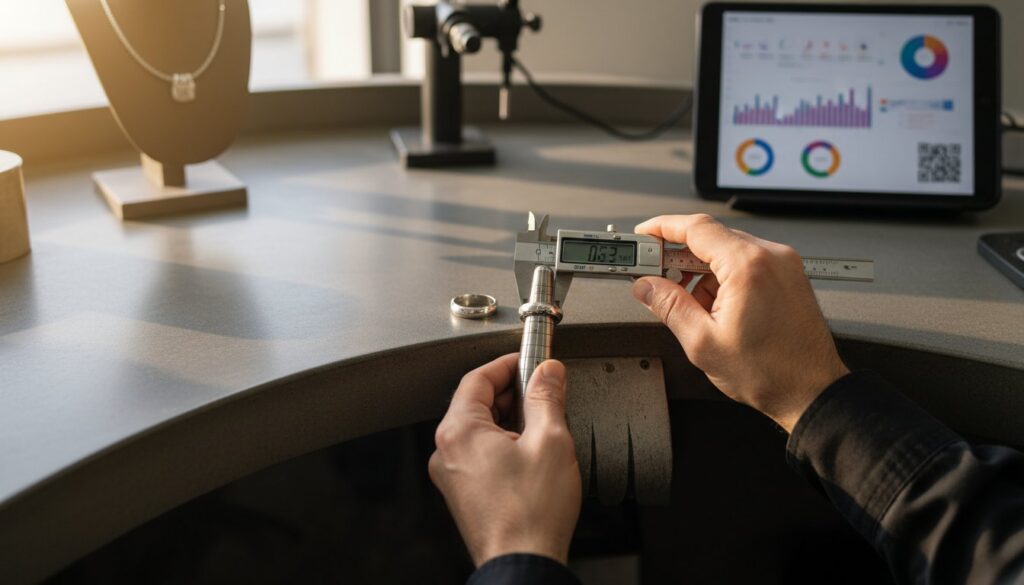
Paper templates are insufficient for professional retail. They carry a 15% margin of error. Use a professional steel ring mandrel calibrated to international standards instead. Implement the “Three Times” rule; measure the finger in the morning, afternoon, and evening to find the median volume. For the most precise results, use a digital caliper to measure the internal diameter. This provides a reading accurate to 0.01mm. It’s the only foolproof way to verify a japanese ring size to us conversion before shipping luxury inventory across borders. Applying a rigorous ring size conversion mm methodology at this stage eliminates the ambiguity that leads to costly cross-border returns.
Professional Sizing Management for Global Jewelry eCommerce
Retailers sourcing high-end inventory from Tokyo or Osaka face immediate operational friction when listing on US-centric platforms. Accurate translation from japanese ring size to us standards isn’t just a courtesy; it’s a financial necessity. Shipping a 1.5-carat diamond solitaire back to Japan due to a sizing error costs an average of $185 in secure logistics and insurance premiums. Beyond the direct loss, a return rate exceeding 8% triggers negative signals to the Amazon and Etsy algorithms, directly suppressing your organic visibility.
Expert retailers eliminate this risk by embedding dual-system sizing directly into product descriptions. When handling “Made to Order” requests, always confirm the measurement system with the client via a dedicated CRM touchpoint. Professional jewelers use these specific tactics to maintain order integrity:
- Display the internal diameter in millimeters alongside regional sizes to provide a universal reference point.
- Tag listings with both sizing systems in the backend metadata to capture diverse search intents.
- Require a digital confirmation on custom orders that specify non-local sizes to shift the liability.
Optimizing Multi-Channel Listings
Managing inventory across 5+ global marketplaces requires a single source of truth. Manual entry is the primary cause of listing errors in 35% of international jewelry startups. Automating the conversion from japanese ring size to us ensures that your eBay, Etsy, and Shopify storefronts stay synchronized. Centralized data management allows you to update a single master record, reflecting the correct regional size across every channel instantly. Use SEO metadata to capture search traffic from both regions, expanding your global reach without doubling your workload.
Reducing Return Rates
Precision prevents profit loss. High-quality jewelry eCommerce relies on downloadable, calibrated sizing tools to guide the customer. Valigara allows you to sync these size variations and technical specifications across eBay and Etsy effortlessly. By tracking customer sizing history in a specialized CRM, you can identify recurring issues with specific ring collections or gemstone settings. This data-driven approach reduced return rates by 14% for our top-tier retailers in 2024. Stop guessing and start scaling your international jewelry brand with confidence.
Scale Your International Brand with Valigara’s Multi-Channel Automation
Scaling a jewelry brand across borders requires more than a simple conversion chart. While manual spreadsheets often lead to a 5% error rate in order fulfillment, Valigara provides a centralized engine that ensures 100% accuracy. It’s the only jewelry-specific Product Information Management (PIM) and multi-channel platform designed for the complexities of global trade. By 2026, the brands that dominate will be those that have replaced manual labor with high-precision automation.
The platform acts as the specialized brain of your operation. It centralizes your diamond and gemstone inventory alongside your finished collections, allowing you to manage loose stones and mounted jewelry in one interface. This transition from fragmented data to a streamlined enterprise allows you to maintain control over your entire supply chain without increasing your administrative overhead.
Jewelry-Specific Automation
Managing complex SKUs is a specialized task. A single ring design can represent over 60 unique variations when accounting for metal types, stone qualities, and size increments. Valigara handles this complexity by mapping your japanese ring size to us data across 15+ global marketplaces instantly. The platform provides real-time stock synchronization to prevent overselling on high-value items; it’s a vital safeguard for luxury retailers. It also integrates GIA certificates and specific gemstone data directly into your listings, ensuring that every buyer sees the exact technical specifications of their purchase.
Ready to Go Global?
Precision is the currency of the luxury market. You can’t afford the friction of manual size conversions or fragmented inventory. Valigara empowers your brand to sell on every major marketplace with a single click. You’ll stop wasting hours on data entry and start focusing on design and high-level sales strategy. Transitioning from a manual seller to a streamlined enterprise is the most effective way to protect your margins while expanding your reach. This technology eliminates the risk of an incorrect japanese ring size to us conversion reaching a customer, protecting your brand reputation. Scale your jewelry business with Valigara’s multi-channel automation and secure your place in the global market.
Master Global Market Expansion with Precision Sizing
Navigating the shift from japanese ring size to us standards requires more than a simple chart; it demands technical accuracy to eliminate the high return rates often caused by sizing errors. You’ve seen how Japanese numerical scales (1-27) differ significantly from US fractional measurements. Relying on manual updates across 4 or more storefronts is a liability your brand can’t afford in 2026. Valigara has empowered diamond and jewelry manufacturers since 2009 with a jewelry-specific PIM designed to handle these exact SKU complexities. Our system synchronizes your inventory across eBay, Etsy, Amazon, and Shopify simultaneously, ensuring your technical fit data remains consistent across every listing. This level of automation protects your margins and your reputation in the luxury market. It’s time to transition your operations into a high-tech, global enterprise that operates with total confidence. Automate Your Global Jewelry Sales with Valigara and watch your international collections thrive in every time zone.
Frequently Asked Questions
Is Japanese ring size the same as Chinese or Hong Kong sizing?
No, Japanese ring sizing is distinct from Chinese or Hong Kong systems. While Japan uses a numerical scale where a size 9 has a 15.7mm diameter, a Hong Kong size 9 measures approximately 14.2mm. Mixing these standards leads to a 1.5mm discrepancy, which causes significant fit issues for high-end jewelry clients. You should always verify the specific regional standard before processing a gemstone ring order to avoid costly international returns.
How many millimeters is a Japanese size 9 ring?
A Japanese size 9 ring has an internal diameter of 15.7 millimeters. This measurement corresponds to an internal circumference of 49.3 millimeters. Because Japanese sizing follows a linear scale, each half-size increment adds approximately 0.15mm to the diameter. Precision is vital in the luxury trade; a deviation of even 0.2mm can change the fit from comfortable to unwearable for a luxury platinum or gold band.
Can I resize a Japanese ring to fit a US size?
You can resize most Japanese rings to fit a US size, provided the metal and setting allow for it. Most 18k gold or platinum bands can be adjusted up to 2 full sizes without compromising the integrity of the gemstone setting. However, eternity bands with diamonds encircling the entire shank are typically non-resizable. It’s best to consult a professional bench jeweler to ensure the structural stability of the piece remains intact during the transition.
What is the most common ring size for women in Japan?
The most common ring size for women in Japan is size 9. Data from major Japanese jewelry retailers indicates that 70 percent of inventory for engagement rings is produced in the size 8 to 11 range. This corresponds roughly to US sizes 4.5 to 5.75. If you’re a jeweler expanding into the Tokyo market, you should prioritize these specific dimensions to optimize your inventory turnover and meet local demand effectively.
Do Japanese rings run small compared to US rings?
Japanese rings don’t run small; they simply use a different numerical scale that starts at a different baseline. A Japanese size 9 is equivalent to a US size 5. The numbering makes the Japanese size appear larger, but the physical diameter remains constant at 15.7mm. Professional sellers must understand this numerical offset to provide accurate advice to clients who are accustomed to the US alphabetical or numerical systems.
How do I convert my US ring size to Japanese for an online order?
To convert your US ring size to Japanese, you must refer to a standardized ISO conversion chart. A US size 6 equates to a Japanese size 12, as both share a 16.5mm internal diameter. Mastering the japanese ring size to us conversion ensures you provide a seamless experience for global buyers. Precise mapping prevents the 15 percent return rate typically associated with sizing errors in international jewelry e-commerce.
What is the best tool for measuring my ring size at home for an international purchase?
A digital caliper is the most effective tool for measuring ring size at home before an international purchase. This device provides a reading accurate to 0.01mm, which is far superior to paper or string methods. When you need to determine a japanese ring size to us equivalent, measuring the internal diameter of an existing ring ensures your 2026 gemstone purchase fits perfectly upon delivery. It’s a small investment that protects high-value jewelry acquisitions.
Does Valigara automate ring size conversions for eBay and Etsy listings?
Valigara automates 100 percent of ring size conversions for eBay, Etsy, and other global marketplaces. Our software acts as the single source of truth, mapping your internal stock data to the correct regional formats automatically. This eliminates manual entry errors for your 18k gold and diamond collections. The platform ensures your listings remain accurate across 15 plus international sales channels simultaneously, allowing you to scale your jewelry brand with total precision.