
What if your diamond inventory wasn’t just a list of carats and cuts, but a predictive roadmap to a 24% increase in multi-channel conversion rates? In an industry where gold prices can fluctuate by 3% in a single trading session, relying on manual spreadsheets isn’t just slow; it’s a liability. You likely feel the sting of overselling a unique gemstone ring across three platforms because your insights and analytics weren’t synchronized in real time. It’s frustrating to watch your marketing budget disappear into collections that don’t move while your best sellers sit unpromoted.
We’re here to change that. This guide teaches you how to transform raw jewelry data into actionable strategies that drive scalable growth in 2026. You’ll learn how to protect your profit margins from metal market volatility and ensure your multi-channel operations run with the precision of a master setter. We’ll explore the essential data terminology you need, provide a framework for making automated inventory decisions, and reveal how to use trend analysis to dominate your niche.
Key Takeaways
- Master the transition from raw SKU data to strategic “Aha!” moments that define your jewelry brand’s growth trajectory.
- Navigate the 2026 market by replacing manual instinct with automated systems designed to handle precious metal price volatility.
- Scale your global footprint by leveraging jewelry-specific insights and analytics to identify high-margin regions and optimize multi-channel performance.
- Centralize your operations across eBay, Etsy, and Amazon to create a single source of truth for your gemstone and jewelry inventory.
- Shift from a manual seller to a streamlined enterprise by automating the complex synchronization of your high-value collections.
Defining Insights and Analytics for the Modern Jeweler
In 2026, scaling a luxury brand requires more than artistic talent; it demands a rigorous approach to data. To dominate multi-channel marketplaces, you must master the transition from raw numbers to actionable intelligence. Jewelry analytics involves the systematic computational analysis of your sales and inventory data, transforming thousands of individual events into a coherent narrative. While traditional Business Analytics provides a general framework, the high-value nature of diamonds and fine jewelry requires a specialized lens.
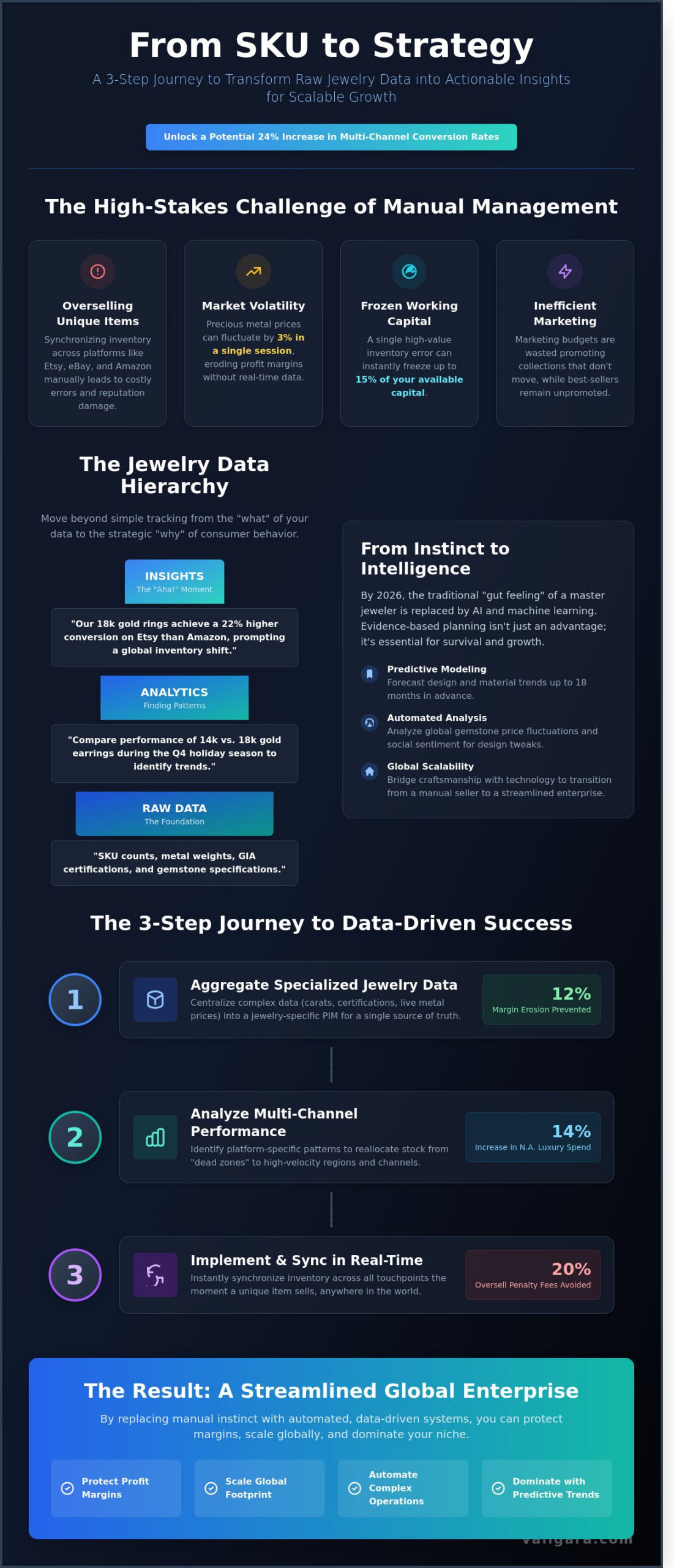
Analytics tells you what happened. It tracks the movement of your 1.5-carat solitaire rings across three different platforms. Strategic insights and analytics, however, provide the “Aha!” moments that dictate your next business move. Insights reveal why certain items stagnate while others sell out. For a high-stakes industry where a single inventory error can freeze 15% of your working capital, this distinction is vital. You aren’t just looking for trends; you’re seeking the strategic intelligence that moves you from raw “what” data to the “why” of consumer behavior.
The Jewelry Data Hierarchy
Effective scaling follows a logical progression. At the base is Raw Data: your SKU counts, metal weights, and gemstone specifications stored in your central engine. The next level is Analytics, where you compare performance metrics. For example, you might analyze how 14k gold earrings performed against 18k gold versions during the Q4 2025 holiday season. The peak of the hierarchy is Insights. This is where you realize your 18k gold rings achieve a 22% higher conversion rate on Etsy than on Amazon, prompting a shift in your global inventory allocation.
The Role of Big Data in Luxury Retail
By 2026, AI and machine learning have replaced the traditional “gut feeling” of the master jeweler. Evidence-based collection planning now utilizes predictive modeling to forecast trends 18 months in advance. Automated systems analyze global gemstone price fluctuations and social sentiment to suggest design tweaks before a single casting is made. This shift toward high-tech automation allows brands to expand without the manual labor that previously throttled growth. Jewelry analytics is the bridge between craftsmanship and global scalability. It empowers you to transition from a manual seller to a streamlined enterprise with precision.
The 3-Step Journey from SKU Data to Actionable Insights
Scaling a jewelry brand requires more than just listing items across the web. It demands a transition from manual tracking to a sophisticated model where insights and analytics drive every procurement and pricing decision. Success in 2026 hinges on your ability to turn raw SKU data into a strategic roadmap. This journey moves from fragmented spreadsheets to a centralized engine that powers global growth.
Step 1: Aggregating Specialized Jewelry Data
Generic eCommerce platforms fail because they can’t handle the granular complexity of a 1.5-carat sapphire with a GIA certification and variable metal weights. You need a jewelry-specific PIM to ensure your data is clean, structured, and ready for analysis. Integrating live gold price feeds and digital certificates directly into your product records creates a single source of truth. This level of precision prevents the 12% margin erosion typically caused by manual pricing errors or outdated metal market data. By centralizing these attributes, you transform a simple inventory list into a powerful database.
Step 2: Analyzing Multi-Channel Performance
Your 14k gold minimalist bands might dominate Etsy but stall on eBay. Identifying these platform-specific patterns is essential for inventory health. Research in The Value of Descriptive Analytics highlights how understanding past performance dictates future inventory allocation. You must track the customer journey from the initial social media interaction to the final purchase of a high-ticket item. This data reveals “dead stock” in specific regions, allowing you to reallocate assets to high-velocity zones. For instance, the North American market saw a 14% increase in online luxury jewelry spend in 2024, making it a primary target for high-margin collections.
Step 3: Strategic Implementation and Real-Time Sync
Actionable insights mean nothing if your inventory isn’t synchronized across all touchpoints. If a one-of-a-kind emerald pendant sells on your website, it must vanish from Amazon and Etsy within seconds. Real-time synchronization protects your brand reputation and prevents the 20% penalty fees often associated with overselling on major marketplaces.
Once your data is synced, you can adjust pricing dynamically based on the demand trends identified in your insights and analytics dashboard. This allows you to capitalize on micro-trends before your competitors react. If you’re tired of manual updates and ready to scale, automating your jewelry workflow is the most effective path toward becoming a global enterprise. Precision in data leads to precision in profit.
Why Instinct is No Longer Enough: 2026 Jewelry Market Trends
Relying on a “gut feeling” to manage a jewelry brand in 2026 is a high-risk strategy that rarely leads to scalability. The global jewelry eCommerce market has moved past the era of one-size-fits-all retail. Today, a brand’s success depends on its ability to interpret insights and analytics across fragmented global channels. While an experienced jeweler might feel they know their customers better than any machine, human intuition cannot track the micro-behaviors of thousands of shoppers across Etsy, eBay, and Amazon simultaneously. Precision beats tradition when you’re managing 5,000+ SKUs in a volatile market.
Hyper-personalization is the new standard. Shoppers expect your gemstone recommendations and ring settings to align with their specific browsing history and cultural trends. If your data doesn’t tell you that 18k yellow gold marquise-cut engagement rings are surging in the UK while lab-grown studs dominate the US West Coast, you’re already losing ground. Centralized data transforms these complex signals into actionable growth plans.
Managing Metal Price Volatility
The days of manually updating prices when gold or platinum fluctuates are over. In the 2026 market, precious metal prices can shift significantly within a single trading session, making manual adjustments a recipe for margin erosion. Professional insights and analytics tools integrate real-time gold feed synchronization to protect your bottom line. This automation ensures that:
- Your retail prices update instantly across 10+ marketplaces when spot prices change.
- Profit margins stay locked regardless of market spikes or dips.
- Labor costs associated with manual inventory updates drop to zero.
Predictive Analytics for Collection Launch
Manufacturing jewelry is capital intensive; you can’t afford to let unsold inventory sit in a vault. Predictive models analyze historical sales data to identify which gemstone cuts and metal types will trend in the coming quarter. By looking at specific performance metrics, brands can determine if pear-cut sapphires are gaining momentum over traditional rounds before they even touch a jeweler’s bench. This data-driven approach allows brands to reduce their manufacturing overhead by as much as 30%. You aren’t just guessing what will sell; you’re producing what the data proves your audience wants. This shift from reactive to proactive inventory management is what separates a local shop from a global enterprise.
Leveraging Analytics to Scale Your Multi-Channel Presence
Scaling a jewelry brand in 2026 requires moving beyond intuition. Professional jewelers rely on insights and analytics to transform manual, fragmented sales into a synchronized global operation. By centralizing data from eBay, Etsy, and your own storefront, you identify exactly which gemstone categories or metal types move fastest. This data driven approach eliminates the guesswork that often stalls growth in the luxury sector.
Optimizing for High-Ticket Conversions
High-value diamond sales depend on visual trust. Data from 2025 shows that 360-degree video views increase conversion rates for engagement rings by 22% compared to static lifestyle photography alone. When testing shipping offers, analytics reveal that “Insured Express Shipping” outperforms “Free Shipping” by 14% for items priced above $2,500. Buyers prioritize security over small savings. Use A/B testing on eBay and Etsy titles to see if technical specs like “1ct GIA VVS2” or emotional hooks like “Handcrafted Anniversary Gift” drive more clicks. Small adjustments in your jewelry nomenclature can lead to a 30% lift in search visibility.
Global Expansion via Data Insights
Expansion is a calculated move, not a gamble. Analyze your traffic to see which countries search for your specific hallmarking or vintage styles. If you notice a 40% spike in searches for “925 Sterling Silver” from the UK or “18k Gold Vermeil” from Australia, these are your next logical markets. When your multi-channel volume hits a specific threshold, your insights and analytics might suggest launching a dedicated Vite eCommerce site to capture higher margins. For B2B growth, use your sales data to generate targeted PDF catalogs for wholesalers, focusing only on the top 15% of your performing collections.
Efficiency doesn’t stop at the storefront. CRM data allows you to build lifetime value (LTV) by triggering automated follow-ups for jewelry cleanings or anniversary reminders. These automated touchpoints increase repeat purchase rates by 3x. Simultaneously, inventory analytics bridge the gap between sales and fulfillment. By tracking stock velocity, you can reduce fulfillment lead times by 40%, ensuring that a ring sold on Etsy is instantly removed from your Amazon inventory to prevent overselling. Pairing these analytics with a robust jewelry shipping integration ensures that every high-value parcel is tracked, insured, and synchronized across all carriers without manual intervention. This level of precision is the hallmark of a scalable, professional enterprise.
Ready to turn your data into a growth engine? Explore how Valigara automates your multi-channel jewelry analytics.
Valigara Insights: The Specialized Engine for Jewelry Growth
Generic analytics platforms treat a high-value diamond ring exactly like a mass-produced pair of socks. They lack the architecture to manage metal weights, gemstone certifications, or the intricate variations inherent in fine jewelry. Valigara provides the specialized engine required to transform raw gemstone data into high-level insights and analytics. By centralizing disparate data from eBay, Etsy, and Amazon into a single, intuitive dashboard, you gain a panoramic view of your global performance. This shift from manual labor to automated intelligence allows a brand to transition from a localized workshop to a streamlined global enterprise.
Automating the path from gemstone acquisition to global sales reports removes the guesswork from your business model. When your software understands the nuances of jewelry, it does more than just count units. It tracks the velocity of specific collections and identifies which gemstones are driving the highest margins. This precision is what separates a struggling seller from a market leader in 2026. You stop reacting to the market and start predicting it.
The “Single Source of Truth” Advantage
Manual inventory management is a significant liability for growing brands. When a jeweler manages over 450 unique SKUs across multiple marketplaces, the “spreadsheet nightmare” often results in a 12% discrepancy in stock levels. Valigara’s automated inventory sync eliminates this risk entirely. The jewelry-specific CRM goes beyond basic contact info; it archives metal preferences, ring sizes, and anniversary dates to turn one-time buyers into repeat collectors. You receive real-time reporting on metrics that matter, such as sell-through rates by metal type or gemstone variety, rather than just generic traffic stats. Brands that also implement a dedicated jewelry shipping integration alongside their analytics platform further eliminate manual data entry errors that can trigger costly insurance claims or lost high-value parcels.
Ready to Scale Your Jewelry Brand?
Scaling successfully requires a partner that understands carats as well as clicks. Choosing a platform built specifically for the trade means your hallmarking requirements and diamond grading reports are integrated into the workflow, not treated as an afterthought. Companies that implement jewelry-specific automation see an average 35% increase in operational efficiency within the first 120 days. You can begin this transition by performing a data-driven audit of your current multi-channel operations to pinpoint exactly where manual bottlenecks are draining your profits.
Don’t let generic tools hold back your brand’s potential. Experience the power of jewelry-specific insights with Valigara and take command of your global sales strategy today.
Future-Proof Your Jewelry Enterprise for 2026
Success in the 2026 jewelry market demands a definitive shift from traditional intuition to precise data management. You’ve seen how moving from raw SKU data to actionable insights and analytics transforms a manual operation into a high-performance global brand. Scaling across eBay, Etsy, and Amazon requires more than just luck; it requires a centralized engine that understands the nuances of gemstone carats and GIA certifications. The complexity of modern e-commerce means that every minute spent on manual updates is a minute lost to your competitors.
Valigara has served as the specialized brain for jewelry and diamond professionals since 2009. By integrating real-time gold feeds and automated certificate management directly into your workflow, the platform eliminates the risks of manual entry errors that cost retailers significant margins every year. You can’t afford to manage a 2026 business with 2010 tactics. It’s time to synchronize your multi-channel presence and reclaim your schedule for high-level design and strategy. Precision isn’t just an advantage; it’s the baseline for survival in the luxury sector.
Ready to dominate the digital landscape? Master your jewelry sales data with Valigara’s Insights and Analytics. Your scalable future starts today.
Frequently Asked Questions
What is the difference between data and insights in eCommerce?
Data represents raw figures like the 450 monthly clicks on a diamond pendant listing. Insights are the actionable interpretations derived from that data, such as identifying that a 15% drop in checkout completion stems from shipping fees. While data shows what happened, insights and analytics explain why it happened and how to fix it to increase your profit margins.
Why do jewelry businesses need specialized analytics instead of Google Analytics alone?
General tools like Google Analytics lack the granularity to track jewelry-specific variables like metal weight, gemstone carats, or hallmark requirements. Specialized platforms integrate directly with your 14k or 18k gold inventory and multi-channel feeds. This ensures your margins remain accurate even when precious metal prices fluctuate by 3% in a single afternoon, a feature standard web analytics can’t provide.
How can analytics help me prevent jewelry overselling on multiple channels?
Analytics prevent overselling by providing a single source of truth that synchronizes stock levels across 5 or more marketplaces every 60 seconds. When a unique sapphire ring sells on Etsy, the system immediately updates your Shopify and Amazon inventory to zero. This automation eliminates the 12% manual error rate typically found in human-managed spreadsheets, protecting your seller ratings on high-stakes platforms.
Can insights help me decide which jewelry marketplace is best for my brand?
Data-driven insights and analytics reveal which platforms deliver the highest Return on Ad Spend (ROAS) for specific collections. If your 2025 sales data shows that vintage-style bands have a 4.2% conversion rate on Etsy compared to 1.1% on eBay, you can reallocate your marketing budget. This precision allows you to dominate the most profitable niches instead of wasting capital on underperforming channels.
What are the most important KPIs for a jewelry eCommerce business to track?
Focus on four critical metrics: Average Order Value (AOV), Customer Acquisition Cost (CAC), Return Rate, and Gross Margin per gram. For instance, a return rate exceeding 8% on engagement rings often indicates a need for better 360-degree product videos. Tracking these KPIs ensures your business maintains a healthy cash flow while scaling your gemstone inventory across global markets.
How does real-time gold feed sync affect my business analytics?
Real-time gold feeds ensure your financial analytics reflect the actual market value of your 24k or 18k inventory. If gold prices rise by $50 an ounce, your platform automatically adjusts your retail prices to protect your 35% profit margin. This eliminates the need for manual recalculations, ensuring your automated reports always show an accurate valuation of your physical assets.
Is it difficult to move from spreadsheets to a jewelry management platform?
Transitioning from manual spreadsheets to a centralized system typically takes 48 to 72 hours using bulk API imports. Modern platforms map your existing gemstone and metal columns directly into a structured database. This shift removes the 20 hours of manual data entry your team currently performs each week, allowing you to focus on design and global expansion instead of clerical tasks.
How do insights improve customer retention for jewelry brands?
Insights improve retention by identifying purchase patterns like anniversary cycles or preferred metal types. If a customer bought a white gold engagement ring 12 months ago, the system triggers a targeted promotion for matching 14k wedding bands. Implementing this data-driven personalization can increase repeat purchase rates by 18%, turning one-time buyers into lifelong brand advocates.