Jewelry inventory is weird in the best and worst ways. A ring isn’t a box of cereal, demand isn’t smooth, and one “missing” SKU can be a lost engagement story. Yet most dashboards still treat jewelry like generic retail—then everyone wonders why the numbers don’t help when it’s time to buy, rebalance, or explain margin.
This guide is a practical framework (not a lecture) for choosing jewelry inventory KPIs that actually move outcomes: cash, profit, availability, and operational sanity. I’ll also show where each metric breaks down—because in 2026, the fastest way to waste time is to track perfect KPIs on messy data.
What “Good Inventory” Looks Like in Jewelry
Before KPIs, you need a working definition of “good inventory.” In jewelry, it’s not “low stock” or “high turnover” in the abstract. It’s a balanced assortment that sells consistently, protects margin, and stays available where customers actually buy (store, website, marketplaces, wholesale).
In practice, I look for three signals: (1) the right pieces are in stock in the right channel, (2) capital isn’t trapped in slow movers, and (3) the team trusts the on-hand numbers enough to promise delivery without sweating. When any one of those fails, you get the familiar triangle: overstock understock, discounting, and overselling.
A merchandising director once summed it up to me like this: “I don’t need perfect forecasts. I need fewer surprises.” That’s exactly what the KPI pack below is designed to deliver—fewer surprises, earlier.
The KPI Pack — grouped by outcome
If you’ve ever searched “inventory kpi pack for jewelry” and found 40 metrics, you already know the problem: more KPIs doesn’t mean more control. A better approach is to group metrics by the outcome you’re trying to protect, then pick 2–4 per group you will actually act on.
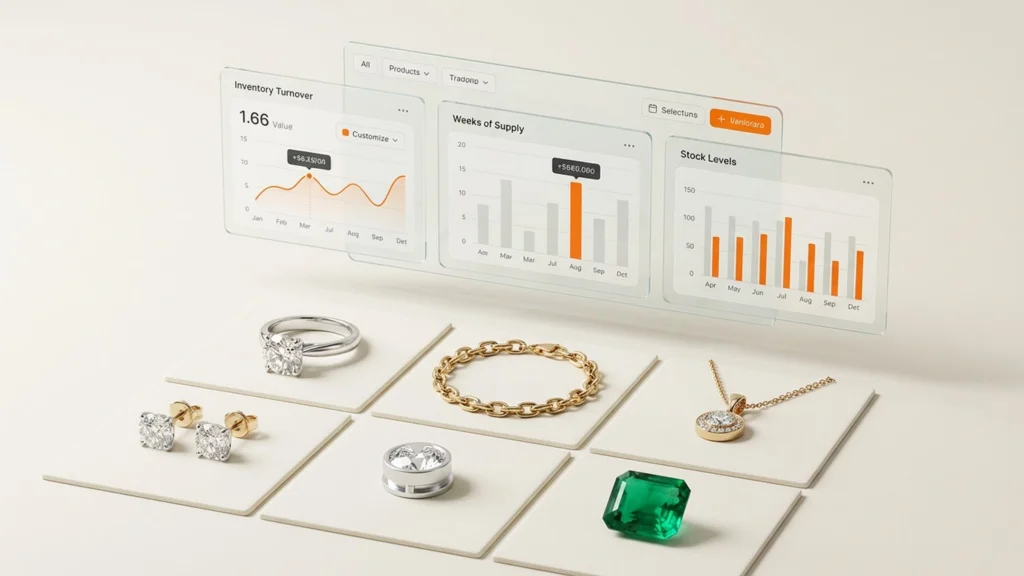
Here’s a tight “inventory kpi pack for jewelry” that covers the essentials without turning your weekly meeting into a spreadsheet trial.
Before you copy this table, one reminder: a KPI is only useful if you can name the decision it triggers. If it doesn’t change buying, replenishment, transfers, pricing, or operations, it’s trivia.
| Outcome | What you’re protecting | Core KPIs to track | Typical decisions triggered |
|---|---|---|---|
| Cash | Capital tied in stock | Inventory Turnover, WOS/FWOS, Open-to-Buy | Reduce buys, rebalance assortment, accelerate sell-through |
| Profit | Margin quality per $ invested | GMROI, Sell-through Rate, Markdown Rate | Stop chasing low-margin volume, revise pricing/promo |
| Availability | Not losing customers to “out of stock” | Stockout Rate / Out of Stock Rate, Fill Rate, Lost Sales estimate | Replenish, transfer, adjust safety stock |
| Execution | Trustworthy operations and data | Inventory Accuracy, Receiving Lead Time, Cycle Count Coverage | Fix process gaps, reduce overselling risk |
If you’re starting from scratch, track the table’s “core KPIs” first, then add nuance only when you’ve proven you can act on it. Otherwise the dashboard becomes a museum: impressive, unused.
Cash & Profit KPIs
Cash and profit KPIs are where jewelry teams usually get whiplash: one month you’re “selling well,” the next month you’re staring at a wall of slow-moving gold. The point of this set is to connect sales performance to inventory investment—so you can stop guessing and start reallocating.
Inventory Turnover
What it tells you: how efficiently you’re converting inventory into sales over a period. For jewelry, turnover is best used to compare categories (studs vs. bridal vs. men’s) rather than to chase a single “perfect” number across the whole business.
Simple formula: Turnover = COGS ÷ Average Inventory (at cost). If you must use retail value, keep it consistent and label it. “inventory turnover jewelry” is only meaningful if everyone agrees on cost vs. retail.
Where it gets tricky: one-of-a-kind and high-ticket pieces can be healthy with low turnover. If your assortment includes true “showpieces,” segment them so they don’t poison the story for the rest of your buys.
Days on Hand (DOH) / Weeks on Hand (WOH)
What it tells you: how long your current stock will last at the current sales pace. DOH/WOH is a sanity check metric—especially when sales spike due to a holiday, influencer moment, or a single marketplace listing popping off.
Formula: DOH = On-hand (at cost) ÷ Daily COGS and WOH = DOH ÷ 7. In jewelry, I prefer WOH because it aligns with buying/replenishment cycles.
If DOH jumps but revenue looks “fine,” that’s often early warning for margin pressure. You’re about to pay for sales with future discounting—unless you intervene.
Weeks of Supply (WOS) + Forward WOS (FWOS)
What it tells you: WOS is the “how long will it last?” question; FWOS is the “how long will it last given what’s coming?” question. In 2026, FWOS is the more actionable metric because lead times, production schedules, and inbound POs matter as much as on-hand.
WOS formula: Weeks of Supply = On-hand units ÷ Avg weekly unit sales. FWOS formula: (On-hand + On-order) ÷ Forecasted weekly sales. Yes, forecasting is imperfect—use a simple moving average if that’s all you trust today.
Use FWOS to prevent the classic jewelry mistake: reordering a “winner” too late, then trying to compensate with expedited shipping or swaps that create gaps elsewhere.
GMROI (Gross Margin Return on Inventory Investment)
What it tells you: how many gross-margin dollars you earn for each dollar invested in inventory. This is the KPI that stops teams from celebrating “sales growth” that quietly burns margin.
Formula: GMROI = Gross Margin ($) ÷ Average Inventory (at cost). If you’re specifically tracking gmroi jewelry, segment by metal, category, and channel, because margin and holding cost behave differently across them.
Here’s a quick (made-up but realistic) example to show why GMROI wins arguments: Category A earns $120k margin on $300k average inventory (GMROI 0.40). Category B earns $90k margin on $120k inventory (GMROI 0.75). Category A can “sell more,” but Category B is the better use of cash.
Open-to-Buy (OTB)
What it tells you: how much you can spend on inventory while staying within your planned stock level. OTB prevents accidental overbuying—especially when sales feel good and everyone wants to “double down.”
Basic approach: Planned Stock + Planned Sales – On-hand – On-order = OTB. Keep it monthly at first; weekly OTB is powerful but can get noisy if your data isn’t stable.
OTB becomes dramatically more useful when paired with FWOS. If FWOS is high and OTB is negative, you don’t need more inventory—you need a plan to convert it.
Availability & Customer Experience KPIs
Jewelry customers don’t just bounce when something is unavailable—they often remember the disappointment. Availability KPIs help you quantify the invisible loss: the “I’ll check another brand” moment that never shows up in your sales report.
The trap here is tracking “availability” at the wrong level. If you sell variants (size, metal, stone), availability must be measured at the shoppable variant level, not the parent SKU. Otherwise you’ll think you’re in stock while customers see “sold out” for their size.
Stockout Rate / Out of Stock Rate
What it tells you: how often customers face a zero-availability situation. People use both phrases—stockout rate and out of stock rate—so pick one definition and document it.
Two useful versions: (1) SKU Stockout Rate = Stocked-out SKUs ÷ Active SKUs and (2) Demand-weighted Stockout Rate = Out-of-stock demand ÷ Total demand. The second one hurts more, but it’s closer to reality.
If your out-of-stock rate is “fine” but you’re still losing sales, check whether you’re measuring at a too-broad SKU level or ignoring your highest-intent channel (often search-driven eCommerce).
Sell Through Rate
What it tells you: how much of what you received (or had available) actually sold in a period. This is one of the cleanest ways to identify winners and dead weight without waiting for year-end.
Formula: Sell through rate = Units sold ÷ (Units sold + Units on hand) for the period, or Units sold ÷ Units received for a specific drop/collection. Use the version that matches your decision.
Sell-through is your bridge metric between creative and commercial: it respects style and storytelling, but it refuses to lie about what the market chose.
Inventory Velocity (and the Inventory Velocity Report)
What it tells you: the speed at which specific items move—often measured as units/day or weeks-to-sell. A good inventory velocity report doesn’t just rank items; it also shows where velocity changes by channel and location.
Practical approach: classify items into velocity bands (Fast / Medium / Slow) based on your own history, not generic benchmarks. Jewelry is too assortment-dependent for one-size-fits-all cutoffs.
When velocity shifts suddenly, treat it like a signal, not a mystery. Was there a price change? A photo update? A marketplace boost? A broken size run? Velocity is often the earliest KPI to react when something operational goes sideways.
Lost Sales Estimate (simple, not perfect)
What it tells you: the revenue you likely missed due to stockouts. It’s never exact, but it’s useful for prioritizing fixes and justifying replenishment rules.
Lightweight method: Lost sales ≈ Avg weekly sales when in-stock × Weeks out-of-stock. Use item-level history where you have it; otherwise use category averages and label it as an estimate.
Even a rough lost-sales number changes conversations. Teams stop debating feelings (“We’re probably losing a lot”) and start ranking actions (“These 12 SKUs cost us the most when they disappear”).
Data & Operations KPIs
In jewelry, operational KPIs aren’t “back office.” They’re what makes your customer promise believable. If you’re trying to avoid overselling, this section is not optional—overselling is usually a data/process problem long before it’s a marketplace problem.
One honest note: these KPIs can feel unglamorous. But they’re the ones that stop support tickets, emergency transfers, and the quiet margin bleed caused by constant exceptions.
Inventory Accuracy
What it tells you: whether the system quantity matches reality. Inventory accuracy is the KPI that decides if your other KPIs are trustworthy or decorative.
Formula: Accuracy = Correct counts ÷ Total counts during cycle counts, or 1 − (|System − Physical| ÷ Physical) at an item/location level. Track accuracy by location and by workflow (receiving, picking, transfers).
If accuracy is weak, don’t “fix” forecasting first. Fix receiving, returns, and transfer discipline. Forecasts built on bad counts are just well-formatted fiction.
Cycle Count Coverage
What it tells you: whether you’re checking enough of the inventory, often weighted by value and velocity. Coverage prevents the illusion of control—counting the same easy drawer every month while high-value pieces drift.
Practical method: ABC by value, plus velocity tags. Count A items weekly, B items monthly, C items quarterly (adjust to your team size). Keep it realistic; a plan that never gets executed is worse than a smaller plan that sticks.
Coverage pairs nicely with accuracy: you can be “95% accurate” on the 30% of SKUs you counted. That’s not the win it sounds like.
Shrink, Adjustments, and Exception Rate
What it tells you: how much inventory value leaks through loss, damage, mis-scans, and process gaps. Track not only shrink dollars, but also the rate of adjustments (how often you’re changing inventory after the fact).
Simple KPI: Adjustment Rate = # adjustment transactions ÷ # total inventory transactions. If this creeps up, it often correlates with oversell incidents and delayed fulfillment.
Don’t weaponize this metric against staff. Use it to find the step that’s breaking (returns intake, repairs, marketplace sync timing), then fix the workflow.
Replenishment Lead Time & Sync Latency
What it tells you: how long it takes to go from “we need stock” to “it’s sellable,” plus how quickly channels reflect changes. In 2026, sync latency is a real KPI if you sell on multiple channels.
Measure two clocks: (1) vendor/production lead time and (2) internal lead time (receiving, QA, photography, listing). Then track sync latency (minutes/hours) from system update to marketplace availability.
If you’re overselling, don’t just lower safety stock—first confirm whether listings lag behind physical reality. Many “demand problems” are actually “timing problems.”
Cadence — how often to track each KPI
Cadence is where good KPI programs survive. Too frequent and you chase noise; too slow and you only notice problems when the cost is already baked in. The trick is to match the KPI’s “reaction time” to how quickly you can act.
Here’s a pragmatic schedule that works for most jewelry teams, with a bias toward action over reporting.
Before you adopt this cadence, define who owns each KPI. A KPI with no owner becomes a background number everyone nods at and nobody changes.
- Daily (quick checks): Out of stock rate / stockout rate on top sellers, oversell incidents, order fulfillment delays, sync latency (if multichannel).
- Weekly: Inventory velocity report, sell through rate for new drops and key categories, FWOS for winners/risks, receiving and returns backlog.
- Monthly: Inventory turnover jewelry (by category/channel), GMROI (especially gmroi jewelry by segment), OTB, DOH/WOH, cycle count coverage and accuracy trends.
- Quarterly: Assortment cleanup decisions, safety stock policy review, lead-time renegotiation, ABC/velocity reclassification, KPI definitions audit (yes, definitions drift).
The “definitions audit” sounds boring, but it prevents the silent failure where two people calculate the same metric differently. If you’ve ever argued about whether a piece was “in stock,” you already understand why this matters.
The right jewelry inventory KPIs don’t make you a forecasting wizard. They make you earlier—earlier to catch stockouts, earlier to stop overbuying, earlier to protect margin, earlier to spot data issues before they turn into customer apologies.
If you take one thing from this: don’t track “everything.” Track the handful of metrics that connect directly to decisions: WOS/FWOS, sell-through, GMROI, stockout/out-of-stock rate, and inventory accuracy. Then segment them by the way you actually sell: category, metal, price band, and channel.
If you want a clean starting point, build a one-page “inventory KPI pack for jewelry” dashboard with the KPI table above and a weekly inventory velocity report. And if your biggest pain is multichannel visibility and avoiding overselling, Valigara’s jewelry inventory workflow is designed to keep availability, counts, and channel updates aligned—so your KPIs reflect reality, not wishful thinking.