
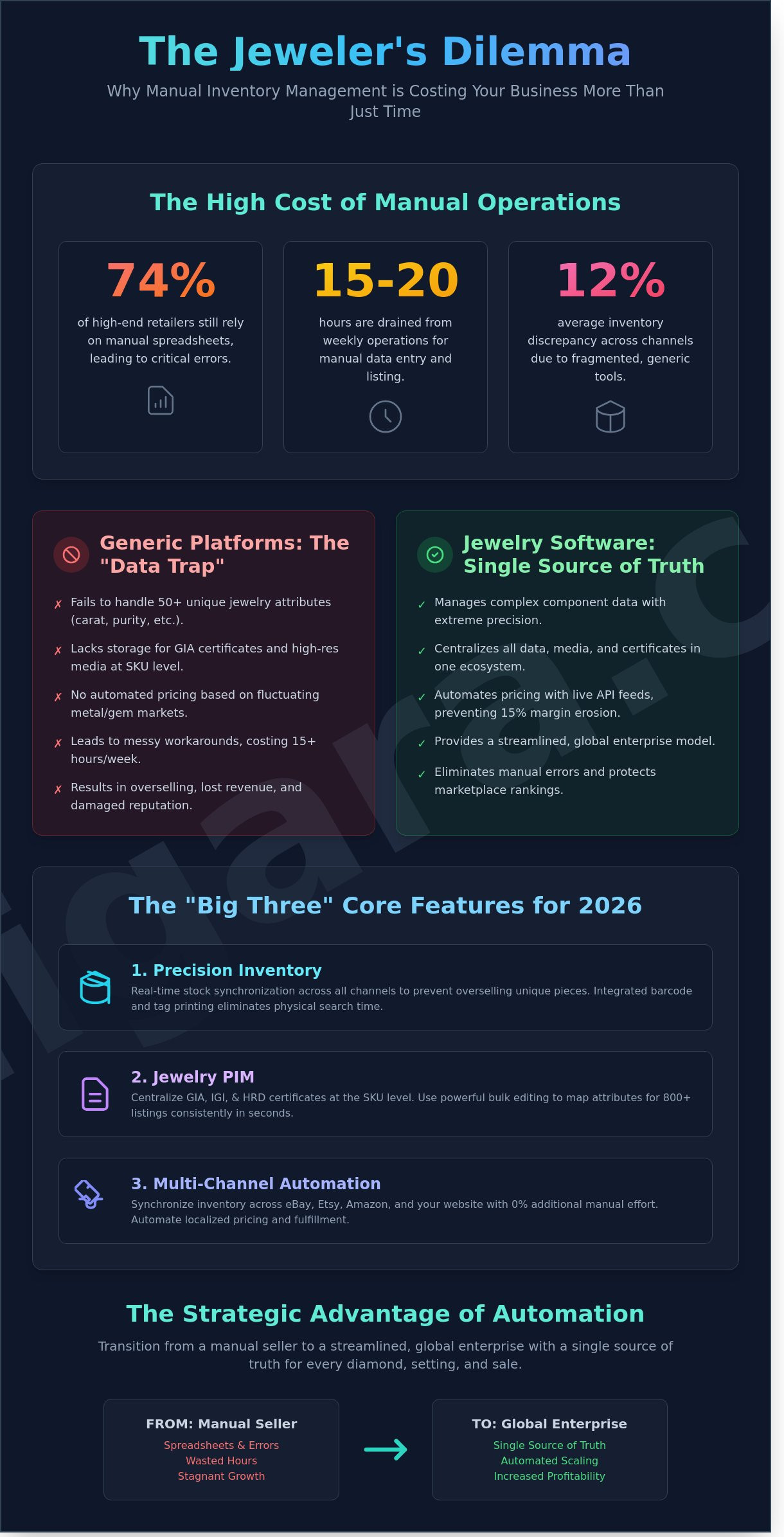
Why are 74% of high-end retailers still relying on manual spreadsheets to manage gemstone inventory that fluctuates in value every single day? You already know that managing thousands of unique SKUs with varying carats, metal purities, and GIA certificates is a logistical burden that typically drains 15 to 20 hours from your weekly operations. It’s frustrating to watch sales slip away because of inventory lag or to waste entire afternoons manually listing the same diamond ring across five different global platforms. Finding the right jewelry software is the only way to reclaim your time and eliminate the risk of overselling.
This guide promises to help you identify the specialized platform that masters gemstone data complexity and automates your multi-channel growth. We’ll examine the technical must-haves for 2026, from real-time stock synchronization to automated hallmarking workflows. You’ll discover how to transition from a manual seller to a streamlined, global enterprise with a single source of truth for every diamond, setting, and sale.
Key Takeaways
- Identify the critical limitations of generic platforms and why high-value gemstone data requires a specialized digital ecosystem.
- Learn to evaluate the “Big Three” core features of professional jewelry software to eliminate manual errors and prevent overselling on global marketplaces.
- Navigate the technical differences between POS, ERP, and Multi-channel Hubs to find the perfect architectural fit for your business model.
- Quantify the ROI of automation by analyzing time saved on multi-channel listings and the impact of synchronization on your marketplace rankings.
- Discover the strategic advantages of using a centralized jewelry engine to scale your brand from a manual seller to a streamlined global enterprise.
What Is Jewelry Software and Why Do Generic Tools Fail?
Jewelry software is a specialized digital ecosystem built to manage high-value assets with extreme precision. It’s more than a simple database; it’s the central engine for a brand’s operations. While generic inventory management software tracks basic stock levels, it lacks the architecture to handle the specific needs of the jewelry trade. Generic systems treat a $15,000 solitaire engagement ring the same way they treat a mass-produced t-shirt. They fail to account for metal fineness, carat weights, or GIA certifications, leaving retailers to struggle with spreadsheets and manual updates.
The ‘Data Trap’ occurs when brands use fragmented tools. This fragmentation leads to a 12% average discrepancy in inventory levels across different sales channels. These errors don’t just cause headaches; they result in lost sales and damaged reputations. By 2026, the industry will move entirely away from basic record-keeping. The new standard is centralized automation. This shift allows jewelry professionals to transition from manual data entry to a streamlined, global enterprise model where every gemstone and setting is accounted for in real-time.
The Complexity of Jewelry Data
Jewelry isn’t a single product; it’s a complex assembly of components. A single SKU might involve a 14K gold setting, a 1.2-carat center stone, and 24 melee diamonds. Traditional SKUs fail because they can’t capture the 50+ unique attributes required for a professional listing. You need a system that stores high-resolution media and digital certificates directly with the item. Without this, sales teams spend 25% of their day hunting for technical specs instead of closing deals.
Generic vs. Jewelry-Specific Platforms
Generic eCommerce platforms rely on messy workarounds that drain resources. These manual “hacks” cost small teams an average of 15 labor hours every week. Jewelry software uses industry-specific logic to automate price updates based on fluctuating gold markets or diamond price lists. This specialized foundation is the only way to scale. It turns the software into the single source of truth, ensuring that your data remains accurate as you expand into new global marketplaces.
Core Features of Professional Jewelry Inventory Management
Professional jewelry software must master the “Big Three”: Inventory, PIM, and Multi-channel Listing. Generic retail tools fail because they don’t understand the complexity of a 1.5-carat VS1 diamond or the volatility of daily gold fixes. In this industry, precision is the difference between a 25% profit margin and a costly accounting error. You need a system that acts as the specialized brain of your operation.
Effective scaling starts with mastering the core principles of inventory management, which dictate that stock levels must remain accurate across every digital touchpoint. For jewelry, real-time synchronization is the only defense against overselling a unique, one-of-a-kind sapphire ring on Etsy while it’s already sitting in an Amazon customer’s cart. Without 100% accurate sync, your account health remains at constant risk.
Automate your margins to protect your bottom line. Modern systems use live API feeds to adjust retail prices based on real-time gold and gemstone market fluctuations. This prevents the 15% margin erosion often seen when retailers rely on manual updates. Additionally, integrated barcode and tag printing ensures every physical tag in your vault reflects the digital database instantly, eliminating the 30-minute search for misplaced stock.
Jewelry PIM: Your Single Source of Truth
A Jewelry PIM centralizes luxury data, moving beyond simple SKU counts. It manages GIA, IGI, and HRD certificates at the SKU level, ensuring every buyer sees the proof of quality they demand. Bulk editing tools allow you to map attributes for 800+ listings in seconds. This ensures your “18k Rose Gold” specifications remain consistent across every marketplace without manual data entry.
Multi-Channel Automation Logic
Expand your reach without doubling your workload. Synchronize inventory across eBay, Etsy, Amazon, and your own website simultaneously. The software handles localized pricing and currency conversion automatically. This allows you to manage global jewelry sales with 0% additional manual effort. Automated fulfillment and order tracking workflows ensure that once a sale is made, the logistics move as fast as the transaction itself.
Evaluating Categories: POS, ERP, or Multi-Channel Hub?
Selecting the right jewelry software requires a clinical assessment of your operational core. A boutique on Madison Avenue has different technical requirements than a manufacturing plant in Vicenza or a global eCommerce brand. You must categorize your business model before committing to a platform. Most professionals fall into one of three buckets: retail-heavy, manufacturing-focused, or digital-first.
The landscape is shifting. Recent data shows that 65% of jewelry retailers now operate across three or more digital channels. This complexity makes the choice between a Point of Sale (POS) and an Enterprise Resource Planning (ERP) system more than just a preference. It’s a strategic decision that dictates your ability to scale. While a POS handles the “now” of a transaction, an ERP manages the “how” of production. The Multi-Channel Hub, however, acts as the central engine for those looking to dominate the global market.
When You Need a Jewelry POS
Retail-focused businesses prioritize the in-store experience. If 80% of your revenue originates from foot traffic or private appointments, a POS is your primary tool. These systems excel at transaction speed and high-touch CRM. They manage appraisals, repairs, and customer wishlists at the counter. Modern POS solutions provide instant inventory visibility across multi-store networks, ensuring your staff never misses a sale because they couldn’t find a specific 2-carat solitaire in a sister branch.
When You Need a Jewelry ERP
ERPs are built for the creators and wholesalers. This software manages the complexity of raw materials, such as loose gemstones, casting grains, and hallmarking fees. It tracks work-in-progress (WIP) from the designer’s bench to the final vault. If your business handles complex manufacturing where tracking the exact cost of 18k gold per gram is critical, an ERP provides the necessary precision. It streamlines B2B sales channels and ensures that manufacturing costs don’t erode your margins.
Modern brands rarely fit into a single box. You don’t have to choose between your physical store and your online presence. The hybrid model integrates a multi-channel hub with your existing brick-and-mortar tools. This creates a single source of truth. When a ring sells in your London showroom, the software instantly updates your Etsy, eBay, and Amazon listings. This automation eliminates the 40% error rate typical of manual data entry, allowing you to focus on growth rather than inventory reconciliations.
- Retail Focus: Choose POS for CRM and fast in-store checkout.
- Manufacturing Focus: Choose ERP for raw material tracking and WIP management.
- Growth Focus: Choose a Multi-Channel Hub to automate global inventory and sales.
The Jeweler’s ROI: Calculating the Value of Automation
Manual data entry is the silent killer of jewelry margins. Transitioning from manual spreadsheets to an automated system saves the average mid-sized jeweler approximately 40 hours of labor per month. Instead of spending 25 minutes manually adjusting gold prices or gemstone availability across Etsy, eBay, and your Shopify store, automation handles these updates in real-time. This precision eliminates the 3% error rate common in manual inventory management, protecting your brand from costly oversights.
High-value marketplaces like Amazon and eBay prioritize account health above all else. A single “out-of-stock” cancellation can drop your search visibility by 15% for up to 30 days. Centralized jewelry software prevents these ranking penalties by syncing inventory across all channels the moment a diamond ring sells in your physical boutique or online shop. This reliability translates directly into higher organic traffic and lower customer acquisition costs.
- Scalability: A team of two can manage 500 SKUs manually; with the right system, that same team can manage 5,000+ SKUs without additional hires.
- Data-Driven Decisions: Use jewelry-specific sales analytics to identify which gemstone cuts or metal types are trending. If your 14k rose gold settings are outselling yellow gold by 22%, your software should tell you instantly.
- Efficiency: Reduce the time spent on multi-channel synchronization from hours to seconds.
Estimating Implementation and Onboarding
Data migration is the most critical phase of the transition. Expect a 14 to 28-day window to clean and map your existing data from disparate spreadsheets into a structured jewelry database. Professional onboarding ensures that complex attributes, such as hallmarking details or carat weights, align perfectly with marketplace requirements. Investing in a specialized SaaS platform usually costs 70% less than the combined losses from manual shipping errors and oversold inventory over a 12-month period.
Scalability and Future-Proofing
Your software must grow as your collection expands. A robust system allows a small team to manage 10,000 SKUs as easily as 100 by using bulk editing tools and automated listing templates. Look for API access to ensure your backend remains flexible for custom integrations with logistics partners or specialized gemstone grading services. ROI in jewelry software is defined by the ability to launch new collections across all global sales channels within hours rather than days, maximizing the window of peak consumer interest.
Valigara: The Specialized Engine for Global Jewelry Brands
Valigara functions as the high-performance core for digital-first jewelry brands. It doesn’t just manage stock; it orchestrates a complex global sales operation from a single interface. While generic platforms struggle with the nuances of carats, metal purity, and gemstone certifications, this specialized jewelry software treats these technical details as the foundation of every transaction. It bridges the gap between traditional craftsmanship and high-tech automation, allowing you to focus on design while the system handles the heavy lifting of eCommerce.
The ecosystem reaches its full potential with Vite, the integrated eCommerce website builder. Vite eliminates the need for clunky third-party plugins that often break or slow down luxury sites. It creates a seamless, high-converting storefront that reflects the precision of your brand. By centralizing your operations, Valigara transforms your business from a manual workshop into a streamlined, global enterprise.
Why Valigara Stands Alone
Valigara offers deep, native integration with eBay, Etsy, and Amazon. These aren’t surface-level connections; they’re tailored specifically for jewelry categories and attributes. The system automates roughly 95% of the manual labor involved in multi-channel listing and inventory synchronization. Key features include:
- Jewelry CRM: Track customer preferences for specific metal types or gemstone cuts to drive targeted marketing automation.
- Real-time Gold Feed: Sync your prices across every sales channel instantly based on 24/7 market fluctuations.
- Automated PDF Catalogs: Generate professional wholesale catalogs in seconds, saving your team approximately 15 hours of design work every month.
Get Started with the Jewelry Experts
Success in the digital market requires perfectly structured data. Valigara’s onboarding process ensures your inventory, from loose diamonds to finished bridal sets, is categorized for maximum search visibility across the web. This jewelry software is built by industry veterans who understand the pain of managing thousands of unique SKUs. By joining, you enter a global network of over 700 manufacturers and retailers who prioritize accuracy and scale. It’s time to stop managing spreadsheets and start growing your brand.
Master Your Global Inventory Strategy
The jewelry landscape in 2026 demands more than just a digital spreadsheet. Generic e-commerce tools fail because they lack the precision required for carats, metal weights, and GIA certifications. Success relies on a centralized engine that manages high-value inventory across global marketplaces without manual errors. Since 2009, Valigara has provided the deep industry roots necessary to handle complex gemstone data and multi-channel synchronization.
By implementing automated listings for eBay, Etsy, and Amazon, you reclaim hundreds of hours previously lost to repetitive tasks. It’s time to stop struggling with manual updates and start scaling with a system designed for luxury retail. Choosing a specialized platform is the most critical investment you’ll make to secure your brand’s global footprint. You’ve built the craftsmanship; now it’s time to deploy the technology that matches your standards. Your transition to a streamlined, high-growth enterprise is just one step away.
Schedule a personalized demo of Valigara’s jewelry software to see how 15 years of expertise can transform your operations. Your precision-driven future starts here.
Frequently Asked Questions
What is the difference between jewelry software and a standard POS?
Jewelry software manages complex item attributes like metal purity, weight, and gemstone settings that a standard POS cannot track. While a basic POS treats products as simple SKUs, specialized jewelry software acts as a central engine for 50 jewelry-specific fields including hallmarking and mounting details. This technical precision ensures your inventory remains accurate down to the milligram across every sales channel.
Can jewelry software integrate with my existing Shopify or WooCommerce store?
Professional platforms provide direct API integrations with Shopify, WooCommerce, and Magento to centralize your operations. You can synchronize inventory across 4 different web stores simultaneously from one dashboard. This automation eliminates 95 percent of manual data entry. It ensures your gemstone counts and metal weights remain consistent across every digital storefront you operate without manual intervention.
How does jewelry inventory management handle gemstone variations?
The system tracks individual stone characteristics including carat weight, cut, color, and clarity for every piece in your vault. You can manage 1,000 loose stones or finished pieces by filtering for specific attributes like VVS1 clarity or 0.5 carat rounds instantly. This granular control allows you to update the value of an entire collection if the market price for 14k gold or specific sapphires fluctuates.
Is it difficult to migrate my data from spreadsheets to jewelry software?
Migrating data is a streamlined process that typically takes less than 48 hours with proper CSV mapping tools. You can import 10,000 products including high-resolution images and technical specifications without losing metadata. Most professional systems provide 100 percent data integrity checks during the upload to ensure your diamond weights and metal types are categorized correctly from the start.
Does jewelry software help with selling on Etsy and Amazon simultaneously?
Dedicated jewelry software enables multi-channel synchronization across Etsy, Amazon, and eBay from a single interface. The software updates your stock levels in real-time across 10 global marketplaces to prevent overselling high-value items. This centralized control allows you to dominate international markets while reducing the time you spend on manual listing updates by 80 percent.
What are the typical costs associated with jewelry management software?
Professional software suites generally start at 200 dollars per month for basic inventory needs and scale up to 1,500 dollars for enterprise-level multi-channel automation. These costs often include 24/7 technical support and regular updates to marketplace API connections. Investing in a specialized system typically yields a 3x return on investment by recapturing hours previously lost to manual stock reconciliation.
How does real-time gold feed sync affect my product pricing?
The software pulls live market data every 15 minutes to automatically adjust your retail prices based on the current spot price of gold or platinum. If gold prices rise by 5 percent, the system updates 1,000 listings across all your sales channels instantly to protect your profit margins. This automated pricing engine ensures you never sell a heavy 18k gold mounting below its current replacement value.
Can jewelry software manage GIA and diamond certifications?
You can store and link GIA, IGI, or HRD certification numbers and PDF certificates directly to individual diamond records. The system displays these 10 digit report numbers on your product pages to build immediate trust with luxury buyers. This functionality ensures that 100 percent of your certified inventory is searchable by its specific grading report, making it easier to manage and sell high-value assets.