
Is your jewelry brand truly scaling, or is it just becoming more difficult to manage? For many designers, growth feels less like a milestone and more like a mounting pile of manual updates and desynced inventory. Implementing specialized jewelry software for a growing brand is the only way to transition from a manual seller to a data-driven enterprise without losing your mind to spreadsheets. You likely understand the frustration of overselling a unique piece on Etsy because your inventory didn’t update across Shopify and eBay in time. You’ve felt the drain of manually adjusting gold prices for hundreds of SKUs while the market shifts beneath you. It’s exhausting, and it’s a bottleneck that stifles your ability to compete globally.
We promise to show you how to build a streamlined operation that functions with the precision of a master watchmaker. This 2026 guide covers the essential steps to centralizing your product data and automating your global listings. You’ll learn how to implement real-time stock synchronization and maintain a single source of truth for every gemstone, metal variation, and finished piece in your collection. It’s time to stop managing chaos and start leading an automated, multi-channel empire with total confidence.
Key Takeaways
- Understand why generic e-commerce platforms fail at scale and how specialized software manages complex jewelry specifications that standard tools ignore.
- Discover how a dedicated Jewelry PIM serves as the operational hub, enabling you to launch new collections across global marketplaces in minutes.
- Protect your profit margins by implementing automated gold feed synchronization and digital gemstone certificate management directly within your sales flow.
- Explore the strategic advantages of jewelry software for a growing brand, including mobile-ready B2B catalogs and high-intent marketing automation.
- Master a low-risk implementation roadmap to transition your legacy spreadsheets into a professional, multi-channel digital architecture.
Why Generic E-commerce Tools Stunt Jewelry Brand Growth
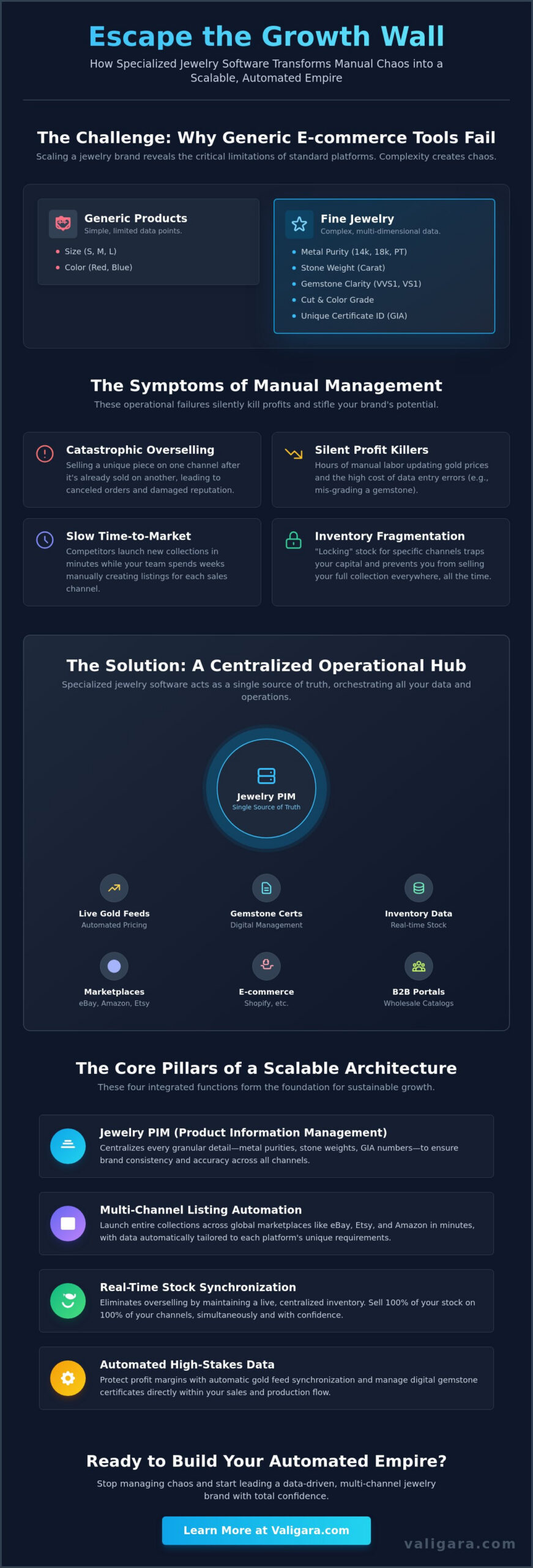
Scaling a jewelry brand requires more than just a beautiful collection. It demands a digital infrastructure that can handle the granular complexity of fine jewelry. Most brands hit what we call the “Growth Wall” around the 1,000 SKU mark. At this stage, generalist platforms like Shopify or Etsy become a liability. They’re built for simple products; they don’t account for the multi-dimensional data inherent in luxury items. A standard t-shirt has size and color. A diamond ring has metal purity, stone weight, clarity, cut, and a unique GIA certificate. Managing these as simple variants in a generic tool is a recipe for operational gridlock.
This technical gap often leads to “spreadsheet creep.” You start using Excel to track what your e-commerce platform can’t. Soon, your data is scattered across multiple files. During peak seasons, this fragmentation causes catastrophic overselling. If you sell your last 18k gold emerald pendant on eBay but fail to delist it on your website within minutes, you’re forced to cancel a high-value order. Specialized jewelry software for a growing brand solves this by acting as a centralized operational hub. It is essentially a tailored version of Enterprise Resource Planning (ERP) designed for the jewelry trade. It doesn’t just store data; it orchestrates it.
The Hidden Cost of Manual Data Entry
Manual updates are a silent profit killer. If you manage 500 listings and the gold price shifts, updating each one manually takes hours of expert labor. This isn’t just inefficient; it’s dangerous. Human error in gemstone grading is a massive liability. A single typo changing a clarity grade from VS1 to VVS1 can lead to legal disputes and a shattered reputation. Beyond the risk, manual entry slows your time-to-market. If it takes your team two weeks to list a new seasonal collection across all channels, you’re losing revenue to more agile competitors who use automation to launch in minutes.
Inventory Fragmentation vs. Centralized Control
Fragmented stock across eBay, Etsy, and your own site kills your margins. When you’re forced to “set aside” stock for specific channels, your capital is trapped. You might have a buyer on Amazon ready to pay full price, but the item is “locked” in your Etsy inventory. A single source of truth eliminates this friction. By centralizing your inventory, you can list 100% of your stock on 100% of your channels simultaneously. You transition from reactive inventory management to a proactive strategy where your software handles the heavy lifting. This allows you to focus on the craftsmanship and growth that built your brand in the first place.
Whether you are building a high-end jewelry label or a modern hospitality brand like Tacoverse, the goal is the same: automating the routine tasks so you can focus on the unique elements that define your business.
The Core Pillars of a Scalable Jewelry Software Architecture
Scalability for a luxury brand isn’t achieved by simply increasing your headcount. It requires a fundamental shift in how you manage your digital assets. To move past the manual limitations that trigger the “Growth Wall,” you must implement a digital foundation built on four specific pillars. Selecting the right jewelry software for a growing brand means moving beyond basic inventory tracking. You need a system that understands the technical nuances of the trade, from metal fineness to gemstone clarity grades.
Jewelry PIM: Managing Complex Variations
A standard database cannot handle the depth of information required for fine jewelry. A specialized Jewelry PIM software acts as the primary operational hub for your brand. It stores every granular detail, including metal purities, stone weights, and GIA certification numbers, alongside your high-resolution imagery. This centralization ensures your brand voice remains consistent across every touchpoint. Instead of recreating technical descriptions for each site, the PIM automatically formats data to meet the specific requirements of different marketplaces. This eliminates the risk of data mismatch and ensures your customers always see accurate product specifications.
Multi-Channel Listing: Beyond Simple Syncing
True expansion requires a global presence, but every marketplace has its own culture and technical constraints. Multi-channel listing automation allows you to tailor your product presentation for different audiences. You can maintain a curated, handmade vibe on Etsy while adhering to the rigid, data-heavy structures of Amazon. Bulk editing tools enable you to launch site-wide promotions or adjust pricing across all global channels simultaneously. This level of automated control is what allows a lean team to manage an enterprise-level presence without the stress of manual updates.
Real-time inventory synchronization is the third pillar of this architecture. It acts as the essential failsafe against the “out of stock” nightmare. When a unique, one-of-a-kind sapphire ring sells on your Shopify store, the software immediately delists it from eBay and Amazon. This immediate communication prevents the reputational damage and marketplace penalties caused by canceled orders. Finally, an integrated CRM tracks the high-touch journey of your buyers. Because jewelry is an emotional, high-value purchase, knowing a client’s metal preferences or significant anniversaries allows you to provide a personalized experience that drives long-term loyalty.
If you’re ready to move away from fragmented tools and manual workflows, exploring an integrated jewelry management platform can provide the centralized control your brand needs to scale with precision.
Automating High-Stakes Data: Gold Feeds and Gemstone Certs
High-value inventory carries risks that lower-cost retail sectors never face. When your primary raw materials are gold, platinum, and certified diamonds, a data error isn’t just a nuisance; it’s a direct hit to your bottom line. Transitioning to professional jewelry software for a growing brand allows you to automate these high-stakes variables. This ensures your margins remain protected even during periods of extreme market volatility, moving your operations away from the dangerous delays of manual oversight.
Real-Time Gold Feed Integration
Precious metal prices are not static, and your digital storefront shouldn’t be either. Relying on manual price adjustments across hundreds of listings is a profit killer. If the market price for 18k gold spikes while you’re offline, every sale made before you manually update your site is a lost opportunity for profit. In the fast-paced 2026 market, these delays are unacceptable for a scaling enterprise.
A sophisticated Gold Feed Sync solves this by pulling live market data and applying it to your catalog instantly. You can set specific pricing rules to maintain control over your final retail prices. These rules include:
- Automatic markups based on the current spot price of gold or platinum.
- Currency-specific adjustments for international marketplaces.
- Tiered pricing models for different metal purities and alloys.
This automation does more than protect your margins; it builds consumer confidence. Modern luxury consumers appreciate the transparency of live pricing. It signals that your brand is sophisticated, data-driven, and operating at the highest industry standards. It positions you as an expert insider who values accuracy above all else.
Gemstone and Diamond Management
Managing a growing collection of unique stones requires more than just a basic inventory list. Each diamond or colored gemstone carries its own set of technical specifications, from carat weight to country-of-origin determination. By integrating GIA, AGS, or IGI certifications directly into your sales flow, you digitize the trust-building process. This is particularly important in 2026 as GIA expands its origin determination for a wider array of gemstones.
Advanced software allows you to link specific stones to finished jewelry SKUs automatically. When a customer views a ring, they see the exact certificate associated with that specific center stone. This level of granular management includes tracking unique stone IDs and laser-inscribed serial numbers. It also simplifies the process for B2B expansion. The ability to generate automated PDF catalogs for wholesalers ensures your partners always have access to accurate, up-to-date stone data. This eliminates the back-and-forth of manual inquiries, allowing your sales team to focus on closing high-value deals with total precision.
Expanding Your Reach: B2B Tools and Marketing Automation
Luxury brands that scale successfully don’t just sell more; they sell smarter. Moving into wholesale or high-volume B2B partnerships is a natural progression for a maturing label, but it requires a specialized digital infrastructure. Implementing jewelry software for a growing brand allows you to manage these complex relationships with the same precision you apply to your retail storefront. By consolidating wholesale orders and custom commissions into one operational hub, you ensure that your high-value inventory is never double-booked or improperly priced across different sales channels.
The Modern B2B Jewelry Sales Stack
Empowering your sales team means giving them live access to your entire catalog. At major industry events like JCK, having real-time stock visibility on a mobile-ready device is the difference between a closed deal and a missed opportunity. Private B2B portals provide a professional, password-protected interface where repeat wholesale buyers can browse collections, view tiered pricing, and place orders independently. This system also streamlines custom jewelry workflows. You can automate the quote-to-order process, keeping all design specifications, gemstone choices, and client communications linked directly to the final production SKU within your jewelry CRM.
Leveraging Jewelry Sales Analytics
Growth without insights is just expensive guesswork. Advanced analytics help you identify “dead stock” early, allowing you to liquidate pieces or repurpose precious materials before they drain your working capital. You need to know exactly which collections are driving revenue and which marketplaces offer the highest ROI. With channel-specific tracking, you can see if your marketing spend is more effective on direct retail leads or through your automated B2B outreach programs.
Predictive inventory tools take this a step further by analyzing seasonal trends to forecast what you should manufacture for the next holiday rush. This data-driven approach ensures your production schedule aligns perfectly with market demand, preventing overstock of slow-moving styles. By using these insights, you transition from a reactive business model to a proactive enterprise that anticipates consumer behavior with technical accuracy.
Marketing automation is the final piece of the reach expansion puzzle. High-value jewelry purchases rarely happen on the first touch. You need to nurture leads from initial interest to final purchase using automated workflows that respect the luxury nature of your brand. Whether it’s a personalized follow-up after a gallery visit or an automated reminder for a significant anniversary, these touchpoints are managed by your integrated system. This ensures no high-potential lead falls through the cracks while your team focuses on high-level creative strategy.
Ready to turn your operational data into a competitive advantage? Implement our B2B and analytics tools to scale your jewelry brand with total authority.
Implementation Roadmap: Moving to a Professional Jewelry Platform
Transitioning from manual spreadsheets to a specialized digital brain is a strategic evolution. It isn’t just about changing tools; it’s about shifting your entire operational philosophy. Most brands hesitate to move because they fear the technical complexity of migration. However, staying tethered to fragmented data is the greater risk. Implementing the right jewelry software for a growing brand requires a structured approach to ensure your data integrity remains intact while you build a foundation for global expansion. This roadmap focuses on a phased rollout that minimizes disruption while maximizing immediate control.
The 5 Steps to Software Migration
A successful transition follows a logical, modular path. You can’t automate chaos, so the first priority is establishing a clean foundation. Follow these steps to move from manual labor to a streamlined enterprise:
- Step 1: Centralize your core product data. Perform a comprehensive data audit. Clean your existing spreadsheets and migrate all technical specifications into a centralized PIM. This becomes your single source of truth.
- Step 2: Map your attributes. Align your internal data fields with the specific requirements of global marketplaces. This ensures your gemstone clarity, metal purity, and certificate data display correctly on every channel.
- Step 3: Connect your primary sales channels. Start by integrating your core storefront, whether it’s Shopify or Etsy. This allows the software to begin orchestrating your existing order flow.
- Step 4: Enable real-time synchronization. Activate your live gold feeds and stock sync. This is where you eliminate the risk of overselling and begin protecting your margins automatically.
- Step 5: Roll out advanced automation. Once your retail core is stable, activate your B2B portals and marketing automation features to drive new revenue streams.
Why Growing Brands Choose Valigara
Generic e-commerce tools often leave jewelers stranded because they don’t understand the technical nuances of the trade. Valigara is built specifically for jewelers by industry experts who recognize that a diamond ring isn’t just another SKU. It’s the only platform that effectively bridges the gap between your inventory management and the complex realities of global retail. Our system provides scalable SKU volumes that grow alongside your business revenue, ensuring you never hit another “Growth Wall.”
Staff training is a vital part of this transition. We move your team away from the drudgery of manual data entry and empower them to become system managers. This shift in focus allows your experts to spend more time on craftsmanship and high-level strategy rather than fighting with desynced inventory. Specialized onboarding ensures your migration is handled with the precision your high-value inventory deserves. It’s time to stop managing spreadsheets and start leading a data-driven jewelry empire. Scale your brand with Valigara’s expert onboarding today.
Master Your Global Expansion with Precision
Scaling a luxury label to a global enterprise requires moving beyond the limitations of manual labor. You’ve seen how a centralized PIM serves as the core intelligence of your operation and how automated gold feeds protect your bottom line. Implementing specialized jewelry software for a growing brand is no longer a luxury; it’s a fundamental requirement for staying competitive in 2026. By centralizing your inventory and automating your marketplace listings, you reclaim the time needed to focus on creative growth and high-level strategy, which is how brands like Stellar Malaysia can dedicate more energy to developing signature curation guides for their clients.
Valigara was founded by jewelry industry veterans in 2009 to solve these exact operational hurdles. We provide specialized support for complex diamond and gemstone data while enabling seamless reach across Amazon, eBay, Etsy, and other global marketplaces. It’s time to replace the chaos of spreadsheets with the clarity of a professional, multi-channel architecture. Your brand’s craftsmanship deserves a digital foundation that matches its quality. Take the first step toward a more efficient, automated future for your business.
Book a personalized demo to see how Valigara scales your jewelry brand
Frequently Asked Questions
Can jewelry software integrate with my existing Shopify or Etsy store?
Yes, professional jewelry software for a growing brand integrates directly with major platforms like Shopify and Etsy via API. The software acts as a central command center, allowing you to manage your complex product data in one PIM and push it out to multiple storefronts simultaneously. This ensures every listing stays consistent and every order is funneled into a single, organized fulfillment queue for your team.
How does real-time gold feed sync actually work for my pricing?
Real-time gold feed sync works by pulling live spot prices from global markets and applying them to your predefined pricing formulas. Instead of manually editing hundreds of items when metal prices shift, the system automatically recalculates the retail price for every SKU based on its specific metal weight and purity. This protects your profit margins instantly without requiring human intervention or constant market monitoring.
Is it possible to manage gemstone certificates (like GIA) within the software?
You can absolutely manage and display gemstone certificates like GIA, AGS, or IGI within the system. The software allows you to link digital certificate files and specific grading data directly to unique stone IDs or finished jewelry SKUs. This data can then be automatically displayed on your product pages or B2B catalogs, building immediate buyer trust by providing verifiable proof of quality.
What is the difference between a general ERP and specialized jewelry software?
The primary difference lies in technical granularity. A general ERP treats products as simple units, whereas specialized jewelry software understands the multi-dimensional nature of fine jewelry. It handles specific attributes like metal fineness, gemstone clarity, and carat weights that general systems ignore. This specialization allows for more accurate inventory management and automated listing on marketplaces that require detailed, industry-specific nomenclature.
How long does it typically take to migrate data from spreadsheets to Valigara?
Migration timelines typically depend on the cleanliness of your existing data, but most brands complete the transition within two to four weeks. During the initial audit phase, we identify inconsistencies in your spreadsheets to ensure a smooth import into the PIM. Our specialized onboarding team guides you through each step, from attribute mapping to channel connection, ensuring your operations don’t experience downtime.
Can the software handle both retail and B2B wholesale operations?
Yes, the platform is designed to manage both retail and B2B wholesale operations from a single inventory pool. You can create private B2B portals with tiered pricing for wholesale partners while simultaneously running your public-facing retail site. This unified approach ensures that your stock levels are always accurate across all sales channels, regardless of whether you are selling a single piece or a bulk order.
Does jewelry software help with barcode and tag printing for physical inventory?
Specialized jewelry software includes integrated tools for barcode and tag printing. You can generate custom tags that include essential data like SKU, price, metal purity, and stone weight directly from your PIM. This bridges the gap between your digital catalog and physical inventory, making it easier to track items in a showroom or at trade shows while maintaining a professional, branded appearance.
How does multi-channel automation prevent overselling during holiday rushes?
Multi-channel automation prevents overselling by synchronizing your inventory levels in real-time across every platform. When an item sells on Etsy during a holiday rush, the software instantly updates the stock count on Amazon, eBay, and your Shopify store. This immediate communication eliminates the risk of double-selling unique pieces, protecting your marketplace seller ratings and ensuring a seamless experience for your customers during peak seasons.