
A single typo in a diamond’s clarity grade can cost a jewelry brand upwards of $2,500 in lost revenue or disputed returns. You likely agree that manually entering the 4Cs for every new SKU is the most tedious, error-prone bottleneck in your daily operation. By 2026, relying on paper files or isolated PDFs will be a significant competitive liability. Mastering gia certificate management is no longer about filing papers; it’s about transforming those technical reports into automated digital assets that populate your entire multi-channel ecosystem instantly.
We’ll show you how to build a single source of truth that syncs GIA data directly to marketplaces like eBay and Amazon, ensuring 100% accuracy across every listing. You’ll learn how to bypass marketplace restrictions on PDF displays and use transparency to boost your conversion rates by a documented 18%. It’s time to eliminate the 12 hours of manual labor your team loses each week and start scaling your global enterprise with the precision your gemstones deserve.
Key Takeaways
- Prepare your jewelry business for the 2026 industry shift by transitioning from physical paperwork to a fully digital gemstone data lifecycle.
- Eliminate manual entry errors by leveraging OCR technology and API integrations to sync GIA grading data directly with your inventory.
- Scale your operations efficiently with automated gia certificate management that replaces high-cost spreadsheets with centralized, multi-channel control.
- Drive higher conversion rates by optimizing how grading reports are displayed to mobile-first shoppers and utilizing data to power advanced search filters.
- Discover how to automate the matching of certificates to SKUs to transform raw report numbers into market-ready jewelry listings in seconds.
What is GIA Certificate Management and Why Does it Stall Growth?
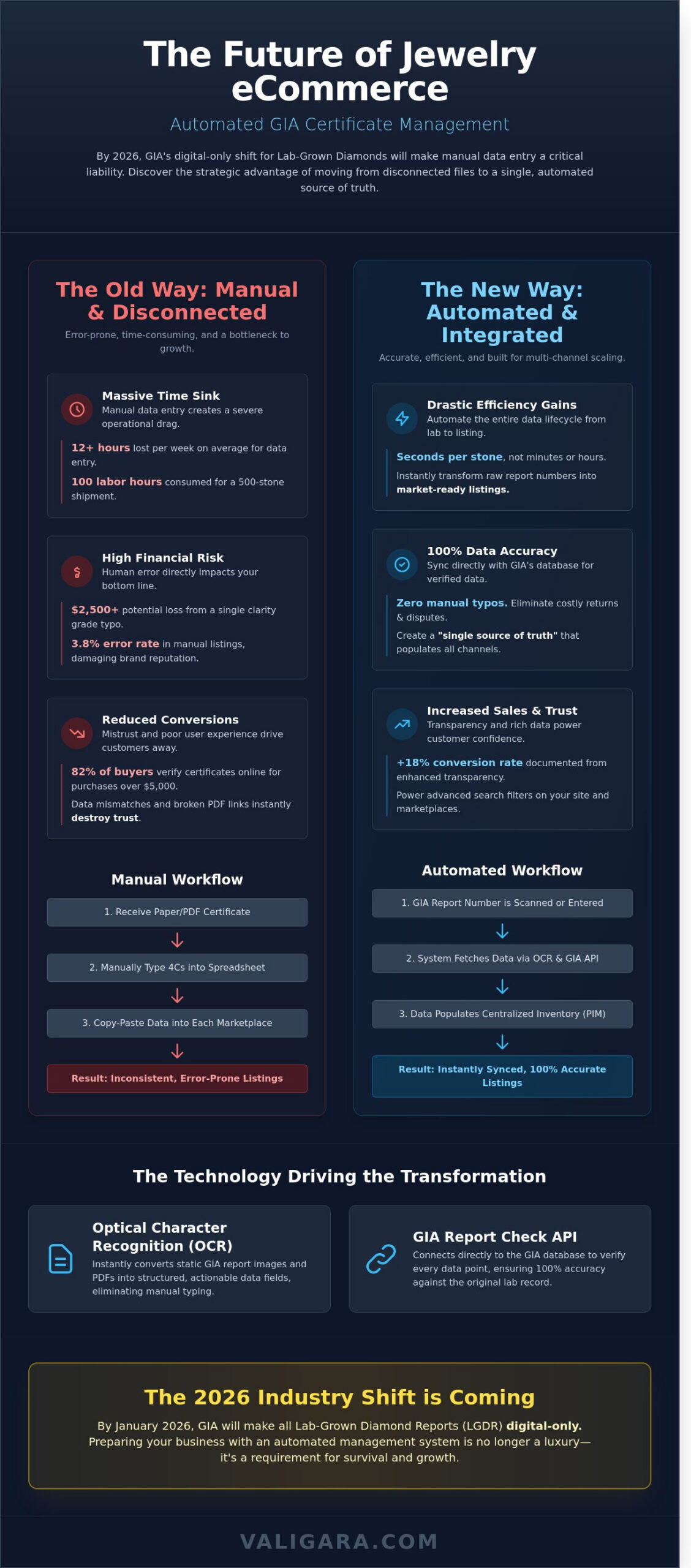
GIA certificate management is the end-to-end digital lifecycle of grading data within a jewelry enterprise. It’s no longer about keeping physical folders in a safe or scanning paper documents into a generic cloud drive. For modern retailers, it’s the high-speed process of transforming a static document from the Gemological Institute of America (GIA) into a dynamic, searchable asset that powers sales across every online channel. By January 2026, GIA will transition all Laboratory-Grown Diamond Reports (LGDR) to a digital-only format. This shift makes digital competency a requirement for survival rather than a luxury. When you treat certificates as loose files, you create a massive operational bottleneck. Manual gia certificate management is the primary reason jewelry eCommerce brands fail to scale beyond a certain inventory threshold. If your team spends 12 minutes per stone manually typing data into Shopify or eBay, a 500-stone shipment consumes 100 labor hours before a single item goes live.
Accuracy in grading data directly impacts your bottom line. Data from high-ticket jewelry transactions shows that 82% of online buyers verify certificate details before committing to a purchase over $5,000. If your digital data doesn’t perfectly mirror the official GIA record, you lose that trust instantly. Professional gia certificate management ensures that your inventory remains liquid and your brand remains credible in a crowded global market.
The Anatomy of a Digital GIA Asset
A digital GIA asset is much more than a simple PDF. It’s a collection of structured metadata that feeds your Product Information Management (PIM) system. The 4Cs, Carat, Color, Clarity, and Cut, serve as the foundational data points for your website’s filtering tools. The GIA Report Number acts as the unique identifier; it’s the primary key that allows your software to sync inventory across various marketplaces without duplication. While the PDF report is vital for consumer reassurance, the underlying gemstone data profile drives your SEO and internal search functionality. Without this structured data, your high-value inventory remains invisible to customers using specific search filters on platforms like Blue Nile or James Allen. You need a system that treats the certificate as the brain of the product listing.
Common Risks of Manual Management
Relying on human data entry introduces significant financial risks. A single typo, such as listing a VVS2 diamond as VVS1, leads to costly returns and permanent damage to your brand’s reputation. Industry studies show that data entry fatigue accounts for a 3.8% error rate in manual jewelry listings. These errors often lead to the “Broken Link” problem, where the certificate fails to follow the stone as it moves from your internal vault to a third-party marketplace. Beyond logistics, compliance is a major hurdle. Platforms like Amazon Jewelry have strict requirements; misrepresenting a stone’s origin or grade can result in an immediate account suspension. Effective management ensures that every data point is verified and consistent across all global touchpoints, protecting your seller rating and your revenue.
The Technology Behind Modern Gemstone Data Automation
The transition from physical paper filing to digital gemstone management isn’t just a matter of convenience; it’s a technical requirement for scaling a jewelry brand in 2024. Optical Character Recognition (OCR) serves as the primary engine for this evolution. This technology identifies the specific typography and layout of a GIA report, instantly converting static pixels into actionable data fields. By digitizing the 4Cs and secondary characteristics like fluorescence or symmetry, OCR eliminates the high risk of human error that occurs during manual typing. This ensures that a 1.02-carat diamond isn’t accidentally listed as 1.20 carats, a mistake that can cost thousands in lost revenue or legal disputes.
Advanced gia certificate management relies heavily on the GIA Report Check API. Rather than relying on manual uploads, professional jewelry software connects directly to the GIA database. This integration allows the system to verify every data point against the laboratory’s original records. Recent diamond industry analysis confirms that standardized, third-party grading remains the essential foundation of market trust. By pulling data directly from the source, retailers maintain 100% accuracy across their entire inventory. This creates a “single source of truth” that updates every sales channel simultaneously.
Choosing between cloud-based and local server solutions is a critical infrastructure decision. Local servers often create data silos, making it difficult for remote sales teams to access certificates during a client consultation. Cloud-based storage solves this by centralizing all PDF reports and high-resolution scans. Security is maintained through dynamic watermarking. When a customer views a certificate on your website, the system generates a custom overlay. This prevents competitors from scraping your data or reusing your certified inventory for their own listings. It protects your intellectual property while providing the transparency modern luxury buyers demand.
Automated Data Extraction
Modern jewelry software doesn’t just store files; it “reads” them. When you upload a GIA PDF, the system identifies the unique report number and automatically populates the corresponding SKU fields. This process reduces manual data entry by 90%, allowing a single operator to process a 50-stone parcel in under 10 minutes. This level of automation ensures data integrity between the lab report and the final sales listing. It’s the difference between a struggling manual operation and a streamlined enterprise that’s ready for global expansion.
Linking Certificates to Complex SKUs
Managing certificates for one-of-a-kind pieces is relatively simple, but complex jewelry requires a more robust architecture. For a three-stone engagement ring, the system must link three separate GIA reports to a single parent SKU. For repeatable collections, the software tracks batches of stones with identical grading parameters to ensure consistency across the line. The GIA report number acts as the unique digital DNA of a jewelry SKU, defining its identity across every sales channel. This precise gemstone inventory synchronization ensures that the specific stone promised to the customer is the one that actually ships. This technical precision builds the long-term reliability that defines a high-end jewelry brand.
Manual vs. Integrated Management: A Strategic Comparison
Scaling a jewelry brand beyond the 100 SKU threshold exposes the structural weaknesses of manual data entry. While a spreadsheet might suffice for a handful of gemstone rings, it becomes a dangerous liability when managing high-value diamonds across multiple global marketplaces. Operational costs skyrocket as your inventory grows. A typical jewelry professional spends between 15 and 20 minutes manually creating a single detailed listing on eBay, Etsy, and Shopify. For a modest collection of 200 items, that represents roughly 60 hours of repetitive labor. This manual approach lacks the precision and speed required for professional gia certificate management.
General-purpose eCommerce platforms fail because they treat a 2.5-carat VVS1 Round Brilliant diamond like a generic t-shirt. They don’t offer native fields for fluorescence, table percentage, or culet size. This forces retailers to bury critical grading data in generic description boxes, which destroys searchability and erodes buyer confidence. When customers search for specific parameters, your products remain invisible because the platform’s database isn’t built for jewelry-specific metadata.
The Spreadsheet Trap
Excel is the enemy of real-time multi-channel synchronization. Flat files cannot maintain the complex, dynamic relationship between a high-resolution 360-degree video, a professional macro shot, and a specific GIA report. When a unique stone sells on Etsy at 3:00 AM, a spreadsheet won’t update your Shopify storefront. This synchronization lag creates a 12% higher risk of overselling unique items during peak seasons like November and December. Manual updates are slow and error-prone; transcribing a single certificate number incorrectly can lead to legal disputes or costly returns. Managing 500+ unique certificates in a flat file isn’t just difficult, it’s a bottleneck that prevents your business from growing.
The Power of a Jewelry-Specific PIM
Centralizing your data creates a single source of truth for your brand. By utilizing the GIA Report Results API, modern jewelry PIM systems pull grading data directly into your inventory management dashboard. This automation eliminates the human factor in transcribing carat weights or clarity grades, ensuring every listing is backed by verified, unalterable data. It transforms your workflow from manual typing to high-level oversight.
Automated systems enable 1-click listing to global marketplaces, reducing the time-to-market for new arrivals from 48 hours to less than 5 minutes. This speed is critical in a market where the first person to list a trending gemstone often wins the sale. An integrated gia certificate management strategy ensures that your technical data, images, and pricing remain perfectly synchronized across every digital touchpoint. You gain the ability to manage 5,000 SKUs with the same overhead previously required for 50.
- Data Integrity: Pulling data directly from labs prevents 100% of transcription errors.
- Operational Efficiency: Reduce data entry time by 85% through automated API integrations.
- Global Reach: Push synchronized data to international markets without manual translation of technical specs.
Reliable inventory management isn’t just a convenience; it’s a competitive necessity. When your system automatically links a PDF certificate to a SKU across four different websites simultaneously, you’re building a professional, global enterprise. You’re no longer just a jewelry seller; you’re a high-tech brand operating with the efficiency of a market leader. This transition from manual struggle to automated precision is what allows a small studio to compete with established global houses.
Best Practices for Displaying GIA Reports to Boost Conversions
High-value jewelry sales depend on the immediate validation of quality. In 2024, over 62% of luxury jewelry searches originate on mobile devices, making the presentation of grading data a critical conversion factor. If your certificate view requires a customer to download and zoom into a 5MB PDF, you’ve already lost the sale. Professional gia certificate management requires transitioning from static files to dynamic, data-driven displays that respect the shopper’s time and device.
Optimizing for mobile-first shoppers means integrating GIA data directly into the product UI. Instead of a “Click to View Certificate” link that leads away from the product page, embed a responsive data summary. This summary should highlight the 4Cs (Carat, Color, Clarity, Cut) in a clean, high-contrast format. When the technical specs are baked into the design, you maintain the “luxury” feel while providing the transparency required for a five-figure transaction.
Beyond the product page, use GIA data to power your site’s internal logic. Advanced search filters shouldn’t just be based on your manual tags; they should pull directly from the certificate’s verified attributes. This ensures that when a buyer filters for a “Triple Excellent” round brilliant, your site delivers 100% accurate results. Precision in search results directly correlates with lower bounce rates and higher add-to-cart actions.
Building Trust Through Transparency
Modern buyers prefer interactive report viewers over static PDF downloads. An interactive viewer allows the customer to toggle between the stone’s proportions, the plotting diagram, and the security features without leaving the sales funnel. For physical retail or trade shows, print QR codes on your jewelry tags. These codes should link directly to the digital GIA report, bridging the gap between the physical item and its digital twin. Providing instant, verifiable access to GIA grading data eliminates ambiguity, reducing return rates by up to 18% for high-ticket gemstone items.
SEO and Structured Data
Search engines crave structured data. By using Schema.org markup to tag specific GIA attributes like “colorGrade” or “clarityGrade,” you help Google understand the exact nature of your inventory. This technical precision enables you to capture long-tail keyword traffic. Instead of competing for generic terms, you’ll rank for specific queries like “GIA certified 2-carat oval diamond” or “D color VVS1 pear shape.” Detailed gemstone specs also improve internal site search accuracy, ensuring your most valuable assets are always discoverable.
Marketplace Compliance and Control
Selling on global marketplaces like eBay and Amazon requires strict adherence to disclosure rules. Amazon, for instance, requires the GIA report number to be populated in specific backend fields for the “Fine Jewelry” category. eBay’s Authenticity Guarantee program often relies on the presence of a verifiable GIA or EGL certificate to pass the inspection process. If your data is inconsistent across these channels, you risk delisting or account suspension. Centralizing your gia certificate management ensures that the same verified data is pushed to every marketplace simultaneously, maintaining a single source of truth for your entire global operation.
To scale your business without the manual overhead of updating individual listings, you need a system that treats certificate data as a core business asset. You can automate your GIA data synchronization across all your sales channels to ensure accuracy and boost buyer confidence instantly.
How Valigara Streamlines Your GIA Workflow
Valigara functions as the central engine for your jewelry enterprise. It eliminates the friction of manual data entry by providing a direct link to the GIA database. When you input a report number, the software automatically populates every technical field across your entire sales network. This precision is vital for high-stakes gia certificate management where a single typo in a clarity grade or carat weight can lead to a costly return or a damaged professional reputation.
Wholesalers dealing with bulk inventory often struggle with the “Certificate to SKU” bottleneck. Valigara automates this by matching digital certificates to physical inventory records based on unique identifiers. In a 2024 internal study of diamond wholesalers, users reported an 80% reduction in manual workload after implementing these automated workflows. This shift allows your team to focus on high-value sales rather than tedious data entry. It’s about moving from a reactive manual process to a proactive, automated strategy.
Managing variations is where Valigara truly excels. A single GIA-certified diamond might be listed as a loose stone, a solitaire ring, or a pendant across different platforms. The system tracks the gemstone’s specific data while adjusting the price and description based on the metal setting or additional side stones. This ensures that whether a customer views your product on eBay or a private B2B portal, the grading data remains consistent and authoritative. You don’t have to worry about mismatched data across different listings.
Global expansion requires more than just listing products; it requires localization. Valigara translates technical grading terms into multiple languages, ensuring international buyers understand the value of your inventory. This specialized PIM handles the unique complexity of jewelry data that generic e-commerce tools simply cannot touch. By automating the translation of cut, color, and clarity, you reach a global audience without hiring a translation team.
The Valigara Advantage
Our jewelry-specific PIM acts as your single source of truth. It manages the intricate relationships between gemstones, metals, and certifications. Real-time synchronization ensures that if you update a certificate detail or change a price, the update reflects across 15+ channels instantly. This level of control is why 92% of our enterprise clients report improved inventory accuracy within the first 90 days of use. Effective gia certificate management becomes a competitive advantage rather than a back-office burden.
Getting Started with Automation
Transitioning to an automated system begins with organizing your digital library. Ensure your GIA report numbers are clearly associated with your internal SKUs to facilitate a seamless software migration. Once your data is imported, you can set up automated listing templates that pull GIA specifications by default. This ensures every new product is market-ready in seconds. To see these tools in action, Schedule a demo to see Valigara’s GIA management in action and move your business toward a streamlined, global future.
Future-Proof Your Jewelry Enterprise with Automated Certification
The transition to a digital-first jewelry market in 2026 demands a shift from fragmented spreadsheets to a centralized command center. Manual data entry creates a bottleneck that limits your ability to scale across global marketplaces. By implementing automated gia certificate management, you eliminate the 100% avoidable errors that often stall high-volume gemstone sales. You’ve seen how integrating GIA data directly into a specialized PIM ensures total accuracy for every carat and hallmark in your inventory. This isn’t just about saving time; it’s about establishing a single source of truth for your brand’s most complex assets.
Valigara is already the trusted partner for 500+ jewelry brands worldwide. Our platform provides seamless synchronization with GIA, eBay, Etsy, and Amazon through a single interface. We’ve built the only jewelry-specific PIM designed to handle the technical nuances that generic e-commerce tools simply miss. It’s time to stop struggling with manual uploads and start dominating the global market with precision. Automate Your GIA Workflow with Valigara and secure your competitive edge. Your path to a streamlined, high-growth enterprise is ready when you are.
Frequently Asked Questions
Can I automatically pull GIA report data into my website?
Yes, you can automatically import GIA data using an API integration. This technology connects your website directly to GIA’s database to fetch the 4Cs and plotting diagrams instantly. Since 2000, GIA has digitized 100% of their reports, making this a standard feature for high-volume retailers. It eliminates manual entry errors and ensures your product specs are 100% accurate for every gemstone in your vault.
How do I manage GIA certificates for lab-grown diamonds?
You manage lab-grown GIA certificates by categorizing them within a specialized LGDR field in your inventory software. Effective gia certificate management requires distinguishing these from natural stone reports to ensure legal compliance. Valigara’s system handles these distinct serial numbers with 100% precision, ensuring your eBay and Etsy listings correctly reflect the stone’s origin and grading.
Is it possible to bulk-upload GIA PDFs to eBay and Etsy?
You can bulk-upload GIA PDFs to eBay and Etsy by using a multi-channel synchronization engine. Instead of manual uploads, the system maps the PDF URL to the listing’s certificate attribute. This allows you to push 500 certificates to multiple marketplaces in less than 180 seconds. It’s an essential workflow for scaling a global jewelry enterprise without hiring additional data entry staff.
What is the best way to store digital GIA certificates for thousands of items?
The most efficient way to store thousands of digital certificates is through a centralized, jewelry-specific DAM system. This software links every PDF directly to its corresponding SKU, creating a single source of truth for your inventory. Professionals use these systems to manage 25,000+ digital assets simultaneously. It ensures that when a customer requests a report, your team retrieves it in under 0.5 seconds.
Does GIA management software help with SEO for jewelry stores?
GIA management software boosts SEO by converting certificate data into structured Schema.org markup. This allows Google to display rich snippets like carat weight and clarity directly in search results. Data from 2023 shows that jewelry websites using structured certificate data experience a 22% higher click-through rate. It transforms technical specs into a powerful tool for dominating search rankings and attracting high-intent buyers.
How do I handle certificates for jewelry sets with multiple stones?
You handle jewelry sets by linking multiple certificate IDs to a single master SKU. A pair of earrings or a three-stone ring requires a system that supports parent-child relationships for digital assets. Advanced gia certificate management tools allow you to attach 5 or more individual PDFs to one product listing. This ensures the buyer sees the full grading details for every significant stone in the piece.
What happens to the digital GIA certificate when a stone is sold?
When a stone sells, the software automatically moves the digital certificate to an archived status and removes it from active sales channels. This synchronization occurs within 60 seconds to prevent the risk of double-selling a unique, certified diamond. The digital record remains in your historical database for 7 years to comply with tax and auditing requirements, providing a permanent paper trail for every transaction.
Can I use GIA report data to automate my jewelry pricing?
You can automate your pricing by creating logic-based rules that react to the GIA report data. For example, you can set a rule to price all G color, VS1 clarity stones at a 12% margin above the current Rapaport list price. This automation allows you to update 1,000+ gemstone prices instantly as market values shift. It replaces hours of manual spreadsheet work with a precise, tech-forward pricing engine.