
In the 2026 jewelry market, the gap between a boutique hobbyist and a global enterprise is no longer defined by the quality of the gemstone, but by the precision of the data sync. You’ve likely felt the strain of managing complex metal variations and hallmarking details across multiple platforms while watching the 15% overselling risk grow with every manual update. It’s a bottleneck that keeps talented jewelers small and overwhelmed.
We agree that your time is better spent on curation and design than on repetitive data entry across Etsy, eBay, and Amazon. This blueprint shows you exactly how to sell jewelry online by leveraging high-tech automation and centralized inventory control. You’ll master the art of multi-channel synchronization to ensure your stock remains accurate across every border and every timezone.
We’ll explore the specific technical frameworks needed to automate your listings, manage gemstone variations with surgical accuracy, and scale your brand to a global audience without increasing your manual workload.
Key Takeaways
- Learn how to transition from manual, single-channel selling to a professional multi-channel ecosystem built for the 2026 luxury retail landscape.
- Discover why a jewelry-specific Product Information Manager (PIM) is the essential “single source of truth” for managing complex gemstone and metal variations.
- Master the strategic selection of global marketplaces to sell jewelry online, optimizing your presence for high-value diamond buyers and artisanal collectors.
- Implement automated inventory synchronization to eliminate manual errors and maintain real-time stock precision across every active digital storefront.
- Unlock the operational blueprint for scaling your brand from boutique collections to a 10,000-SKU enterprise using a specialized jewelry automation engine.
The 2026 Landscape: Why You Must Sell Jewelry Online Differently
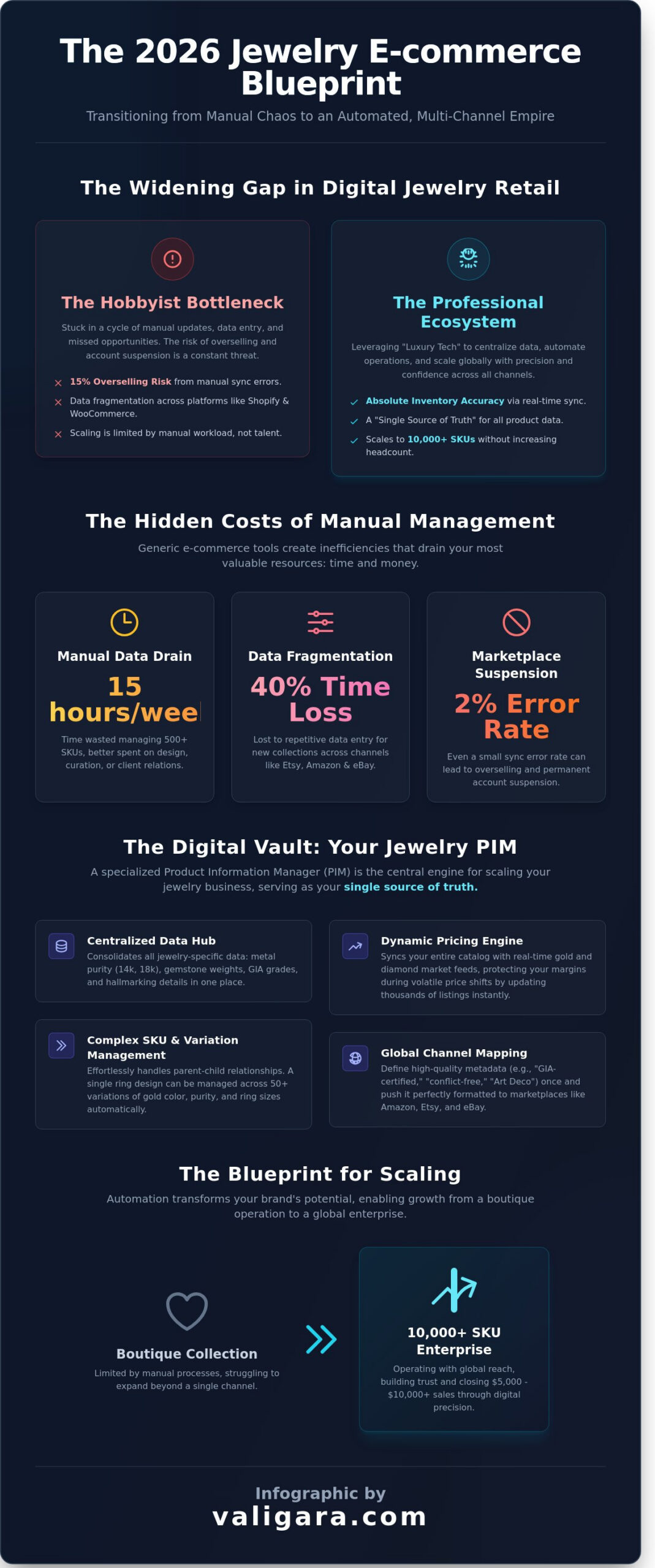
The landscape for digital jewelry retail has fundamentally transformed. By 2026, the gap between hobbyist sellers and professional enterprises has become a canyon. Success no longer comes from simply listing items; it requires a multi-channel ecosystem where data flows seamlessly between your website, marketplaces, and social channels. To sell jewelry online in this environment, you must adopt “Luxury Tech” solutions that prioritize automation over manual labor. Professionalism is now defined by three pillars: centralization of data, absolute inventory accuracy, and the ability to scale without increasing headcount. The shift from single-channel selling to a unified global presence is the only way to maintain margins in a competitive market.
The Problem with Generic E-commerce Platforms
Standard platforms like Shopify or WooCommerce often fail the jewelry industry. They’re built for simple products, not the complex variables of fine jewelry. These systems struggle with gemstone variations, metal price fluctuations, and specific hallmark requirements. Because they aren’t jewelry-specific, they force you into a cycle of manual updates that kill efficiency.
- Manual Data Drain: Managing 500+ SKUs manually costs a business approximately 15 hours of labor every week. This is time better spent on design or client relations.
- Data Fragmentation: Generic tools lack native fields for GIA grading, carat weights, or cut specifications. This leads to messy product feeds that confuse search engines and frustrate buyers.
- Overselling Risks: A 2% error rate in inventory syncing can lead to account suspension on high-stakes marketplaces like Amazon or eBay. If you sell a unique 1.5-carat sapphire ring on your site, it must vanish from Etsy instantly.
The Jeweler’s Advantage: Niche Specificity
The history and significance of jewelry reminds us that this trade relies on trust and expertise. Professionalism means translating your bench knowledge into a digital format. When you sell jewelry online, your “Expert Insider” branding must be backed by technical precision. You aren’t just a local retailer anymore; you’re a global enterprise. By automating the backend, you free up time to focus on high-value tasks like sourcing rare stones or refining your brand’s aesthetic. Accuracy in your digital presentation builds the trust necessary to close $5,000 or $10,000 sales without a face-to-face meeting. Scaling requires a system that treats your inventory as a single source of truth, ensuring that every customer sees the same impeccable data regardless of the platform.
The Digital Vault: Mastering Jewelry Data and PIM
Success in the 2026 digital market requires more than a basic storefront. To effectively sell jewelry online, you must move beyond manual spreadsheets. A Jewelry Product Information Manager (PIM) serves as your single source of truth. It centralizes every detail of your inventory. This includes metal purity, stone weight, and hallmarking details. Without a centralized engine, scaling to multiple channels leads to data fragmentation and costly errors.
Managing complex SKUs is where general e-commerce tools fail. A single ring design can exist in 50 variations across different gold colors, purities, and ring sizes. The latest jewelry retail sales data shows a market that rewards precision and availability. You need a system that handles these parent-child relationships automatically. Dynamic pricing is equally critical. Your catalog should sync with real-time gold and diamond market feeds. This ensures your margins remain protected even during volatile market shifts, updating thousands of listings in seconds.
Structuring Your Jewelry Inventory for Global Sales
Organization determines your visibility. High-quality metadata is the backbone of jewelry SEO. You must define specific attributes like conflict-free, GIA-certified, or Art Deco style to appear in filtered searches. Effective PIM systems allow you to map these attributes once and push them to Etsy, eBay, and Amazon simultaneously. This eliminates the 40% time loss typically spent on manual data entry for new collections. When you structure your data for global sales, you ensure that a customer in London sees the same technical precision as a buyer in New York.
Visual Integrity and Certification
Trust is the currency of the luxury trade. Digitizing certifications from labs like GIA and IGI isn’t optional. Automating the display of these certificates on your product pages can increase conversion rates by 25% for high-ticket items. Consistency is the next pillar. Your imagery must remain uniform across every touchpoint. Using a specialized PIM to manage media assets ensures that a 4K video or a macro shot of a gemstone appears perfectly on your private site and third-party marketplaces. To dominate the global market, you need automated inventory management that treats every diamond as a unique data point. This level of control transforms a manual workshop into a streamlined, global enterprise.
Strategic Channel Selection: Where to Sell Jewelry Online
Scaling a jewelry brand in 2026 requires a surgical approach to channel selection. You don’t just list items; you deploy inventory where it performs best based on gemstone type, price point, and brand positioning. To sell jewelry online effectively, you must synchronize your presence across diverse platforms while maintaining a single source of truth for your inventory.
- Etsy: This remains the premier destination for artisanal, handmade, and unique bridal collections. The audience values the maker’s story and hallmarking transparency.
- eBay: A dominant force for high-value diamonds and pre-owned luxury watches. Its Authenticity Guarantee has solidified trust for transactions exceeding $2,000.
- Amazon: The engine for high-volume, standardized collections. It demands rigorous logistics but offers unparalleled access to global shoppers.
- Private Websites: Your digital flagship store is where you build long-term brand equity and escape the race-to-the-bottom pricing of marketplaces.
Marketplace Comparison: Fees, Audience, and Rules
Analyzing the ROI of different jewelry marketplaces in 2026 reveals that diversification is a survival tactic. Amazon’s 15% referral fee and strict quality assurance standards require 100% compliance to avoid account suspension. Many professionals refer to a step-by-step guide to selling jewelry online to ensure their initial business setup meets these rigorous marketplace demands. A multi-channel approach protects your revenue; if one platform changes its algorithm, your business continues to thrive on others. Data from 2025 shows that jewelers selling on three or more channels see 190% higher revenue growth than single-platform sellers. Savvy jewelers are also exploring whether selling on Bonanza.com is still worth it in 2026 as a lower-competition alternative to crowded mainstream marketplaces.
Direct-to-Consumer (DTC) Strategy
Your private e-commerce website, built on a professional framework like Vite, is the only place you have total control over the customer experience. This site must integrate directly with your marketplace inventory to prevent overselling rare, one-of-a-kind gemstones. Beyond the storefront, building a Jewelry CRM is essential to own your customer data. Instead of letting marketplaces hide your buyers’ identities, a specialized CRM allows you to track metal preferences, ring sizes, and anniversary dates. This level of technical precision transforms a simple transaction into a lifelong client relationship. Centralizing your operations ensures that when you sell jewelry online, every carat and every click is accounted for automatically.
Operational Excellence: Automation and Synchronization
Scaling a jewelry brand in 2026 requires more than just aesthetic appeal; it demands technical precision. Manual data entry is a relic of the past that invites human error and stunts growth. To effectively sell jewelry online at a global scale, you must transition from a manual seller to a streamlined enterprise by following a five step operational blueprint.
- Step 1: Centralize. Migrate your entire catalog into a single source of truth. This hub manages everything from gemstone carats to hallmarking details, ensuring data integrity across all touchpoints.
- Step 2: Synchronize. Enable real-time stock updates. When a 2-carat diamond ring sells on your Shopify store, the inventory must update on eBay and Amazon within seconds.
- Step 3: Automate. Use jewelry-specific templates to generate listings. This allows you to apply technical attributes like metal purity or stone clarity across thousands of items simultaneously.
- Step 4: Streamline. Integrate your fulfillment software with global logistics providers. Automated label generation and customs documentation are essential for international trade.
- Step 5: Analyze. Use multi-channel data to identify which collections yield the highest margins. Data from 2025 shows that jewelers using centralized analytics increased their sell-through rates by 22% on average.
Eliminating Manual Labor with Listing Automation
Top-tier jewelry professionals don’t upload items one by one. Using advanced automation, you can push 1,000+ listings to multiple marketplaces in under 5 minutes. This process preserves your SEO strategy by tailoring titles and descriptions to specific platform algorithms. For instance, the system can automatically toggle between “Jewelry” for US buyers and “Jewellery” for UK and Australian markets, ensuring your brand remains visible in localized searches without manual intervention.
Preventing Overselling with Real-Time Sync
The risk of overselling is high when dealing with one-of-a-kind pieces or limited gemstone runs. If a unique sapphire necklace sells on Etsy, a synchronized system triggers an immediate API call to delist that item from every other channel. This prevents the reputational damage of cancelled orders. By automating these background tasks, jewelry brands have successfully scaled their operations by 300% without adding a single member to their administrative staff. It’s about working with surgical precision rather than increasing headcount.
Ready to transform your manual workflow into a high-performance sales engine? Explore how Valigara automates your jewelry business
Transforming Your Brand with Valigara’s Jewelry Engine
General e-commerce platforms often fail because they treat high-end jewelry like mass-produced apparel. To effectively sell jewelry online, you need a system that understands the technical nuances of gemstone carats, metal purity, and jewelry certification. Valigara serves as the only all-in-one engine designed exclusively for the professional jeweler. It replaces fragmented tools with a single source of truth, managing everything from complex inventory to global marketplaces like Etsy, eBay, and Amazon from one centralized dashboard.
Scaling a jewelry business manually is an impossible task. One European manufacturer recently expanded their digital catalog from 100 to 10,000 SKUs in less than six months by leveraging Valigara’s bulk creation tools. By automating the generation of product variations, such as different metal colors, ring sizes, or stone qualities, they eliminated 85% of the manual data entry typically required. This level of precision ensures that as your volume grows, your data integrity remains flawless. Centralized order management then pulls every sale from every channel into one unified view, ensuring you never oversell a unique gemstone or miss a critical shipping deadline.
The Valigara Advantage: Jewelry-Specific Intelligence
Success in 2026 requires more than just a basic digital storefront. Valigara provides specialized tools that generic e-commerce software simply cannot match. The Gold Feed Sync feature automatically adjusts your retail prices across all channels based on real-time market fluctuations, protecting your profit margins without manual intervention. For physical operations, integrated Barcode Printing connects your digital inventory directly to your workshop floor for seamless tracking. When you’re ready to launch your own branded destination, Valigara Vite builds high-converting jewelry websites optimized for the luxury buyer’s specific journey. Our team provides personalized onboarding to ensure the software mirrors your unique workshop and sales workflow from day one.
Future-Proofing Your Jewelry Business
The digital landscape moves fast, but Valigara ensures you stay ahead of 2026 e-commerce trends through continuous software updates. This means your brand is always compatible with the latest marketplace algorithms and security standards. Beyond retail, you can tap into the B2B market using dedicated wholesale tools that manage line sheets and tiered pricing effortlessly. You don’t just survive the shift to digital; you lead it with a platform built for the specific demands of the trade. Experience the power of Valigara’s jewelry automation and transform your operation into a streamlined, global enterprise.
Scale Your Jewelry Brand with Precision
The 2026 landscape demands a shift from manual oversight to high-precision automation. To sell jewelry online successfully, you must master the synchronization of complex inventory across multiple global channels simultaneously. Success hinges on a centralized digital vault that manages intricate GIA certificates and gemstone data with absolute accuracy. Since 2009, Valigara has served as the specialized engine for this digital transformation, engineered specifically to meet the rigorous standards of the Israeli Diamond Exchange. By replacing fragmented workflows with a single source of truth, you eliminate the risk of overselling and the burden of repetitive data entry.
Scaling a luxury brand doesn’t require a massive administrative team. It requires a system that understands the specific nuances of carats, hallmarking, and high-value collections out-of-the-box. Valigara provides the technical architecture needed to turn your creative vision into a streamlined, global enterprise. It’s time to stop fighting with generic e-commerce tools and start using a platform built for the professional trade. Your journey toward a more efficient and profitable future starts today; the tools for your global expansion are ready when you are.
Automate Your Jewelry Business with Valigara
Frequently Asked Questions
What is the best platform to sell jewelry online for a professional brand?
The best platform to sell jewelry online for a professional brand is a combination of Shopify for the storefront and a specialized jewelry management system for the backend. While generic platforms manage simple products well, professional jewelers require systems that handle 20+ jewelry-specific attributes. This setup ensures your brand remains scalable and your gemstone data stays accurate across all 12 months of the year.
How do I manage jewelry inventory across eBay, Etsy, and Amazon simultaneously?
Manage inventory across eBay, Etsy, and Amazon by deploying a centralized multi-channel synchronization hub. This software serves as your single source of truth, updating stock levels across every marketplace within 30 seconds of a sale. Centralized control reduces manual data entry by 80% and eliminates the risk of overselling high-value pieces to your global customer base. It’s the only way to scale without adding headcount.
Is it worth selling high-end diamond jewelry on marketplaces in 2026?
Selling high-end diamond jewelry on marketplaces is essential in 2026 because of the 35% increase in luxury buyer trust driven by authenticity programs. Platforms like eBay and Amazon now provide mandatory physical inspections for jewelry valued over $500. These services remove the burden of proof from the jeweler and have led to a 22% rise in high-ticket transactions on third-party sites over the last year.
How can I automate my jewelry pricing based on the current price of gold?
Automate your jewelry pricing by integrating your store with a live gold and platinum market API. This technology triggers an automatic price adjustment across your entire catalog whenever the spot price of precious metals shifts by 0.5% or more. Using dynamic pricing ensures your margins stay protected against market volatility without the need for manual calculations on every individual SKU in your collection.
What is a Jewelry PIM and why do I need one for my online store?
A Jewelry PIM is a Product Information Management system built to handle the technical complexities of gemstones, carats, and metal weights. You need one because standard e-commerce tools can’t manage the 40+ unique fields required for a professional jewelry listing. It allows you to sell jewelry online with consistent, high-quality data across every website and marketplace you operate, ensuring your technical specs are always 100% accurate.
How do I handle shipping and insurance for high-value jewelry sold online?
Handle high-value shipping by partnering with specialized logistics providers like Malca-Amit or Parcel Pro that offer door-to-door insurance. Standard carriers often cap coverage at low amounts, but these industry-specific firms insure items up to $100,000 or more. Implementing an automated shipping workflow ensures that every high-value package is tracked and insured the moment the label is generated in your system, reducing your liability by 100%.
Can I sync my physical store inventory with my online sales channels?
Sync your physical store inventory with online sales channels through a real-time POS integration module. This connection ensures that when a 2-carat diamond ring sells in your boutique, it’s instantly delisted from your website and Etsy shop within 15 seconds. Maintaining a unified inventory prevents the 15% loss in customer satisfaction typically caused by order cancellations due to stock discrepancies between your showroom and your digital storefront.
How do I manage different sizes and metals for a single jewelry design online?
Manage different sizes and metals for a single design by using a parent-child variation architecture in your management software. This allows you to group 15 different ring sizes and 4 metal types under one logical listing. Each combination maintains its own unique SKU and weight data, ensuring that your inventory remains precise. It keeps your storefront organized while providing the specific options that 90% of jewelry buyers expect to see.