
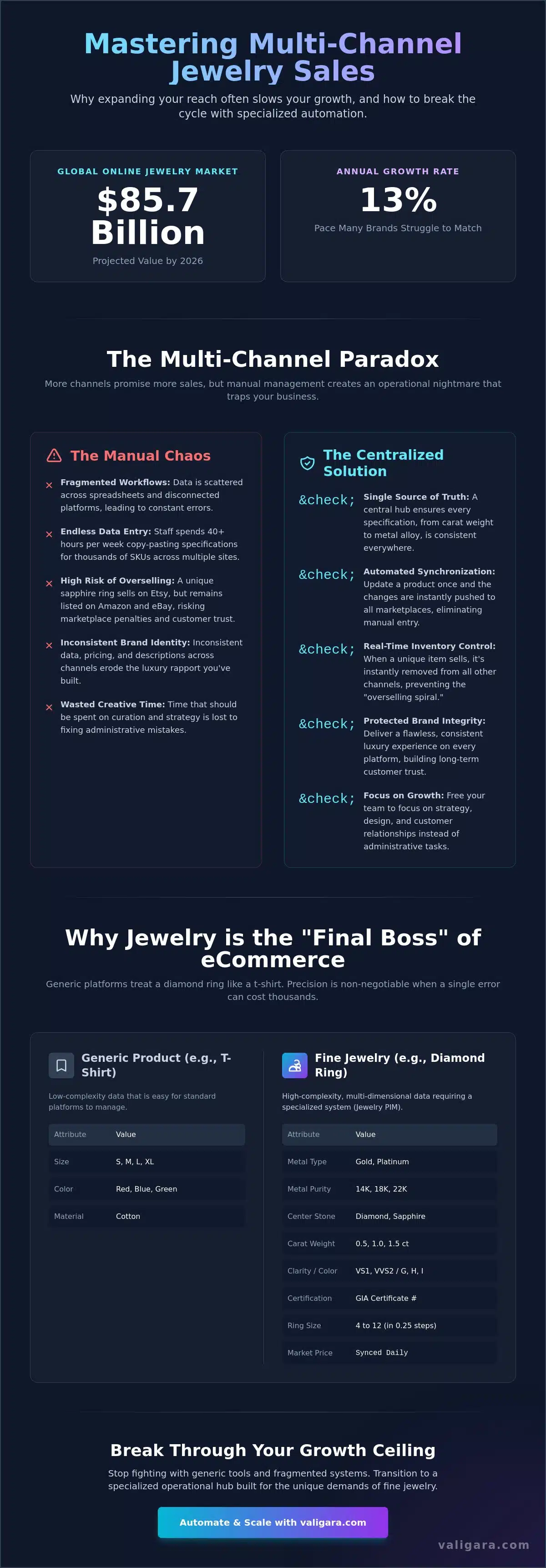
The global online jewelry market is projected to reach 85.7 billion dollars in 2026, yet many brands are struggling to keep pace with this 13% annual growth rate. While the opportunity for expansion is vast, the technical challenges of selling jewelry on multiple sites often turn a dream of global retail into an operational nightmare. You’ve likely felt the strain of manual data entry for thousands of SKUs or the high-stakes pressure of preventing an oversell on a unique sapphire ring listed across Etsy, eBay, and Amazon. It’s a common pain point for retailers who rely on fragmented workflows instead of sophisticated automation.
We understand that your time should be spent on curation and strategy, not fixing inventory errors. This guide provides a clear path to mastering multi-channel retail through centralized control and automated synchronization. You’ll learn how to eliminate manual chaos, protect your brand integrity, and scale your enterprise with the precision of an expert insider. We are breaking down the five critical hurdles and the exact technical solutions needed to solve them once and for all.
Key Takeaways
- Identify the growth ceiling where manual management stalls expansion and learn how to break through with specialized automation.
- Navigate the technical challenges of selling jewelry on multiple sites by mastering complex SKU variations and GIA certificate synchronization across every channel.
- Eliminate the risk of the “Overselling Spiral” and protect your marketplace standing with real-time inventory updates for unique gemstone pieces.
- Maintain a consistent luxury brand identity and centralize fragmented customer communications into a single, efficient operational hub.
- Move beyond general e-commerce platform hacks to implement a specialized system that manages the intricate data of diamonds, metals, and fine jewelry.
The Multi-Channel Paradox: Why Expanding Your Reach Often Slows Your Growth
Multi-channel jewelry selling is the strategic distribution of your inventory across global marketplaces and your own branded digital storefront. While the logic seems sound—more channels equal more sales—many retailers encounter a hidden “growth ceiling.” This plateau occurs when manual workflows collide with the sheer volume of data required for high-end retail. Instead of scaling, the business becomes trapped in a cycle of administrative maintenance that eats into profit margins and creative time.
Transitioning from a boutique craftsman to a global enterprise in 2026 demands a shift in operational philosophy. General-purpose eCommerce tools often fail because they treat a diamond ring like a t-shirt. They lack the specialized architecture to manage metal weights, gemstone carats, and lab certifications simultaneously across different API environments. This is where a true Omnichannel approach becomes essential; it’s about creating a unified experience where every platform reflects the same intelligence and precision without requiring individual manual updates.
The Lure of Greater Visibility vs. The Reality of Operational Friction
Adding a new sales channel promises immediate eyeballs, but it also creates new points of failure. The technical challenges of selling jewelry on multiple sites manifest most clearly during the listing process. For example, managing the 0.20 dollar listing fee and specific attribute requirements on Etsy alongside the complex 15% referral fee structure and compliance standards on Amazon requires constant data oversight. When your staff spends forty hours a week copy-pasting specifications, you aren’t growing; you’re just treading water. You’ve reached the point where “busy” is simply a symptom of systemic inefficiency.
Why Jewelry is the “Final Boss” of Multi-Channel eCommerce
Jewelry is a high-ticket industry where precision is the only currency that matters. Unlike low-cost commodities, a single error in a gemstone description can lead to a legal dispute or a devastating marketplace penalty. There’s a significant trust deficit when a customer sees a 5,000 dollar necklace with inconsistent specifications across eBay and your private site. Maintaining absolute data integrity is the only way to bridge this gap and build long-term luxury rapport. You need an operational hub that acts as the core intelligence of your business, ensuring that your technical specifications are as flawless as the pieces you sell. Without this centralized control, expansion will always be limited by the number of manual hours your team can provide.
The Complexity Crisis: Managing Gemstones, Metals, and Variations Across Platforms
Jewelry retail involves a multi-dimensional data structure that standard eCommerce platforms simply aren’t built to handle. A single ring design isn’t just one product; it’s a complex matrix of metal purities, gemstone grades, and finger sizes. One of the primary technical challenges of selling jewelry on multiple sites is maintaining this matrix without data degradation. When your product information lives in disconnected spreadsheets, you’re constantly fighting “stale data.” Gold prices fluctuate daily, and if your listings don’t reflect these market shifts in real time, you’re either sacrificing your profit margins or losing competitive ground.
To scale, you need a “Single Source of Truth.” This centralized hub ensures that every technical specification, from the total carat weight to the specific metal alloy, remains consistent across every touchpoint. Without it, the administrative burden of updating hundreds of listings manually becomes a barrier to entry for new marketplaces. You don’t just need a place to store data; you need a system that understands the relationship between a mounting and its center stone.
Variation Management: From Ring Sizes to Metal Purity
Mapping variations across eBay, Etsy, and Shopify is an intricate task because each platform uses different logic for attribute grouping. If these variations aren’t synced correctly, you’ll likely create “ghost SKUs”—orphaned listings that confuse search engines and frustrate customers who can’t find the size they need. A Jewelry PIM is the specialized brain of your operation, centralizing every attribute from karat weight to gemstone clarity into a single, distributable record. This level of precision helps you manage the marketplace selling complexities that often overwhelm brands using generic tools.
Handling High-Value Data: Certifications and Diamond Feeds
For high-ticket items, technical specifications are non-negotiable for building buyer trust. Amazon Fine Jewelry, for instance, has notoriously strict requirements for metal stamps and stone descriptions. You need to automate the distribution of high-resolution certificates, such as GIA or IGI reports, and integrate real-time diamond feeds like RapNet directly into your workflow. Manually uploading certificates for hundreds of unique stones is a recipe for human error. Implementing a specialized jewelry PIM allows you to manage these high-value assets as part of the core product record, pushing updates and professional photography to all channels instantly. This ensures your technical data is as flawless as the jewelry itself, regardless of where the customer is shopping.
The Inventory Synchronization Trap: Preventing Overselling and Marketplace Penalties
The “Overselling Spiral” is a silent killer of growing jewelry brands. It starts when a unique, high-value piece, like a one-of-a-kind sapphire pendant, sells on Etsy while it’s simultaneously being processed on eBay. Because your systems aren’t communicating, you’re forced to cancel an order. This isn’t just a lost sale; it’s a technical failure that triggers a cascade of negative consequences. One of the most severe challenges of selling jewelry on multiple sites is managing this inventory latency before it compromises your business standing.
Marketplaces like Amazon and eBay prioritize customer reliability above all else. When you cancel an order due to stock errors, your “Seller Defect Rate” spikes. Amazon, for instance, maintains strict thresholds for Pre-fulfillment Cancel Rate; exceeding these can lead to immediate buy-box suppression or total account suspension. Additionally, frequent “Out of Stock” (OOS) statuses signal to search algorithms that your listings are unreliable, causing your organic search rankings to plummet. To protect your visibility, you must implement automated stock buffering, which acts as a safety net by hiding the last remaining unit from secondary channels to ensure you never over-commit.
The 15-Minute Sync Window: Why “Near Real-Time” Isn’t Enough
Many general eCommerce tools rely on “near real-time” synchronization, which often translates to a 15-minute polling interval. In the high-stakes world of fine jewelry, fifteen minutes is an eternity. During peak seasons or flash sales, technical latency leads to double-selling that manual updates simply can’t catch. Professional-grade Jewelry Inventory Management utilizes instant API triggers to update stock levels across 10+ channels the second a transaction occurs. Our system uses specialized “Last Piece” logic; once a unique item is sold, it’s instantly delisted globally, preventing the operational chaos of a dual-order scenario.
Marketplace Health and the Cost of Human Error
Quantifying the risk is simple: one bad week of inventory sync failures can get you banned from a marketplace that took years to build. Maintaining “Top Rated Seller” status requires absolute precision in your Orders & Fulfillment Management. Centralizing your operations ensures that every channel reflects the same reality, reducing the human error inherent in fragmented workflows. For price-sensitive inventory, a Gold Feed Sync is equally vital; it ensures your margins are protected even as market prices shift, allowing your hub to remain the specialized brain of your global enterprise.
Maintaining Brand Integrity and Customer Trust in a Fragmented Ecosystem
Scaling a jewelry brand across several marketplaces often triggers a sudden “Identity Crisis.” High-value clients expect a consistent luxury experience. Maintaining that standard on a discount-heavy marketplace like eBay while simultaneously running a high-end branded site is difficult. One of the psychological challenges of selling jewelry on multiple sites is ensuring your brand voice doesn’t become diluted or contradictory. Building customer trust without a physical storefront is already a critical hurdle; if a buyer finds your 10,000 dollar diamond ring with a detailed GIA report on your site but sees a thin, poorly formatted description of the same piece on Etsy, you’ve lost their trust before they even reach the checkout.
True professionalization requires centralizing every touchpoint. Managing fragmented communications—balancing eBay messages, Etsy convos, and direct emails—leads to delayed responses and missed opportunities. Beyond communication, global sellers must also tackle localized pricing and currency conversion. A centralized hub ensures your margins remain intact while presenting a professional, local face to international buyers. You can centralize your customer relationships to transform these disjointed interactions into a cohesive, high-touch brand experience that builds long-term loyalty.
Consistent Storytelling Across eBay, Etsy, and Your Branded Site
Your technical data must tell a story. By utilizing a Jewelry PIM, you can push rich, high-luxury descriptions to every channel instantly. This isn’t just about text; it’s about the professional distribution of assets. For B2B or high-end retail opportunities, the ability to generate professional PDF catalogs directly from your inventory ensures your brand looks sophisticated in every format. Adapting your brand voice to fit different demographics is essential, but your core technical specifications must remain the absolute “Single Source of Truth” across the entire ecosystem.
The CRM Challenge: Knowing Your Customer Across Channels
Effective retail is built on data, not guesses. Identifying a “repeat buyer” who purchased on Amazon last year and is now browsing your Etsy shop is nearly impossible without a unified Jewelry CRM. This system tracks cross-channel behavior, allowing you to personalize marketing automation based on specific preferences. If you know a customer is a “Sapphire lover,” your system should automatically prioritize those pieces in their feed. Leveraging advanced Insights and Analytics reveals which channels provide the highest Lifetime Value (LTV), letting you invest your resources where they actually generate the most growth.
Transitioning to an Automated Operational Hub: The Path to Scalable Jewelry eCommerce
Scaling is a choice. You can hire more staff or implement better systems. General-purpose eCommerce platforms like Shopify or Magento are designed for simple commodities; they lack the native architecture to handle the challenges of selling jewelry on multiple sites without extensive, fragile workarounds. When you rely on “hacks” to manage diamond certifications or metal weight fluctuations, you create a brittle foundation. Transitioning to a specialized hub allows you to move from constant manual oversight to “Management by Exception,” where your team only intervenes when the system flags a specific outlier.
Valigara acts as the core intelligence of your business, designed specifically for the unique data structures of the jewelry trade. By centralizing your operations, you eliminate the friction that prevents international expansion. You aren’t just buying software; you’re partnering with an expert insider that understands why a 14k gold ring requires different logic than a sterling silver one. This specialized focus ensures your technical precision remains intact as you scale from one channel to dozens. It empowers you to transition from a manual workflow to a streamlined, global enterprise with ease.
Why Niche Software Beats General Purpose Every Time
- Industry-Specific Synchronization: Native GIA/IGI certificate mapping and real-time Gold Feed Sync protect your margins and buyer trust automatically.
- Complex Variation Logic: Manage metal purities and gemstone grades as core data points rather than simple text attributes across your Jewelry PIM.
- Operational ROI: Automating the listing process for 100 items can save dozens of manual labor hours, allowing your staff to focus on high-value curation.
The result is absolute accuracy across your global footprint. You no longer need to worry about stale data or mismatched specifications. Your inventory remains 100% accurate every second of the day. This reliability is the foundation of customer trust in high-ticket retail.
Implementation Strategy: Moving to Valigara in 2026
A successful transition requires more than just a login. Our team provides personal onboarding and expert-led data migration to ensure your complex inventory moves seamlessly into your new operational hub. We offer robust API access to integrate with your existing ERP or accounting software, creating a unified ecosystem that mirrors your actual business workflow. It’s time to stop fighting your tools and start using a system built for your craft. Scale your jewelry brand with Valigara’s multi-channel automation and reclaim the time you need to lead your global enterprise.
Secure Your Operational Future in a Global Marketplace
Scaling a luxury retail brand requires more than just visibility; it demands absolute technical precision. We’ve explored how a specialized “Single Source of Truth” eliminates the manual chaos of SKU management and protects your reputation from the high-stakes risks of inventory latency. By centralizing your data and automating the distribution of diamond certifications, you transition from a reactive business to a proactive, global enterprise. As you navigate the challenges of selling jewelry on multiple sites, the distinction between a generic retailer and a market leader lies in the intelligence of your operational hub.
Valigara was founded in 2009 by industry insiders who recognized that fine jewelry requires a unique digital architecture. Today, we’re trusted by global manufacturers and high-end retailers to manage their most complex gemstone and metal data through our specialized jewelry PIM. It’s time to stop fighting fragmented workflows and start scaling with quiet confidence. Book a personal demo to see how Valigara automates your jewelry business and discover how our technology empowers your brand to reach its full potential.
Frequently Asked Questions
What are the biggest risks of selling jewelry on multiple sites manually?
Manual management leads to the “Overselling Spiral” where unique pieces are sold twice, resulting in immediate account suspensions. It’s a primary hurdle among the technical challenges of selling jewelry on multiple sites. You also risk technical data errors in gemstone carats or metal purity, which quickly erodes luxury brand trust and leads to costly returns.
Can I sync my Etsy and eBay jewelry inventory automatically?
Yes, you can synchronize inventory across Etsy and eBay using specialized multi-channel listing automation. This ensures that when a unique ring sells on one platform, it’s instantly delisted from the other. This prevents marketplace penalties and maintains your status as a reliable seller without the need for constant manual intervention.
How do I handle gold price fluctuations across multiple sales channels?
The most efficient method is to automate your pricing through a Gold Feed Sync that updates your entire inventory based on live market spot prices. This ensures your margins are protected across every channel simultaneously. You won’t have to manually recalculate prices for hundreds of listings every time the market shifts, keeping your business both competitive and profitable.
Is it better to use a general eCommerce tool or a specialized jewelry platform?
Specialized platforms are designed for jewelry-specific data like metal weights and stone clarity, which general tools often ignore. A Jewelry PIM acts as the specialized brain for your operation, handling complex SKU variations and GIA certificates. General eCommerce platforms often require brittle “hacks” to manage these intricate details, creating a foundation that’s prone to failure.
How does multi-channel selling affect my Amazon seller rating?
Multi-channel selling can negatively impact your Amazon rating if your inventory isn’t synced, leading to order cancellations. Amazon’s algorithm heavily penalizes high “Pre-fulfillment Cancel Rates,” which can lead to buy-box suppression. Using automated stock buffering ensures you never over-commit on your inventory, keeping your seller health metrics in the green across the entire ecosystem.
What is the best way to manage GIA certificates for hundreds of listings?
The most professional approach is using a Jewelry PIM that stores high-resolution certificates as part of the core product record. This allows you to automate the distribution of GIA or IGI reports to every marketplace listing instantly. It eliminates the high risk of human error associated with manually matching certificates to unique stones in a fragmented digital environment.
How do I maintain consistent pricing for jewelry in different currencies?
Centralized operational hubs allow you to set base prices that automatically convert into localized currencies for global marketplaces. This ensures your brand maintains a consistent pricing strategy worldwide while accounting for specific marketplace fees. It protects your profit margins and provides a professional, local experience for international buyers without requiring individual manual updates.
Can I manage my wholesale (B2B) and retail sales in one system?
You can manage both wholesale and retail operations within a single system using integrated B2B sales tools. This allows you to track different price lists and diverse customer behaviors through a unified Jewelry CRM. It provides a holistic view of your global enterprise from one operational hub, ensuring that your inventory remains accurate across every sales channel.