
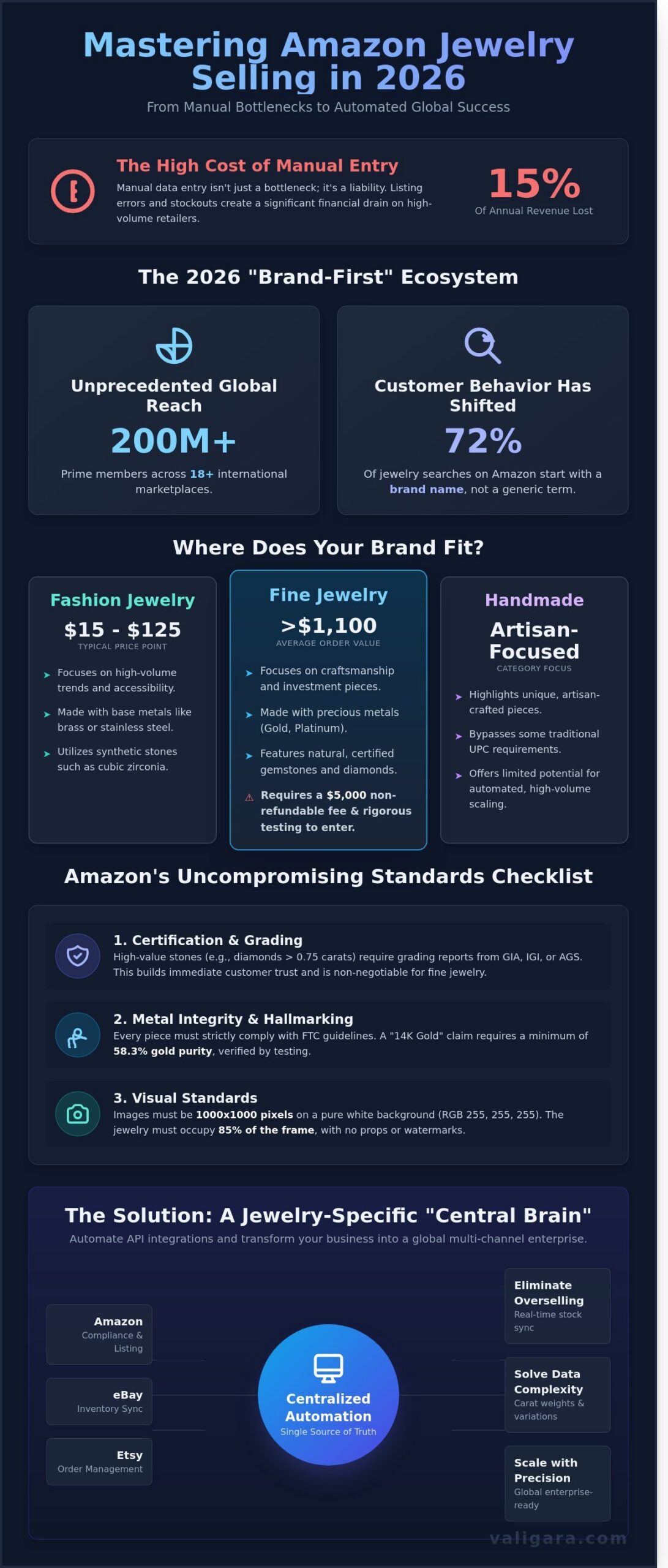
In 2026, manual data entry isn’t just a bottleneck; it’s a liability that costs the average high-volume retailer 15% of their annual revenue through listing errors and stockouts. You’ve likely felt the pressure of maintaining Amazon’s uncompromising Fine Jewelry standards while juggling thousands of unique gemstone and metal SKUs. It’s a relentless cycle where one mismatched carat weight or a late inventory update on a multi-channel order can jeopardize your entire account health.
We’re here to change that trajectory. You’ll learn how to master amazon jewelry selling by implementing a centralized automation strategy that turns your complex inventory into a streamlined global enterprise. We’ll examine the exact workflows needed to synchronize your stock across Amazon, eBay, and Etsy while ensuring every listing remains 100% compliant with the industry’s strictest marketplace protocols. This is your roadmap to scaling with precision and reclaiming your time for the craft that matters most.
Key Takeaways
- Navigate the 2026 landscape by distinguishing between Fashion, Fine, and Handmade categories to position your brand for maximum visibility.
- Secure your professional status by mastering the certification and hallmarking requirements essential for high-value gemstone and metal listings.
- Solve the technical data complexity of ring variations and carat weights that frequently cause generic eCommerce tools to fail.
- Scale your amazon jewelry selling operations using automated synchronization to eliminate the risks of overselling and manual data entry.
- Implement a jewelry-specific “central brain” to automate your API integrations and transform your business into a global multi-channel enterprise.
Understanding the Amazon Jewelry Marketplace Opportunity in 2026
The 2026 Amazon jewelry landscape has shifted into a “Brand-First” ecosystem. It’s no longer enough to list generic items and hope for visibility. Success in amazon jewelry selling now requires a strategic pivot toward established identity and verified quality. While the history of jewelry spans millennia, the digital transition has accelerated. By early 2026, data indicates that over 72% of jewelry searches on Amazon start with a brand name rather than a generic term like “gold ring.” This shift rewards manufacturers who treat the platform as a global flagship store rather than a secondary clearance channel.
Amazon Global Selling offers a massive reach for jewelry manufacturers, providing direct access to over 200 million Prime members across 18 international marketplaces. This reach is a high-reward opportunity, but it comes with a high barrier to entry. Amazon’s Fine Jewelry category remains one of the most gated segments on the platform. To enter, sellers often face a $5,000 non-refundable application fee and rigorous laboratory testing of their inventory. This friction is intentional; it filters out low-quality players and ensures that professional enterprises can scale without competing against a flood of substandard products.
Fashion vs. Fine Jewelry: Where Does Your Brand Fit?
Amazon categorizes jewelry with surgical precision, and misclassification can lead to immediate account suspension. Fashion jewelry includes items made of base metals like brass or stainless steel and synthetic stones like cubic zirconia. Fine jewelry is reserved for precious metals such as 14k, 18k, or 24k gold, platinum, and natural gemstones. The requirements for Fine Jewelry are absolute. You must provide hallmarking proof for every piece and comply with strict FTC guidelines regarding gemstone treatments.
- Fashion Jewelry: Focuses on high-volume trends and price points typically between $15 and $125.
- Fine Jewelry: Focuses on craftsmanship and investment pieces, with average order values often exceeding $1,100 in the 2026 market.
- Handmade: A separate artisan-focused category that bypasses some traditional UPC requirements but limits automated scaling.
The Role of Amazon Brand Registry for Jewelers
Brand Registry acts as the single source of truth for your jewelry IP. It’s the central engine that powers advanced marketing tools and protects your creative assets. By enrolling, you gain access to A+ Content, which is vital for showcasing the specific carats, clarity, and craftsmanship of your collections. High-resolution imagery and video modules replace the physical “touch and feel” of a luxury boutique, allowing you to explain complex gemstone certifications directly on the product page. Brand Registry is a jeweler’s primary defense against counterfeiters.
For a professional jewelry brand, amazon jewelry selling is about more than just a transaction. It’s about data-driven growth. Brand Registry provides a suite of analytics that reveals exactly how customers interact with your rings, necklaces, and earrings. You can track which gemstone colors are trending in specific regions or identify which metal types are losing favor. This level of technical precision allows you to sync your production schedules with actual market demand, eliminating the guesswork that often plagues traditional retail models.
Navigating Amazon’s Jewelry Category Requirements and Standards
Success in amazon jewelry selling requires more than just high-quality craftsmanship; it demands a rigorous commitment to technical precision and regulatory compliance. Amazon treats the jewelry category with a level of scrutiny that exceeds almost any other department. You aren’t just selling an accessory; you’re selling a high-value asset that must meet exact specifications. Failure to adhere to these standards leads to immediate listing suppression or permanent account suspension.
- Step 1: Certification. High-value stones, particularly diamonds over 0.75 carats, must be accompanied by grading reports from recognized laboratories like GIA, IGI, or AGS. Uploading these as secondary images builds immediate trust.
- Step 2: Metal Integrity. Every item must comply with the FTC jewelry guidelines regarding metal fineness and hallmarking. If you claim 14K gold, the item must test to at least 58.3% purity without exception.
- Step 3: Visual Standards. Amazon mandates 1000×1000 pixel images on a pure white (RGB 255, 255, 255) background. The jewelry must occupy 85% of the frame. No props, no watermarks, and no packaging can appear in the main image.
- Step 4: The Gating Process. To enter the Fine Jewelry category, you must provide three invoices from the last 90 days reflecting a combined purchase of at least 30 units. This proves you have a legitimate, scalable supply chain.
- Step 5: Data Centralization. Implement a specialized Jewelry PIM to manage your technical specifications. Manual data entry for 500 rings with 10 size variations each creates a 15% margin for error, which Amazon’s algorithms won’t tolerate.
The Jewelry Quality Assurance (JQA) Program
Amazon’s JQA program is a “blind buy” audit where the marketplace purchases your inventory anonymously and sends it to an independent lab for destructive testing. If your 18K gold band tests at 17.8K, you’ve failed. The most common reasons for failure include under-caratage and failing to disclose “treated” or “lab-grown” status. To maintain a 100% pass rate, you need an internal auditing process that mirrors Amazon’s standards. This means batch-testing metals and verifying gemstone weights to within 0.01 carats before they ever reach a fulfillment center.
Listing Accuracy: Titles, Bullets, and Keywords
The anatomy of a high-converting jewelry title is a formula, not an art form. It should follow a precise sequence: Brand + Metal Purity + Metal Type + Gemstone + Shape + Product Category. For example, “Valigara 14K Yellow Gold 2ct Oval Blue Sapphire Engagement Ring” is optimized for both the buyer and the search engine. Using jewelry-specific inventory software allows you to automate this formatting across thousands of SKUs instantly.
In the backend, your keywords must be surgical. Don’t waste space on generic terms like “gift for her.” Instead, focus on technical attributes such as “rhodium plated,” “friction back,” or “milgrain edge.” These specific descriptors capture high-intent shoppers who know exactly what they want. When your data is 100% accurate, your conversion rates increase because you’re matching the right piece with the right search query. Precision isn’t just a requirement; it’s your primary competitive advantage in the global marketplace.
Managing Complex Jewelry Data: The Key to Amazon Conversion
Manual data entry is the silent killer of jewelry brands. Industry data shows that spreadsheet-based inventory management leads to a 12% error rate in listing attributes. On Amazon, these small mistakes result in suppressed listings or, worse, customer returns due to “item not as described.” You need a system that understands that 14k white gold and 18k yellow gold aren’t just colors; they’re distinct technical specifications with different weights and price points.
The volatility of raw material costs adds another layer of risk. The market price of gold can fluctuate by 2% or more within a single trading day. If your Amazon prices are static, you’re likely sacrificing your margins during market spikes. Specialized software automates price recalculations based on live London Bullion Market Association (LBMA) feeds. This ensures your 14k gold bands remain profitable without you touching a single cell in a spreadsheet. Integrating these data points is essential for modern e-commerce fulfillment strategies, where technical accuracy defines the winner of the Buy Box.
Automating SKU Variations for Rings and Necklaces
Integrating Gemstone Certificates and Jewelry PIM
Trust is the primary currency of high-ticket amazon jewelry selling. Linking GIA, IGI, or HRD certificates directly to your listings provides the transparency high-net-worth buyers demand. Valigara serves as a specialized Jewelry PIM, acting as the single source of truth for your entire operation.
- Centralize all high-resolution imagery and 360-degree videos in one vault.
- Sync gemstone grading reports to specific serial numbers or SKUs.
- Update product descriptions across five different Amazon marketplaces simultaneously.
- Reduce time-to-market for new collections by 75% compared to manual uploads.
When you update a stone’s availability or a metal’s weight in your central dashboard, every listing across Amazon reflects that change in under 120 seconds. This level of control transforms you from a manual seller into a streamlined, global enterprise. You stop fighting with spreadsheets and start focusing on design and growth.
Scaling Operations: Fulfillment Strategies and Multi-Channel Sync
Scaling an amazon jewelry selling operation requires a fundamental shift from manual oversight to automated precision. As your catalog grows from 50 to 5,000 SKUs, the margin for error disappears. You need a logistical framework that handles high-value logistics while maintaining the “single source of truth” for your inventory across every touchpoint.
Fulfillment choices define your brand’s reach and security. While Fulfillment by Merchant (FBM) allows you to maintain physical control over high-carat diamonds and bespoke engagement rings, it lacks the conversion power of the Prime badge. Data from 2023 indicates that jewelry listings moving from FBM to FBA often see a 35% increase in sales velocity due to consumer trust in Amazon’s shipping speed. However, you must weigh this against the risks. Amazon’s standard reimbursement for lost or damaged items typically caps at $2,000. For a $12,000 tennis necklace, FBM using specialized couriers like Malca-Amit remains the superior choice for risk management.
Managing customer expectations in the Amazon ecosystem is equally critical. Approximately 15% of jewelry returns are triggered by sizing issues or “not as described” gemstone colors. To protect your account health, you must implement a rigorous return-inspection protocol. Every returned piece requires a professional cleaning and a 10-point authenticity check before it returns to stock. This ensures you never ship a “second-hand” item to a new buyer, which is a fast track to permanent account suspension.
Fulfillment by Amazon (FBA) for Jewelry
Prime eligibility is the primary driver for amazon jewelry selling success. It unlocks access to Amazon’s most loyal spenders. For items under the $1,000 threshold, FBA is highly efficient. You gain the advantage of 24/7 customer service and simplified logistics. You must use tamper-evident seals and double-box shipments to satisfy Amazon’s strict jewelry packaging requirements. Security is paramount. Ensure your commercial insurance policy explicitly covers goods in transit to and while stored at third-party warehouses.
The Multi-Channel Engine: Syncing Amazon with Global Marketplaces
Inventory fragmentation is the silent killer of jewelry brands. If you sell a unique 2.5-carat sapphire ring on Etsy at 2:00 AM, your Amazon listing must reflect that zero-stock status instantly. Amazon enforces a strict Pre-fulfillment Cancel Rate of less than 2.5%. Exceeding this threshold leads to immediate deactivation. You cannot rely on manual updates in a 24-hour global market.
Your Amazon presence should serve as one limb of a larger body that includes eBay, Etsy, and your own Vite-powered website. Centralizing these channels through a dedicated management engine allows you to push product data, gemstone certificates, and high-resolution renders to all platforms simultaneously. To master this complexity, refer to The Ultimate Guide to Multi-Channel Jewelry Selling. This level of integration transforms your business from a series of disconnected storefronts into a streamlined, global enterprise.
Automated order management doesn’t just sync stock; it centralizes your fulfillment workflow. By pulling orders from every marketplace into one dashboard, you eliminate the need to log into five different portals. This efficiency allows you to focus on sourcing and design rather than data entry. It’s the difference between a struggling hobbyist and a dominant jewelry brand.
Ready to automate your jewelry business and eliminate manual errors? Explore the Valigara multi-channel engine today.
Dominating Amazon with Valigara’s Jewelry-Specific Automation
Scaling a high-end jewelry brand on Amazon demands more than just a seller account; it requires a specialized engine. Valigara serves as the central brain for your entire operation, replacing fragmented spreadsheets with a unified command center. Most retailers struggle because they treat jewelry like any other commodity. Mastering amazon jewelry selling requires a shift from manual updates to algorithmic precision. By centralizing your inventory, Valigara allows you to manage thousands of SKUs across multiple marketplaces without ever duplicating your efforts.
The core of this power lies in the Listing Automation feature, which is built directly onto Amazon’s latest API. This isn’t a generic uploader. It’s a sophisticated translator that understands the nuances of jewelry data. Whether you’re dealing with metal purity, gemstone carats, or specific hallmarking requirements, the system maps your internal data to Amazon’s strict category requirements automatically. This eliminates the “invalid attribute” errors that frequently plague jewelry sellers. It’s the difference between spending forty hours on a new collection launch and finishing the task in under ten minutes.
Pricing volatility is another silent profit killer that Valigara neutralizes. The Gold Feed Sync provides automated, real-time pricing updates based on current market fluctuations for precious metals. If the price of 18k gold spikes at 10:00 AM, your Amazon listings can reflect that change by 10:05 AM. This protects your margins on high-ticket items like engagement rings and heavy gold chains. You no longer have to choose between losing money on a sale or spending your entire day manually adjusting price tags. It’s professional-grade protection for your bottom line.
Why General Purpose Software Isn’t Enough
Generic platforms like Shopify or basic Amazon tools treat a diamond necklace the same way they treat a cotton t-shirt. They don’t account for the complexity of “Jewelry Insider” variables like stone clarity, certificate numbers, or metal weight variations. Valigara was developed by industry veterans who understand these pain points intimately. Because the software is jewelry-specific, it streamlines the workflow so effectively that users report a reduction in operational costs by up to 80%. You’re not just buying a tool; you’re adopting a workflow that scales your expertise without increasing your headcount.
Getting Started: Your Path to Amazon Mastery
The transition from a manual seller to a global enterprise begins with a structured onboarding process. Valigara’s team handles the heavy lifting of data migration, ensuring your existing catalog is cleaned and optimized for the Amazon environment. We provide personalized training sessions for jewelry manufacturers and retailers, focusing on the specific features that drive your revenue. You’ll move from setup to your first automated sale with total confidence in your data integrity. Schedule a demo to see Valigara’s Amazon integration in action and discover how to simplify the complexities of amazon jewelry selling today. It’s time to stop managing software and start growing your jewelry empire.
Future-Proof Your Jewelry Brand for 2026
Success in the next era of commerce requires more than just high-quality craftsmanship; it demands technical precision and operational agility. You’ve seen how mastering complex data points like gemstone clarity and metal hallmarking is the only way to drive conversions. By 2026, the barrier to entry will be even higher as Amazon tightens its category standards. Professional jewelers who rely on manual updates will struggle to stay visible. Transitioning your amazon jewelry selling strategy to an automated, jewelry-specific model is the only path to scale across global marketplaces without losing control.
Valigara provides the specialized engine your business needs to thrive. Trusted by 1000+ jewelry brands, our platform offers a dedicated Jewelry PIM and inventory management system designed for the unique nuances of rings, diamonds, and luxury collections. We provide real-time sync for eBay, Etsy, and Amazon, turning hours of manual labor into seconds of automated precision. You can finally move from managing spreadsheets to leading a global enterprise with quiet confidence.
Automate your Amazon jewelry business with Valigara
The tools for your expansion are ready. It’s time to build your legacy with the precision your jewelry deserves.
Frequently Asked Questions
Is it hard to get approved to sell jewelry on Amazon?
Approval is rigorous and requires a Professional Seller account at $39.99 monthly along with proof of established business history. Amazon jewelry selling demands strict adherence to Jewelry Quality Assurance standards to maintain an active status. You must provide invoices from the last 90 days showing purchases of at least 10 units to prove your supply chain’s legitimacy and consistency.
What is the difference between Amazon Fashion and Amazon Fine Jewelry?
The distinction lies in the specific materials used for the shank, setting, and stones. Amazon Fashion covers base metals and synthetic stones, while Fine Jewelry includes 10k gold or higher, sterling silver, and genuine gemstones like sapphires. Fine Jewelry sellers often face a $5,000 application fee and must pass a 10-piece sample test to verify hallmarking accuracy and metal purity.
Can I sell handmade jewelry on Amazon?
You can sell handcrafted pieces through the Amazon Handmade category after completing a dedicated application process. This sub-market waives the $39.99 monthly fee but applies a flat 15% referral fee on every sale. Your production process must involve manual labor or hand-finishing; 100% mass-produced items are strictly prohibited in this specialized section to protect the artisan marketplace.
How does Amazon’s Jewelry Quality Assurance (JQA) program work?
Amazon’s JQA program involves random secret shopper audits where the platform purchases your products to verify material claims. These items are sent to independent labs to check if the gold purity or gemstone carats match your listing descriptions exactly. A single failure can result in an immediate 30-day suspension or the permanent removal of your jewelry selling privileges.
Do I need a GIA certificate to sell diamonds on Amazon?
You must provide a GIA, IGI, or AGS grading report for any loose diamond sold on the platform. For set jewelry containing diamonds over 0.75 carats, these certificates are mandatory to prove clarity and color grades. This ensures your high-ticket listings meet the 100% accuracy threshold required for luxury e-commerce transactions and builds consumer trust in your brand.
How much does it cost to sell jewelry on Amazon in 2026?
In 2026, selling jewelry requires a $39.99 monthly subscription plus tiered referral fees based on the total sales price. Amazon charges 20% on the portion of the sales price up to $250 and 5% for any amount exceeding that threshold. If you use Fulfillment by Amazon, expect additional storage fees ranging from $0.75 to $2.40 per cubic foot depending on the season.
How can I prevent overselling when selling on Amazon and eBay simultaneously?
Preventing overselling requires a centralized inventory engine that provides real-time multi-channel synchronization. By using API integrations to link your Amazon and eBay accounts, your stock levels update within 60 seconds of a sale on either platform. This automation eliminates the risk of selling a one-of-a-kind diamond ring twice, protecting your seller performance metrics and customer satisfaction levels.
What are the image requirements for Amazon jewelry listings?
Amazon jewelry listings must feature a main image with a pure white background using RGB values of 255, 255, 255. The jewelry piece must occupy at least 85% of the 1000 x 1000 pixel frame to enable the zoom function for shoppers. You can’t include watermarks, props, or additional text; these violations lead to suppressed listings and a total loss of search visibility.