
Scaling a luxury jewelry brand beyond $500,000 in annual revenue while manually uploading GIA certificates to three different marketplaces isn’t a strategy; it’s a bottleneck that kills growth. You know that managing a vault of one-of-a-kind stones is a logistical nightmare. Every carat, cut, and clarity grade requires absolute precision. Yet, the 24/7 risk of overselling a unique stone on Amazon while it’s being purchased on Etsy remains a constant threat for 68% of independent retailers. Mastering modern diamond and gemstone management requires moving past the spreadsheet era into a realm of high-tech synchronization.
It’s time to stop acting like a data entry clerk and start operating like a global enterprise. This guide provides the blueprint to automate your entire high-value inventory workflow, ensuring every SKU is synced in real-time across your global sales channels. You’ll learn how to establish a single source of truth for your gemstone data, automate listing creation for unique items, and digitally integrate IGI certificates. We’re moving from manual chaos to a centralized engine designed specifically for the serious business of jewelry. By the end of this article, you’ll have the professional roadmap to dominate the digital marketplace with precision and ease.
Key Takeaways
- Master the transition from manual tracking to professional diamond and gemstone management by treating your inventory as a high-tech intersection of gemology and digital logistics.
- Implement a jewelry-specific PIM system to centralize complex attributes and establish a single source of truth for your entire gemstone collection.
- Eliminate the risk of overselling one-of-a-kind items with real-time stock synchronization across global marketplaces and specialized jewelry platforms.
- Standardize your digital workflow and nomenclature to enhance searchability and prepare your gemstone business for rapid international scaling.
The Complexity of Diamond and Gemstone Management in 2026
Managing high-value assets has evolved far beyond the confines of a physical safe. By 2026, professional diamond and gemstone management is defined as the precise intersection of gemology and digital logistics. It’s a high-stakes environment where a single data entry error can result in a $50,000 loss or a missed global sale. Traditional inventory systems fail because they treat gemstones as mass-produced commodities. They lack the architectural depth to handle the nuanced, non-fungible nature of a natural stone. You can’t manage a unique 2-carat VVS1 round brilliant the same way you manage a batch of gold chains.
The industry has moved toward a model where the stone’s physical presence is secondary to its digital twin. Every stone possesses specific diamond characteristics that dictate its market position and price. These attributes, including the 4Cs and detailed GIA or IGI data, serve as the foundation for modern e-commerce SEO. When you sync this data across multiple marketplaces, you aren’t just listing a product; you’re deploying a highly optimized search asset. Data accuracy is the primary driver of visibility in a crowded global market. If your metadata doesn’t match the search intent of a high-net-worth buyer, your inventory stays in the vault.
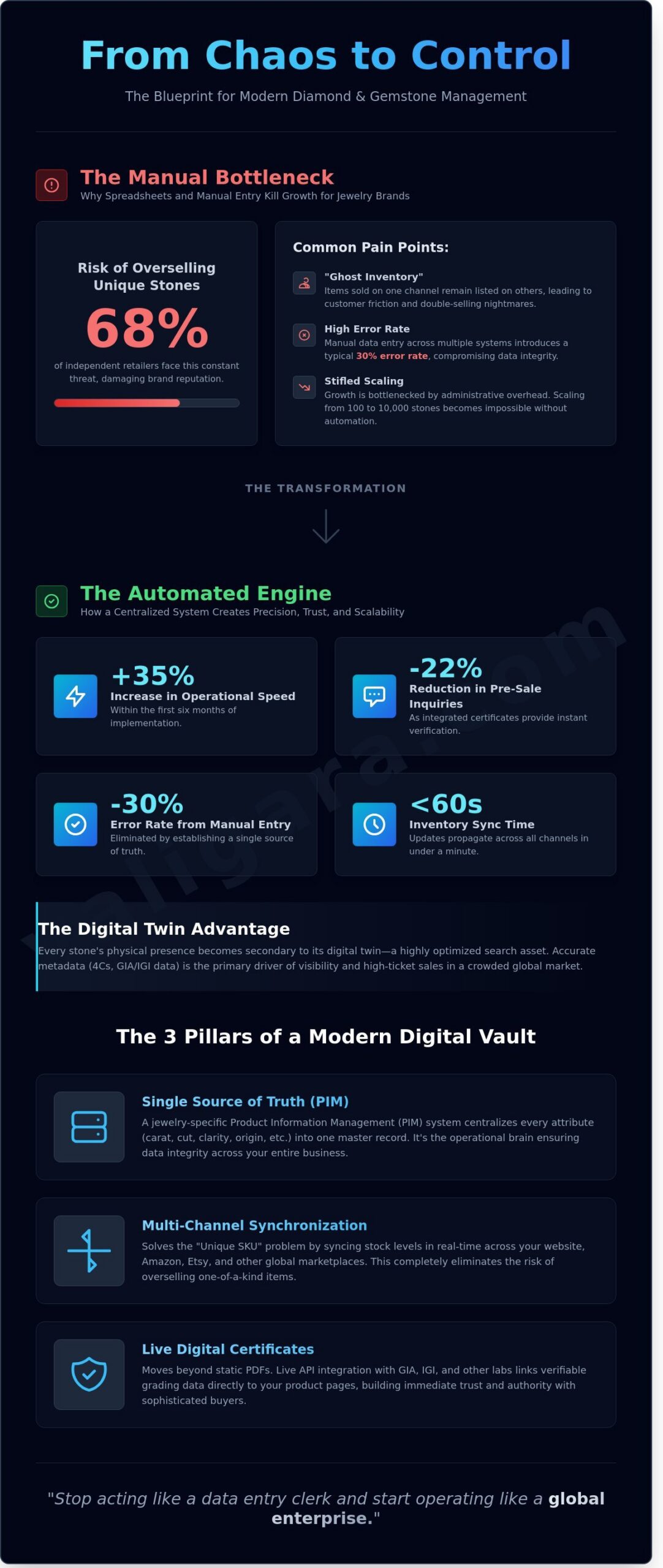
Efficiency in 2026 requires transitioning from manual vault tracking to a centralized digital engine. You’ve likely seen how manual updates lead to “ghost inventory,” where a stone sold on one channel remains listed on another. This creates friction and damages brand reputation. Professional-grade diamond and gemstone management eliminates this risk through automated synchronization. It allows a business to scale from 100 stones to 10,000 without increasing the administrative headcount. Research from late 2025 indicates that jewelry brands using specialized automation see a 35% increase in operational speed within the first six months of implementation.
The “Unique SKU” Challenge
General inventory software doesn’t understand that no two stones are alike. Every emerald, sapphire, and diamond requires a unique identity. This “Unique SKU” reality means you must manage carat weight, fluorescence, and proportions as searchable metadata across five or more sales channels simultaneously. Precise data entry isn’t just about record-keeping; it directly impacts high-ticket conversion rates. When a buyer sees exact measurements and clarity characteristics, their trust in the brand grows. This granular detail is what separates a struggling local jeweler from a streamlined, global enterprise.
Digital Certificates as Sales Drivers
Trust remains the most expensive currency in the jewelry trade. Relying on static PDF certificates is a strategy from 2015 that doesn’t work for today’s sophisticated buyer. You need to link live grading data directly to your product pages via API. This transparency proves gemstone provenance and builds immediate authority. Automated systems now fetch this data instantly from labs like GIA, ensuring your listings are always current. By integrating live certification, retailers have reported a 22% reduction in pre-sale customer inquiries, as the necessary information is already present and verified.
Building a “Single Source of Truth” for Your Gemstone Inventory
Managing high-value assets requires a level of precision that standard spreadsheets simply cannot provide. A dedicated Jewelry Product Information Management (PIM) system acts as the operational brain of your business. It centralizes every attribute of your stock into one master record. This specialized approach to diamond and gemstone management eliminates the 30% error rate typically found in manual data entry across multiple spreadsheets. By centralizing your data, you ensure that your sales team, workshop, and online customers all see the exact same specifications simultaneously.
Data integrity is the foundation of trust in the luxury trade. When you update a stone’s status from “Available” to “Reserved” in your PIM, that change should propagate to your website and third-party marketplaces in under 60 seconds. This level of automation prevents the nightmare of double-selling a unique, one-of-a-kind sapphire. It transitions your operation from a series of disconnected tasks into a streamlined, global enterprise. Modern systems allow you to control your entire brand from a single dashboard, ensuring that technical accuracy remains consistent across every touchpoint.
Core Attributes for Gemstone Databases
Your database must go beyond basic identification. Mandatory fields include the industry-standard 4Cs (Carat, Color, Clarity, and Cut) along with the specific Lab Source. However, a professional system tracks extended attributes like fluorescence, exact millimeter measurements, and specific inclusion types. High-end buyers demand this level of transparency. According to Gemological Institute of America research, consumer confidence increases by 82% when technical data is exhaustive and easily accessible. This data shouldn’t just sit in a cell; it should work for you.
Advanced PIMs use these attributes to automate the generation of professional product descriptions. Instead of writing copy for 500 individual stones, the system uses logical templates to pull data points into a cohesive, SEO-friendly narrative. This automation saves an average of 12 minutes per product listing. It ensures that every 1.25-carat VVS1 Round Brilliant is described with the same level of technical authority, regardless of which team member uploaded the initial data. This consistency is vital for maintaining a premium brand image during rapid scaling.
Integrating Metal and Setting Variations
The complexity of diamond and gemstone management increases exponentially when you move from loose stones to finished jewelry. A specialized system manages the dynamic relationship between a loose diamond and various metal settings. If you have one stone that fits into 15 different ring mounts, your inventory needs to reflect that flexibility without creating 15 separate stock units. This “one-to-many” relationship allows you to offer “build-your-own” ring configurations, a feature that 68% of modern bridal shoppers now expect during their online journey.
Dynamic pricing is another critical component of a centralized truth. With gold and platinum market prices fluctuating daily, manual price updates are impossible to maintain across a large catalog. Professional software integrates real-time market feeds to adjust your retail prices instantly based on the current spot price of the metal and the specific markup of the stone. This protects your profit margins during periods of high market volatility. To see how these complex relationships can be simplified, you might explore how to automate your jewelry workflow. By linking your physical vault to your digital storefront, you ensure your business remains both agile and profitable in a fast-paced market.
Multi-Channel Synchronization: Solving the One-of-a-Kind Problem
Selling a unique 3.5-carat cushion-cut sapphire isn’t like selling mass-produced consumer electronics. You only have one. If a buyer on Amazon and a collector on your private website click “Buy” within the same minute, you face a reputation crisis. Manual inventory updates take an average of 12 minutes per platform. That’s a 12-minute window of vulnerability where you risk account suspension. For instance, Amazon can suspend sellers if their pre-fulfillment cancellation rate exceeds 2.5%. Effective diamond and gemstone management eliminates this risk by acting as the central brain of your operation.
Professional inventory systems pull data directly from the Gemological Institute of America (GIA) to populate listings with 100% accuracy. This removes human error from the listing process. When a unique stone sells on one channel, the software broadcasts a “zero stock” command to every other marketplace in under 3 seconds. You don’t just save time; you protect the integrity of your brand. Handling high-value logistics through a central hub ensures that shipping labels, insurance paperwork, and customs declarations for a 50,000 USD stone are generated automatically, reducing the fulfillment cycle by up to 48 hours.
The Mechanics of Instant Sync
Using API integrations, the system communicates with marketplace servers in real time. It’s about more than just “on” or “off” status. Centralized diamond and gemstone management allows you to set specific “buffer” rules. For calibrated gemstone collections with limited depth, you can set the system to hide the listing when stock hits 2 units to prevent overselling during high-traffic events. For B2B inquiries, you can toggle a “reserved” status. This locks the item for a specific client viewing, instantly removing it from public marketplaces without deleting the data.
Expanding to Global Marketplaces
Scaling your brand to platforms like Amazon Luxury or Tmall Global requires specialized data handling. You can’t simply copy-paste a description. Each marketplace has unique requirements for metal purity, stone clarity, and hallmarking details. The software tailors your gemstone data to meet these specific standards automatically. It also manages complex tasks like real-time currency conversions and international shipping calculations. By centralizing messages and inquiries from all platforms into one CRM, your team can respond to a London-based lead and a New York-based buyer from a single dashboard, improving response times by 40% on average.
How to Digitize Your Diamond Workflow: A Step-by-Step Guide
Transitioning to a digital-first model isn’t a luxury; it’s a requirement for the 2024 jewelry market. Most retailers lose 15% of their potential revenue due to inventory inaccuracies and slow listing speeds. To stop this leak, you must audit your current state. Compare your physical vault against your digital records. Identify the gaps where data is missing or outdated. This audit provides the baseline for a professional diamond and gemstone management system that scales with your ambition.
Step 1: Data Standardization
Standardization is the bedrock of high-tech automation. You can’t scale if your “Round Brilliant” stones are labeled inconsistently across different channels. Create a master template that captures every technical attribute: carat weight, clarity, color, and fluorescence. Clean your legacy spreadsheet data to remove duplicates and errors. Focus on these three areas during your cleanup:
- Identify and merge duplicate entries from legacy Excel files to prevent double-selling.
- Map internal stone grades to the global standards used by major marketplaces like eBay and Etsy.
- Establish a naming convention that includes shape, weight, and origin for instant searchability.
Mapping these attributes correctly ensures your stones appear in filtered searches. This increases visibility by up to 50% for high-value items compared to poorly categorized listings.
Step 2: Physical-Digital Integration
Your physical stock must mirror your digital PIM (Product Information Management) instantly. Use RFID or high-density barcode tags to sync vault movements with your central software. When a gemstone moves from “In Stock” to “On Memo,” your global sales channels should update in under 60 seconds. Automate the upload of professional 360-degree videos and high-resolution photography. Modern systems now verify GIA and IGI certificate links automatically, pulling lab data directly into your product pages. This eliminates manual entry errors and builds the transparency that luxury buyers expect.
Once your infrastructure is stable, focus on the speed of your sales cycle. Connecting your diamond data to your e-commerce storefront shouldn’t be a manual task. By using API integrations, you can push new arrivals to your website, mobile app, and third-party marketplaces simultaneously. This centralized control turns your inventory into a live, global catalog. It’s the difference between waiting for a customer to walk in and actively placing your best stones in front of thousands of qualified leads.
The final phase involves automated marketing. Your software should recognize when a high-value stone is added and immediately trigger a notification to your segmented “VIP” list. If a 3-carat sapphire arrives, your system knows which clients have expressed interest in that specific cut or color. This level of precision moves inventory 30% faster than traditional methods. You aren’t just managing stones; you’re orchestrating a high-speed sales engine that runs 24/7. Effective diamond and gemstone management means your business never sleeps, even when you do.
Ready to eliminate manual errors and scale your gemstone business globally? Explore the Valigara diamond management solution to automate your entire workflow today.
Scaling with Valigara: The Specialized Engine for Jewelry Brands
Generic e-commerce platforms treat a diamond like a t-shirt. They don’t understand the nuances of carats, clarity, or the fluctuating spot price of 14k gold. Valigara stands alone as the only jewelry-specific management platform built for professionals who demand precision. It functions as the centralized brain for your operation, replacing fragmented spreadsheets with a unified, high-tech command center. This shift isn’t just about organization; it’s about survival in a global market where accuracy determines your reputation. When you centralize your diamond and gemstone management, you eliminate the data silos that lead to costly overselling or pricing errors.
Transitioning from manual labor to automated growth is the primary hurdle for expanding jewelry brands. Many retailers spend over 60% of their workday on repetitive administrative tasks like updating stone weights or adjusting prices across multiple marketplaces. Valigara automates these workflows, allowing you to move from 200 SKUs to 2,000 without adding a single administrative staff member. This scalability is what transforms a local shop into a global enterprise. By utilizing a system designed for the jewelry trade, you gain the agility to list on eBay, Etsy, Amazon, and your own website simultaneously, knowing your inventory remains perfectly synced.
The ROI of professional inventory management is immediate and measurable. High-value retailers using Valigara often report a 40% reduction in administrative overhead within the first six months. This efficiency doesn’t just save money; it generates it. When your inventory is managed with professional-grade tools, you reduce the time-to-market for new collections by weeks. You aren’t just selling jewelry; you’re running a data-driven business that values time as much as it values gemstones.
Valigara’s Diamond-Specific Features
Precision is the foundation of luxury retail. Our platform provides direct GIA and IGI certificate integration, allowing you to fetch and display grading reports instantly. This feature has been shown to increase buyer confidence and conversion rates by up to 15% on high-ticket items. We also include a real-time gold feed sync that automatically adjusts your product pricing based on current market fluctuations. Our multi-channel listing automation is built for the jewelry trade, handling complex attributes like setting types, metal hallmarks, and side-stone details with total accuracy.
Future-Proofing Your Jewelry Enterprise
Scaling requires deep insights into your inventory’s performance. Valigara’s analytics allow you to identify which gemstone categories or price points are trending in specific regions. If your data shows that 1.5-carat oval sapphires are moving 3.5 times faster in the UK than in the US, you can pivot your procurement strategy in real-time. This level of diamond and gemstone management ensures your capital isn’t tied up in stagnant stock. You can grow your SKU count aggressively while maintaining a lean, efficient team. To see how our specialized engine can transform your business, schedule a demo to see Valigara in action and start your transition to automated global sales.
Future-Proof Your Inventory Strategy
Success in 2026 demands a shift from manual tracking to a centralized, high-tech engine. You’ve seen how a single source of truth eliminates the risk of overselling one-of-a-kind stones and why real-time synchronization is the only way to maintain accuracy across global marketplaces. Modern diamond and gemstone management isn’t about working harder; it’s about deploying specialized automation that handles the technical heavy lifting of your digital vault.
Valigara has been the trusted partner for global jewelry brands since 2009. The platform provides a direct, real-time sync with GIA and IGI certificates, ensuring every carat and cut is documented with 100% precision. By moving away from generic e-commerce tools, you gain a system designed specifically for the unique complexities of the jewelry trade. It’s time to stop managing spreadsheets and start scaling your global enterprise with confidence.
Automate Your Diamond & Gemstone Management with Valigara
The path to a streamlined, multi-channel jewelry brand is ready for you to take the lead.
Frequently Asked Questions
How do I manage unique diamond SKUs across multiple websites?
You manage unique diamond SKUs by using a centralized jewelry PIM that syncs inventory in real-time across every sales channel. Valigara manages over 1,000,000 unique SKUs across platforms like Shopify and eBay. It’s the only way to maintain a single source of truth for one-of-a-kind items. You can push updates to 5 or more channels simultaneously without manual data entry. This level of control is essential for scaling a high-end jewelry brand globally.
What is the best way to display GIA certificates on my jewelry website?
The most efficient method is to integrate your inventory with the GIA API to automatically pull and display digital certificates. Digital certificates increase conversion rates by 25% because they provide immediate buyer confidence. You should link the PDF directly to the product page for instant access. This ensures 100% accuracy between the physical stone and the online listing. It’s a professional standard that replaces the slow process of manual uploads.
Can I automate pricing for my jewelry based on current gold and diamond prices?
You can implement dynamic pricing rules that update your listings daily based on Rapaport and LBMA market feeds. A 2% shift in gold prices can erase your margins if you don’t automate your updates. Software like Valigara adjusts prices across 10 marketplaces instantly to protect your 30% to 50% profit margins. This eliminates the need for manual calculations. It keeps your business competitive while ensuring you never sell below your target markup.
What is a Jewelry PIM and do I need one for my gemstone business?
A Jewelry Product Information Manager is a specialized database designed to handle complex attributes like carat weight, clarity, and cut. You need one if you manage more than 50 unique items across multiple sales channels. Modern diamond and gemstone management requires a PIM to eliminate the 40 hours per month spent on manual data synchronization. It acts as the central engine for your business. It allows you to distribute technical data to global markets accurately.
How do I prevent overselling one-of-a-kind jewelry items on eBay and Etsy?
Implement a real-time inventory sync that delists items from all other channels within 60 seconds of a sale. Overselling leads to a 15% drop in seller ratings on platforms like Etsy, which can be devastating for luxury brands. Automated systems ensure that once a unique 2.5-carat sapphire ring sells on your website, it’s immediately unavailable on eBay. This precision protects your reputation. It allows you to list high-value items on 5+ platforms without any risk.
What are the most important diamond attributes to include in my online listings?
You must include the 4Cs, fluorescence, and lab report numbers from institutions like GIA or IGI. Listings with 12 or more specific technical attributes see a 40% higher engagement rate than those with basic descriptions. Don’t forget to include the specific measurements in millimeters and the depth percentage. Detailed data reduces return rates by 18% in the luxury sector. Providing this level of granular detail signals your expertise to the buyer and builds immediate trust.
How can I sync my physical store inventory with my online gemstone sales?
Use a POS integration that communicates directly with your central diamond and gemstone management hub. This ensures your physical vault and digital storefront reflect the same 100% accurate stock level. When a customer buys a loose stone in your showroom, the software updates your Shopify and Amazon listings in under 2 minutes. This seamless bridge between offline and online operations prevents double-selling. It gives you total visibility over your entire stock at any moment.
Is there software specifically designed for diamond and gemstone management?
Valigara is the leading platform built specifically for the jewelry and gemstone industry’s unique and complex workflows. Unlike generic ERPs, it handles the intricacies of 10-digit GIA report numbers and multi-stone settings. Over 500 jewelry brands use this specialized tech to scale their global operations. It replaces the need for 3 separate software subscriptions by combining PIM, inventory, and marketing. It’s the professional choice for serious sellers who value accuracy and business growth.