
Your jewelry brand is only as strong as its most inaccurate spreadsheet cell. With poor data quality costing organizations an average of $12.9 million per year according to Gartner, the stakes for your digital catalog have never been higher. You already know that managing thousands of SKUs across five or more marketplaces while tracking GIA certificates and fluctuating metal prices is an operational nightmare. You’ve likely felt the sting of a cancelled order because a stock sync failed or a gemstone weight was entered incorrectly during a late-night manual update.
Discovering the best PIM for jewelers is the secret to scaling your brand across global marketplaces without the manual data headache. This guide provides the technical roadmap to transition from a struggling manual seller to a streamlined, global enterprise. We will analyze the top jewelry-specific solutions of 2026, explain how to navigate the July 8, 2026 CPSC eFiling mandate, and show you how AI-driven automation can finally handle your complex diamond and gemstone attributes with total precision.
Key Takeaways
- Break the spreadsheet ceiling by understanding why manual data management fails once your catalog exceeds 500 SKUs.
- Discover the technical benchmarks for the best PIM for jewelers, from handling complex metal variations to mapping dynamic gemstone attributes.
- Save on development costs by identifying why generic PIM solutions often require expensive, jewelry-blind customizations.
- Evaluate software based on its ability to act as both a centralized data repository and an automated multi-channel listing engine.
- Build a scalable global empire by establishing a single source of truth for your entire inventory of loose stones and finished jewelry.
Why Jewelry Brands are Swapping Spreadsheets for PIMs in 2026
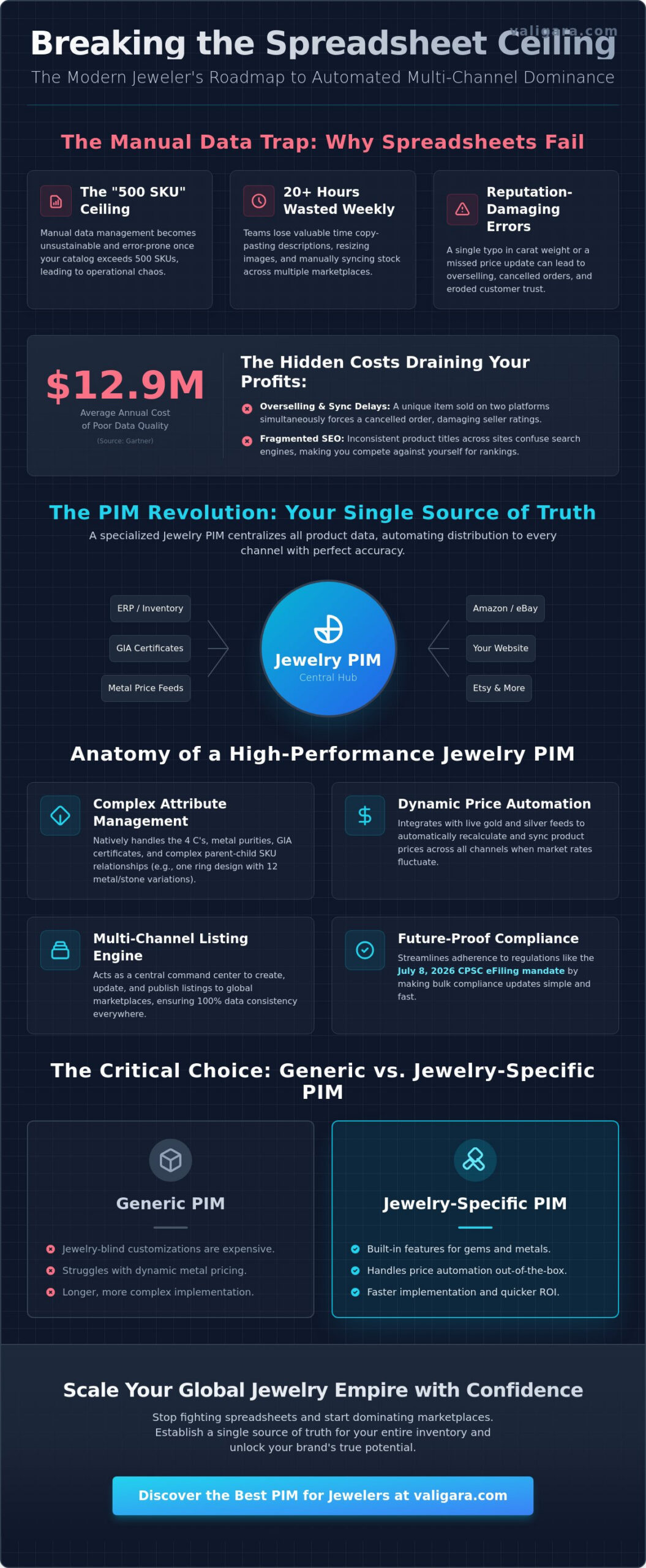
The 2026 jewelry landscape has shifted. Multi-channel selling is no longer a growth strategy; it’s the baseline for survival. If you’re managing 500+ SKUs, you’ve likely hit the “Spreadsheet Ceiling.” Manually updating a single diamond ring’s weight or price across Amazon, eBay, and Etsy is a recipe for disaster. One typo in a carat weight or a missed price update on a gold feed can lead to significant financial loss and eroded customer trust.
Centralized control is the only way to maintain a professional brand image. When your data is fragmented, your SEO suffers. Search engines prioritize consistency across the web. A robust Product Information Management (PIM) system serves as the central engine for your business, ensuring every marketplace reflects the same high-precision data. Finding the best PIM for jewelers is about more than just storage. It’s about creating a single source of truth that empowers your catalog team to move at the speed of global commerce.
The True Cost of Manual Jewelry Data Management
Manual data entry is a silent profit killer. Catalog teams often lose over 20 hours per week simply copy-pasting descriptions and uploading images to different platforms. For a luxury brand, the hidden cost of “overselling” a high-value item due to a 10-minute sync delay can be devastating. If a unique gemstone sells on your website and eBay simultaneously, you’re forced to cancel an order. This damages your seller rating and wastes marketing spend. Inconsistent product titles also confuse search algorithms. If your “14k Gold Sapphire Ring” is listed differently across three sites, you’re effectively competing against yourself for search rankings.
PIM as the Foundation for Multi-Channel Growth
Transitioning to the best PIM for jewelers allows you to move from merely “selling online” to dominating global marketplaces. Automation handles the heavy lifting of multi-currency conversions and multi-language localization, making international expansion a reality rather than a distant goal. By May 2026, data shows that 80% of jewelry shoppers expect detailed technical specifications before committing to a high-ticket purchase. A specialized PIM acts as the missing link between your manufacturing data and your customer’s screen. It ensures hallmarking details, gemstone certifications, and metal purities are always accurate, allowing you to scale your empire with absolute confidence.
The Anatomy of a High-Performance Jewelry PIM
Jewelry data is multidimensional. Unlike a standard retail item with simple size and color variations, a diamond halo ring involves metal purity, gemstone origin, carat weights, and unique certification numbers. Inaccurate data isn’t just a nuisance; it’s a heavy financial liability. Research highlights the yearly cost of poor quality data at trillions of dollars, a reality that hits jewelers hard when precious metal prices fluctuate or stone grades are mislabeled. The best PIM for jewelers recognizes these nuances by moving beyond flat data structures to support complex parent-child SKU relationships. This architecture allows you to manage a single ring design across 12 different metal and stone combinations without creating 12 disconnected, fragmented entries.
A high-performance system integrates directly with gold and silver feeds to automate price adjustments across all channels. This eliminates the manual labor of recalculating margins every time the market moves. When the spot price of gold shifts, your PIM should recalculate the retail price of every 14k and 18k item in your catalog instantly. It’s the difference between reactive survival and proactive market dominance. By centralizing these technical attributes, you ensure that your sales team and your customers always see the most accurate, up-to-date information.
Specialized Attributes for Diamonds and Gemstones
Managing the “Four Cs” (Cut, Color, Clarity, and Carat) requires dynamic attribute mapping that general-purpose software cannot handle without expensive customization. The best PIM for jewelers allows you to automate these technical descriptions across every listing. You can manage loose stone inventory and then “mount” them to finished jewelry virtually, tracking the lineage of every piece. This level of detail is critical for meeting the July 8, 2026 CPSC eFiling deadline, which mandates electronic filing of compliance certificates for jewelry. Bulk-editing 1,000 gemstone entries for marketplace compliance takes seconds rather than weeks when using a specialized engine.
Media Management for Luxury Retail
Visuals sell luxury. Your PIM must act as a digital vault for high-resolution 360-degree videos and professional photography. It should handle automated watermarking and resizing to meet the specific requirements of Amazon, eBay, or your own Vite-powered website. Regarding 2026 standards, a specialized Jewelry PIM ensures GIA certificate digitization by automatically linking PDF certificates to product SKUs and displaying them as high-trust assets on every product page. Using an integrated jewelry management system ensures your technical data and luxury media work in perfect harmony, providing the transparency that modern buyers demand.
General Purpose vs. Jewelry-Specific PIM: The Critical Comparison
Choosing the best PIM for jewelers often comes down to a choice between a generic data bucket and a specialized industry engine. Generic PIM systems like Akeneo or Pimcore are powerful tools, but they’re inherently jewelry-blind. They treat a sapphire necklace the same way they treat a consumer electronic. To make a general-purpose system understand ring sizes, metal purities, or gemstone certifications, you’ll need extensive and expensive custom development. These hidden customization costs can quickly spiral, turning a seemingly affordable software choice into a multi-month engineering project that drains your resources.
In contrast, industry-specific software offers an Expert Insider advantage that generic tools cannot match. Because the architecture is built specifically for the trade, onboarding time is typically reduced by 70%. You don’t have to explain to the software what a carat is or how a halo setting functions; the system already understands the hierarchy of jewelry data. This specialized logic extends to marketplace compliance. For instance, Etsy’s jewelry categories have specific attribute requirements that change frequently. A jewelry-specific PIM handles these updates natively, whereas a generic system requires manual re-mapping for every platform change.
Integration Depth: Marketplaces and ERPs
Native integrations with eBay Jewelry, Etsy, and Amazon Handmade are essential for global scaling. A jewelry-specific PIM bridges the gap between your workshop ERP and your digital storefronts. It ensures that when a jeweler finishes a piece in the workshop, the technical data flows seamlessly into the listing engine. For those building custom storefronts, Jewelry-Aware API access is the secret weapon. It allows your developers to pull complex data like Gold Feed Sync or diamond attributes without reinventing the data model from scratch.
User Experience for Jewelry Professionals
The interface of a general PIM is often a sterile wall of text. Jewelry professionals require visual inventory management to work efficiently. The best PIM for jewelers allows you to browse your catalog by stone type, metal, or specific collection, mirroring the way you actually organize your physical stock. For B2B wholesale operations, the ability to generate a professional PDF catalog instantly from your live data is a significant competitive advantage. While a general-purpose setup often requires six months of configuration, a jewelry-specific platform is usually operational within weeks, allowing you to focus on your craftsmanship rather than software architecture.
5 Essential Criteria for Choosing the Best Jewelry PIM
Selecting the best PIM for jewelers requires a shift in perspective. You aren’t just buying a digital filing cabinet; you’re investing in a central engine for global commerce. If your software doesn’t understand the difference between a halo setting and a pavé band, your team will spend hundreds of hours on manual corrections. To ensure your brand is ready for the 15.04% trade growth seen in categories like fine bangles in 2026, you must evaluate your software based on five technical pillars.
- Evaluate Variation Complexity: Jewelry isn’t a flat product. A single ring design often exists in 10 different metals and five stone types. Your PIM must handle these 50 variations under one parent SKU without manual duplication.
- Verify Native Listing Capabilities: A PIM that only stores data is half a solution. Ensure the software is a “PIM plus Lister” that pushes live updates to eBay, Etsy, and Amazon natively.
- Audit Gemstone Management: The system must digitize GIA or IGI certificates and map carat weights to marketplace-specific fields automatically.
- Test Sync Speed: For high-value jewelry, “near real-time” isn’t enough. Demand sub-minute synchronization to prevent overselling on global marketplaces and protect your seller rating.
- Review API Flexibility: Your brand will grow. Ensure the PIM offers robust API access to connect with future ERPs or custom Vite storefronts as your enterprise expands.
The ROI of a Jewelry PIM
Launching a 50-piece collection shouldn’t take a week. With a specialized PIM, this timeline drops to under 60 minutes. Accurate data reduces customer service inquiries by 30% because buyers don’t have to ask about metal purity or gemstone origin. When you consider that poor data costs organizations an average of $12.9 million per year, the investment in accuracy pays for itself. If you’re still relying on Excel, check these 5 Signs You’ve Outgrown Spreadsheet Inventory Management to see the hidden costs you’re currently absorbing.
Onboarding and Industry Support
You need a partner who understands the technical difference between “karat” and “carat.” General software support teams won’t understand hallmarking requirements or the urgency of a gold feed sync failure during a market spike. Personal onboarding and data migration assistance are non-negotiable for a smooth transition from manual workflows. A partner that speaks the language of the trade ensures you transition from a struggling seller to a global powerhouse without losing data integrity. To see these criteria in action, book a professional walkthrough of the Valigara platform today.
Scaling Your Global Jewelry Empire with Valigara PIM
Valigara stands alone as the only platform engineered by jewelry insiders for the global trade. While generic providers offer generic data buckets, Valigara provides a specialized engine that understands carats, hallmarking, and collection hierarchies. It serves as your single source of truth, centralizing loose gemstones and finished jewelry into one cohesive digital catalog. This architecture allows you to dominate global marketplaces through automated listing and real-time synchronization, ensuring your brand stays ahead of the 12.5% month-over-month demand growth seen in luxury categories in early 2026.
Transitioning from a local artisan to a global enterprise requires technical precision. Valigara’s jewelry-specific tools empower this growth by eliminating the manual labor that stalls scalability. You’re no longer just managing data; you’re orchestrating a multi-channel empire from a single dashboard. By establishing this centralized control, you ensure your brand maintains a professional image across every touchpoint, from your own Vite-powered storefront to global giants like eBay and Amazon. It’s the difference between reacting to the market and leading it.
Valigara Features That Define the Best PIM for Jewelers
The platform’s PIM-first architecture provides automated multi-channel listing for eBay, Etsy, Amazon, and Shopify. This isn’t a simple data feed. It’s a sophisticated system that maps your unique attributes to each marketplace’s specific requirements automatically. Advanced diamond and gemstone management tools integrate directly with GIA data, ensuring your certifications are always visible and verified for every SKU. To master this complexity, learn How to Manage Complex Jewelry SKUs & Variations within a specialized environment.
Get Started with the Jewelry Industry Standard
Moving away from fragmented spreadsheets is the first step toward enterprise-level efficiency. Valigara simplifies this migration by providing structured data frameworks designed specifically for the jewelry trade. Once your data is centralized, you gain access to the full Valigara ecosystem, including Jewelry CRM, Inventory Management, and Marketing Automation. This unified approach ensures that your technical data drives your sales strategy rather than hindering it. Don’t let manual entry limit your brand’s potential in a competitive global market. Schedule your personalized Valigara demo today and see how the industry standard can transform your operations into a streamlined, automated success story.
Take Command of Your Global Jewelry Operations
The shift from manual data entry to a centralized digital engine is a necessity for 2026. You’ve seen how specialized architecture handles the high-complexity reality of diamonds and gemstones while generic tools fail to scale. Consolidating your inventory into a single source of truth eliminates the human errors that cost retailers millions annually. Selecting the best PIM for jewelers ensures your brand is ready to meet rising global demand without the operational friction of the past.
Valigara offers the only jewelry-specific data architecture built to bridge the gap between the workshop and the marketplace. Trusted by 1,000+ global jewelry brands, the platform delivers real-time gold and gemstone feed sync to keep your pricing precise across every channel. You shouldn’t struggle with fragmented systems or outdated spreadsheets. It’s time to empower your business and dominate the trade with professional automation.
Scale Your Jewelry Brand with the Industry’s Best PIM
Your journey toward a streamlined, global enterprise starts with accurate data and expert tools. We look forward to seeing your brand shine on the world stage.
Frequently Asked Questions
What is the difference between a jewelry PIM and a general PIM?
A jewelry PIM understands complex product attributes like carats, metal purities, and gemstone clarity natively. General purpose PIMs are built for generic retail and require expensive, time-consuming customization to handle jewelry-specific data structures. Choosing the best PIM for jewelers means using a system that already speaks the language of the trade, reducing your setup time by 70% compared to generic alternatives.
Can a jewelry PIM help with selling on Etsy and eBay simultaneously?
Yes, it uses multi-channel listing automation to synchronize your entire catalog across Etsy, eBay, and Amazon in real-time. This prevents the frequent overselling of high-value items that occurs when manual stock updates lag. When a 14k gold sapphire ring sells on one platform, the software updates the available inventory on all other marketplaces within seconds to protect your seller rating.
How does a PIM handle diamond certifications like GIA?
The software acts as a digital vault that digitizes GIA, IGI, and HRD certificates and links them directly to their respective SKUs. This automation is critical for meeting the US Consumer Product Safety Commission (CPSC) eFiling mandate effective July 8, 2026. It ensures that every customer sees the correct certification on the product page, building immediate trust and reducing pre-purchase inquiries.
Does a jewelry PIM integrate with my existing ERP system?
Most professional jewelry PIMs offer robust API access to bridge the gap between your workshop ERP and your sales channels. This allows for seamless data flow from manufacturing to the customer’s screen. By integrating these systems, you create a single source of truth that ensures your inventory levels and technical specifications remain accurate across your entire global enterprise.
Is a PIM necessary for a small jewelry brand with under 100 SKUs?
A PIM is essential if those 100 SKUs involve high variation complexity, such as multiple metal and stone combinations. Even a small catalog becomes difficult to manage across 5+ marketplaces without automation. If you plan to scale, establishing a PIM early prevents the “Spreadsheet Ceiling” where manual data entry errors begin to cost your brand significant revenue and customer trust.
How much does a jewelry PIM cost in 2026?
Pricing varies based on features and SKU volume. As of April 2026, reports indicate Valigara’s starting price is between $199 and $500 per month. For comparison, Catsy PIM started at $599 per month in February 2026. When evaluating the best PIM for jewelers, consider the total cost of ownership, including the potential thousands of dollars saved on custom development and manual labor.
Can a PIM automate jewelry pricing based on the current gold market?
Yes, through Gold Feed Sync, the software automatically adjusts your retail prices based on real-time spot market fluctuations. This eliminates the need for manual recalculations when precious metal prices shift. When the market moves, your PIM recalculates every 14k and 18k item in your catalog and pushes those updates to all connected marketplaces instantly to protect your margins.
What happens to my data if I decide to switch PIM providers?
You maintain full ownership of your product data, images, and certifications. Professional systems allow you to export your entire catalog via CSV, XLSX, or API integration at any time. This flexibility ensures you aren’t locked into a single provider and can move your single source of truth to a new platform if your business requirements change as you expand globally.