
The global jewelry market is projected to reach $254.13 billion in 2026, yet many retailers still lose over 10% of their potential revenue to de-synced inventory and manual data entry errors. You likely understand the frustration of overselling a unique sapphire ring because your marketplace and website failed to communicate in real time. Manually updating gold prices across five channels or correcting inconsistent gemstone carats across dozens of listings isn’t just tedious; it’s a direct barrier to scaling your brand.
By implementing a centralized product catalog for jewelry, you transition from a struggling manual seller to a streamlined, global enterprise. This guide teaches you how to transform fragmented inventory into a high-performance “Jewelry Brain” that powers your entire operation with expert precision. We’ll examine the specific steps to create a single source of truth for your collections, automate multi-channel listing updates, and ensure your business meets the new July 8, 2026, CPSC eFiling mandates for imports. You’ll learn how to eliminate manual labor and reclaim the time needed to dominate the luxury market.
Key Takeaways
- Define the Single Source of Truth as the core digital engine required to manage every SKU, gemstone, and metal variation with absolute precision.
- Learn how to automate the technical relationships between loose stones and finished mountings to manage infinite product variations without manual intervention.
- Follow a professional 5-step roadmap to audit your data and deploy a centralized product catalog for jewelry that replaces error-prone spreadsheets.
- Understand why general-purpose ecommerce tools fail to handle jewelry-specific needs like carats, hallmarking, and multi-channel synchronization.
- Empower your brand to scale globally by centralizing control over every asset, from diamond certificates to automated marketing across all retail channels.
What is a Centralized Product Catalog for Jewelry?
A centralized product catalog for jewelry is the single source of truth (SSoT) that houses every SKU, gemstone attribute, and metal variation in your inventory. By 2026, the shift from static CSV files to a dynamic digital ecosystem is no longer optional for brands aiming to scale. Unlike general fashion or consumer electronics, jewelry data is multi-dimensional and high-value. A single ring design can exist in 14k yellow gold, 18k white gold, or platinum, each paired with different diamond clarities or sapphire weights. Managing this complexity requires a specialized Product Information Management (PIM) system designed specifically for the jewelry trade.
Implementing a centralized product catalog for jewelry allows you to move beyond the limitations of generic e-commerce platforms. These systems often fail to account for the technical nuances of hallmarking, gemstone certificates, and metal weight fluctuations. A dedicated jewelry catalog acts as the central engine for your business, ensuring that every piece of data is accurate, accessible, and ready for global distribution.
The “Jewelry Brain” Concept
Think of this catalog as the central brain of your operation. It eliminates fragmented data silos where inventory lives in disconnected spreadsheets. This hub feeds synchronized data to eBay, Etsy, Amazon, and your own Vite-powered website simultaneously. When you update a stone’s availability or a collection’s description, the change reflects across every touchpoint instantly. This level of control ensures brand consistency whether a client views your pieces on a wholesale portal or a retail marketplace.
Key Components of a Modern Jewelry Catalog
A professional catalog in 2026 isn’t just a list of names; it’s a rich data repository. It must handle complex media and technical specifications with ease. Key components include:
- Rich Media Management: Centralized storage for high-resolution images, 360-degree videos, and GIA or IGI certificate PDFs.
- Technical Metadata: Granular details such as metal purity, hallmark locations, stone carats, and setting types.
- Real-time Price Logic: Integration with market feeds, such as Gold Feed Sync, to adjust retail prices automatically as precious metal spot prices fluctuate.
By centralizing these elements, you eliminate the “hidden tax” of manual data entry. You stop wasting hours on repetitive updates and start focusing on growth. This architecture is the foundation for any jewelry brand looking to dominate the international market with precision and speed.
Managing Complex Jewelry Data: Diamonds, Gemstones, and Variations
The personalized jewelry market is expected to reach $118 billion by 2035, growing at a CAGR of 8.4%. This surge is driven by consumer demand for bespoke pieces, which introduces the massive technical challenge of “Infinite Variations.” A single ring design can morph into hundreds of unique SKUs based on ring size, metal purity, and center stone choice. In a jewelry PIM, the parent-child relationship functions as a hierarchical data structure where the parent represents the core design concept and the children represent every unique physical combination of metal, size, and stone. Managing these combinations manually is a recipe for operational failure.
A high-performance centralized product catalog for jewelry automates the complex relationship between loose stones and finished mountings. This logic is vital for preventing the “Ghost Inventory” problem. This occurs when a unique, GIA-certified diamond is listed within three different ring settings across your website, but you only have one physical stone in your vault. If that diamond sells in a solitaire setting on Etsy, your central system must instantly terminate the listings for the halo and three-stone variations on eBay and Amazon. Without this automation, you risk the reputational damage and financial cost of canceling high-value orders due to inventory de-sync.
Digitizing Gemstone and Diamond Certifications
Modern consumers demand transparency and immediate access to grading reports. Centralizing GIA, IGI, and HRD certificate data allows for instant retrieval across all sales channels. When you link a certificate to a specific SKU, the data populates your listings automatically, which can reduce customer inquiries by up to 30%. Many retailers struggle with gemstone database challenges, particularly when trying to standardize data from different labs into a single format. Automating this process ensures your high-value assets are always presented with verified authority and technical precision.
Dynamic Pricing and Gold Feed Synchronization
Manual price updates are a relic of the past that your business can’t afford in 2026. With Gold Feed Sync, your central hub adjusts prices across 10 or more marketplaces simultaneously as the spot price of gold fluctuates. If the market shifts significantly in a single afternoon, your retail prices follow suit without a second of manual intervention. This protects your margins during volatile periods and ensures you’re never selling below your target markup. Using specialized jewelry inventory management tools ensures your technical data remains a competitive advantage rather than an administrative burden.
Manual Spreadsheets vs. Centralized Catalog Systems
Every manual update in a spreadsheet carries a “Hidden Tax” that erodes your profit margins. For a jewelry business, this tax manifests as the time spent cross-referencing metal weights or the financial loss of a canceled order due to a stock discrepancy. When your inventory exceeds 500 SKUs or expands across more than three sales channels, the spreadsheet model inevitably fails. It cannot handle the multi-dimensional nature of jewelry data, leading to fragmented listings where your Etsy technical specs don’t match your Amazon descriptions. In 2026, data integrity is the foundation of luxury retail; any inconsistency signals a lack of professionalism to the discerning buyer.
Transitioning to a centralized product catalog for jewelry eliminates these vulnerabilities by providing a robust digital architecture. Speed to market is the most immediate benefit. Brands using a centralized hub report cutting product launch times by 80%. Instead of uploading CSV files to each marketplace individually, you create a single master record that populates every channel simultaneously. This ensures that your hallmarking details, gemstone carats, and high-resolution media remain perfectly synchronized across your entire global footprint.
The ROI of Automation in 2026
The return on investment for catalog automation is measured in reclaimed labor hours and increased scalability. In a manual environment, managing 1,000 SKUs across five channels requires a dedicated team. With a centralized system, a single operator can manage 10,000 SKUs with higher accuracy. This efficiency directly impacts customer trust. By eliminating “out of stock” cancellations through real-time inventory synchronization, you protect your seller ratings and ensure long-term growth. The system acts as a force multiplier, allowing a boutique operation to function with the precision of a global enterprise.
Addressing the Transition Anxiety
Many jewelers hesitate to move away from familiar spreadsheets due to the perceived complexity of the migration. There’s also a common myth that bespoke or custom jewelry cannot be centralized because every piece is unique. In reality, custom pieces benefit the most from standardized attribute management, as it allows you to track specific gemstone parcels and metal costs with surgical precision. To mitigate risk, we recommend a phased implementation. Start by moving one core collection to the central brain. Once you experience the ease of automated updates and the elimination of manual errors, you can migrate your remaining inventory with total confidence.
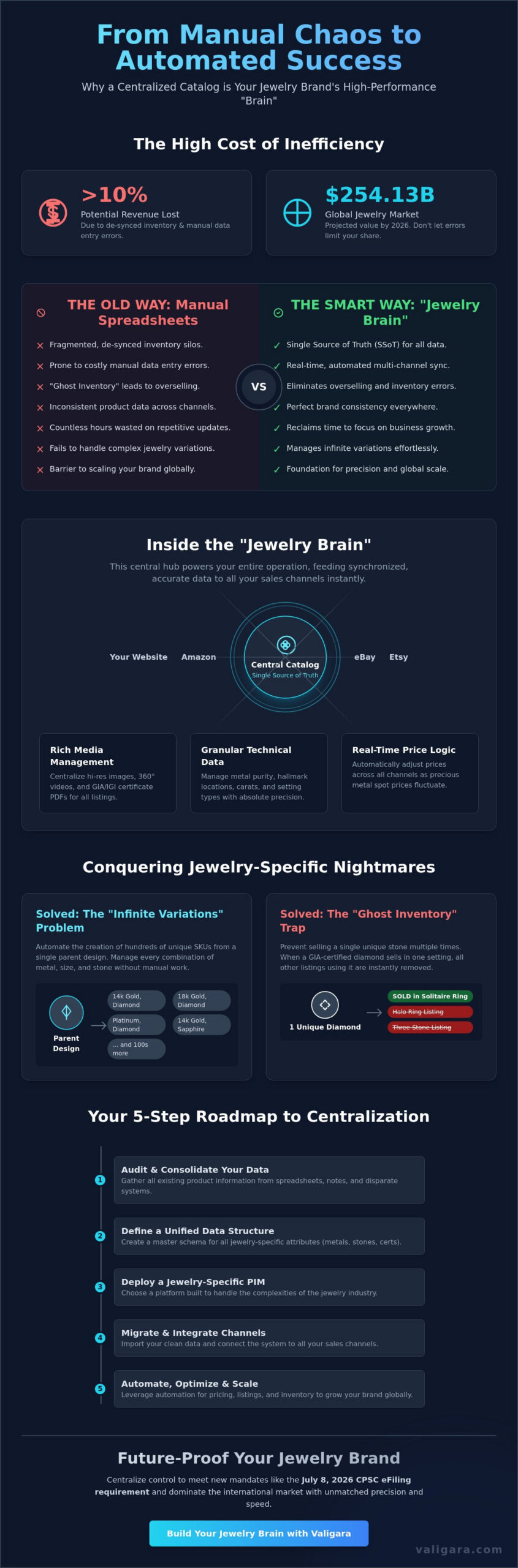
How to Implement a Centralized Catalog: A 5-Step Roadmap
Transitioning to a professional digital architecture requires a structured approach. Stop treating your product data as a secondary concern and start viewing it as a high-value asset. Implementing a centralized product catalog for jewelry is a strategic move that demands technical precision. Follow this five-step roadmap to build your brand’s digital engine.
- Audit your existing data: Identify every inconsistency in your current records. You’ll likely find “14k” in one spreadsheet and “14kt” in another. Standardizing these gemstone and metal descriptions is the first step toward a clean migration.
- Select a jewelry-specific PIM: General tools like Shopify or Magento aren’t enough. They lack the native ability to handle diamond parcels, metal weight variations, or GIA certificate links. As of April 28, 2026, professional solutions like Valigara offer entry plans starting at $199 per month, providing the specialized infrastructure you need to scale.
- Map your attributes: Create a “Jewelry Schema” that defines every possible product variation. This includes metal purity, stone carats, ring sizes, and hallmarking details. This schema ensures that every new product added to the system follows the same technical logic.
- Centralize media assets: Move away from disorganized local folders. Transition your high-res photography, 360 videos, and grading certificates to a cloud-based Digital Asset Management (DAM) system that links media directly to SKUs.
- Connect your channels: Sync your central hub with your retail marketplaces, B2B portals, and your Vite-powered website. This ensures that a single update to a gemstone’s clarity reflects across your entire global sales network instantly.
To begin this transformation, explore how a dedicated jewelry PIM can automate these steps for your business.
Standardizing Your Jewelry Taxonomy
Consistency is the hallmark of a luxury brand. You must establish naming conventions for collections and materials that are both technically accurate and SEO-friendly. By using standardized tags and attributes, you empower your customers to use advanced filters on your website. This allows a buyer to find a “1.5ct Emerald Cut Sapphire Ring in Platinum” in seconds. When your product titles are generated from a central source of truth, you eliminate the risk of conflicting information across different sales channels.
Integrating with ERP and Logistics
A centralized catalog does more than just power listings; it talks to your workshop and shipping software. By the July 8, 2026, CPSC eFiling deadline, having your certificate data ready for automated customs filing will be mandatory for US imports. Ensure your system drives barcode and tag printing directly from the central record. This creates a seamless flow from the moment a piece is finished in the workshop to the moment it’s scanned for fulfillment. Real-time stock sync is the final step, ensuring your inventory levels are always accurate across every global touchpoint.
Future-Proof Your Jewelry Brand with Valigara
Valigara serves as the definitive Single Source of Truth for global jewelry leaders who demand precision. By consolidating your operations into a centralized product catalog for jewelry, you eliminate the fragmentation that stunts growth. Our platform is the specialized brain of your business, managing the complex lifecycle of every ring, necklace, and loose stone from a single point of control. While generic e-commerce platforms struggle with the multi-dimensional nature of jewelry variations, Valigara thrives on it. You gain the ability to post once and sell everywhere, ensuring your brand remains synchronized across every marketplace and B2B portal you operate.
The Valigara Advantage: Jewelry-First Architecture
Our Jewelry PIM is designed specifically for the diamond and gemstone trade. It accounts for the technical nuances that general-purpose tools ignore, such as hallmarking standards and certificate linking. Consider the operational impact of centralization: in a documented 2025 case study, one jewelry brand doubled their SKU count from 2,500 to 5,000 without increasing their administrative headcount. This efficiency is possible because our system automates the relationship between your inventory and your sales channels. You gain the power of integrated marketing automation and analytics, all driven by the clean, standardized data living in your central hub. This allows you to expand your wholesale and retail operations simultaneously without losing control of your brand integrity.
Getting Started with Centralization
Moving from manual processes to a high-tech ecosystem is a significant transition. We mitigate the risk through personalized onboarding and expert data migration assistance. Our team understands the unique structure of jewelry data and ensures your collections are mapped correctly from day one. You aren’t just buying software; you’re adopting a workflow used by the most successful global jewelry brands to dominate marketplaces like eBay, Etsy, and Amazon. By centralizing your catalog, you future-proof your business against upcoming regulatory changes, such as the July 8, 2026, CPSC eFiling requirements. It’s time to transition from a manual seller to a streamlined enterprise.
Book a demo to see Valigara’s centralized catalog in action and discover how to automate your path to global scaling.
Dominate the Global Jewelry Market with Centralized Control
Scaling a jewelry brand in 2026 requires more than craftsmanship; it demands a high-performance digital infrastructure. You’ve seen how moving beyond manual spreadsheets eliminates the “Hidden Tax” of human error and accelerates your speed to market. By adopting a centralized product catalog for jewelry, you ensure that every diamond clarity, metal hallmark, and high-res video remains perfectly synchronized across your entire global network. This isn’t just about organization; it’s about building a scalable engine for your brand’s growth.
Valigara has empowered global jewelry professionals since 2009 with a PIM designed specifically for the technical nuances of carats, metals, and gemstones. Our platform provides the automated sync you need for eBay, Etsy, Amazon, and Shopify, allowing you to manage thousands of SKUs with surgical precision. You don’t have to settle for fragmented data or the risk of overselling. It’s time to reclaim your time and focus on the artistry of your collections while our technology handles the complexity of your multi-channel operations.
Master Your Jewelry Inventory with Valigara’s Centralized Catalog and start your journey toward a streamlined, enterprise-level operation today. Your brand deserves the precision of a professional jewelry brain.
Frequently Asked Questions
What is a centralized product catalog for jewelry?
It’s the digital core of a jewelry business, acting as a single source of truth for all product data. It consolidates SKU attributes, gemstone specs, and media into one hub. This architecture allows you to manage thousands of variations without manual data entry. It ensures that every piece of information, from hallmarking details to high-res videos, remains consistent across every retail and wholesale channel you operate.
How does a jewelry PIM differ from a standard eCommerce platform?
Standard platforms like Shopify or Magento treat jewelry as generic items. A jewelry PIM handles industry-specific metadata like carats, metal purity, and certification links natively. It manages the complex logic between loose stones and finished mountings that general tools cannot process. This specialized focus allows jewelers to handle the technical data required for high-value assets without relying on clunky workarounds or third-party plugins.
Can I sync my centralized catalog with Etsy and eBay simultaneously?
Yes, you can synchronize your inventory across Etsy, eBay, and Amazon from a single dashboard. When a unique diamond ring sells on one channel, the system instantly terminates or updates listings across all other connected marketplaces. This real-time synchronization eliminates the risk of overselling high-value assets. It allows a small team to maintain a massive global presence with absolute inventory accuracy.
Is it possible to manage GIA certificates within a centralized catalog?
You can store and link GIA, IGI, or HRD certificates directly to specific gemstone SKUs. This ensures grading reports are automatically included in your listings and customer communications. Providing this transparent data upfront reduces pre-purchase inquiries by approximately 30% and builds immediate buyer trust. It also ensures that your technical documentation is always ready for compliance audits or insurance appraisals.
How does a centralized catalog help with gold price fluctuations?
The system uses Gold Feed Sync to adjust your retail prices in real time based on current market spot prices. If gold prices shift significantly in a single afternoon, your entire centralized product catalog for jewelry reflects this change across all sales channels. This protects your margins without requiring a single manual recalculation. It’s an essential tool for maintaining profitability during periods of high market volatility.
Can a centralized system handle custom, one-of-a-kind jewelry pieces?
The system is designed to track unique, one-of-a-kind items with the same precision as mass-produced collections. You can manage specific gemstone parcels and unique metal weights for bespoke commissions. This ensures every unique asset is accounted for in your financial and inventory reports. Even for custom pieces, the centralized hub maintains a clear history of the components used, from the primary stone to the casting grain.
How long does it take to transition from spreadsheets to a centralized catalog?
A typical migration from fragmented spreadsheets to a centralized hub takes between 2 to 4 weeks depending on data cleanliness. Our onboarding team assists with the initial audit and mapping phases to ensure a smooth transition of your legacy records. This structured timeline allows for thorough testing of your multi-channel connections before your global synchronization goes live.
Does Valigara integrate with my existing jewelry ERP system?
Valigara provides robust API access to integrate with your existing ERP or workshop management software. This connectivity ensures that production data flows directly into your centralized product catalog for jewelry without manual intervention. It creates a seamless link between your manufacturing floor and your global retail storefronts. This integration is vital for brands that need to maintain a continuous data flow from the workbench to the customer’s doorstep.