With digital channels now accounting for nearly 30% of the $448 billion global jewelry market, the distance between traditional artistry and digital scale is closing fast. You’ve likely felt the frustration of losing a high-value sale because of a stock lag or spent hours manually re-entering gemstone specifications across three different marketplaces. Relying on fragmented systems is no longer just a nuisance; it’s a bottleneck to your growth. Implementing a specialized cloud-based jewelry management software is the only way to transition from manual workflows to a streamlined, global enterprise that operates with absolute precision.
We understand that your inventory isn’t just stock. It’s a complex collection of precious metals, certified stones, and unique designs that require a single source of truth. This guide promises to show you how to transform your jewelry PIM and inventory into a centralized hub that powers automated multi-channel listings and real-time synchronization. We’ll explore the technical shift toward 2026 scalability, covering everything from gold feed sync to the automated fulfillment workflows that turn your boutique into a high-performance eCommerce powerhouse.
Key Takeaways
- Understand why transitioning to a cloud-based jewelry management software is the critical first step in replacing inefficient legacy systems with a scalable digital brain.
- Master the use of a centralized PIM to maintain consistent branding while managing high-value inventory and complex gemstone specifications across every sales channel.
- Learn to bridge the gap between unique custom pieces and series production by integrating professional certifications directly into your automated sales flow.
- Discover how to eliminate listing bottlenecks by adapting your product data to meet the specific algorithmic requirements of global marketplaces like Etsy and Amazon.
- Gain clarity on migrating from fragmented spreadsheets to a unified hub with a structured onboarding process designed for the jewelry industry’s unique needs.
Table of Contents
What is Cloud-Based Jewelry Management Software?
Cloud-based jewelry management software is a centralized Software as a Service (SaaS) platform designed to manage jewelry-specific product data, inventory, and sales across all digital and physical channels. It replaces the fragmented spreadsheets and localized servers that once anchored a jeweler to their desk. By hosting operations in the cloud, you gain a single source of truth for high-value inventory. This technology acts as the central intelligence hub for modern jewelry brands, ensuring that every stone, setting, and sale is tracked with surgical precision.
Localized servers are failing because they can’t keep pace with a globalized market. If your data lives on a physical machine in your office, it’s a silo. These systems won’t communicate with Amazon, Etsy, or your own website without constant manual intervention. This lag leads to overselling and missed opportunities. Modern cloud-based jewelry management software merges PIM, ERP, and CRM functionalities into one industry-specific interface. It’s no longer just about counting items; it’s about managing the entire lifecycle of a luxury asset from the moment it enters your vault to the final delivery to a customer.
This shift toward specialized, cloud-integrated infrastructure is a broader trend across all high-value asset industries; for instance, in the automotive sector, Verifacto offers advanced dealer management systems that provide the same level of precision and centralized control for vehicle inventory and financing operations.
The Core Difference: Generic vs. Jewelry-Specific Cloud Systems
Generic eCommerce tools aren’t built for the nuances of jewelry. They struggle with complex variations like ring sizing, metal fineness, and gemstone grading. A specialized system includes dedicated fields for carats, clarity, and certifications from bodies like the GIA or IGI. This industry-specific logic prevents costly data errors. When you’re dealing with high-ticket items, a single typo in a diamond’s clarity grade can lead to a legal or financial nightmare. Specialized software enforces the standards required by the trade, allowing you to manage “one-of-a-kind” pieces and series production with equal ease.
Why 2026 is the Year of the Cloud Transition
The jewelry landscape is changing rapidly. Digital channels now account for up to 30% of total jewelry purchases, and online sales are growing at approximately 13% annually. Marketplaces now demand real-time data synchronization to maintain seller ratings. With the publication of new international standards like ISO 9202:2026 for metal fineness, your data must be accurate and instantly updatable across all platforms. Moving to the cloud eliminates the need for expensive on-site IT infrastructure. It provides the security and accessibility needed to manage your jewelry empire from any device, anywhere in the world. The ability to scale without technical friction is your greatest competitive advantage.
4 Essential Pillars of a Professional Management Hub
The transition to digital isn’t just a trend; it’s a structural shift in how luxury retail functions. The jewelry store management software market is projected to grow at a 5.28% CAGR, driven by the urgent need for automation and multi-channel integration. To capture this growth, your cloud-based jewelry management software must rest on four non-negotiable pillars. These aren’t just features. They are the operational foundation for any brand aiming to scale beyond a basic website or a single storefront.
- Centralized Product Information Management (PIM): A single repository for all technical specs, stone certifications, and media.
- Dynamic Inventory Control: Real-time tracking that bridges the gap between physical vaults and digital storefronts.
- Multi-Channel Listing Automation: The ability to deploy inventory to global marketplaces with a single click.
- Integrated CRM and Order Management: A unified view of the customer journey to ensure high-touch service at scale.
Pillar 1: The PIM as Your Single Source of Truth
A professional Jewelry PIM allows you to manage complex product data once and distribute it everywhere. You shouldn’t have to upload the same GIA certificate or high-resolution 360-degree video multiple times. In a centralized hub, these assets live within the product record. This ensures that whether a customer views a diamond ring on your specialized eCommerce site or a third-party marketplace, the technical specifications remain identical. It also streamlines SEO-optimized descriptions across different marketplace languages, maintaining your brand’s luxury positioning without manual re-writes.
Pillar 2: Real-Time Inventory and Stock Sync
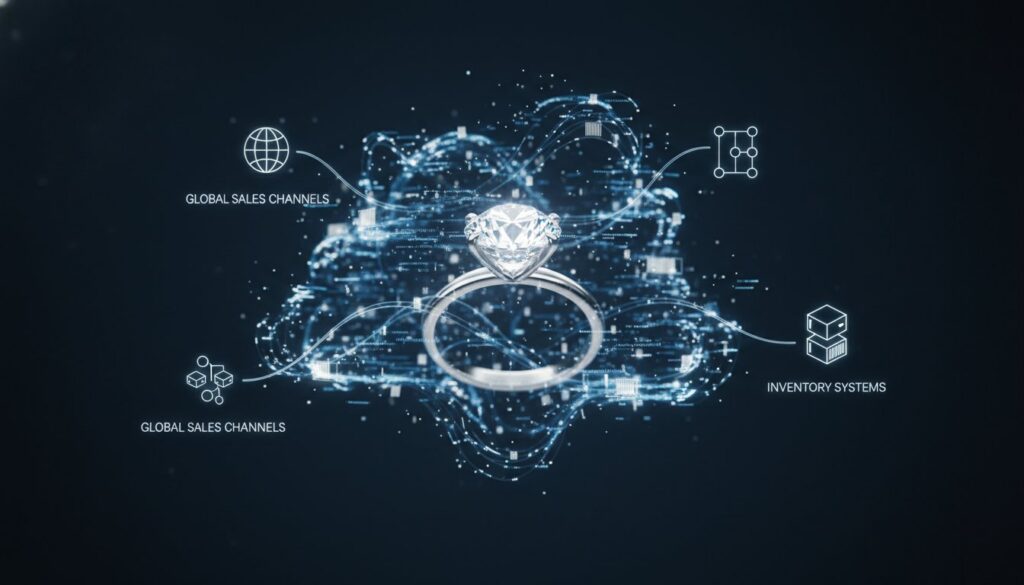
Managing “Global Stock” is the ultimate challenge for retailers dealing in high-value, unique items. When you sell a one-of-a-kind sapphire necklace, you can’t afford a five-minute delay in synchronization. Professional cloud-based jewelry management software triggers automated stock adjustments the second an order is placed on eBay, Etsy, or Amazon. This eliminates the risk of overselling, which can damage marketplace seller ratings. It also handles the nuances of “Memo” inventory and balances wholesale vs. retail stock levels, giving you total visibility into where your assets are at all times. If you’re tired of manual stock checks, it’s time to transition to a jewelry inventory management system that works in real-time.
Listing automation and integrated CRM complete the hub. Automation allows you to push hundreds of listings to new markets in hours, not weeks. Meanwhile, an integrated CRM ensures every customer interaction is logged, from the initial inquiry to final fulfillment. This level of control transforms a fragmented operation into a streamlined global enterprise. It empowers you to focus on growth rather than data entry.
Handling Complexity: Gemstones, Metals, and Certifications
Managing a jewelry brand requires more than basic inventory tracking. You’re dealing with volatile commodities and highly technical specifications that generic software simply can’t process. A professional cloud-based jewelry management software acts as the central brain, handling the critical distinction between “Unique” one-of-a-kind pieces and “Series” production items. While generic ERPs treat every item as a static unit, a jewelry-specific hub understands that a ring is a complex assembly of a Bill of Materials (BOM). This includes specific metal weights, casting costs, and individual stone characteristics that define the item’s final value.
Automating the Diamond and Gemstone Workflow
Jewelry production is rarely linear. You might have a series of 100 identical gold bands or a single engagement ring featuring a GIA-certified sapphire. Specialized systems ingest stone data to create thousands of unique SKUs automatically. By integrating GIA, IGI, and HRD certifications directly into the sales flow, you build immediate buyer trust. When the system ingests a grading report, it attaches that certificate to the online listing. This transparency increases conversion rates by providing the documentation high-end buyers expect. It also allows you to track stone provenance for ethical sourcing compliance, a requirement that is becoming non-negotiable in the 2026 market.
Dynamic Pricing Strategies for Precious Metals
Managing precious metals requires constant vigilance. Market fluctuations mean a price set on Monday might be unprofitable by Friday. A specialized hub uses Gold Feed Sync to link your product prices to real-time metal spot prices. This protects your margins without manual oversight. If the price of 18k gold rises, your entire catalog across every marketplace and your own website updates in a single click. It eliminates the risk of selling high-value items at outdated prices. The system also manages global currency conversions, allowing international jewelry brands to scale into new regions with confidence that their pricing remains accurate and competitive.
For manufacturers and custom designers, this level of technical precision is the difference between profit and loss. The software tracks the exact weight of gold and the specific stones used in every piece. This data flows directly into your Jewelry PIM, creating a detailed technical record that stays with the item through its entire lifecycle. Whether you’re using B2B sales tools to present to wholesalers or printing barcodes for a physical showroom, the precision of your data remains absolute. You transition from guessing your margins to controlling them with surgical accuracy.
This demand for specialized digital records is mirrored in other high-precision sectors; for example, those in industrial fabrication can visit SOCWeld to learn more about automating welding documentation and technical compliance.
Scaling Globally: The Multi-Channel Advantage
Manual data entry is the primary bottleneck for jewelry brands attempting to move from a single storefront to a global presence. If your team spends hours copy-pasting gemstone specifications into eBay, Etsy, and Amazon, your growth is capped by your headcount. A robust cloud-based jewelry management software functions as a high-speed distribution engine. It takes your verified PIM data and adapts it to the unique requirements of every marketplace algorithm simultaneously. This transition allows you to manage international logistics and fulfillment from a centralized dashboard, ensuring that a sale in London is processed with the same efficiency as one in New York.
Scaling globally also means mastering regulatory complexity. Effective July 8, 2026, the U.S. Consumer Product Safety Commission (CPSC) requires electronic submission of compliance certificates for jewelry exporters through the ACE system. Managing these mandates manually is a recipe for operational failure. A centralized hub integrates these requirements into your fulfillment workflow, protecting your brand from customs delays. By using cloud-based multi-channel listing automation, you move from reactive survival to proactive market expansion.
Conquering eBay, Etsy, and Amazon Simultaneously
Each marketplace has a distinct personality and technical requirement. Amazon demands rigid, structured data for its A10 algorithm, while Etsy prioritizes descriptive, keyword-rich titles and a more personal brand story. Professional systems use marketplace-specific templates to deploy listings rapidly without compromising quality. You can manage all customer communications, such as eBay messages and Etsy conversations, within a single interface. This centralized CRM approach ensures no inquiry falls through the cracks. It also allows you to synchronize marketing campaigns across the web, ensuring your seasonal promotions go live everywhere at the exact same moment.
Wholesale and B2B Expansion via Cloud Tools
Growth isn’t limited to direct-to-consumer sales. Your cloud hub should empower your wholesale operations through dedicated B2B sales tools. You can generate professional PDF catalogs and line sheets in minutes, pulling live data directly from your inventory. This eliminates the embarrassment of presenting out-of-stock items to retail partners. Specialized B2B portals allow your distributors to log in, view their specific pricing tiers, and place orders directly. The system can even automate the reordering process for your top-selling collections. This level of automation turns your wholesale department into a self-sustaining revenue stream while you focus on high-level strategy.
Finally, use your cloud analytics to identify which channels drive the highest margins. It’s not just about where you sell the most; it’s about where you keep the most profit after marketplace fees and shipping costs. Insights and Analytics tools provide the granular data needed to pivot your strategy in real-time. You gain the clarity to double down on high-performance channels and optimize or exit underperforming ones. This data-driven approach is what separates a local jeweler from a global eCommerce powerhouse.
Transitioning to Valigara: From Chaos to Control
Transitioning to a professional cloud-based jewelry management software shouldn’t feel like an operational gamble. Valigara positions itself as an Expert Insider, acting as a seasoned partner that understands the high-stakes nature of luxury retail. Our onboarding process isn’t a generic software tutorial. It’s a strategic alignment of our high-tech automation with your specific jewelry workflow. We focus on migrating your data from fragmented spreadsheets or generic ERPs without losing your vital business history. This ensures that your transition from chaos to control is as precise as the craftsmanship of the pieces you sell.
The core intelligence of your business resides in your data. Moving this data requires a system that understands the difference between a simple SKU and a complex jewelry assembly. Because Valigara is built by jewelers for jewelers, the platform recognizes the industry-specific nomenclature required for high-value listings. We don’t just host your data; we optimize it for global scalability. Whether you’re a boutique brand or an expanding global manufacturer, our scalability tiers ensure the software grows alongside your revenue, providing the B2B sales tools and API access you need at every stage.
Your First 30 Days with Valigara
Success begins with a structured implementation. During your first month, we prioritize data cleanup and Jewelry PIM setup. This phase organizes your catalog, ensuring every gemstone certification and metal specification is correctly mapped for search engine visibility. Next, we handle channel integration, connecting your marketplace accounts to the central hub. Finally, we automate your first workflow. Whether it’s implementing Gold Feed Sync or multi-channel listing automation, we ensure the software begins absorbing your manual labor immediately. You’ll move from managing individual tasks to overseeing an automated global enterprise.
The ROI of Specialized Management
The return on investment for specialized management is both measurable and immediate. By eliminating manual data entry across multiple platforms, brands save hundreds of hours annually, allowing staff to focus on high-value clienteling. You’ll see a direct reduction in overselling incidents, which protects your marketplace seller ratings and long-term customer trust. Use our insights and analytics to measure the impact of reduced stockouts and improved fulfillment speeds on your bottom line. Precision in inventory leads directly to precision in profit. If you’re ready to stop managing spreadsheets and start managing growth, Schedule your personalized Valigara demo today.
Secure Your Global Expansion in 2026
Transitioning to a high-performance cloud-based jewelry management software is no longer a luxury for the few; it’s an operational necessity for any brand aiming to lead in 2026. You’ve seen how centralizing your data through a specialized PIM eliminates the friction of manual entry and how real-time synchronization protects your reputation across global marketplaces. By automating the technical complexities of gemstone certifications and metal price fluctuations, you free your team to focus on what matters: craftsmanship and client relationships.
The shift from fragmented spreadsheets to a unified intelligence hub is the defining move for the modern jeweler. Valigara provides the Expert Insider advantage, currently managing over $3B in jewelry catalogs globally. With specialized tools for GIA and IGI certificate integration and real-time sync across eBay, Etsy, and Amazon, the platform ensures your operations remain as precise as your inventory.
Empower your jewelry brand with Valigara’s all-in-one management platform.
Your journey from manual workflows to a streamlined, global enterprise starts with a single, strategic decision. Take control of your digital future today.
Frequently Asked Questions
Is cloud-based jewelry software secure for high-value data?
Professional cloud-based jewelry management software uses enterprise-grade encryption and secure data centers that far exceed the security of a local office server. Access is controlled through role-based permissions, ensuring that sensitive gemstone data and customer records are only visible to authorized personnel. This infrastructure protects your high-value assets from physical hardware failure and cyber threats while providing reliable, global accessibility.
Can I manage my physical store and online sales in one cloud system?
You can manage both physical showrooms and digital storefronts from a single centralized hub. The system acts as the core intelligence of your business, tracking stock levels whether a sale occurs at your counter or through a global marketplace. This unified approach eliminates data silos and provides a single source of truth for your entire inventory and customer history.
Does cloud jewelry software support GIA and IGI certifications?
Specialized cloud jewelry software is built specifically to handle GIA, IGI, and HRD certifications. The Jewelry PIM allows you to attach digital certificates directly to the product record. These documents flow automatically to your online listings, building buyer trust by providing verifiable proof of quality for every diamond and gemstone in your catalog without manual uploads.
How long does it take to migrate from spreadsheets to Valigara?
The migration from spreadsheets typically occurs within the first 30 days of onboarding. This timeframe includes data cleanup, Jewelry PIM setup, and initial channel integration. While the exact duration depends on the complexity of your catalog, the process is designed to align the cloud-based jewelry management software with your existing workflow without disrupting your daily operations.
Can I sync my jewelry prices with the live gold market?
You can link your product pricing directly to live market fluctuations using Gold Feed Sync. The software monitors real-time metal spot prices and automatically adjusts your entire catalog across all sales channels. This protects your margins by ensuring you never sell high-value gold items at outdated, unprofitable prices, even during periods of high market volatility.
Does the software handle different ring sizes and metal variations automatically?
The software handles complex variations like ring sizes, metal types, and gemstone grades through industry-specific logic. Unlike generic eCommerce tools, it treats these variations as structured data points. This allows you to generate thousands of unique SKUs automatically, ensuring that every combination of metal and stone is accurately represented in your inventory and across all marketplace listings.
Is Valigara compatible with my existing website (Shopify, WooCommerce)?
Valigara is fully compatible with major platforms including Shopify, WooCommerce, Magento, and specialized jewelry eCommerce websites built on Vite. It uses multi-channel listing automation to bridge the gap between your website and global marketplaces. This ensures your product data remains consistent and synchronized across your entire digital footprint from a single dashboard.
What happens if I sell a one-of-a-kind piece on two channels at once?
Real-time inventory synchronization prevents the risk of selling a unique piece twice. The moment an order is placed on one channel, the software triggers an immediate update across all other connected platforms. This instant delisting ensures you never have to cancel a high-value order due to stock lag, protecting your marketplace seller ratings and customer reputation.