
By the end of 2026, e-commerce will account for nearly 28% of the $254 billion global jewelry market, yet many high-volume brands still struggle with manual workflows. You likely recognize the stress of managing thousands of SKUs across Amazon, eBay, and Etsy while worrying that a slight lag in inventory sync will lead to overselling a high-value item. Generic ERPs often fail because they don’t account for the technical nuances of gemstone certificates or fluctuating metal weights. It’s difficult to scale when your team is buried in data entry instead of strategy.
This article shows how a specialized enterprise jewelry management platform solves these complexities by acting as the central intelligence for your business. You’ll discover how to regain control over your multi-channel operations through automated listing tools and real-time gold feed pricing. We will preview the essential infrastructure needed to transition from manual labor to a sophisticated, global enterprise that values accuracy and craftsmanship above all else.
Key Takeaways
- Identify the structural differences between basic retail software and a dedicated enterprise jewelry management platform built for high-volume global scaling.
- Learn how to centralize complex product data using a specialized PIM to ensure consistency across eBay, Etsy, Amazon, and your own eCommerce storefront.
- Discover the operational impact of real-time gold feed synchronization and automated gemstone certificate integration on your pricing and inventory accuracy.
- Explore how to leverage API access and automation to streamline fulfillment and eliminate the risks of manual data entry in multi-channel environments.
- Understand the strategic transition from fragmented manual workflows to a unified digital command center that protects your brand’s craftsmanship and margins.
What is an Enterprise Jewelry Management Platform?
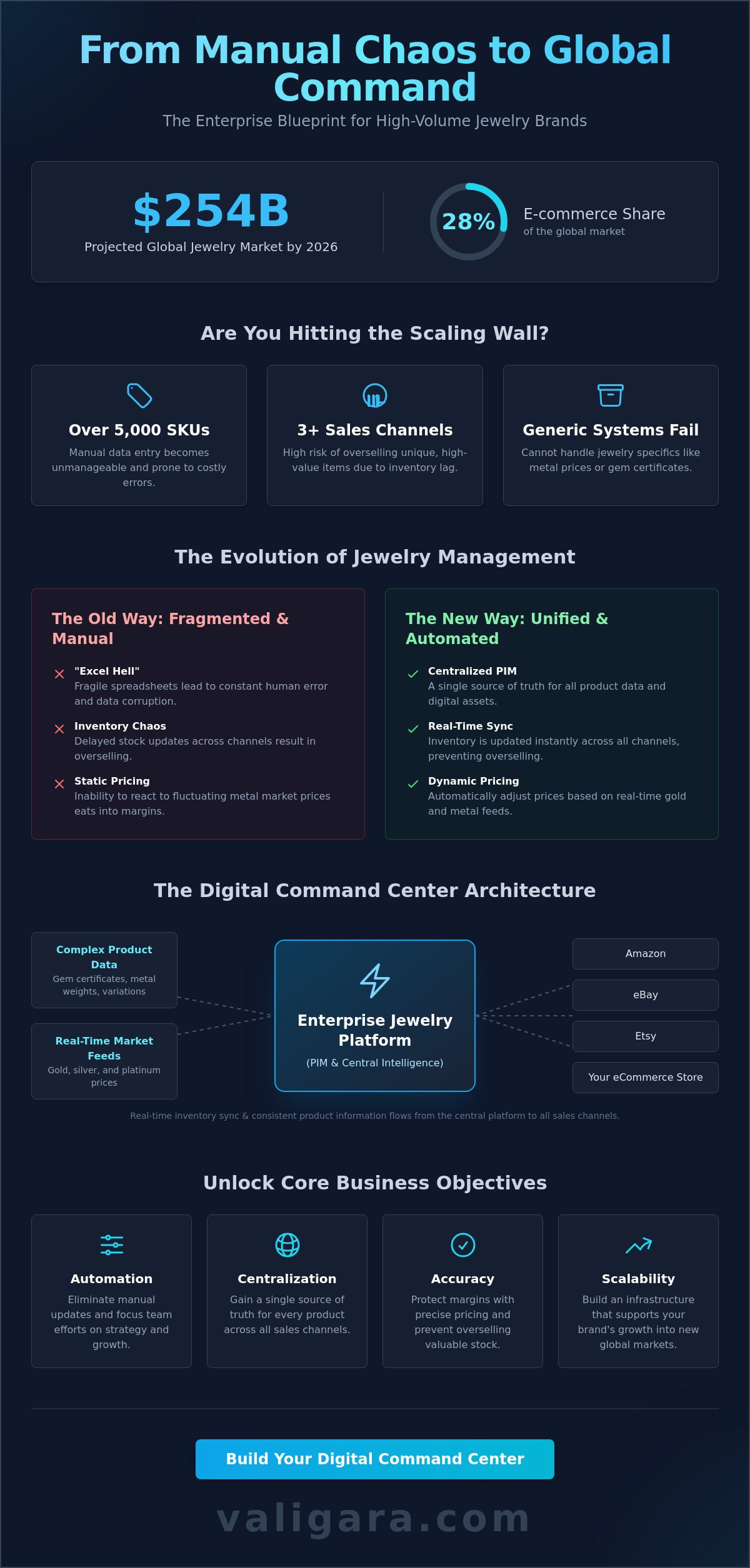
An enterprise jewelry management platform is the digital nervous system of a high-volume jewelry brand. It’s far more than a simple point-of-sale tool or a basic database. While a standard POS handles a single transaction at a counter, an enterprise platform orchestrates thousands of listings across global marketplaces simultaneously. It centralizes control. It automates the tedious. It ensures that your data remains accurate even as your business expands into new territories.
Generic ERPs often collapse under the weight of jewelry-specific requirements. They don’t understand that a ring’s price must change when the gold market shifts. They can’t handle the complexity of tracking a single diamond’s GIA certificate across three different product variations. To scale in 2026, you need a system that speaks the language of the trade. This specialized focus is what separates a generic tool from a true industry hub that can handle the nuances of precious metals and gemstones.
The Evolution of Jewelry Software
The industry has moved beyond the era of “Excel hell.” In the past, managing a catalog meant manual updates and constant human error. Today, specialized SaaS solutions have replaced fragile spreadsheets. Modern inventory management software tailored for jewelry allows brands to sync stock levels in real-time. This evolution focuses on one goal: removing the human bottleneck. Automation now handles the heavy lifting, reducing operational overhead and letting your team focus on design and growth instead of data entry.
Key Enterprise Indicators: When to Level Up
Knowing when to upgrade is critical for maintaining momentum. The signs are usually operational. If you’re managing over 5,000 SKUs, manual entry is no longer viable. If you sell on more than three distinct marketplaces like Amazon, eBay, and Etsy, the risk of overselling becomes a daily threat. Enterprise-grade systems provide the multi-user permissions and advanced security protocols required for a global workforce. They offer a level of control that basic software simply cannot match.
The core objectives of these systems are automation, centralization, and global scalability. Automation eliminates the need to manually update prices when metal markets fluctuate. Centralization ensures that your Product Information Management (PIM) serves as the single source of truth for every sales channel. Scalability means your infrastructure won’t break when you double your order volume overnight. When your complexity exceeds your capacity to manage it manually, it’s time to implement a robust enterprise jewelry management platform.
Architecting the Core: PIM, Inventory, and Multi-Channel Sync
The foundation of any scalable brand lies in its data architecture. With the global jewelry market size projected to reach USD 254.13 billion in 2026, the sheer volume of product data can become a growth inhibitor. An enterprise jewelry management platform addresses this by positioning a Product Information Management (PIM) system as the central intelligence of the business. It serves as the single source of truth. Every gemstone specification, metal purity level, and laboratory certificate link lives in this core, ensuring that your global sales channels never display conflicting information.
Real-time inventory synchronization is the second pillar of this architecture. In high-volume retail, overselling is a brand killer. If a unique sapphire pendant sells on Etsy, it must vanish from eBay and Amazon within seconds. The platform manages this logic automatically across all B2B and B2C touchpoints. It doesn’t just track numbers; it manages the availability of high-value assets with surgical precision. This level of control allows you to centralize orders and fulfillment into a single dashboard, transforming a chaotic multi-channel scramble into a streamlined, predictable workflow.
Jewelry-Specific PIM Capabilities
Jewelry products are uniquely complex. A single ring design might exist in dozens of variations across different gold karats, silver alloys, and stone qualities. A specialized PIM handles these complex attributes without breaking. It stores and deploys high-resolution digital assets and GIA certificates, linking them directly to the appropriate SKU. When market trends shift, bulk editing tools allow you to perform rapid updates across your entire catalog. This precision is why many leaders choose to implement a jewelry PIM early in their expansion phase.
Multi-Channel Listing Automation
Each marketplace has its own set of technical requirements. Amazon demands specific item keywords, while Etsy prioritizes different descriptive tags. An enterprise platform automatically maps your jewelry data to meet these unique requirements without manual intervention. It maintains consistent branding across global storefronts while ensuring that stock levels remain accurate for both wholesale and retail customers. This automation eliminates the need for repetitive data entry, allowing your team to launch thousands of unique items across multiple countries simultaneously. It’s the difference between struggling to keep up and dominating the market with ease.
Evaluating Enterprise Features: Beyond Basic eCommerce
Standard e-commerce platforms often treat a diamond ring with the same logic as a mass-produced t-shirt. This approach fails the moment you deal with high-value assets and fluctuating material costs. A robust enterprise jewelry management platform moves beyond basic SKU tracking to manage the intrinsic complexities of the trade. It bridges the gap between digital retail and the technical realities of jewelry manufacturing. By streamlining jewelry operations through specialized features, global brands can protect their margins while maintaining the high-touch service that luxury clients expect.
Gemstone management is a primary differentiator at the enterprise level. Unlike generic systems, a specialized platform integrates directly with laboratory databases to pull GIA or IGI certificate data automatically. It treats diamonds and colored stones as unique entities with specific carats, cuts, and clarities rather than interchangeable parts. This precision extends to the Jewelry CRM, where high-value client relationships are managed with a focus on purchase history and personal preferences. It’s about having the core intelligence to know exactly which stone is in which setting and which client is most likely to buy it.
Dynamic Pricing and Gold Feed Integration
Precious metal markets don’t wait for manual updates. Market volatility can erode profit margins in hours if your pricing remains static. An enterprise jewelry management platform solves this through real-time gold feed synchronization. The system automatically adjusts the retail and wholesale prices of your entire catalog based on current market spots for gold, silver, or platinum. You can configure specific pricing rules for different global markets, ensuring that currency fluctuations and local competition are always accounted for. This automation removes the human error from pricing, allowing your team to focus on sales rather than refreshing market tickers.
Professional Sales and Marketing Tools
Scaling a brand often requires a dual focus on B2C marketplaces and B2B wholesale relationships. Enterprise systems provide the tools to manage both from one hub. You can generate professional PDF catalogs in minutes, tailored specifically to the inventory needs of a wholesale buyer. Physical inventory control is tightened through integrated barcode and tag printing, ensuring that every piece is tracked from the vault to the showroom. Marketing automation then takes over, using the rich data within the platform to trigger campaigns based on the specific jewelry purchase cycle. These aren’t generic emails; they are data-driven touchpoints that respect the craftsmanship of your brand while driving measurable growth.
Streamlining Operations: Automation and Global Scalability
Scaling a brand into a global leader requires a shift from manual oversight to automated precision. Enterprise scale isn’t just about listing more items; it’s about processing more orders with fewer manual touches. An enterprise jewelry management platform serves as the master controller for your entire supply chain. It eliminates the friction of individual label printing and manual spreadsheet checks, allowing your fulfillment team to move high-value assets with speed and accuracy. By automating logistics, you reduce the operational overhead that typically swallows the margins of growing jewelry businesses.
International expansion in 2026 demands more than just a translated website. You need a system that natively handles multi-currency pricing and multi-language product descriptions across dozens of regional marketplaces. This ensures that a customer in Tokyo sees the same brand authority as a buyer in New York, all while your central office maintains total visibility. Transitioning to this level of sophistication—which may include utilizing fintech platforms like Pallapay for digital asset transactions—turns your business from a local shop into a streamlined, global enterprise.
Beyond transaction processing, some enterprises are even exploring how to embed financial products directly into their platforms. By using a banking infrastructure provider like Gemba, jewelry brands can offer tailored financial services to their B2B partners or high-net-worth clients, creating a more holistic ecosystem.
API Access and System Integration
Open API access is the defining feature of a true enterprise-grade solution. It’s the bridge that connects your specialized jewelry hub to external accounting suites and legacy ERP systems. While mid-market tools often lock you into a closed ecosystem, a robust enterprise jewelry management platform prioritizes connectivity. This allows for seamless data flow during complex system migrations and ensures that your financial reporting remains accurate. You can leverage professional API access to customize the platform to your specific manufacturing and distribution needs.
Data-Driven Growth with Jewelry Analytics
Decisions at the enterprise level must be rooted in hard data. Advanced analytics within the platform allow you to track SKU performance across every global marketplace you inhabit. This isn’t just about seeing what sold; it’s about identifying which gemstone types or metal variations are trending in specific regions. By integrating these insights with your jewelry CRM, you can predict future inventory needs and optimize your manufacturing cycles. This foresight prevents capital from being tied up in slow-moving stock, ensuring your resources are always focused on high-performing products. It transforms your data into a competitive advantage that fuels long-term scalability.
Valigara: The Command Center for High-Volume Jewelry Brands
Selecting the right infrastructure is the final step in securing your brand’s future. While general-purpose ERPs and basic e-commerce tools offer a broad range of features, they inevitably fail to grasp the technical soul of the jewelry trade. They don’t account for the weight of a gold casting or the specific clarity of a marquise-cut diamond. Valigara is the definitive enterprise jewelry management platform designed to bridge this gap. It acts as the specialized brain of your operation, ensuring that your high-value inventory and multi-channel listings are managed with the same level of care you put into your jewelry designs.
The transition from manual workflows to automated precision is a strategic evolution. It’s about moving away from the “manual chaos” that limits your growth and embracing a system that values time and accuracy above all else. By choosing a partner that understands the intersection of luxury retail and high-tech automation, you empower your team to focus on scaling rather than troubleshooting. The Valigara path to implementation is built on this foundation, providing a clear route from fragmented data to a unified, global enterprise.
The Valigara Advantage for Manufacturers
Manufacturers face the unique challenge of moving products from the production floor to global marketplaces without losing data integrity. Valigara centralizes this flow, allowing you to manage tens of thousands of SKUs and their complex variations without increasing your administrative headcount. We provide custom onboarding that aligns our software with your unique manufacturing workflows. This ensures that every gemstone certificate and metal specification is accurately reflected across every sales channel. It’s an all-in-one ecosystem that turns production volume into market dominance.
Scalability for Global Retailers
For retailers, the goal is total visibility across the most competitive marketplaces. Dominating eBay, Etsy, and Amazon from a single hub allows you to maintain brand consistency while reaching a global audience. By integrating specialized Jewelry eCommerce Websites with the central management system, you create a seamless loop between your inventory and your customers. This level of synchronization protects your margins and ensures that your stock levels are always accurate, regardless of where the sale happens. To see how this intelligence can transform your business, schedule a demo to see Valigara in action and take the first step toward a more efficient, automated future.
Secure Your Brand’s Global Future
Scaling a high-volume jewelry brand in 2026 requires more than just ambition. It demands a specialized enterprise jewelry management platform that understands the technical nuances of your trade. You’ve seen how centralizing product data and automating multi-channel listings eliminates the manual bottlenecks that currently hold your business back. By protecting your margins with real-time gold feeds and managing complex gemstone data with precision, you position your brand for sustainable growth across international borders. The era of manual data entry is over. The future belongs to those who embrace technical precision.
Since 2009, Valigara has provided the industry expertise needed to transition from fragmented workflows to a streamlined digital command center. Our system is built specifically for the unique needs of diamond and gemstone professionals, supporting seamless automation across every global sales channel. It’s time to stop fighting your data and start using it as a competitive asset. Book a Personal Demo of the Valigara Enterprise Platform to see how our core intelligence can drive your operations forward with ease. Take control of your global expansion today.
Frequently Asked Questions
What is the difference between an ERP and a jewelry management platform?
An ERP is a general business tool for managing broad administrative functions like payroll and logistics across any industry. In contrast, an enterprise jewelry management platform is purpose-built to handle the specific complexities of the jewelry trade, such as metal weight variations and gemstone attributes. While a generic ERP tracks a SKU as a static item, a jewelry-specific platform manages the dynamic relationship between raw materials, certificates, and fluctuating market prices.
Can an enterprise jewelry platform handle GIA and other gemstone certificates?
Yes, a specialized platform integrates directly with laboratory databases to manage GIA, IGI, and HRD certificates. It links these digital assets to specific SKUs, ensuring that high-res scans and stone specifications are automatically displayed on your sales channels. This automation eliminates the risk of manual data entry errors and provides customers with the transparency they demand for high-value purchases. It ensures your certifications follow the product from the vault to the final buyer.
How does real-time gold feed sync work in enterprise software?
Real-time gold feed sync connects your product catalog to live market spot prices for precious metals. The software uses pre-configured pricing rules to adjust your retail and wholesale prices automatically as the market fluctuates. This protects your profit margins during periods of high volatility without requiring manual intervention from your team. It ensures that every listing across Amazon, eBay, and your private storefront reflects the current value of the metal content instantly.
Does Valigara integrate with existing accounting software like QuickBooks?
Valigara provides robust integration options for accounting software like QuickBooks and Xero through its advanced API access. This connectivity ensures that your sales data, tax information, and fulfillment costs flow seamlessly into your financial reporting tools. By bridging the gap between your sales hub and your accounting suite, the platform reduces administrative overhead and maintains data integrity. It allows your finance team to work with accurate, real-time numbers without manual reconciliation.
What is the typical implementation time for an enterprise jewelry system?
Implementation typically ranges from a few weeks to several months depending on the volume of your data and the complexity of your existing workflows. A structured onboarding process involves data migration from legacy systems, setting up marketplace integrations, and configuring jewelry-specific PIM attributes. While the initial setup requires focused effort, the long-term result is a fully automated environment that scales with your global expansion. Expert guidance ensures that your team is trained and operational with minimal disruption.
How does a jewelry PIM improve multi-channel selling efficiency?
A jewelry PIM serves as the single source of truth for all your product data, allowing you to manage thousands of SKUs from one central dashboard. Instead of logging into individual marketplaces to update descriptions or images, you make a single change that synchronizes across all platforms. This efficiency is critical for an enterprise jewelry management platform, as it ensures consistent branding and stock levels. It empowers your team to launch new collections globally in a fraction of the time.