
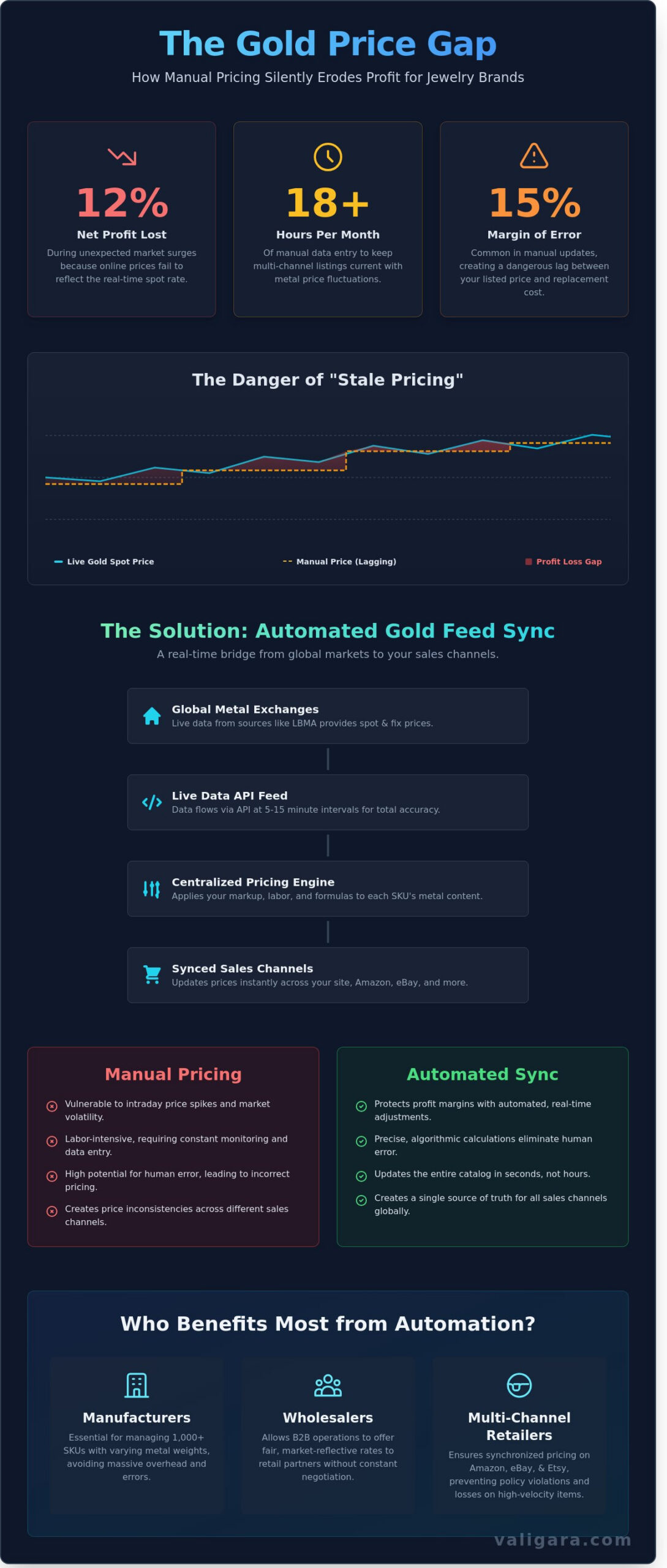
Every minute you spend manually recalculating the price of a 14k gold band is a minute you aren’t scaling your global jewelry brand. Most retailers lose up to 12% of their net profit during unexpected market surges because their online prices fail to reflect the current spot rate in real time. Managing a multi-channel presence on Amazon, eBay, and Etsy often requires 18 hours of manual data entry every month just to stay current with metal fluctuations. This creates a dangerous lag where your listed price falls below your actual replacement cost. You know that in the luxury trade, precision is the only way to maintain customer trust. Integrating a professional gold feed sync is the only way to protect your bottom line without sacrificing your time.
You deserve a system that works as hard as your craftsmanship. This article explains how to integrate live market data directly into your sales channels to eliminate manual errors and centralize your pricing strategy. We’ll show you how to reclaim those lost hours of productivity and transform your operation into a streamlined, high-tech enterprise that dominates the global jewelry market with total pricing accuracy.
Key Takeaways
- Stop losing revenue to market volatility by understanding how automated bridges connect live metal markets directly to your jewelry listings.
- Master the technical workflow of gold feed sync to automatically map metal purity and weight across your entire SKU catalog.
- Protect your profit margins from intraday price spikes with automated pricing formulas that eliminate human error and labor-intensive manual updates.
- Learn how to audit your inventory data and establish precise pricing relationships between spot prices, metal fineness, and your brand’s markup.
- Discover how to scale your jewelry brand globally by synchronizing real-time price updates across multiple sales channels from a single, centralized engine.
What is Gold Feed Sync and Why Does Your Jewelry Business Need It?
Gold feed sync is the automated bridge between global metal exchanges and your eCommerce storefront. It functions as a live data pipeline that adjusts your jewelry prices based on the current market value of precious metals. For a business selling 18k gold engagement rings or heavy platinum chains, this technology isn’t a luxury; it’s a fundamental requirement for protecting margins. It replaces the error-prone process of manual price adjustments with a precise, algorithmic calculation that updates your entire catalog in seconds.
Manual updates create what we call the Gold Price Gap. In a 24-hour trading cycle, bullion prices can swing by 2% or more due to geopolitical shifts or economic data releases. If you’re managing a catalog of 500 gold pendants, a human employee cannot possibly update every listing fast enough to keep pace with these fluctuations. This lag results in “stale pricing,” where you’re either overpricing and losing sales to competitors or underpricing and selling your inventory at a loss. Understanding the factors that influence gold prices is essential for any jeweler, but reacting to them manually is a recipe for operational failure.
Generic eCommerce platforms like Shopify or Magento aren’t built for the jewelry trade. They treat products as static units with fixed costs. They don’t understand that a ring’s price is a fluid equation involving metal weight, purity, and labor. Without a specialized gold feed sync integration, these platforms force you to use flat pricing, which leaves you vulnerable to market volatility. By centralizing your pricing logic within a dedicated jewelry PIM, you create a single source of truth. This ensures that every sales channel, whether it’s your retail site or a wholesale portal, displays the correct price at the exact moment a customer clicks “buy.”
The Anatomy of a Live Metal Feed
A professional feed distinguishes between spot prices and fix prices. Spot prices represent the current trading value on the 24-hour market, while fix prices, such as the LBMA Gold Price, are set twice daily. Most high-volume jewelry enterprises prefer a feed that updates at 5-minute or 15-minute intervals to maintain absolute accuracy. The data flows via API from the exchange directly into your management system, which then applies your specific markup and labor formulas to the current metal weight of each SKU.
Who Benefits Most from Pricing Automation?
- Manufacturers: Those handling 1,000+ SKUs with varying gold weights need automation to avoid massive overhead in catalog management.
- Wholesalers: B2B operations rely on dynamic pricing to offer fair, market-reflective rates to their retail partners without constant negotiation.
- Multi-Channel Retailers: Sellers active on eBay or Amazon need synchronized pricing to ensure they don’t violate marketplace policies or lose money on high-velocity items during a market spike.
How Real-Time Gold Price Integration Works
The bridge between global markets and your storefront relies on a four-stage technical architecture. It begins with raw market data. This data flows through an API into a dedicated pricing engine. From there, the system pushes updates to every connected sales channel. A robust gold feed sync ensures that a price change in London or New York reflects on your website within 60 seconds. This automation eliminates the 15% margin of error common in manual updates, protecting your jewelry brand from sudden market volatility.
Precision requires mapping the exact metal content of every SKU in your catalog. For a 14K gold ring weighing 4.2 grams, the system calculates 58.5% of the current 24K spot price. It applies these variables across your entire inventory, whether you carry 10K, 18K, or 24K pieces. By separating the “Metal Component” from “Labor and Markup,” you stabilize your profit margins. Fixed costs like casting, stone setting, and hallmarking remain static. Meanwhile, the volatile metal value fluctuates automatically based on global commodity price data provided by authoritative financial sources.
Global selling demands sophisticated multi-currency support. The pricing engine converts live rates into local currencies like EUR, GBP, or JPY using real-time exchange feeds. This ensures a customer in Tokyo sees a price as accurate as one in New York. Valigara’s logic handles these conversions instantly, ensuring your international storefronts remain competitive without requiring 24-hour manual supervision.
The Role of Jewelry-Specific PIM
Standard inventory tools treat price as a static field. They fail because they can’t calculate dynamic metal values based on purity and weight. A jewelry-specific PIM defines gold weight as a dynamic variable in your database. Valigara’s PIM centralizes these complex calculations, acting as the single source of truth for your brand. It allows you to manage complex jewelry inventory and synchronize it across 15+ marketplaces simultaneously. This centralized control transforms how you handle high-volume collections.
API Connectivity and Data Reliability
Reliability depends on the quality of your API integration. Professional systems pull from trusted providers like Kitco or Reuters to maintain 24/7 accuracy. Speed is a critical factor. High-frequency trading means even a 5-minute latency can cost a retailer $300 on a high-weight 18K chain during a market spike. Fail-safes are mandatory. If a data feed is interrupted, the gold feed sync must lock prices at the last known reliable rate to prevent underpricing your stock during an outage.
Manual vs. Automated Pricing: Protecting Your Profit Margins
Manual inventory management is a silent profit killer for the modern jeweler. For a business managing over 500 SKUs across multiple marketplaces, updating prices daily is a logistical nightmare. Human error accounts for approximately 18% of pricing discrepancies in manual jewelry retail operations. A gold feed sync eliminates this vulnerability by tying your digital storefront directly to live market rates, ensuring your margins remain intact without constant supervision.
Margin erosion happens fast. Consider a 14K gold bridal set weighing 8 grams. If the gold market spikes by $50 per ounce, your raw material cost increases by nearly $9 per unit instantly. According to historical gold price data, these intraday swings are no longer rare occurrences. If you sell 15 sets before your team manually adjusts the price, you’ve leaked $135 in pure profit. Automated systems prevent this by recalculating the retail price the moment the spot price moves.
Beyond protection, automation provides a sharp competitive edge. When gold prices drop, sellers using a gold feed sync can lower their prices instantly. This allows them to capture price-sensitive shoppers while competitors are still stuck at yesterday’s higher rates. It also preserves customer trust. There’s nothing more damaging to a brand’s reputation than canceling an order because the item was “mispriced” due to a market shift. Automation ensures the price a customer sees is always the price you can afford to honor.
The ROI of Automation
Managing 1,000 SKUs across four channels typically requires 30 to 45 labor hours per month for basic price maintenance. Automation slashes this to nearly zero. By removing the need for “price protection” buffers, you can stop padding your prices by an extra 5% to 8% to cover volatility. This allows you to keep your prices tight and aggressive. It enables a single operator to handle 10,000+ listings without hiring additional administrative staff, making global scalability a reality rather than a burden.
Risk Management and Safety Nets
Effective automation isn’t just about speed; it’s about control. Professional jewelry software acts as the central brain of your operation, providing safety nets that prevent radical price swings.
- Floor and Ceiling Prices: Set absolute minimums to ensure you never sell below your COGS (Cost of Goods Sold), regardless of market drops.
- Volatility Alerts: Get notified immediately if the market exceeds a specific threshold, such as a 4% shift within a single trading day.
- Detailed Audit Trails: Track every price adjustment across every channel to maintain a transparent history of your pricing strategy.
Implementing Gold Feed Sync: A Step-by-Step Integration Guide
Precision is the foundation of high-volume jewelry retail. Transitioning to an automated gold feed sync requires a meticulous audit of your current digital catalog. If your weights are off by even 0.1 grams, a sudden $50 surge in gold spot prices leads to significant margin erosion across a 5,000-SKU inventory. You’ve got to ensure every piece is ready for the engine to take over.
Data Preparation and Cleaning
Success begins with a clean data set. We’ve found 85% of pricing errors during automation stem from missing metal attributes. Identify every listing missing a specific metal weight or purity grade. Standardize your units immediately; mixing grams and pennyweights in one database is a recipe for disaster. Use bulk-upload tools to update your catalog. This creates the “single source of truth” your gold feed sync relies on for accurate calculations. For diamond jewelry, this same principle of data accuracy extends to your certification records — mastering GIA certificate management ensures that stone attributes like clarity and cut grades are just as precisely captured as your metal weights.
Configuring the Pricing Engine
Your pricing engine applies a logical formula: (Spot Price * Purity * Weight) + Labor + Profit Margin. Different rules apply to different collections. An 18K gold ring requires a 0.750 multiplier while 14K uses 0.585. Test the logic in a sandbox environment first. Verify that a $2,000 spot price translates correctly across 950 Platinum and 18K Gold lines before risking live capital. This ensures technical precision before the first automated update.
Once your logic is sound, select your integration depth. High-volume sellers typically opt for full automation to handle the 24-hour market cycle. If you prefer more oversight, a semi-automated “approval mode” lets you review price shifts before they hit the storefront. This centralized control allows you to push synchronized updates to eBay, Etsy, and Amazon simultaneously. It eliminates the 4-hour manual update window that often leaves jewelry brands vulnerable to market volatility. You’re no longer just reacting to the market; you’re commanding it from a single dashboard. For jewelers looking to expand their diamond sourcing without tying up capital in physical inventory, integrating a platform like Nivoda’s diamond marketplace alongside your gold feed sync creates a fully automated, multi-attribute product pipeline.
Ready to eliminate manual pricing errors and scale your operations? Explore Valigara’s jewelry-specific automation tools and take control of your global margins today.
Scaling with Valigara’s Intelligent Gold Price Synchronization
Valigara functions as the specialized engine for your jewelry operation. By embedding the gold feed sync into your core inventory management, you remove the danger of selling 18k bridal sets at outdated market rates. When the LBMA or COMEX prices shift, Valigara instantly applies those changes across your entire catalog. This isn’t just about gold. The system handles silver, platinum, and even integrates Rapaport price lists for diamond jewelry. This multi-metal capability ensures your 925 sterling silver collections and high-end platinum bands remain profitable regardless of daily market volatility. The gold feed sync provides the foundation for a truly scalable business by acting as your single source of truth.
Transitioning from a manual seller to a global enterprise requires more than just a website; it requires a centralized nervous system. Valigara allows you to manage thousands of SKUs across multiple continents from one dashboard. One update in Valigara triggers instant price adjustments across your web store and global marketplaces. This level of automation means you can focus on design and customer acquisition while the software handles the heavy lifting of financial precision. For sellers carrying certified diamond pieces, pairing this pricing automation with automated GIA certificate management creates a fully synchronized product record that keeps both metal values and gemstone specifications accurate across every channel.
The Valigara Advantage
Generic apps like Shopify Flow aren’t designed for the complexities of jewelry manufacturing and retail. They lack the logic to handle metal volatility alongside gemstone markups. Valigara provides native integration with eBay, Etsy, and Amazon jewelry categories. This means your technical specifications, from metal fineness to stone clarity, stay synced with your pricing. Our expert onboarding team assists you in setting up advanced pricing rules that account for 3% to 5% casting loss and specific labor costs. This transition from manual updates to automated synchronization typically saves enterprise jewelers over 40 hours of administrative work every month.
Future-Proofing Your Jewelry Brand
Market data suggests that by 2026, 90% of luxury consumers will demand real-time pricing transparency during their digital journey. Valigara prepares you for this shift. Our platform provides the analytics needed to track how price dips or spikes impact your sales volume. You can see exactly which price points trigger the most “Add to Cart” actions for your 14k gold hoops or diamond studs. This intelligence turns your pricing strategy into a competitive weapon. It’s time to stop acting like a local boutique and start operating like a global powerhouse. Scale your jewelry business with Valigara’s automated pricing tools to ensure your brand remains the most accurate and reliable option for your customers.
Secure Your Margins with Intelligent Automation
Market volatility shouldn’t dictate your brand’s profit margins. By implementing a robust gold feed sync, you eliminate the 10% to 15% margin erosion caused by delayed manual price updates across global platforms. Since 2009, Valigara has operated as the industry’s specialized PIM, providing the technical precision required to manage multi-attribute jewelry data. We’re trusted by members of the Israeli Diamond Exchange to handle the serious business of scaling high-value inventory. Our platform serves as your central engine. It offers total control over eBay, Etsy, Amazon, and Shopify from one dashboard. This transition from manual labor to high-tech synchronization ensures your rings and gemstones are always priced accurately against live market fluctuations. You don’t have to spend hours updating spreadsheets when you can deploy a system that handles the heavy lifting for you. It’s time to stop reacting to market shifts and start operating as a streamlined, global enterprise. Your business deserves the accuracy that only a jewelry-specific solution can provide. Automate your jewelry pricing with Valigara today and take command of your global sales strategy.
Frequently Asked Questions
What is a gold feed sync in jewelry eCommerce?
A gold feed sync is an automated API connection that links live market metal prices directly to your jewelry inventory. Valigara’s gold feed sync eliminates manual recalculations for 1,000+ SKUs by updating the price component based on the current market value of the metal content in each ring or necklace.
This technology ensures your retail prices reflect the actual cost of materials in real time. It transforms your operation from a manual spreadsheet process into a streamlined, global enterprise that protects your margins automatically.
How often does the gold price update in Valigara?
The system fetches live market data every 15 minutes to ensure your margins remain protected. This frequency prevents losses during high volatility periods where gold might fluctuate by 3% or more in a single trading day. You maintain a 100% accurate price point across eBay, Etsy, and your Shopify store without manual intervention.
Can I set different markups for different marketplaces?
You can apply unique pricing formulas for each sales channel to account for varying commission structures. For example, you might set a 20% markup for your direct website while applying a 35% markup for Amazon to cover their 15% referral fee. Valigara acts as the central engine, calculating these distinct final prices automatically from the same base metal cost.
Does gold feed sync work for silver and platinum as well?
The gold feed sync functionality extends to all major precious metals including silver, platinum, and palladium. You define the metal type and purity, such as 925 silver or 950 platinum, in the product specifications. The system then pulls the specific spot price for that metal, ensuring your entire catalog of bridal sets and fine jewelry stays profitable regardless of the material.
Will my listings be deactivated during a price update?
Your listings remain active and searchable throughout the entire synchronization process. Valigara uses background API updates to push new pricing data to marketplaces, which ensures 0% downtime for your storefronts. Customers can continue browsing and purchasing your diamond earrings while the system recalibrates the price in the background.
What happens if the live gold market closes on weekends?
The system maintains the last recorded market price from Friday’s close until the markets reopen on Sunday evening. Since global trading pauses, your prices stay locked at the most recent official rate. This stability protects your 48 hour weekend sales window from artificial price spikes or data gaps while the LBMA or COMEX exchanges are offline.
Do I need technical skills to set up the pricing formulas?
You don’t need coding knowledge to build complex pricing rules within the Valigara interface. We provide a visual formula builder where you combine variables like metal weight, stone cost, and labor fees. Most users have their first 500 listings synced and live within 2 hours of initial setup using our pre-configured jewelry industry templates.
How does automated pricing affect my SEO on marketplaces like Etsy?
Frequent, accurate updates signal to marketplace algorithms that your shop is active and professionally managed. Platforms like Etsy and eBay prioritize listings with consistent data flow. By keeping your prices aligned with market reality, you avoid the “stale listing” penalty. Shops using automated sync often see a 12% increase in organic visibility due to regular API activity and improved price competitiveness.