
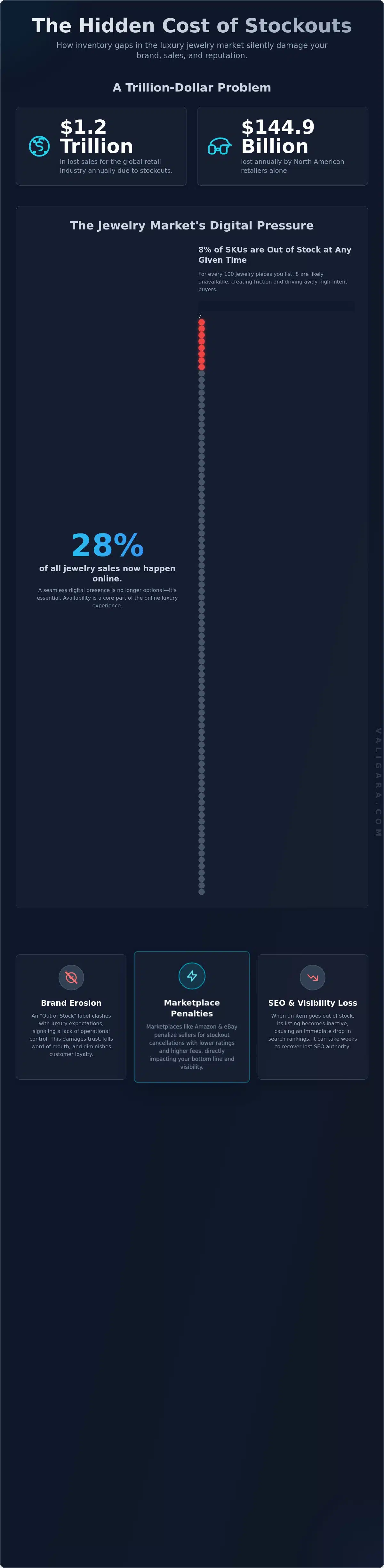
Did you know that stockouts cost the global retail industry $1.2 trillion in lost sales every year, with North American retailers alone hemorrhaging $144.9 billion? For a specialized jewelry brand, these aren’t just abstract figures on a spreadsheet. They represent missed connections with high-value clients and damaging marketplace penalties for canceled orders. Learning how to avoid stockouts in jewelry retail is no longer a back-office task; it’s a core requirement for protecting your brand reputation in a market where 28% of all jewelry sales now happen online.
You already know that manual inventory updates are a drain on your time and a primary source of synchronization errors. It’s exhausting to watch a piece sell out on your website while the listing remains active on a global marketplace, leading to a frantic scramble to manage customer expectations. This strategic guide promises to help you master the precision of jewelry inventory management to eliminate these gaps entirely. We’ll examine the shift toward AI-powered forecasting and multi-channel automation, providing a clear path to transform your operation into a streamlined, global enterprise that values accuracy above all else.
Key Takeaways
- Identify the hidden costs of stockouts in the luxury sector and why missed high-ticket sales are harder to recover than standard retail transactions.
- Learn how to avoid stockouts in jewelry retail by moving beyond manual spreadsheets to a jewelry-specific PIM designed for complex product data.
- Eliminate the risk of marketplace penalties by implementing real-time multi-channel synchronization to prevent selling “ghost inventory” across Etsy, eBay, and Amazon.
- Leverage centralized insights and historical sales data to transition from reactive restocking to proactive, data-driven inventory forecasting.
- Scale your operations by automating repetitive workflows, freeing your team to focus on high-value activities like craftsmanship and strategic marketing.
The Invisible Cost of Stockouts in Jewelry Retail
In the high-stakes world of luxury commerce, understanding what is a stockout requires looking beyond a simple zero on an inventory sheet. For a jewelry retailer, it signifies a critical breakdown in the supply chain that halts the customer journey at its most vulnerable point. Unlike fast fashion, where a consumer might easily swap one generic item for another, jewelry purchases are often deeply emotional and highly specific. When a shopper finds the perfect 18k gold sapphire ring or a bespoke anniversary piece, there is no substitute. If the item is unavailable, they don’t buy an alternative from your collection. They simply leave for a competitor who can fulfill their desire immediately.
The financial implications are staggering. Research shows that stockouts cost the global retail industry $1.2 trillion in lost sales annually. In the jewelry sector, where 8% of SKUs are typically out of stock at any given time, the damage extends far beyond the immediate transaction. A single missed sale of a high-ticket item can represent thousands of dollars in lost revenue. More importantly, it erodes the lifetime customer value. Mastering the logistics of how to avoid stockouts in jewelry retail is essential for protecting these high-value relationships before they migrate to another brand permanently.
Brand Erosion and the Luxury Expectation
Luxury availability is a core brand promise. When a client visits your digital storefront, they expect a seamless experience that reflects the craftsmanship of your pieces. Seeing an “Out of Stock” label on a signature item creates immediate friction. It signals a lack of operational control that clashes with the prestige of a luxury brand. This failure doesn’t just lose a sale; it kills word-of-mouth referrals and diminishes customer loyalty. In an industry built on trust and exclusivity, being unable to deliver is the ultimate brand detractor.
Marketplace Penalties and SEO Impact
The technical consequences of poor inventory management are equally severe. Global marketplaces like eBay and Amazon prioritize reliability; they actively penalize sellers for “out-of-stock” cancellations with lower seller ratings and higher fees. When your inventory hits zero, your listing goes inactive, causing an immediate drop in search rankings. This “re-ranking” struggle is a silent killer. Even after you restock, it can take weeks of consistent sales to recover your previous visibility. Implementing a centralized system is the only way to truly understand how to avoid stockouts in jewelry retail across diverse digital storefronts while maintaining your hard-earned SEO authority.
Why General Inventory Tools Fail Jewelry Brands
Many growing brands fall into the “Spreadsheet Trap,” relying on manual data entry to track high-value assets. While this might suffice for a boutique with a handful of items, it becomes a significant operational liability as soon as you surpass 100 SKUs. Standard retail platforms treat jewelry like any other commodity, failing to account for the technical precision required to manage precious metals and certified gemstones. To understand how to avoid stockouts in jewelry retail, you must first acknowledge that general-purpose tools lack the granular data fields necessary for luxury goods. They cannot distinguish between a 14k gold setting and an 18k version of the same design, leading to inaccurate stock levels and missed sales opportunities.
High-value, low-volume inventory requires a level of oversight that generic systems simply don’t provide. While basic effective inventory management strategies like ABC analysis offer a starting point, they don’t address the unique complexities of jewelry. In this industry, a stockout isn’t just a missing item; it’s often a missing component that halts the entire production or fulfillment cycle. Relying on software designed for t-shirts or electronics will inevitably lead to data silos and synchronization gaps that jeopardize your brand’s reliability.
The Complexity of Jewelry SKUs and Variations
Jewelry retail faces a “variation explosion” that generic tools cannot handle. A single ring design can easily translate into 50 or more unique SKU combinations when you factor in metal types, ring sizes, and gemstone variations. General tools often fail to track specific gemstone attributes like the 4Cs (cut, color, clarity, and carat). This creates a dangerous scenario where your system shows a design “in stock” even if the specific size or stone requested by a client is unavailable. Transitioning to a jewelry-specific PIM allows you to manage these complex relationships with surgical precision.
Managing Raw Materials vs. Finished Goods
The most significant gap in standard software is the inability to manage the relationship between loose stones and finished goods. A single loose diamond might be virtually listed in three different ring settings across your sales channels. If that diamond sells in one setting, every other related listing must update instantly to prevent a stockout. Without a single source of truth for gemstones, you risk overselling components that are no longer in your vault. True mastery of how to avoid stockouts in jewelry retail requires a system that understands these modular dependencies and updates your global inventory in real time.
Solving the Multi-Channel Synchronization Puzzle
Managing a luxury brand across Etsy, eBay, and Amazon creates a unique technical challenge: the threat of ghost inventory. This occurs when a unique piece of jewelry sells on one platform but remains active on another. It leads to the high-risk scenario of double-selling. To master how to avoid stockouts in jewelry retail, you must move beyond the traditional POS mindset. Embrace full multi-channel synchronization. Relying on manual updates or simple tab-switching workflows is a recipe for marketplace penalties. It destroys customer trust. Instead, your inventory must exist as a single, fluid entity. It should update across every global sales channel the moment a transaction is finalized.
The traditional method of manual labor involves checking multiple browser tabs to adjust stock levels after every sale. This is not only inefficient; it’s dangerous. In the time it takes to log in to eBay and update a quantity, another customer could purchase that same item on Amazon. Automated multi-channel listing management removes this human error. It ensures that your digital storefronts are always in sync with your physical vault. This transition from manual “hustle” to high-tech automation is what separates a small-scale jeweler from a global enterprise.
Real-Time Sync: Preventing Overselling Across Platforms
API-driven synchronization acts as the central intelligence of your business. When a sale occurs, the system triggers an immediate update across all connected APIs. This is particularly vital for “last item” scenarios. If you only have one GIA-certified diamond pendant left, the software ensures that a purchase on your website instantly delists the item from your marketplace storefronts. This level of automated listing management maintains 100% accuracy without human intervention. It transforms a chaotic manual workflow into a streamlined, enterprise-level operation that values time and precision above all else.
Centralizing Global Stock for Local Sales
Efficiency in luxury retail often depends on managing stock across multiple geographical warehouses or physical boutique locations. Centralizing this data allows you to offer your entire collection to every global buyer. It doesn’t matter where the physical item is currently stored. You can also implement strategic prioritization. For example, reserve limited-edition pieces for your own website or high-performing channels. This centralized control provides the definitive answer for how to avoid stockouts in jewelry retail. It ensures your most valuable assets are always visible to the right audience. Mastering How to Manage Complex Jewelry SKUs & Variations is the first step toward this level of operational maturity. By consolidating your stock data, you eliminate the friction of fragmented sales channels and protect your brand’s reputation for reliability.
Data-Driven Strategies to Predict and Prevent Stockouts
Relying on intuition is a luxury brand’s greatest operational risk. True precision in how to avoid stockouts in jewelry retail comes from transitioning from a reactive mindset to a proactive, data-driven strategy. By analyzing historical sales data, you can anticipate demand patterns before they result in empty shelves or missed marketplace opportunities. This intelligence allows you to set precise “Safety Stock” levels for your core collections, ensuring your best-selling gold bands or signature pendants are always available for immediate fulfillment without over-extending your capital on slow-moving inventory.
Effective management requires a deep dive into your product performance. Use advanced analytics to identify items that tie up your liquid assets. If a specific gemstone variety or metal alloy hasn’t moved in six months, that capital is better served reinvested in high-velocity SKUs. This optimization is the hallmark of a streamlined, global enterprise. It ensures your vault is filled with assets that drive revenue rather than items that simply gather dust. To master this level of control, you need a system that offers comprehensive Insights and Analytics to guide your procurement decisions.
Seasonal Forecasting for Peak Jewelry Windows
Jewelry retail is defined by high-intensity seasonal cycles. Engagement season, Valentine’s Day, and Mother’s Day require months of preparation to ensure fulfillment success. You should use your 2025 sales data to prepare for 2026 peak cycles, accounting for the extended lead times often required for custom-made or manufactured pieces. By forecasting these windows with technical precision, you can secure raw materials like certified diamonds and specific gold alloys well in advance, preventing the frantic scramble that often leads to stockouts during your most profitable months.
Automated Reordering and Low-Stock Alerts
Automation serves as the core intelligence of your inventory strategy. Setting threshold alerts for specific gemstones or metal weights ensures you’re notified the moment stock dips below a safe level. This is particularly critical when using specialized tools like Gold Feed Sync, which allows you to adjust your pricing and stock strategy in real-time based on market fluctuations. By automating the communication between your retail front-ends and your manufacturing or procurement back-ends, you eliminate the delays of manual oversight. It’s the most reliable method for how to avoid stockouts in jewelry retail while maintaining the surgical accuracy required for high-value asset management.
Scaling with Automated Jewelry Inventory Management
Scaling a jewelry brand requires more than just increased production; it demands a fundamental shift in operational philosophy. Moving from a “hustle” mindset, where you manually verify stock levels before every shipment, to an “enterprise” model is the only way to sustain growth in 2026. Automation serves as the engine for this transition. It liberates your team from the tedious cycle of manual data entry and “ghost inventory” anxiety. Instead of wasting hours on administrative maintenance, you can redirect your focus toward creative design and high-impact marketing. Understanding how to avoid stockouts in jewelry retail at scale means implementing a system that acts as the primary operational hub, or the core intelligence, for your entire business.
Mastering how to avoid stockouts in jewelry retail is the definitive step toward professionalizing your brand for the global market. It ensures that your growth is not hampered by the limitations of human oversight. By centralizing your control, you transition from a reactive state of “putting out fires” to a proactive state of strategic expansion.
Transitioning from Manual Workflows to Centralized Intelligence
The return on investment for inventory automation is immediate and measurable. Industry professionals often find that transitioning to automated systems saves significant time each week by eliminating manual cross-platform updates and human error. This efficiency is bolstered by integrating barcode and tag printing directly into your physical workflow. This creates a seamless, unbreakable link between your physical vault and your digital storefronts. Every scan updates your global stock levels in real time, providing the technical precision required for high-value asset management. If you are still tracking certified diamonds or unique settings on a manual grid, you are likely already seeing the 5 Signs You’ve Outgrown Spreadsheet Inventory Management. Centralized intelligence doesn’t just prevent errors; it provides the structural integrity needed to support rapid international expansion and multi-channel dominance.
Leveraging Valigara for Global Multi-Channel Precision
Valigara functions as the specialized brain for modern jewelry and diamond businesses. It understands that a diamond is not just a SKU; it is a complex asset with specific data needs including cut, color, clarity, and certification. By automating the listing, synchronization, and fulfillment processes within a single platform, you ensure that your brand remains reliable and authoritative across every sales channel. This tech-forward approach future-proofs your business against the increasing complexities of the 2026 retail landscape. It allows you to manage high-value inventory with quiet confidence. You can finally stop reacting to stock crises and start driving your business forward with surgical accuracy.
Scale your jewelry brand with Valigara’s automated inventory management to eliminate the risk of missed sales and protect your hard-earned reputation. It is time to move beyond manual workflows and embrace the future of streamlined jewelry retail.
Secure Your Brand’s Future with Precision Control
The 2026 retail landscape leaves no room for manual errors or fragmented data. Protecting your brand reputation requires a shift from reactive restocking to centralized intelligence. We’ve explored the necessity of real-time multi-channel synchronization and the power of data-driven forecasting to secure your high-value assets. Understanding how to avoid stockouts in jewelry retail is ultimately about maintaining the luxury promise of availability across every digital and physical storefront. By integrating specialized tools for diamond and gemstone management, you eliminate the “ghost inventory” that threatens your marketplace standing and your bottom line.
Valigara provides the dedicated jewelry PIM and multi-channel sync required to scale with precision. Trusted by 1000+ jewelry brands worldwide, our platform serves as the specialized brain for your complex operations. Master your jewelry inventory with Valigara today and transition your business into a streamlined, global leader. Your path to operational excellence starts with accurate data and automated control. Take the first step toward a more resilient, scalable brand today. You have the craftsmanship; now give your business the intelligence it deserves.
Frequently Asked Questions
What is the primary cause of stockouts in jewelry retail?
The primary cause is the reliance on manual inventory tracking across fragmented sales channels. When retailers use disconnected spreadsheets or basic POS systems, they fail to account for real-time sales occurring on different platforms. This leads to inaccurate stock counts and a failure to synchronize high-value assets effectively. Without centralized control, the lag between a sale and a manual update creates a dangerous window for overselling.
How does real-time inventory sync prevent overselling on eBay and Etsy?
Real-time inventory sync uses API-driven automation to update every marketplace listing the instant a transaction occurs. If you sell a unique sapphire ring on Etsy, the system immediately delists it from eBay and Amazon. This prevents the existence of “ghost inventory” and protects your brand from the marketplace penalties associated with out-of-stock cancellations. It ensures your digital storefronts always reflect the actual contents of your physical vault.
Can I use general eCommerce software like Shopify to avoid jewelry stockouts?
General eCommerce software often lacks the granular data fields required for specialized jewelry attributes like gemstone certifications or metal weights. While these platforms handle basic SKUs, they struggle with the modular dependencies of luxury jewelry. To truly understand how to avoid stockouts in jewelry retail, you need a system that manages diamonds and settings as separate but linked entities. General tools simply cannot provide that level of technical precision.
What is safety stock and how do I calculate it for jewelry?
Safety stock is a buffer of inventory held to mitigate the risk of stockouts during demand spikes or supply chain delays. You calculate it by multiplying your maximum daily sales and maximum lead time, then subtracting your average daily sales and average lead time. In the jewelry sector, you should focus this calculation on high-velocity items like standard gold bands or best-selling bridal mountings to ensure consistent availability.
How do stockouts affect my jewelry brand’s SEO on marketplaces?
Stockouts trigger the immediate deactivation of your listings on marketplaces like Amazon and eBay, which signals unreliability to their search algorithms. This results in a sharp drop in organic search rankings. Even after you restock the item, your listing may take weeks to regain its former visibility. The platform algorithms prioritize sellers with consistent fulfillment histories; frequent stockouts can lead to long-term suppression of your most valuable products.
What features should I look for in jewelry inventory management software?
Prioritize a dedicated Jewelry PIM that handles complex variations and a multi-channel sync engine with real-time API access. Essential features include diamond and gemstone management tools, automated low-stock alerts, and gold feed synchronization to adjust pricing dynamically. These specialized capabilities ensure your high-tech automation matches the precision of your craftsmanship. Look for a platform that acts as the core intelligence of your entire global operation.
How can I manage inventory for jewelry with many variations (sizes, metals)?
Managing complex variations requires a parent-child SKU architecture that tracks each combination of metal, size, and stone as a distinct unit. A specialized jewelry PIM automates this process, ensuring that stock levels for a 14k gold version don’t conflict with an 18k version. This level of detail is critical for maintaining 100% accuracy across diverse global channels. It prevents the risk of showing a design as “in stock” when a specific size is unavailable.
Is it possible to automate reordering for diamonds and gemstones?
You can automate the procurement process by setting threshold-based alerts within your inventory system. When a specific gemstone count drops below a predetermined level, the software triggers a notification to your manufacturing or procurement back-end. This ensures your production cycle is always aligned with your retail demand. It provides a definitive solution for how to avoid stockouts in jewelry retail by maintaining a steady flow of essential components for your custom and signature pieces.