
If gold prices swing between $2,200 and $2,600 per ounce in a single quarter, can you honestly say your current sales reports reflect your actual take-home profit? Most jewelry wholesalers struggle with inaccurate margins because their data doesn’t account for live material costs or the hidden drain of marketplace fees. You’ve likely spent hours reconciling manual data from different channels, only to find that delayed reporting led to overselling a high-value piece you no longer have in stock. Relying on a generic b2b jewelry sales platform that treats a diamond ring like a standard consumer good is a recipe for operational gridlock.
We understand that scaling a specialized brand requires more than just revenue totals; it demands precision. This guide will show you how to master your jewelry sales data using specialized reporting tools designed for the complexities of 2026. You’ll learn how to implement a single dashboard that synchronizes multi-channel performance, automates gemstone inventory updates, and tracks real-time margins based on live gold feeds. We’ll explore the transition from manual workflows to a streamlined, global enterprise where every gram and point is accounted for with absolute certainty.
Key Takeaways
- Identify the critical flaws in generic reporting software that overlook gemstone specifications and gold price volatility.
- Master essential 2026 KPIs like net margin after metal adjustments to ensure your reports reflect real-time market fluctuations.
- Leverage a b2b jewelry sales platform to synchronize multi-channel analytics and capitalize on the halo effect across your digital storefronts.
- Turn raw data into a scaling roadmap by identifying which metal and stone combinations deliver the highest return on investment.
- Replace manual data entry with professional reporting tools that offer a centralized hub for your global enterprise operations.
Why Generic Reporting Software Fails Jewelry Sales Teams
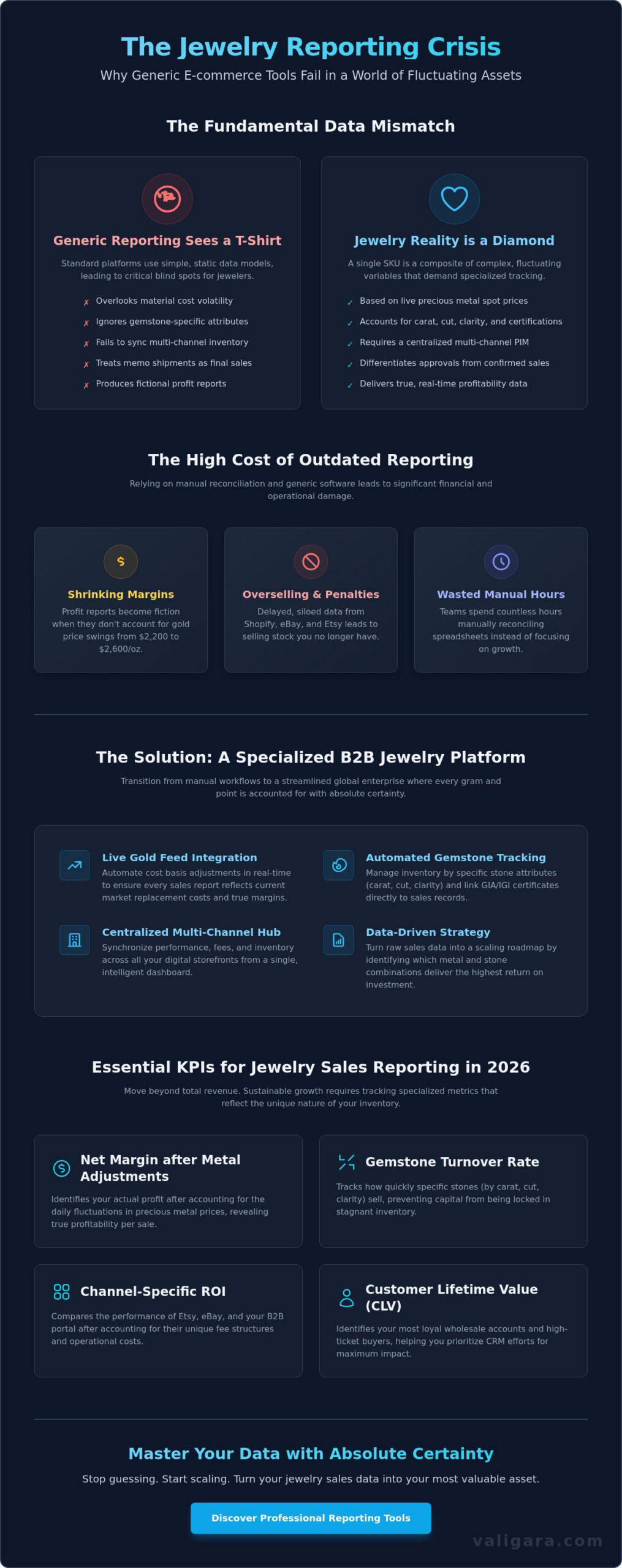
Generic e-commerce platforms view a diamond necklace the same way they view a t-shirt. This fundamental misunderstanding creates a data vacuum that threatens your bottom line. For a jewelry enterprise, a single SKU is a composite of fluctuating variables, including current metal spot prices, gemstone carat weight, and specific labor costs. Just as CarSeek provides a specialized portal for finding vehicles with specific attributes, jewelry wholesalers need tools that account for these unique variables. When your reporting tool lacks a specialized jewelry PIM, it ignores these attributes. This renders your profitability data obsolete before the sales cycle even completes.
To scale effectively, you need accurate Key Performance Indicators (KPIs) that reflect the reality of the vault. Standard software often relies on static pricing models. If you sold a 14k gold band based on gold prices from three months ago, but the market has since climbed toward $2,600 per ounce, your reported profit is a fiction. Manual data consolidation across global marketplaces only compounds this risk. It hides the true cost of doing business behind layers of disconnected spreadsheets and marketplace fee silos.
The Jewelry Data Complexity Gap
Jewelry data isn’t just numbers; it’s documentation. High-value sales depend on gemstone certifications from GIA or IGI. If your reporting doesn’t link these certificates directly to the sales record, you lose the ability to track which stone categories drive growth. The industry also relies heavily on Memos and approvals. Standard software sees a shipped item as a finalized sale. A specialized b2b jewelry sales platform understands the distinction between an approval shipment and a finalized transaction. This prevents inflated revenue reports and keeps your financial outlook grounded in reality.
The 2026 Multi-Channel Reporting Crisis
Selling exclusively on one channel is a relic of the past. However, reporting silos on Shopify, eBay, and Etsy create a fragmented view of your brand. Without a centralized hub, you’re forced to manually reconcile different fee structures and currency conversions. This delay is more than an administrative headache; it’s a financial liability. Delayed reporting leads to overselling across channels, resulting in marketplace penalties and tarnished brand reputation. True profitability requires an integrated b2b jewelry sales platform that treats material, channel, and customer data as a single, synchronized intelligence. Efficiency is the only path to scalability.
Essential KPIs for Jewelry Sales Reporting in 2026
In the rapidly expanding global B2B ecommerce market, relying on total revenue as your primary metric is a strategic error. For jewelry wholesalers, revenue often masks shrinking margins caused by volatile material costs. To achieve sustainable growth, your reporting must pivot toward specialized Key Performance Indicators (KPIs) that reflect the unique nature of luxury inventory. A sophisticated b2b jewelry sales platform allows you to track several critical metrics with precision:
- Net Margin after Metal Adjustments: This identifies your actual profit after accounting for the daily fluctuations in precious metal prices.
- Gemstone Turnover Rate: You need to know which specific stones move fastest. Tracking turnover by carat weight, cut, and clarity prevents capital from being locked in stagnant inventory.
- Channel-Specific ROI: Compare the performance of Etsy, eBay, and Amazon against your private B2B portal. Each marketplace has a different fee structure that impacts your bottom line.
- Customer Lifetime Value (CLV): High-ticket jewelry buyers have distinct purchasing patterns. Identifying your most loyal wholesale accounts helps you prioritize your CRM efforts.
Refining your data strategy is simpler when your jewelry insights and analytics system automates these complex calculations for you.
Dynamic Profitability: The Gold Feed Integration
In 2026, gold prices have fluctuated significantly between $2,200 and $2,600 per ounce. If your sales reports use static pricing, your margin data is essentially a guess. Modern reporting tools utilize a Gold Feed Sync to adjust your cost basis in real time. This integration ensures that every sales report reflects current market replacement costs. By automating these price adjustments, you can maintain consistent profitability regardless of market volatility. This level of technical precision transforms your reporting from a historical record into a live strategic tool.
Similarly, just as My Car Value provides vehicle owners with accurate, real-time market valuations for their assets, jewelry wholesalers must rely on live data feeds to ensure their financial reporting remains precise and profitable.
Inventory Health and Aging Reports
High-value gemstone inventory that sits for more than six months is a drain on your liquidity. Aging reports help you identify “Dead Stock” before it becomes a liability. These reports reveal the relationship between SKU complexity and sales velocity. For example, you might find that 14k gold settings with lab-grown diamonds are moving 30% faster than traditional mined-stone counterparts. Use this data to optimize your manufacturing schedule and focus on the metal and stone combinations that drive immediate cash flow. Centralized control over these metrics is the hallmark of a professional, scalable enterprise.
Multi-Channel vs. Single-Channel Analytics
Managing a global jewelry enterprise requires a bird’s-eye view of every touchpoint. If you only look at your Shopify dashboard, you’re missing the broader picture of how eBay, Etsy, and Amazon contribute to your ecosystem. A professional b2b jewelry sales platform bridges this gap. It provides the cross-platform intelligence needed to identify where your high-margin pieces actually thrive. Fragmented reporting isn’t just an inconvenience; it’s a strategic blind spot that leads to poor inventory allocation and wasted marketing spend.
According to McKinsey’s analysis of the jewelry market, the shift toward branded jewelry and digital sales is accelerating. This evolution creates a “Halo Effect” that single-channel tools can’t track. A customer might discover your diamond collection on Etsy but complete the purchase on your own website to seek a more bespoke experience. Without multi-channel analytics, you might mistakenly cut your marketplace marketing budget, inadvertently starving your direct website traffic. Centralized order management serves as the foundation for clean data, ensuring that every interaction is captured in a single source of truth.
Marketplace Performance Comparison
Not all channels are created equal for high-ticket items. Amazon’s fee structure for fine jewelry differs significantly from Etsy’s listing fees and transaction percentages. Your reports must account for these nuances to reveal your true ROI. Geographic reporting is equally vital. You might find that your emerald-cut diamonds sell best in the UK, while your 18k gold bands dominate the US market. A centralized b2b jewelry sales platform captures this geographic data, allowing you to move inventory where demand is highest. Tracking marketing automation success across these platforms ensures you aren’t overspending on low-converting channels.
Consolidated Insights: One Dashboard to Rule Them All
Clean data starts with a robust Jewelry PIM. When your product information is centralized, your sales reports inherit that technical precision. You eliminate the data silos that typically exist between your CRM and your sales history. This synchronization acts as the core intelligence of your business. Real-time stock sync is the final piece of the puzzle. It prevents the reporting errors that occur when a one-of-a-kind gemstone sells on one channel but remains listed as available on another. Centralized control isn’t just about convenience; it’s about maintaining the integrity of your global enterprise.
Turning Sales Data into Scaling Strategy
Data isn’t just a rearview mirror; it’s a strategic compass for your global enterprise. By analyzing which metal and stone combinations dominate your sales reports, you can de-risk future collection launches. If your reports show a 25% surge in emerald-cut lab-grown diamonds set in 14k yellow gold, you don’t have to guess for your next production cycle. This level of granular insight allows you to negotiate from a position of strength with gemstone suppliers. When you can prove your volume and consistency through an integrated b2b jewelry sales platform, you secure better rates and more reliable supply chains.
Scaling to new marketplaces like Walmart or Bonanza shouldn’t be a leap of faith. Your historical data provides the blueprint for international expansion. By identifying which demographics and price points convert best on your existing channels, you can predict success on new platforms with high accuracy. This historical perspective ensures your marketing spend is optimized, focusing only on the channels with the highest verified conversion rates. It’s the difference between a scattered approach and a targeted, results-driven expansion.
Predictive Analytics for Jewelry Operations
Use your 2025 sales trends to forecast 2026 holiday demand with technical precision. Don’t wait for the Q4 rush to realize you’re understocked on popular jewelry components. A specialized b2b jewelry sales platform lets you automate re-order points based on real-time consumption data. This functionality ensures you allocate your most valuable inventory to the channels with the highest sell-through rate. By positioning the software as your primary operational hub, you maximize liquidity and eliminate the manual labor of inventory forecasting.
B2B vs. B2C Sales Reporting Strategies
Wholesale and retail operations require distinct analytical lenses. While B2C reports focus on immediate conversion and marketplace fees, B2B reporting prioritizes relationship longevity and volume. Use your Jewelry CRM data to personalize sales reports for your top-tier wholesale accounts. You can instantly generate professional PDF catalogs tailored to their specific buying history, highlighting top-selling SKUs they haven’t yet stocked. This targeted approach transitions your brand from a simple vendor to an indispensable strategic partner.
Valigara Insights: Professional Reporting for Modern Jewelers
Valigara’s Insights and Analytics module isn’t an afterthought; it’s the core intelligence of a sophisticated jewelry business. While generic platforms force you to choose between ease of use and technical depth, this b2b jewelry sales platform delivers both. It integrates seamlessly with global marketplaces like eBay, Etsy, Amazon, and Shopify. This connectivity ensures that your high-ticket inventory is tracked with absolute precision across every channel. You no longer have to guess which platform delivers the best return on investment for your specific collections.
The true power of the platform lies in its Jewelry PIM. Reporting isn’t limited to SKU numbers and revenue. You can analyze performance based on specific metal weights, gemstone origins, or GIA certificates. This granularity is essential when managing complex inventory where a single point difference in a diamond’s clarity significantly impacts your margin. Combined with an automated gold feed sync, Valigara provides the only reliable way to track profitability in a market where gold prices have fluctuated between $2,200 and $2,600 per ounce in 2026. You gain the ability to see exactly which attributes drive your highest returns and adjust your strategy accordingly.
The Valigara Advantage: Multi-Channel Listing & Reporting
Accuracy starts at the source. Valigara’s multi-channel listing automation doesn’t just save time; it ensures your sales analytics are fed by clean, consistent data. When your listings are synchronized across all platforms, reporting discrepancies disappear. You move away from the chaos of manual spreadsheets and into a state of automated jewelry intelligence. This transition eliminates the risk of human error and provides a single source of truth for your entire operation. It’s about maintaining centralized control while your business expands across international borders, ensuring your data remains as flawless as your jewelry.
Scale Your Jewelry Brand with Expert Data
Scaling a jewelry brand in 2026 requires more than just craftsmanship; it requires data mastery. Valigara empowers manufacturers to transition from traditional wholesalers to global eCommerce leaders. By providing tech-forward reporting for high-value inventory, the platform gives you the quiet confidence to make bold business decisions. You aren’t just reacting to the market; you’re leading it with precision and ease. Your data becomes your most valuable asset in the pursuit of business scalability, allowing you to focus on growth rather than manual data entry.
Discover how Valigara transforms your jewelry sales data into growth.
Secure Your Competitive Edge with Precision Data
Precision is the dividing line between a stagnant business and a scaling enterprise. Relying on generic reporting is no longer a viable strategy in a market where material costs and marketplace fees shift daily. You’ve seen how specialized tracking for gemstone attributes and real-time gold feed synchronization protects your margins. By centralizing your multi-channel intelligence, you eliminate the manual errors that lead to overselling and fragmented data. It’s time to move beyond simple revenue totals and embrace the technical precision required for high-value retail.
Implementing a dedicated b2b jewelry sales platform transforms your data into a primary operational hub. Valigara provides the core intelligence needed to manage complex inventory with ease. With specialized tools for diamonds and jewelry, real-time gold feed sync, and multi-channel listing automation, you can focus on growth rather than data entry. Master Your Jewelry Sales Data with Valigara and take command of your brand’s future. The path to global scalability is built on accurate, actionable insights. Start your transition today.
Frequently Asked Questions
What is the best reporting software for multi-channel jewelry sales?
Valigara stands as the premier choice because it integrates jewelry-specific logic directly into its multi-channel reporting engine. It functions as a comprehensive b2b jewelry sales platform that manages everything from gemstone inventory to automated listing and final sales analytics in one hub. This centralized control eliminates the need for third-party tools that don’t understand the nuances of luxury retail and high-value inventory management.
How do gold price fluctuations affect jewelry sales reporting?
Gold prices moved between $2,200 and $2,600 per ounce in 2026, making static reporting a major financial risk. If your sales reports don’t include a live gold feed sync, your profit data is essentially a guess. Specialized software automatically adjusts your cost basis to reflect real-time market replacement costs. This ensures your net margin remains accurate regardless of how much the precious metals market fluctuates during the quarter.
Can I track gemstone inventory and certifications in my sales reports?
Professional platforms allow you to link individual diamonds and gemstones directly to their GIA or IGI certifications within your sales records. This connection ensures that every report includes the technical specifications and grading of the piece sold. By tracking certifications alongside inventory, you maintain a complete digital audit trail that is essential for building trust with high-ticket buyers and managing a global enterprise with precision.
What KPIs should jewelry retailers track for eCommerce success?
Retailers should prioritize net margin after metal adjustments and gemstone turnover rates rather than just total revenue. These KPIs reveal the true health of your business by identifying which stone and metal combinations move fastest. Additionally, tracking channel-specific ROI and customer lifetime value (CLV) helps you optimize your scaling strategy. These metrics allow you to focus your resources on the marketplaces and clients that drive long-term growth.
How does a Jewelry PIM improve sales reporting accuracy?
A Jewelry PIM centralizes every technical attribute, from metal purity to stone clarity, before that data reaches your sales reports. This centralized hub eliminates the errors associated with manual data entry across multiple marketplaces. Because the reporting engine pulls from a single, verified source of product information, your final analytics are guaranteed to be precise. This level of accuracy is vital for maintaining the integrity of your financial records.
Is it possible to consolidate Etsy and eBay sales into one report?
Consolidating these marketplaces is a core function of a robust b2b jewelry sales platform. By synchronizing orders from Etsy, eBay, Amazon, and your own website into a single dashboard, you gain a unified view of your global sales performance. This synchronization removes the delay of manual reconciliation and prevents reporting discrepancies. You can see exactly which channel is performing best in real-time, allowing for immediate strategic adjustments.
How do I track the ROI of my jewelry marketing campaigns?
Tracking ROI requires tight integration between your sales reports and marketing automation tools. By analyzing channel-specific conversion data, you can identify which campaigns lead to high-ticket sales rather than just superficial engagement. This technical approach allows you to see the direct relationship between your marketing spend and your net profit. It transitions your marketing from a speculative expense into a results-driven engine for business scalability.
Why are general eCommerce reporting tools insufficient for diamond sellers?
General tools treat jewelry like generic consumer goods, failing to account for variables like carats, points, and metal weights. They don’t support the specialized fields required for diamond grading or live market feeds for precious metals. This lack of industry-specific nomenclature leads to significant inaccuracies in inventory health and profit reporting. Diamond sellers need tools that understand the complexity of the trade to ensure their operations remain profitable.