

What if the greatest risk to your jewelry business isn’t a physical heist, but a manual data entry error on a shipping label? You’ve likely felt that familiar surge of anxiety the moment a high-value parcel leaves your hands, wondering if the insurance covers the full replacement value or if it’ll get stuck in a customs bottleneck. Managing these complexities while manually calculating declared values is an exhausting, high-stakes gamble that limits your ability to scale. To truly grow, you must integrate shipping carriers for jewelry business workflows into a centralized, automated hub that treats logistics with the same precision as a master diamond cutter.
We understand that shipping a $2,000 ring requires more than just a box; it requires a secure chain of custody and real-time data integrity. This guide will help you master high-value logistics by automating your jewelry shipping, reducing risk, and scaling your multi-channel operations. You’ll learn how to implement a streamlined ‘one-click’ shipping process, navigate the July 2026 USPS rate increases, and synchronize tracking across every platform you sell on. We’ll show you how to transition from manual workflows to a global enterprise where insurance calculations and customs documentation happen with a single click.
Key Takeaways
- Eliminate the risk of insurance disputes by replacing manual data entry with automated shipping label generation.
- Discover how to integrate shipping carriers for jewelry business workflows to synchronize inventory data with real-time logistics.
- Evaluate the security of standard carriers against specialized jewelry couriers to determine the best fit for your high-value parcels.
- Streamline international trade with automated HS code management and customs documentation for precious metals and stones.
- Master a modular five-step workflow to centralize multi-channel fulfillment into a single, high-tech operational brain.
Why Manual Shipping is a Liability for Modern Jewelry Brands
Jewelry shipping integration acts as the automated bridge between your sales channels, inventory data, and logistics providers. It functions as a specialized transportation management system designed to handle the unique security requirements of the luxury sector. When you fail to integrate shipping carriers for jewelry business operations, you rely on human hands to transfer sensitive data between your Jewelry PIM and various carrier portals. This manual approach is a gamble. A single typo in a high-value address isn’t just a minor delay; it’s a catastrophic point of failure. If a $10,000 diamond ring is delivered to an incorrect suite because of a copy-paste error, insurance claims often spiral into six-figure legal disputes when carriers deny coverage based on data entry discrepancies.
General e-commerce shipping tools are built for volume, not value. They often fail to grasp the nuances of the jewelry industry, such as the distinction between “declared value” and third-party insurance. These platforms typically default to standard carrier coverage, which is woefully inadequate for precious metals and stones. In the luxury market, fulfillment speed and precision are the primary drivers of customer trust. If your shipping process is clunky or prone to errors, you damage your brand’s reputation long before the package arrives.
The Risk of Under-Insurance in Manual Workflows
Manual entry frequently leads to “flat-rate” insurance habits where entrepreneurs apply the same coverage to every parcel. This is dangerous. As of June 2026, standard UPS accounts restrict the maximum declared value for jewelry to just $500. FedEx limits standard shipments to $1,000. Without a real-time inventory value sync, you might inadvertently ship a $5,000 necklace with only $500 of protection. Only a specialized integration ensures 100% coverage by pulling the exact item value directly from your PIM at the moment of label creation.
Scalability Bottlenecks: The ’10 Orders a Day’ Wall
Manual shipping creates a ceiling on your growth. When you integrate shipping carriers for jewelry business workflows, you slash the time-per-label metric from several minutes to a few seconds. Manual processes require you to log into separate accounts for eBay, Etsy, and Amazon, manually calculating insurance fees for each.
- Time Loss: Manual workflows can consume 2-3 hours daily for just 10 high-value orders.
- Marketplace Friction: Without automation, expanding to new channels becomes an operational nightmare.
- Mental Fatigue: The “shipping anxiety” caused by manual data entry drains the energy your team needs for sales and design.
Automation removes these hurdles, allowing you to scale from ten orders to hundreds without increasing your administrative headcount.
The Anatomy of a Jewelry-Specific Shipping Integration
A sophisticated integration functions as the central intelligence of your logistics. It doesn’t just print a label; it queries your Jewelry PIM to retrieve granular details like metal weight, purity, and gemstone specifications. When you integrate shipping carriers for jewelry business operations, you ensure that every commercial invoice is backed by the precise data stored in your inventory management system. This level of synchronization is what separates professional luxury retailers from general hobbyists. By pulling data directly from your Jewelry PIM, the system eliminates the need for manual data entry, ensuring that the item described on the shipping document perfectly matches the physical piece in the box.
Most general shipping APIs ignore the most critical part of a jewelry transaction: the certificates. A jewelry-first integration captures GIA, IGI, or HRD certificate numbers and attaches them to the digital shipping record. This ensures that high-value gemstone data follows the parcel through every stage of transit. If a package is inspected by customs, the digital record provides immediate proof of the item’s specifications, reducing the likelihood of a hold. You can also perform real-time rate shopping within a single dashboard, comparing the speed of FedEx Priority Overnight against the security of USPS Registered Mail while adhering to specific USPS regulations for shipping jewelry.
Automating Customs and International Compliance
International shipping for precious metals requires strict adherence to Country of Origin and Material Composition reporting. Integrated systems automatically assign the correct HS codes for gold, silver, and loose diamonds, generating commercial invoices that prevent border delays. For diamond retailers, the system manages Kimberley Process documentation automatically. This automation ensures that your international expansion isn’t throttled by the complexities of global trade compliance or the fear of a seized shipment due to missing paperwork.
The Digital Paper Trail: Tracking and Security
Internal tracking is just as vital as the carrier’s tracking number. A specialized integration uses barcode and RFID scanning to verify that the correct SKU is packed before the label is even generated. This creates an immutable digital paper trail. By integrating tamper-evident packaging protocols into the software workflow, you ensure that the “packing event” is recorded, often with associated images or weight checks. This multi-layered security approach provides the “Expert Insider” level of control needed to manage six-figure inventories with absolute confidence.
Evaluating Carriers: Standard vs. Specialized Jewelry Couriers
Choosing the right carrier is a strategic decision that balances cost, speed, and risk. While general e-commerce platforms suggest FedEx or UPS for everything, luxury professionals know these carriers have strict ceilings. To integrate shipping carriers for jewelry business operations effectively, you must map your inventory value to the specific carrier’s risk appetite. Standard accounts often carry hidden restrictions that can leave a $10,000 shipment essentially uninsured if you aren’t careful. Your logistics strategy must be modular, allowing you to pivot between standard volume shipping and high-security armored transport as the value of the parcel dictates.
USPS Registered Mail remains a unique anomaly in 2026. While it is the slowest domestic option, it is arguably the most secure. It accepts declared values up to $50,000 and provides a meticulous chain of custody with signatures at every transfer point. For high-value items where security outweighs speed, this is the gold standard. In contrast, standard Priority Mail only includes $100 of coverage. As of June 2026, a new HazMat fee and temporary price increases on domestic services make USPS a complex but necessary component of your carrier mix that requires automated rate management to navigate profitably.
Standard Carrier Limitations for High-Value Goods
Standard carriers like UPS and FedEx are sufficient for mid-market jewelry, but the fine print is restrictive. As of June 2026, the standard maximum declared value for jewelry is limited to $1,000 for FedEx and $500 for UPS standard accounts. Exceeding these limits requires a special high-value goods contract. Additionally, the “Plain Box” rule is mandatory; you must use discreet packaging that does not indicate the valuable contents inside. Standard signature requirements often fail for items over $5,000, as they don’t provide the same level of verification as a dedicated jewelry courier.
When to Upgrade to Armored and Specialized Logistics
Once your average order value exceeds $10,000, or when moving loose diamonds and high-carat stones internationally, you must transition to specialized couriers like Malca-Amit or Brink’s. These providers specialize in the global diamond trade, offering armored, door-to-door security and white-glove delivery. The threshold for this upgrade is typically defined by your insurance policy’s transit limit. By using a centralized platform to integrate shipping carriers for jewelry business, you can manage these specialized couriers alongside standard ones in a unified view. This allows you to select armored transport for a $50,000 engagement ring and USPS for a $200 sterling silver pendant from the same dashboard.
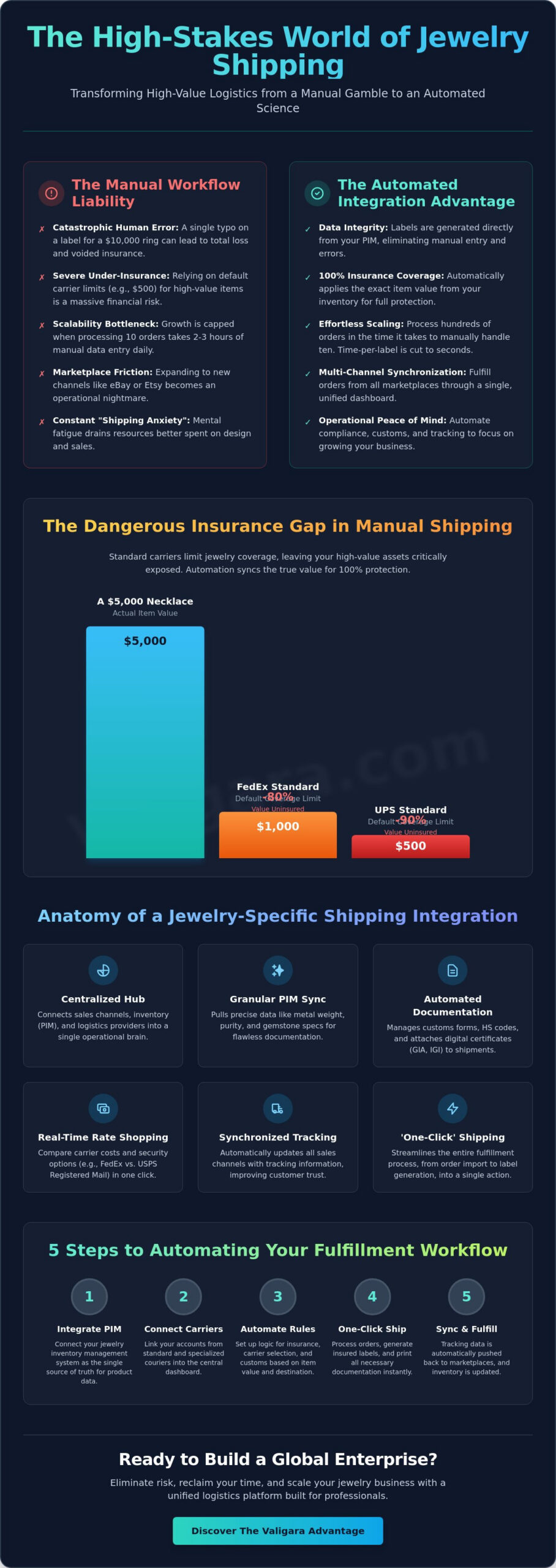
5 Steps to Automating Your Jewelry Fulfillment Workflow
To integrate shipping carriers for jewelry business operations, you must follow a modular implementation plan that treats logistics as a data-driven process rather than a manual chore. Transitioning from a fragmented workflow to an automated hub requires a systematic approach to ensure data integrity from the vault to the doorstep. This five-step framework allows you to scale your multi-channel operations while maintaining the high-touch service expected in the luxury sector.
- Step 1: Centralize your inventory and sales data. Use a specialized Jewelry PIM to act as your single source of truth. This ensures that every SKU’s weight, material composition, and value are accurate before they ever reach the shipping stage.
- Step 2: Connect your carrier accounts. Link your standard UPS, FedEx, and DHL accounts alongside specialized couriers like Malca-Amit to your Orders & Fulfillment Management platform. This creates a unified dashboard for all logistics activities.
- Step 3: Define automation rules. Create logic-based triggers that dictate how an order is handled. For example, you can set a rule that states: “If item value exceeds $1,000, automatically select UPS Next Day Air with Direct Signature Required.”
- Step 4: Implement bulk label printing. Move away from printing labels one by one. Use a system that generates labels and packing slips in batches, pulling data directly from your sales channels to eliminate typos.
- Step 5: Configure automated notifications. Set up branded tracking pages and automated emails. This keeps your customers informed without requiring manual updates from your team.
Setting Intelligent Shipping Rules
Automation is only as effective as the logic behind it. You can automate carrier selection based on weight, value, and destination to optimize for both cost and security. For example, high-carat loose diamonds might be routed through armored transport, while silver charms are sent via standard priority mail. You should also set mandatory rules for ‘Adult Signature Required’ on specific categories like engagement rings to prevent delivery to unauthorized recipients. Conditional shipping rules are logic-based triggers that automatically assign logistics parameters based on the specific attributes of a jewelry SKU.
Closing the Loop: Multi-Channel Tracking Sync
Generic shipping advice often ignores the complexity of multi-channel inventory. When you ship a package for an eBay order, your system must automatically update the order status on your Shopify site and other marketplaces. This “closed-loop” system is vital for maintaining customer trust across all touchpoints. Real-time stock sync is equally critical; once a label is generated, the item must be marked as “in transit” across all platforms to prevent overselling. You can also automate the return process by providing pre-printed, insured labels for reverse logistics, ensuring that even returns are handled with the same security as outgoing shipments. Optimize your logistics and maintain total control with our Jewelry Inventory Management tools.
The Valigara Advantage: Unified Logistics for Jewelry Professionals
Valigara serves as the primary operational hub for your enterprise, eliminating the need for fragmented third-party shipping plugins. Most general e-commerce tools require a patchwork of extensions to handle high-value logistics, but our all-in-one platform integrates these functions directly into your core workflow. When you integrate shipping carriers for jewelry business operations through Valigara, you leverage a “Jewelry-First” architecture. This means your PIM data, including metal purity, gemstone carats, and lab certifications, is automatically injected into your shipping documents. This ensures total accuracy and compliance without the need for manual oversight.
A unique challenge for wholesalers is the management of “Memo Out” shipments. These are high-value items sent to retail partners for inspection or consignment without a final sale. Valigara tracks these movements with the same rigor as a standard order, ensuring your inventory levels remain synchronized even when items are physically located at a partner’s showroom. For international expansion, the platform consolidates global carriers and customs requirements into a single interface. Whether you are shipping via FedEx to a domestic client or using Malca-Amit for an armored international delivery, the process remains consistent and centralized.
Beyond the Label: Integrated Order Management
Efficiency in the luxury sector depends on how quickly you can resolve customer inquiries. By centralizing messages from eBay, Etsy, and Amazon into a single dashboard, Valigara allows you to handle shipping-related questions with immediate access to tracking data. You can use internal analytics to identify your most cost-effective shipping routes and carrier performance metrics over time. Linking this logistics data to your Jewelry CRM enables superior post-purchase care, allowing you to trigger automated follow-ups once a package is confirmed as delivered.
Scaling with Confidence
Automation is the only path to sustainable growth in the high-stakes jewelry market. By removing the manual labor from fulfillment, jewelry brands can handle 10x their current order volume without increasing their administrative headcount. The security of knowing every shipment is backed by accurate, synchronized data allows you to focus on design and sales rather than logistics. You transition from a manual workflow to a streamlined, global enterprise where every parcel is protected by the core intelligence of your business. Scale your jewelry business with Valigara’s automated fulfillment and reclaim the time needed to build your legacy.
Secure Your Global Logistics Infrastructure
Logistics in 2026 demands more than just a tracking number; it requires a system that understands the intrinsic value of your inventory. By moving away from manual entry and adopting a jewelry-specific integration, you eliminate the catastrophic risk of under-insurance and fragmented data silos. You now have the framework to protect high-value parcels while synchronizing stock across every global marketplace you serve. To successfully integrate shipping carriers for jewelry business operations, your software must act as the primary brain of your enterprise, bridging the gap between your vault and the customer’s doorstep with absolute precision.
Valigara empowers your brand with a specialized Jewelry PIM integration, seamless multi-channel sync for eBay, Etsy, and Amazon, and automated high-value insurance workflows that remove the guesswork from every shipment. Ready to automate your jewelry logistics? Book a Valigara demo today. Transitioning to high-tech automation isn’t just about saving time; it’s about building a scalable, global brand with the quiet confidence of an industry leader. Your craftsmanship deserves a delivery process that is just as refined as the jewelry itself.
Frequently Asked Questions
What is the safest way to ship high-value jewelry internationally?
Specialized armored couriers like Malca-Amit or Brink’s are the safest choice for international transit. These providers offer door-to-door security and white-glove delivery that standard carriers cannot match for six-figure values. For shipments up to $25,000, the FedEx Declared Value Advantage program is a reliable alternative for select international destinations. Always ensure your digital documentation includes the necessary Kimberley Process certificates for diamond shipments to avoid border seizures.
How do I integrate my FedEx account with my jewelry inventory software?
You connect your account by entering your FedEx credentials into your platform’s carrier settings to integrate shipping carriers for jewelry business workflows. Once connected, the software pulls real-time rates and allows you to generate labels directly from your Jewelry PIM. This eliminates manual data entry and ensures that the declared value matches your inventory records exactly, reducing the risk of insurance disputes during a claim.
Does standard shipping insurance cover loose diamonds and gemstones?
Standard carrier insurance often excludes loose gemstones or imposes extremely low liability caps. As of June 2026, UPS limits jewelry-related liability to $500 for standard accounts without a specific high-value contract. You should use third-party insurance providers like Jewelers Mutual or Parcel Pro. These specialists offer lower premiums and comprehensive coverage specifically designed for the unique risks of shipping loose stones and high-purity precious metals.
What are the best carriers for shipping jewelry within the UK vs. the US?
USPS Registered Mail is the most secure domestic option in the US, offering declared values up to $50,000 with a strict chain of custody. In the UK, Royal Mail Special Delivery Guaranteed is the industry standard, providing end-to-end tracking and insurance up to £2,500. For values exceeding these national limits, you must transition to specialized couriers like Ferrari Group or Malca-Amit to ensure armored protection and full replacement coverage. For those in the UK who maintain their own fleet for local deliveries, keeping vehicles in top condition is a key part of brand presentation, often managed through mobile services like Onsite Car Body Repairs Ltd.
How can I automate customs forms for my jewelry business?
Automation occurs when your shipping software pulls material composition and country-of-origin data directly from your Jewelry PIM. The system assigns the correct HS codes for items like gold necklaces or loose diamonds to generate commercial invoices automatically. This process prevents border delays by ensuring every digital document is compliant with international trade regulations. It’s a critical step for scaling your global enterprise without increasing administrative headcount.
What is ‘Memo Out’ shipping and how do I track it?
‘Memo Out’ refers to shipping jewelry to retail partners or celebrities for inspection or consignment without an immediate sale. You track it by using your inventory management system to mark items as “on memo” while generating an insured shipping label. This keeps the item in your digital inventory but updates its physical location. This approach ensures you maintain a complete audit trail and continuous insurance coverage while the piece is out of your vault.
Can I use standard e-commerce shipping apps for expensive jewelry?
General e-commerce apps are often a liability because they lack deep PIM integration and jewelry-specific insurance logic. These tools don’t typically support the ‘Declared Value Advantage’ programs required for shipments over $1,000. To integrate shipping carriers for jewelry business successfully, you need a specialized platform that handles the unique risk profiles and documentation required for precious metals and stones. Standard apps simply aren’t built for high-stakes logistics.
How does multi-channel sync prevent shipping errors?
Multi-channel sync ensures that order details from eBay, Etsy, and Amazon are centralized into one hub. This prevents the need for manual copy-pasting, which is a primary source of label errors. When a label is generated, the system automatically updates the tracking number and order status across all platforms simultaneously. This real-time synchronization prevents “ghost sales” where an item currently in transit is accidentally sold again on a different marketplace.