
With gold spot prices reaching $4,541.91 per ounce, a single manual data entry error isn’t just a clerical mistake; it’s an expensive liability. Scaling a luxury brand requires more than just craftsmanship. It demands a sophisticated framework for how to manage complex jewelry inventory across fragmented marketplaces like Etsy, Amazon, and your own high-performance storefront. If you’re still relying on spreadsheets to track unique gemstone certifications or fluctuating metal costs, you’re risking your brand reputation through overselling and inaccurate pricing.
You already understand that a multi-channel presence is non-negotiable for growth, but the technical debt of manual updates often stalls your momentum. This guide provides the expert framework needed to transition from fragmented workflows to a centralized intelligence hub. We’ll show you how to master high-value variations, professionalize your diamond tracking, and automate stock synchronization across every sales channel to ensure your operations are as precise as your finest setting.
Key Takeaways
- Define your inventory as a multi-dimensional data set of metals, stones, and labor to bypass the technical limitations of generic retail software.
- Master how to manage complex jewelry inventory by consolidating fragmented data into a single, standardized nomenclature for global scalability.
- Link digital certifications directly to your SKUs while integrating live metal feeds to ensure real-time pricing accuracy and technical precision.
- Solve the “Overselling Trap” with automated synchronization that manages Amazon, eBay, and Etsy orders from a unified operational hub.
- Professionalize your workflow by transitioning to a specialized PIM and inventory system designed specifically for the high-value jewelry trade.
The Anatomy of Complex Jewelry Inventory: Beyond Simple SKUs
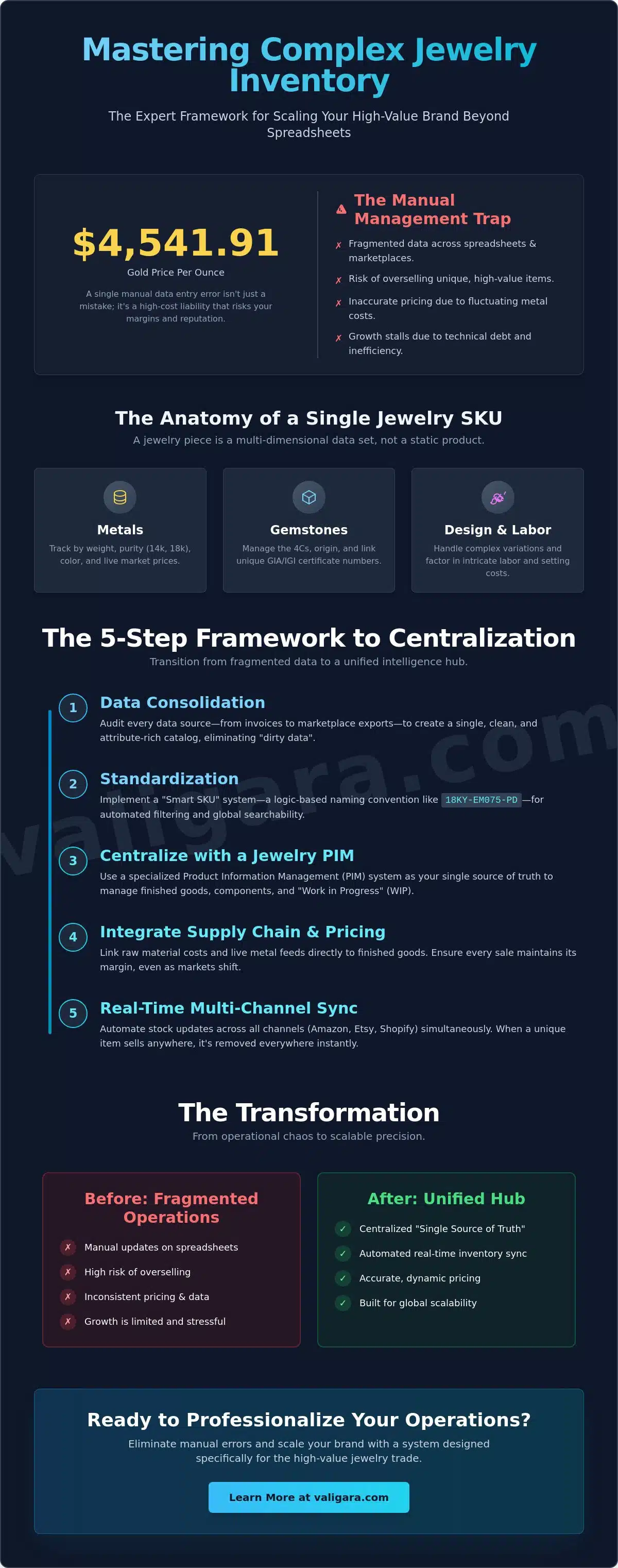
Jewelry isn’t just a product; it’s a sophisticated assembly of high-value components and fluctuating data points. Traditional inventory management models often treat a SKU as a single, static unit. In the luxury sector, a single SKU is actually a multi-dimensional data set. It encompasses the current spot price of precious metals, specific gemstone attributes, and the intricate labor costs of the setting. Precision isn’t a luxury; it’s the only path to scalability. If your data is flat, your growth will be too.
Success in this industry requires a shift from tracking “static inventory” to managing “dynamic inventory.” Static inventory refers to the finished piece sitting in your vault. Dynamic inventory accounts for the components that make it up. Understanding how to manage complex jewelry inventory means knowing exactly how many carats of loose stones and grams of 18k gold are tied up in your displays or listed across your digital channels at any given second.
The Three Pillars of Jewelry Data
To professionalize your operations, you must categorize data into three distinct pillars. First, metal specifications require tracking by weight, purity, and hallmark requirements. You aren’t just selling a “gold ring”; you’re selling 4.2 grams of 14k rose gold. Second, gemstone attributes must include the 4Cs and unique GIA or IGI certificate numbers linked directly to the item record. Third, design variations create a web of complexity. A single base design can generate dozens of unique SKUs based on metal color and stone size. Without a system to handle these variations, your data will inevitably fragment.
Why General eCommerce Tools Fail Jewelers
Standard platforms like Shopify or eBay are designed for mass-produced goods, not high-value luxury items. They often hit hard variation limits that stifle a jeweler’s catalog. These tools also fail to solve the “Unique Item” problem. When you sell a one-of-a-kind emerald pendant, that specific data must vanish from every marketplace instantly to prevent an overselling crisis.
General tools lack the specialized fields for gemstone certifications and metal fineness, forcing you to rely on disconnected spreadsheets. This fragmentation is the primary barrier to international expansion. You can’t scale a global enterprise on manual data entry. When you master how to manage complex jewelry inventory through a centralized intelligence hub, you eliminate the manual labor that keeps your business small. You transition from a local craftsperson to a streamlined, global enterprise with the technical precision the trade demands.
A 5-Step Framework for Centralizing Your Inventory
Transitioning from a chaotic spreadsheet system to a scalable enterprise requires a systematic overhaul of your operational core. To Manage Inventory Effectively in the high-stakes jewelry market, you must move beyond simple counts. You need a centralized intelligence hub that understands the relationship between a loose diamond in your safe and a finished ring listed on Etsy. This framework provides the roadmap for how to manage complex jewelry inventory with the technical precision your brand deserves.
Step 1 & 2: Data Consolidation and Standardization
Legacy systems often leave behind “dirty data,” which includes inconsistent metal weights, misspelled gemstone types, and fragmented pricing. Start by auditing every data source, from paper invoices to marketplace exports. Your goal is an attribute-rich catalog where every item is defined by granular specifications. Implement a “Smart SKU” system; this is a logic-based naming convention that encodes essential data, such as “18KY-EM075-PD” to instantly identify an 18k yellow gold pendant with a 0.75ct emerald. This standardization is the foundation of automated filtering and global searchability.
Step 3 & 4: From PIM to Supply Chain
A specialized Jewelry PIM acts as your single source of truth. Unlike generic tools, a jewelry-specific PIM manages “Work in Progress” (WIP), allowing you to track items currently with the setter or polisher. This is critical for made-to-order models where you sell “virtual stock” based on available components. By linking raw material costs directly to finished goods, you ensure that every sale maintains its margin, even as metal markets shift. You aren’t just tracking a product; you’re managing the entire lifecycle from a loose stone to a global shipment.
Finally, Step 5 involves establishing real-time synchronization. Your centralized hub must push updates to every sales channel simultaneously. When a unique piece sells on your website, the system must instantly delist it from Amazon and eBay. This level of automation eliminates the manual labor that leads to errors and allows you to scale without increasing your administrative headcount. Master how to manage complex jewelry inventory by making your data work for you, rather than the other way around.
Advanced Management: Diamonds, Certifications, and Metal Feeds
Precision in the luxury sector requires managing the data that dictates value, not just the items themselves. For high-end retailers, a diamond’s value is inseparable from its documentation. Digital certificates from labs like GIA or HRD must be linked directly to the SKU record within your central hub. This ensures that when a customer views a 1.5-carat round brilliant on your website or a marketplace, they have immediate access to the grading report. Beyond transparency, this data-first approach to how to manage complex jewelry inventory allows for advanced filtering, enabling buyers to search by specific clarity or fluorescence grades across your entire global catalog.
Automating Price Adjustments with Gold Feed Sync
Precious metal markets are notoriously volatile. With gold prices reaching $4,541.91 per ounce in May 2026, relying on static pricing is a significant financial risk. Manual updates are no longer viable for brands with hundreds or thousands of listings. An automated Gold Feed Sync eliminates this bottleneck by recalculating your retail prices in real time based on the current spot market. When the price of gold or platinum shifts, your system should automatically push those updates to eBay, Etsy, and Amazon. Implementing automated price protection ensures that your margins remain intact without requiring a single minute of manual data entry.
Managing the Diamond Lifecycle
Tracking the transition of a stone from a loose asset to a finished piece is a common pain point. You need a system that distinguishes between stones in your vault and those currently set in a ring. This is where “Virtual Inventory” becomes a powerful growth lever. By integrating with diamond exchanges like RapNet, you can list stones you don’t physically hold yet, only purchasing them once a sale is confirmed. This model reduces capital tie-up while vastly expanding your digital storefront.
Once a unique stone is sold, the technical challenge is immediate removal. A specialized how to manage complex jewelry inventory framework ensures that a one-of-a-kind diamond is delisted from every sales channel the moment the transaction is processed. This level of synchronization is supported by high-resolution media management. Each variation requires specific imagery that reflects the exact stone and metal combination. Managing these assets within a centralized PIM ensures that your brand maintains a professional, high-tech image that matches the craftsmanship of the jewelry itself.
Multi-Channel Synchronization: The “Sell Everywhere” Strategy
Scaling a jewelry brand requires a presence on high-traffic marketplaces like Amazon, eBay, and Etsy. However, expansion without synchronization creates the “Overselling Trap.” If you sell a unique sapphire ring on your website but the listing remains active on Etsy, you’re one click away from a marketplace penalty or a permanent ban. Mastering how to manage complex jewelry inventory requires an architectural shift. You must move from manual updates to an automated hub that treats your entire digital footprint as a single, cohesive unit.
Centralized order management allows you to process every marketplace transaction from one screen. This eliminates the friction of jumping between tabs and logging into multiple portals. It also enables sophisticated attribute mapping. Every marketplace has its own requirements for describing metal fineness or gemstone clarity. Your PIM should translate your internal data into platform-specific language automatically. This technical precision ensures your high-value items are listed accurately, regardless of where the customer finds them.
Real-Time Stock Sync Across Marketplaces
A “Master Inventory” approach is the only way to prevent double-selling one-of-a-kind pieces. When a transaction occurs, your system must trigger a sub-second update across all connected channels. This level of performance is only possible through robust API access. For high-velocity periods, such as the holiday season, you can implement “Buffer Stock” rules. This allows you to hide a portion of your inventory from marketplaces once levels drop below a specific threshold, protecting your brand from fulfillment failures. You gain total control over your stock levels while maximizing your global reach.
Marketing Automation Driven by Inventory Data
Inventory data shouldn’t just sit in a database; it should drive your sales strategy. Sophisticated systems use live stock levels to trigger marketing automation. If a specific collection reaches a certain inventory threshold, your system can automatically initiate social media promotions or email campaigns. For B2B clients, you can utilize PDF Catalog Generation to create personalized lookbooks directly from your live stock. This ensures your wholesale partners always see what’s actually available for purchase.
Advanced analytics further refine this process by identifying “Best Sellers” versus “Dead Stock.” By tracking the performance of specific gemstones or metal types, you can make data-driven decisions about future manufacturing and sourcing. You’re no longer guessing which pieces will sell; you’re using the core intelligence of your business to optimize your margins. If you’re ready to eliminate manual labor and scale your operations, explore our multi-channel listing automation to see how a centralized hub transforms your workflow.
Transitioning to Automation: The Valigara Approach
Transitioning from manual chaos to automated precision is the final step in your brand’s evolution. While generic ERP systems offer broad utility, they often fail the jewelry industry’s specific technical requirements. They don’t inherently understand the relationship between a loose stone’s certificate and a finished ring’s retail price. Valigara serves as the expert insider partner, providing a centralized intelligence hub that masters how to manage complex jewelry inventory by design. By integrating your PIM, inventory, CRM, and multi-channel listings into one ecosystem, you eliminate the technical debt of disconnected tools.
Onboarding with a new system often feels like a hurdle, but specialized data migration simplifies the process. We understand the nuances of jewelry data, from carat weights to metal fineness. Our team handles the transition of your legacy spreadsheets and fragmented records into a streamlined, professionalized catalog. This isn’t just about moving data; it’s about establishing a foundation for global enterprise growth that respects the craftsmanship of your trade.
Built by Jewelers, for Jewelers
Valigara’s history is deeply rooted in the diamond and jewelry trade. We built this platform because generic software like NetSuite or Odoo requires extensive, expensive customization to handle the industry’s unique variables. A specialized Valigara Jewelry PIM handles GIA certificate linking, gold feed synchronization, and variation management out of the box. This industry-specific focus builds immediate rapport with professionals who value time and accuracy above all else. You aren’t just buying software; you’re gaining a partner that speaks your language.
Scalability and Future-Proofing Your Brand
Automation is the primary lever that allows small, agile teams to manage thousands of complex SKUs across global markets. As you expand internationally, the system handles the heavy lifting of multi-currency pricing and platform-specific attribute mapping. This future-proofs your brand, ensuring you can integrate new marketplaces or B2B tools without increasing your administrative headcount. You move from a reactive workflow to a proactive strategy driven by real-time insights and technical precision.
Success in the luxury market depends on your ability to deliver accuracy at scale. Stop struggling with manual entry and the constant risk of overselling. Master how to manage complex jewelry inventory with a system designed for the specialized needs of your business. It’s time to transition from manual labor to an automated hub that acts as the primary operational brain of your brand. Schedule a demo with Valigara today to see how we streamline your path to a global enterprise.
Elevate Your Operational Intelligence
Scaling a luxury brand requires a shift from manual data entry to high-tech automation. You’ve seen how precision in metal tracking, GIA certificate integration, and real-time marketplace synchronization forms the backbone of a modern jewelry enterprise. By centralizing your data, you eliminate the risks of overselling and stale pricing that often stall growth. Mastering how to manage complex jewelry inventory isn’t just about counting stock; it’s about building a single source of truth that powers your entire global operation.
Valigara has been a trusted partner for jewelry brands since 2009, providing the specialized tools generic software lacks. From automated Gold Feed Sync to all-in-one multi-channel automation, our platform serves as the primary intelligence hub for serious retailers. You don’t have to manage the technical burden alone. Transition to a streamlined workflow and focus on the craftsmanship that defines your brand. Master your jewelry inventory with Valigara; Request a Demo to see our specialized framework in action. Your path to a scalable, professionalized enterprise starts today.
Frequently Asked Questions
How do I manage unique, one-of-a-kind jewelry pieces online?
You manage one-of-a-kind pieces by utilizing a Master Inventory hub that recognizes unique SKU signatures. Once a transaction is processed on one channel, the system triggers an immediate delisting across all other integrated marketplaces. This prevents the reputational damage of selling a piece you no longer have in your vault. It ensures your digital storefront always reflects your physical reality.
Can I sync my jewelry inventory between Etsy and Shopify automatically?
Automatic synchronization between Etsy and Shopify is achieved through multi-channel listing automation. This technology eliminates manual data entry by pushing inventory level changes to every storefront simultaneously. It ensures your stock count remains accurate without requiring you to log into separate seller portals. You gain the freedom to sell across multiple platforms without the risk of administrative errors.
What is a Jewelry PIM and do I really need one?
A Jewelry PIM is a centralized hub designed to manage the multi-dimensional data required for luxury items, such as metal purity and stone carats. You need one because standard eCommerce platforms lack the specialized fields for certifications and technical specifications. It’s the core intelligence required for how to manage complex jewelry inventory at scale. This system serves as the primary brain for your global operations.
How do I handle gold price fluctuations in my online store?
Handling gold price fluctuations requires an automated Gold Feed Sync that links your catalog to live market data. The system recalculates your retail prices based on current spot values and pushes those updates to your online store instantly. This protects your margins during periods of high volatility without manual recalculation. You maintain competitive pricing while ensuring your business remains profitable as market conditions shift.
Is it possible to manage loose diamonds and finished jewelry in the same system?
Specialized management platforms allow you to track loose diamonds as raw assets and finished jewelry as unique SKUs within the same ecosystem. You can manage the transition of a stone from your vault to a specific setting. This provides total visibility over your entire capital investment in one unified dashboard. It allows for more accurate reporting on your component costs and finished goods value.
What is the best way to track GIA certificates for my online inventory?
The most efficient way to track GIA certificates is to link the digital report directly to the gemstone’s SKU record within your PIM. This allows the certificate data to flow automatically into your product descriptions and customer-facing listings. It builds immediate trust with buyers by providing verifiable grading reports for every high-value stone. You eliminate the need to manually upload documents for each individual sale.
How does multi-channel inventory management prevent overselling?
Multi-channel management prevents overselling by providing a single source of truth for your stock levels. When a sale occurs on Amazon, the system communicates the change to your website and eBay in sub-seconds. This level of synchronization ensures you never promise an item to a customer that has already been purchased elsewhere. It protects your seller ratings and maintains your standing on competitive marketplaces.
Can I integrate my existing ERP with a specialized jewelry management platform?
Integration with your existing ERP is possible through robust API access. This allows your high-level financial and accounting data to stay synchronized with the granular, technical inventory data managed in your jewelry-specific platform. It bridges the gap between general business operations and the specialized requirements of the diamond trade. You keep your existing financial workflows while gaining the technical precision needed for jewelry retail.