
What if the hours you spend manually updating gold prices across five platforms were actually the biggest bottleneck to your brand’s global expansion? It’s a common frustration for luxury retailers who find themselves trapped in a cycle of data entry rather than business growth. Managing fragmented inventory across Etsy, eBay, and your own site isn’t just a logistical headache; it’s a direct risk to your brand’s reputation. Most jewelry entrepreneurs agree that the manual labor required to reduce stress of multi-channel selling feels like an exhausting hurdle to actual scaling. Between syncing stock for unique diamond rings and managing 2026 EU diamond origin statements, the operational chaos is draining your creative energy.
You can reclaim your schedule and eliminate these errors using jewelry-specific automation strategies. This article shows you how to establish a single source of truth for your entire catalog and implement a stock sync that handles complex variations with precision. We will examine the transition from manual workflows to a centralized PIM, allowing you to focus on high-level design and global scaling rather than repetitive data entry.
Managing a high-growth jewelry brand across multiple platforms doesn’t have to result in operational burnout. By shifting from manual entry to automated intelligence, you can protect your margins and your reputation. In this guide, you will learn how to:
- Identify the “complexity trap” that stalls growth when expanding to new digital marketplaces.
- Automate precision updates for fluctuating precious metal prices and multi-layered gemstone specifications.
- Understand why jewelry-specific PIM architecture outperforms general-purpose e-commerce software.
- Execute a modular framework to reduce stress of multi-channel selling while ensuring global data integrity.
- Learn why it’s vital to transition to a centralized operational hub to reclaim time for creative design and strategy.
The Anatomy of Multi-Channel Stress in Jewelry eCommerce
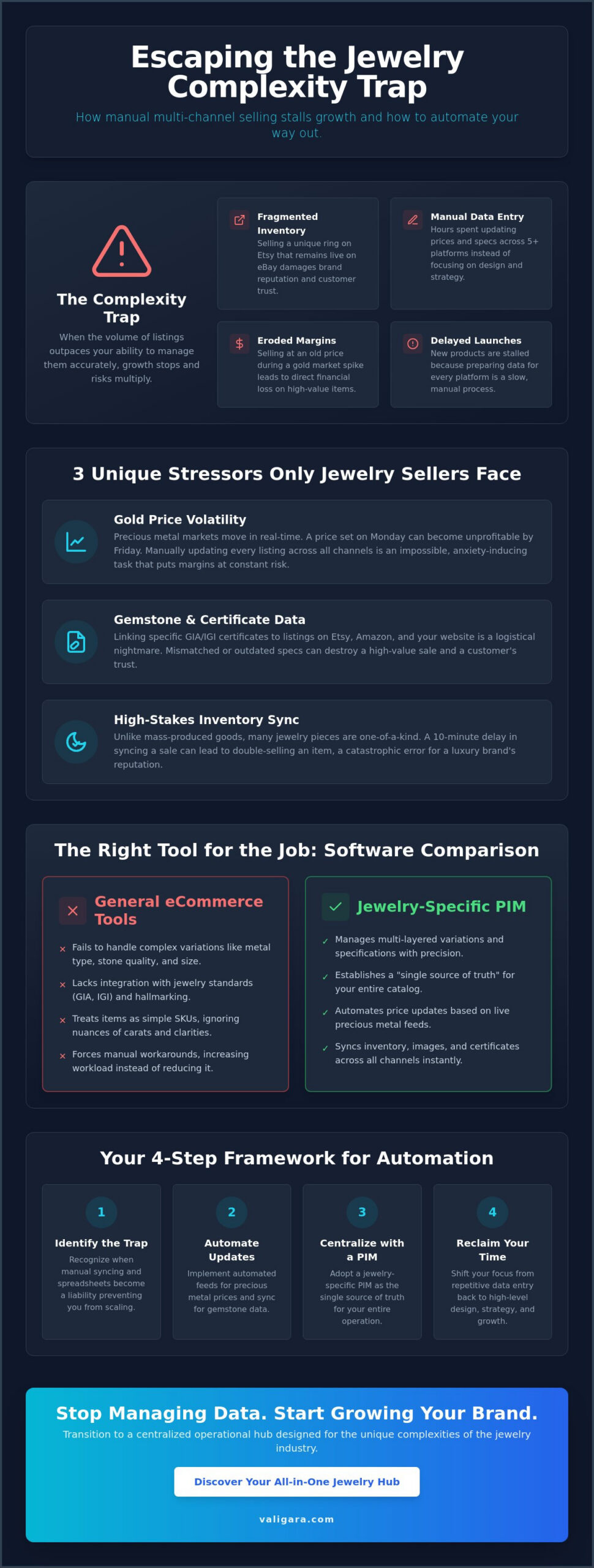
Growth is a double-edged sword for modern jewelry brands. While expanding your presence across global marketplaces is the standard goal of multichannel marketing, many manufacturers fall into a dangerous complexity trap. This happens when the volume of listings outpaces your ability to manage them accurately. The formula seems simple: more channels equals more revenue. However, without a centralized operational brain, this equation quickly results in burnout and eroded margins. Selling a unique, high-value diamond ring isn’t like selling mass-produced apparel. If you sell a one-of-a-kind piece on Etsy and it remains live on eBay for even ten minutes after the transaction, you risk a catastrophic blow to your brand reputation. Manual errors in jewelry retail are expensive. They don’t just cost a sale; they cost customer trust and marketplace standing.
The tipping point arrives when spreadsheets become a liability. When your inventory management relies on a master file that requires constant manual syncing, you’ve reached a plateau that prevents scaling. Spreadsheets are static, but the jewelry market is dynamic. To effectively reduce stress of multi-channel selling, you must move beyond these fragile, manual workflows and embrace a system designed for the precision of luxury retail.
The “Invisible” Costs of Manual Operations
Repetitive listing updates are a silent productivity killer. Every time you change a price due to gold market fluctuations or update a GIA report link, you’re likely logging into five different dashboards. This manual labor steals hours from product development and high-level strategy. There’s also a significant mental load involved in tracking certifications and gemstone-level data across fragmented systems. When product launches are delayed because the data isn’t ready for every platform, you lose immediate market momentum and potential revenue.
Why General eCommerce Tools Fall Short
Most generic software can’t handle the intricate variations inherent in jewelry. A single ring design might have dozens of combinations of metal type, stone quality, and finger size. General tools treat these as simple SKUs, often failing to sync the specific attributes required by specialized marketplaces. They lack integration with professional jewelry standards, forcing you to create manual workarounds that actually increase your workload. One-size-fits-all software creates more work than it saves because it doesn’t understand the nuance of carats, clarities, or hallmarking. True efficiency requires a specialized Jewelry PIM that manages these complexities at the source.
3 Unique Stressors Only Jewelry Sellers Face
General retailers worry about shipping delays or low-quality packaging. Jewelry manufacturers, however, face a different set of anxieties rooted in the fluctuating value of their raw materials and the high stakes of selling one-of-a-kind items. For businesses that feature unique, authentic, artist-made turquoise and silver collections—as you’ll see when you visit Wildflower Artisans—the constant vigilance required to maintain accurate data across multiple marketplaces contributes significantly to the psychological price of entrepreneurship. While other industries manage static SKUs, your inventory value can change while you sleep.
The Gold Price Volatility Headache
Precious metal prices don’t wait for your weekly inventory audit. Gold and platinum markets move in real-time; a price set on Monday might be unprofitable by Friday if a market spike occurs. For brands selling across five or more channels, manually recalculating and updating every listing is an impossible task. It’s a constant source of anxiety that drains your mental bandwidth. Selling a heavy 18K gold chain at a loss because your eBay listing was out of sync with the current spot price is a mistake that erodes your bottom line. Automated Gold Feed Sync technology removes this variable entirely, ensuring your margins remain protected across every storefront without manual intervention.
Gemstone Data and Certification Management
Linking a specific GIA or IGI certificate to multiple listings across Etsy, Amazon, and your own site is a logistical nightmare. If you sell a loose diamond or a finished piece featuring a certified stone, that documentation must be visible and accurate everywhere. A Jewelry PIM acts as the single source of truth, allowing you to upload a certificate once and have it populate across all relevant channels. This level of precision is essential to reduce stress of multi-channel selling, as it eliminates the fear of providing mismatched or outdated technical specs to a discerning client.
The High-Stakes Inventory Sync
Unlike mass-produced goods, many jewelry items are unique. If you have one specific vintage emerald ring, selling it twice is not an option. The stress of “overselling” a high-ticket item is a unique burden for jewelry manufacturers. You need a system that can detect a sale on one channel and instantly terminate the listing on all others within seconds. This high-speed synchronization is the only way to safeguard your marketplace reputation. Implementing specialized jewelry inventory management ensures that your digital storefronts always reflect your physical reality, allowing you to scale without the constant fear of operational failure.
General vs. Jewelry-Specific Software: A Stress Comparison
Generic e-commerce platforms are built for the masses. They excel at managing high-volume, low-complexity goods like apparel or consumer electronics. However, when you attempt to shoehorn a luxury jewelry catalog into a general-purpose system, the friction points become obvious. Selling a $5,000 engagement ring requires a level of data granularity that most systems simply aren’t designed to handle. Choosing specialized software is the most effective way to reduce stress of multi-channel selling because it acknowledges that your inventory is fundamentally different from a t-shirt or a book.
Listing automation speed is where the divide becomes most apparent. A general tool might sync a price, but it won’t understand how to map a “VS1 Clarity” attribute to the specific requirements of an eBay jewelry category or an Etsy attribute field. Without this industry-specific intelligence, your team spends hours fixing “failed” listings or manually adjusting technical specs for every channel. A specialized hub automates these mappings, ensuring that your complex variations are published accurately the first time.
Why Generic PIMs Fail the Jewelry Test
Most Product Information Management (PIM) systems lack the native architecture for precious materials. You won’t find built-in fields for carat weight, metal purity, or gemstone clarity. To make these systems work, manufacturers often create a fragile “patchwork” of custom tags and notes. This manual workaround is prone to error and fails to handle the complex parent-child relationships inherent in jewelry. For example, a single ring design might exist in three different metals and five different sizes; generic tools often struggle to sync these variations without creating duplicate, confusing SKUs that frustrate customers and lead to overselling.
The ROI of Industry-Specific Automation
The return on investment for jewelry-specific automation is measured in hours reclaimed and errors avoided. By using a system that understands diamond-specific workflows and B2B jewelry sales, you eliminate the need for double-entry. Your team can manage high-value order fulfillment with total confidence, knowing the GIA certificate linked in the PIM is the exact one being shipped. Beyond just listing management, a specialized Jewelry CRM provides analytics that track which gemstone types are performing best across specific regions. This data allows you to make informed inventory decisions, moving your brand from a state of reactive chaos to one of strategic, automated growth.
A 4-Step Framework to Automate Your Jewelry Operations
Transitioning from manual chaos to automated precision requires more than just a software subscription. It demands a logical roadmap designed around the unique requirements of luxury retail. To effectively reduce stress of multi-channel selling, you must move away from reactive fixes and toward a proactive, systemized infrastructure. This four-step framework provides the technical implementation path needed to secure your high-value inventory while scaling your global reach.
Step 1: Centralize Your Jewelry Intelligence
The first priority is moving your SKU library from fragmented spreadsheets into a specialized Jewelry PIM. This isn’t just about data storage; it’s about building the core intelligence of your business. Your PIM must handle industry-specific attributes like metal purity, hallmark requirements, and gemstone certifications. For example, ensuring that 2026 CPSC eFiling requirements or EU diamond origin statements are attached to the correct SKUs at the source prevents compliance delays. By organizing your diamond and gemstone data in a central hub, you ensure that every listing across every channel draws from the same accurate information.
Step 2: Sync and Protect Your Inventory
Security is paramount when dealing with unique, high-ticket items. Step two involves configuring real-time stock synchronization to ensure that a one-of-a-kind sapphire necklace isn’t sold twice. This system must also incorporate an automated gold feed sync. Instead of manually adjusting prices during market spikes, the software recalculates your margins and updates your listings across all platforms simultaneously. Linking every order into a single management hub provides a clear overview of your fulfillment pipeline, protecting your brand reputation and your sanity.
Step three focuses on automating the listing process through channel-specific templates. Rather than rewriting technical specs for Etsy, eBay, and Amazon, you create logic-based templates that map your PIM data to each marketplace’s specific requirements. Finally, step four uses specialized insights and analytics to drive growth. By analyzing which metal combinations or gemstone types perform best on specific platforms, you can optimize your inventory investment for maximum ROI. Implement this framework now by exploring multi-channel listing automation built specifically for the jewelry trade.
Reclaiming Your Time with Valigara’s All-in-One Jewelry Hub
Valigara serves as the specialized brain for your jewelry enterprise. It replaces fragmented dashboards and fragile spreadsheets with a unified command center designed for the luxury trade. To truly reduce stress of multi-channel selling, you need a system that understands the inherent value of your materials and the technical requirements of global marketplaces. Our platform doesn’t just store data; it manages the entire lifecycle of your inventory with quiet confidence and technical precision. By centralizing your operations, you transition from a reactive state of manual labor to a streamlined, global enterprise.
Specialized listing automation is the core of this transformation. Valigara’s engine doesn’t just push generic product titles. It adapts your content for Etsy, eBay, and Amazon, ensuring every attribute—from metal purity to gemstone clarity—is optimized for search and marketplace compliance. This eliminates the exhausting manual labor of translating jewelry specs into different marketplace formats. With multi-channel and multi-language tools, international expansion becomes a logical next step rather than an operational hurdle. You gain the power to scale your brand across borders without multiplying your workload.
Expert Insider Support for Your Implementation
Transitioning to a high-tech automation hub shouldn’t be a solo endeavor. We provide personalized onboarding tailored to the specific workflows of jewelry manufacturing and retail. Our team provides dedicated data migration assistance for complex SKU libraries, ensuring your diamond and gemstone data remains intact and organized. We offer ongoing training to ensure your team masters the automation tools. This expert-led approach ensures that your transition from manual workflows to an automated hub is efficient and error-free.
Beyond Listing: CRM and Marketing for Jewelers
Operational efficiency is the foundation, but sustainable growth requires high-level engagement. A jewelry-specific CRM allows you to track customer preferences for specific metals or stone shapes, building long-term loyalty in a competitive luxury market. By integrating marketing automation, you can scale your brand’s reach and nurture leads without adding to your daily administrative burden. You shift from being a data entry clerk to a strategic leader focused on design and growth. It’s time to scale your jewelry business with Valigara and reclaim the time you need to innovate.
Master Your Multi-Channel Operations
The path to a scalable jewelry brand is paved with automation, not manual labor. By moving away from fragmented spreadsheets and general-purpose software, you protect your margins and your brand reputation. You’ve seen how a jewelry-specific PIM and automated workflows transform operational chaos into a streamlined enterprise. This transition is the only sustainable way to reduce stress of multi-channel selling while expanding your global reach. Precision in data management isn’t just a technical requirement; it’s a competitive advantage in the luxury market.
Valigara was founded in 2009 with deep roots in the jewelry industry. We provide the specialized PIM architecture needed for complex diamond and gemstone management. Our systems ensure your business runs on real-time gold feed data and instantaneous stock synchronization across all marketplaces. It’s time to stop managing dashboards and start growing your brand. Automate your jewelry business and reduce stress with Valigara today. Your craft deserves the precision of an expert operational hub.
Frequently Asked Questions
How does jewelry-specific software reduce the risk of overselling?
Jewelry-specific software provides near-instantaneous synchronization across all connected sales channels. When a unique piece sells on Etsy, the system identifies the transaction and immediately terminates the active listings on eBay, Amazon, and your own site. This high-speed coordination protects your marketplace standing by ensuring you never have to cancel a high-value order due to inventory drift or manual lag times.
Can I sync my gold prices in real-time across all sales channels?
Yes, Valigara uses a specialized Gold Feed Sync to automate price adjustments based on current market spot prices. Instead of manually recalculating every SKU when the market fluctuates, the system applies your predefined margin rules across your entire catalog. This is a critical feature to reduce stress of multi-channel selling, as it ensures your business remains profitable even during volatile market spikes without constant manual monitoring.
What is the difference between a general PIM and a Jewelry PIM?
A general PIM lacks the native architecture required for precious materials and gemstones. A Jewelry PIM includes specialized fields for carat weight, gemstone clarity, metal purity, and certification links like GIA reports. It manages the complex parent-child relationships inherent in jewelry variations, such as different ring sizes or metal types, without creating redundant data entry or fragmented SKU records that confuse customers.
How much time can I save by automating my jewelry listings?
Industry professionals often report reclaiming dozens of hours per month by eliminating manual data entry. By using logic-based templates, you can publish a single product to multiple global marketplaces in seconds rather than hours. This automation allows your team to focus on creative design and strategic growth rather than repetitive administrative tasks. This newfound efficiency allows you to explore Direct-to-Consumer Product Sales with Gara Health in other high-growth niches like natural health supplements.
Is it difficult to migrate my jewelry inventory from spreadsheets to Valigara?
The migration process is designed to be efficient and secure for established brands. Our team provides dedicated assistance to map your existing spreadsheet data to our specialized jewelry fields, ensuring your complex SKU library remains intact. This structured approach moves your business from fragile, manual files to a centralized, high-tech hub without losing critical gemstone data or historical technical specifications.
Does multi-channel automation work for one-of-a-kind (OOAK) jewelry pieces?
Automation is actually most critical for one-of-a-kind items because the inventory stakes are higher. The system treats OOAK pieces as unique inventory units, ensuring that once the item sells, it’s immediately removed from every other digital storefront. This prevents the reputational damage and logistical nightmare that occurs when two different buyers purchase the same unique diamond ring on different platforms simultaneously.
What marketplaces are best for selling high-end jewelry in 2026?
In 2026, eBay and Etsy remain dominant for high-end pieces, especially with eBay’s continued focus on luxury authentication services. Amazon Handmade and specialized luxury marketplaces also offer significant reach for designer brands. To reduce stress of multi-channel selling, manufacturers should prioritize platforms that support detailed technical specifications and offer robust seller protections for high-value, certified gemstone transactions. In the broader bridal market, specialized platforms like Bride2Bride also illustrate how niche marketplaces can effectively connect sellers with targeted buyers for high-value items.
How does centralized order management help with eBay and Etsy messages?
Centralized management pulls customer inquiries from all channels into a single Jewelry CRM interface. This eliminates the need to toggle between multiple logins to answer questions about gemstone origins or shipping status. By managing all communication from one hub, you maintain a consistent brand voice and ensure no high-value lead is lost due to fragmented communication or delayed response times.