
Your inventory isn’t just a list of products; it is a living ecosystem of fluctuating metal spot prices, unique gemstone certifications, and thousands of SKU variations. Relying on generic retail tools in a market projected to exceed 254 billion dollars this year is no longer a viable strategy for growth. To scale effectively, you must utilize a specialized jewelry inventory software features checklist that accounts for the technical precision your trade demands. Managing complex metal and stone combinations across Etsy, eBay, and your own storefront shouldn’t feel like a manual race against the clock.
We understand that the pressure to maintain accurate listings while gold markets shift is a constant burden for the modern jeweler. You deserve a system that acts as the central intelligence of your business, not another manual task on your to-do list. This 2026 buyer’s guide delivers a definitive, 35-point checklist designed to help you identify the tools needed to automate inventory, manage high-value gemstones, and eliminate the risk of overselling. We will explore the essential features required to transition from manual workflows to a streamlined, global enterprise, focusing on everything from automated gold feed sync to advanced PIM capabilities.
Key Takeaways
- Understand why generic retail systems fail to manage jewelry variations and why a specialized PIM is the only way to handle complex metal and stone combinations.
- Utilize our definitive jewelry inventory software features checklist to audit your current tech stack against 35 essential functions required for 2026 operations.
- Learn to establish a single source of truth that automates multi-channel listings and prevents overselling on high-traffic marketplaces like Etsy and eBay.
- Discover how professional barcode and tag printing integrates with advanced tracking to secure your high-value assets and streamline physical fulfillment.
- Identify the strategic advantages of centralizing metal, gemstone, and sales data to transition from manual workflows to a scalable, global enterprise.
Why Generic Inventory Software Fails the Jewelry Industry
Generic retail platforms treat a diamond necklace like a box of detergent. They track one unit in and one unit out. But jewelry is a three-dimensional asset; it’s a combination of raw materials, labor, and market-driven pricing. A standard inventory control system lacks the granularity to handle the jewelry industry’s unique demands. This is why a specialized jewelry inventory software features checklist begins with a fundamental shift: moving from simple unit tracking to complex component management.
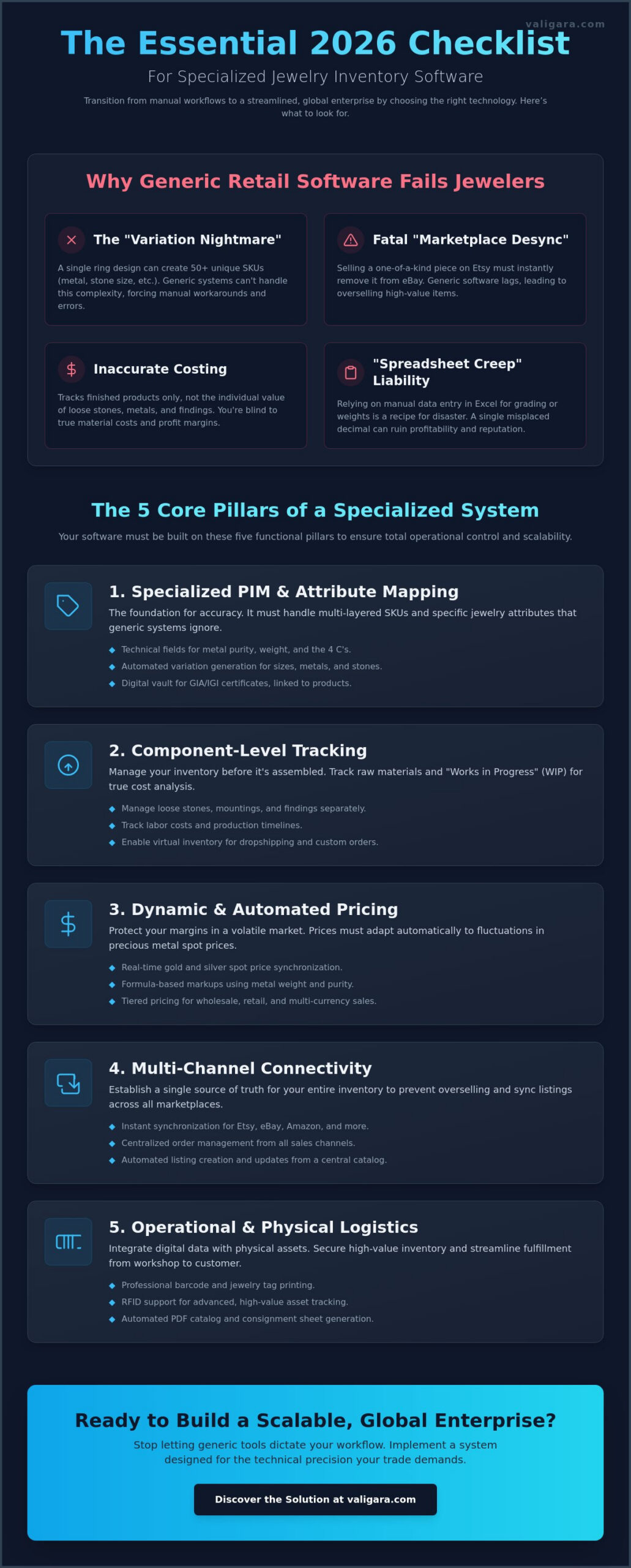
The “Variation Nightmare” is a reality for every growing brand. A single engagement ring design can balloon into 50 unique SKUs once you account for metal types, stone sizes, and center stone varieties. Generic systems crumble under this weight. They force you to create manual workarounds that lead to inaccurate listings and lost sales. When you’re selling high-ticket items across Etsy, eBay, and Amazon, “Marketplace Desync” is a fatal risk. If a one-of-a-kind sapphire ring sells on one channel, it must vanish from all others instantly. High-value retail doesn’t allow for the “out of stock” apologies that low-cost sellers might survive.
The Problem with “Spreadsheet Creep” in 2026
Relying on Excel for gemstone grading or metal weights is a liability. Manual data entry is where margins go to die. One misplaced decimal point in a diamond’s carat weight or a gold purity field doesn’t just confuse customers; it ruins your profitability and brand reputation. Specialized jewelry software serves as the central brain of a modern brand, eliminating the fragmentation that leads to fatal errors. In an era of rapid market shifts, you can’t afford to let human error dictate your bottom line.
Component-Level vs. Product-Level Tracking
Traditional retail software tracks finished products, but professional jewelers must track components. You need to account for loose stones, heads, and shanks separately before they’re ever assembled into a finished piece. This level of detail is vital for managing “Works in Progress” (WIP) during custom manufacturing or tracking virtual inventory for dropshipping models. Without component-level visibility, you’re flying blind on your actual material costs and production timelines. Effective jewelry inventory software features checklist requirements must include the ability to see every stone and gram of gold in your vault, whether it’s currently set in a piece or sitting in a parcel.
For jewelers who also handle estate buy-backs or scrap metal liquidation, having this data ready is crucial; learn more about how precious metal buyers evaluate these assets.
The Essential Jewelry Inventory Software Features Checklist
Selecting the right platform is a strategic decision that defines your ability to scale. Many professionals hesitate, asking the same critical question: “Is it too hard to migrate my data?” In reality, staying on an outdated system is the greater risk. Professional jewelry inventory software features checklist requirements ensure your migration isn’t just a data transfer; it’s a transition to a high-performance business hub. Accuracy is your currency. If your software can’t distinguish between a 0.50ct and a 0.51ct diamond or store GIA and IGI certificates digitally, it isn’t built for this trade.
Your checklist must cover these five functional pillars to ensure total operational control:
- Specialized PIM & Attribute Mapping: Technical fields for metal purity, weight, and the gemstone “4 Cs”.
- Component Tracking: Managing loose stones, mountings, and labor costs separately.
- Dynamic Pricing: Real-time gold spot price synchronization and formula-based markups.
- Multi-Channel Connectivity: Instant synchronization across Etsy, eBay, Amazon, and your own website.
- Operational Logistics: Barcode printing, RFID support, and automated PDF catalog generation.
Core Product Data & PIM Features
A jewelry-specific PIM is the foundation of your digital storefront. It must handle multi-layered SKU management, allowing you to create one design that automatically generates variations for every metal color and ring size. This eliminates the need for manual entry for every combination. Your system should also serve as a digital vault for GIA/IGI certificates, automatically attaching them to listings to build buyer trust. For those working with wholesalers, the ability to generate a professional PDF catalog with a single click turns your inventory data into an immediate sales tool.
Dynamic Pricing & Metal Market Feeds
In 2026, static pricing is a recipe for shrinking margins. A critical requirement in any jewelry inventory software features checklist is a real-time Gold Feed Sync. This feature automatically adjusts your retail prices based on daily market spot prices, ensuring you never sell a piece for less than its replacement value. Use formula-based pricing to set intelligent markups that account for labor, stone costs, and fluctuating metal weights across different currencies. If you’re ready to automate these complex calculations, exploring a specialized jewelry PIM is the logical next step for your brand’s growth.
Global expansion requires multi-currency support that updates as frequently as the metal markets. Your software must handle USD, EUR, and GBP seamlessly, allowing you to maintain consistent margins regardless of where your customer is located. By centralizing these financial triggers, you transition from reactive price updates to an automated, profit-first workflow.
Multi-Channel Synchronization: The Connectivity Checklist
Transitioning from a local boutique to a global enterprise requires more than just high-quality photography. It demands a “Single Source of Truth.” In a professional jewelry inventory software features checklist, connectivity isn’t an optional add-on; it’s the core intelligence that prevents operational collapse. When you update a product’s metal weight or diamond clarity in your central hub, that data must propagate across every sales channel simultaneously. Managing one database that pushes to many platforms ensures your brand remains consistent and your team remains efficient.
Listing automation is more complex than a simple copy-paste. Each marketplace has unique requirements that general-purpose tools often ignore. This section of your connectivity checklist should include:
- Bi-directional sync for Etsy, eBay, Amazon, and luxury marketplaces.
- Automatic listing creation from PIM data to eliminate manual entry.
- Centralized messaging to handle customer inquiries from all platforms in one view.
- Automated tracking number updates to every connected channel upon fulfillment.
- Bulk editing tools to update prices or promotions across thousands of listings instantly.
Marketplace-Specific Data Mapping
Success in multi-channel retail depends on how well you speak the language of each platform. Etsy might demand a “Primary Color” attribute for a sapphire pendant, while eBay requires specific “Metal Purity” and “Total Carat Weight” fields to rank in search results. A specialized system maps your internal PIM data to these external requirements automatically. This ensures your listings are optimized for search algorithms without you having to master the technical nuances of every site. If you’re managing a catalog of thousands, the ability to launch a holiday promotion across three continents with a single click is a non-negotiable requirement for scaling.
The “Ghost Inventory” Problem
Selling a one-of-a-kind emerald ring twice is a customer service disaster that can lead to marketplace suspension. This is the “Ghost Inventory” problem. Real-time stock sync is the only solution. The moment an item sells on Amazon, it must be removed from Etsy and your Vite-powered website in seconds. This level of precision is essential for managing high-value, unique assets that can’t be easily replaced. Real-Time Stock Sync: The Key to Preventing Overselling is a fundamental pillar of any robust jewelry inventory software features checklist.
Beyond digital sales, your software must handle “Reserved Stock” for physical reality. If you’re attending a trade show or negotiating a B2B deal, you need to lock that inventory so it isn’t sold online while it’s in a customer’s hands. Centralized order management then pulls all messages, returns, and fulfillment data into one dashboard. Your team should spend their time closing sales rather than chasing data across five different browser tabs. By centralizing these complex flows, you turn your inventory into an active asset rather than a management burden.
Operational Logistics: Barcodes, Tags, and Fulfillment
Your digital “Single Source of Truth” must extend beyond the screen and into your physical vault. A comprehensive jewelry inventory software features checklist isn’t complete without robust logistical controls. Managing high-value assets requires a reliable bridge between your PIM data and the physical items in your safe. When every second of labor counts, manual stock takes are a liability that your business can’t afford. Professional operations require physical synchronization to maintain total control.
Barcode and Tag Management
Precision labeling is your first line of defense against inventory shrinkage. Your system should support specialized jewelry tag printing, including butterfly tags that don’t leave adhesive residue and durable thermal labels. Scanning for a “Fast Stock Take” can reduce labor hours significantly, allowing your team to focus on high-value sales rather than counting boxes. Implementing Barcode & Tag Printing for Efficient Jewelry Operations is a vital component of a streamlined, modern workflow.
For retailers looking to extend this digital precision to their showroom displays, electronic shelf labels from ESLtags, Corp. provide a way to sync physical price tags with your inventory database instantly—learn more.
In 2026, RFID technology has become the standard for luxury jewelry security and tracking. It allows for instantaneous tracking of entire trays of jewelry without individual scanning, providing a level of speed and accuracy that traditional methods can’t match. Your software must integrate this data with high-value insured shipping carriers. Accurate fulfillment means more than just printing a label; it means ensuring every gemstone is tracked from the vault to the customer’s doorstep with full insurance coverage and real-time status updates.
B2B Sales and Wholesale Tools
Scaling your brand often means expanding into the wholesale market. Your platform should allow you to generate private listings and professional “Line Sheets” for B2B buyers with a single click. Managing different price levels for retail versus wholesale clients ensures your margins remain protected across all business models. A dedicated jewelry CRM tracks customer purchase history, providing the specific insights needed to drive high-ticket repeat sales and build long-term relationships.
Use advanced analytics to identify which gemstone types or metal colors are trending in specific regions. This intelligence allows you to optimize your production and stock levels based on real-time demand rather than guesswork. If you’re ready to master your physical stock and eliminate manual errors, automate your jewelry labeling and fulfillment with our all-in-one platform.
Implementing the Checklist with Valigara
Checking every box on a jewelry inventory software features checklist is only the first step. The real transformation occurs when you move from identifying needs to implementing a centralized intelligence hub. Valigara stands as the only all-in-one platform engineered from the ground up for the professional jeweler. While generic tools struggle with simple variations, we master the complex “Trinity” of the trade: the simultaneous management of precious metals, unique gemstones, and global multi-channel listings.
Transitioning from manual workflows to a high-tech automated enterprise doesn’t happen by accident. In the first 30 days of using Valigara, the typical user moves away from the “Variation Nightmare” and into a streamlined rhythm. You’ll stop manually calculating gold price adjustments and start trusting a system that does it for you in real time. We act as your Expert Insider, providing the technical precision required to eliminate manual labor and reclaim your time for strategic growth.
The Valigara Onboarding Advantage
Data migration is the primary hurdle for most established brands. We solve this through personalized data migration that moves your existing spreadsheets into a specialized jewelry PIM without losing the nuances of your gemstone grading or metal weights. Our training sessions aren’t generic software walkthroughs; they are tailored to jewelry-specific workflows, from diamond parcel management to multi-channel listing automation. This foundation allows you to scale from 100 SKUs to 100,000 without adding headcount, as the software handles the operational heavy lifting that usually requires a massive team.
Future-Proofing Your Jewelry Brand
The 2026 jewelry market demands agility and ethical transparency. With the global market projected to reach over 254 billion dollars this year, your brand must be ready for shifts toward sustainability and personalized luxury. Valigara prepares you for these changes with automated analytics that track gemstone trends and metal demand across every continent. You aren’t just buying software; you’re securing a partner that understands the traditional craftsmanship of the trade and the high-tech requirements of modern e-commerce.
Stop managing your inventory in fragments and start controlling it from a single, powerful hub. If you’re ready to see how a professional jewelry inventory software features checklist comes to life in a live environment, it’s time to take the next step. Schedule a demo of Valigara’s jewelry inventory management software today and transition your brand into a scalable, global enterprise.
Master Your Global Jewelry Operations
Scaling a luxury brand in 2026 requires more than just craftsmanship; it requires an operational hub that understands the technical nuances of your trade. You’ve seen why generic retail systems fail and how a specialized jewelry inventory software features checklist can prevent the variation nightmare and marketplace desync. By centralizing your metal, gemstone, and sales data, you transition from reactive manual labor to proactive, global growth.
Valigara has been the trusted partner for jewelry brands since 2009. Our platform offers the specialized GIA and metal market integrations needed for precision pricing and provides seamless connectivity to over 10 marketplaces, including Amazon, eBay, and Etsy. Don’t let fragmented data hold your business back from its full potential. Download the Complete Jewelry Software Evaluation Checklist to begin your transition from manual workflows to a high-tech automated enterprise. We’re ready to help you build the specialized brain of your operation with confidence and ease.
Frequently Asked Questions
What is the best inventory software for a small jewelry business?
The best software for a small business is a specialized platform that handles the technical complexity of gemstones and metals from day one. Generic retail tools often force you into manual workarounds that become unsustainable as you grow. A system like Valigara provides the foundation to scale from a handful of pieces to thousands without requiring a massive administrative team or a transition to a new system later.
Can I use Shopify for jewelry inventory management?
Shopify works well as an e-commerce storefront, but it lacks the deep technical fields required for professional jewelry inventory management. It doesn’t natively handle loose stone tracking or dynamic gold price updates. To succeed, most jewelers use a specialized PIM to push accurate data to Shopify while maintaining a “Single Source of Truth” behind the scenes for their entire operation.
How do I track loose diamonds and gemstones in my inventory?
Tracking loose stones requires a system that supports component-level inventory. You should record the specific “4 Cs” and certificate numbers for each stone before it’s set into a mounting. This allows you to maintain an accurate vault balance and ensures that the final product’s value is calculated based on the actual components used during the production process.
What is a Jewelry PIM and do I need one?
A Jewelry PIM is a specialized hub designed to manage the complex data structures of high-value items. It handles the “Variation Nightmare” by mapping one design to dozens of metal and stone combinations. You need one if you plan to sell on multiple channels, as it ensures your jewelry inventory software features checklist includes the ability to update data once and publish it everywhere.
How does gold feed sync work for pricing jewelry?
Gold feed sync connects your inventory directly to live market spot prices to automate your pricing strategy. When the market price of gold shifts, the software uses your pre-set formulas to recalculate the retail price of every piece based on its specific metal weight. This protects your margins automatically without requiring constant, error-prone manual updates as markets fluctuate.
Does jewelry inventory software help with GIA certificate management?
Specialized jewelry software serves as a digital vault for GIA and IGI certificates. It allows you to upload high-resolution scans and link them directly to individual diamond records. These certificates are then automatically displayed on your sales channels, building immediate trust with high-ticket buyers and streamlining the authentication process for every piece you list online.
Can I print jewelry tags directly from my inventory software?
Professional jewelry systems allow you to print specialized tags directly from your product database. This includes butterfly tags and thermal labels that are resistant to ultrasonic cleaning and won’t leave adhesive residue on your pieces. Integrating tag printing into your jewelry inventory software features checklist ensures that your physical stock always matches your digital records during every stock take.
How do I prevent overselling jewelry on Etsy and eBay?
Preventing overselling on Etsy and eBay requires real-time, bi-directional synchronization. The moment an item sells on one marketplace, your inventory hub must instantly update the stock levels on all other connected channels. This is especially critical for one-of-a-kind items where a double sale could lead to a negative customer experience and potential marketplace penalties or account suspension.