
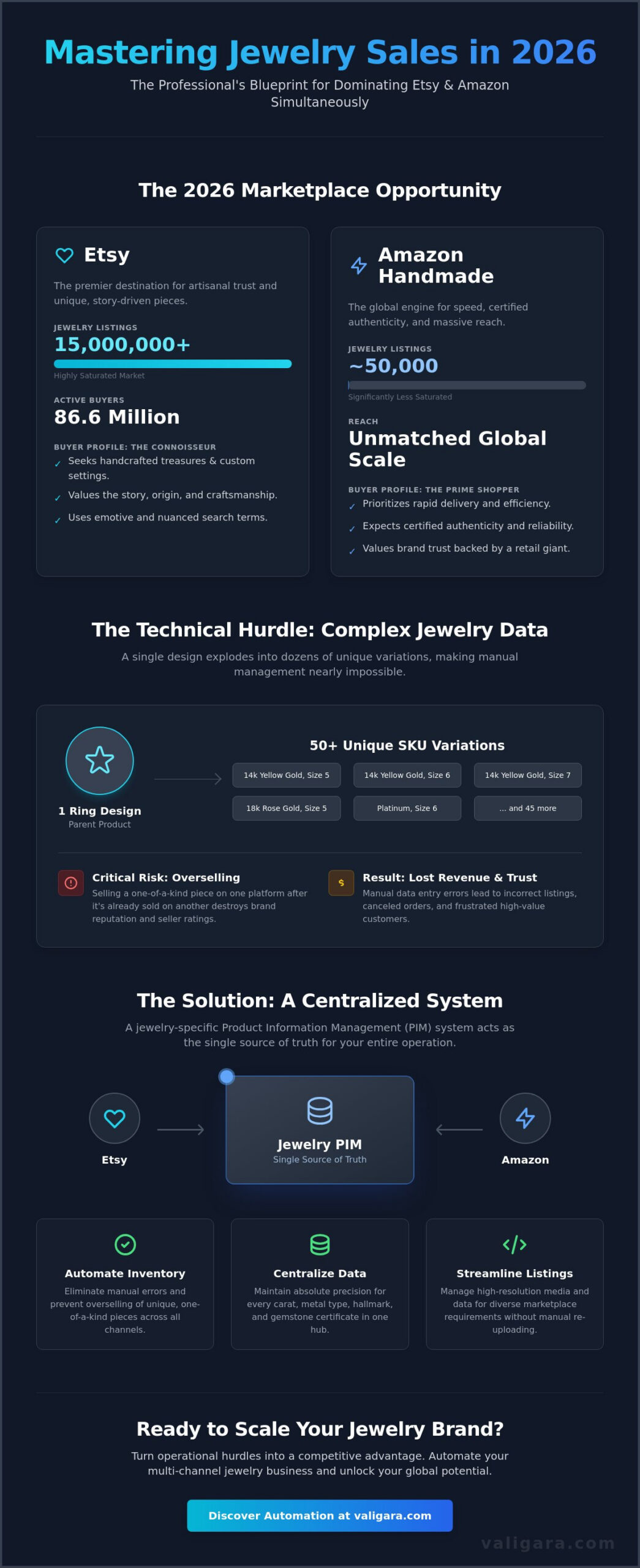
Etsy currently hosts over 15 million jewelry listings, yet Amazon Handmade offers a far less saturated landscape with only about 50,000 search results for the same category. You likely already understand that dominating both platforms is essential to reach Etsy’s 86.6 million active buyers while tapping into Amazon’s unmatched fulfillment speed. The challenge isn’t the desire to grow; it’s the technical friction of managing complex gemstone data and high-value inventory across two very different ecosystems. Learning how to sell jewelry on etsy and amazon at the same time shouldn’t mean doubling your manual workload or risking your reputation through oversold one-of-a-kind pieces.
This professional guide provides the technical roadmap to master multi-channel jewelry selling by turning your operations into a streamlined, global enterprise. We’ll examine the critical March 2026 updates to Etsy’s Purchase Protection Program and Amazon’s latest FBA fee adjustments that took effect on January 15, 2026. You’ll discover how to centralize your listings, automate inventory across every channel, and maintain absolute precision for every carat and hallmark in your collection.
Key Takeaways
- Identify the strategic advantages of combining Etsy’s community trust with Amazon’s massive global reach to scale your jewelry brand.
- Master the technical requirements of how to sell jewelry on etsy and amazon at the same time by establishing a jewelry-specific central hub for your inventory.
- Overcome the complexities of managing high-value variations, including gemstones, metal types, and ring sizes, across diverse marketplace requirements.
- Optimize your pricing and fulfillment strategies based on the latest 2026 fee updates and platform-specific creativity standards.
- Automate your multi-channel operations to eliminate manual errors and prevent the overselling of unique, one-of-a-kind pieces.
Why Jewelry Brands Need Both Etsy and Amazon in 2026
Multi-channel jewelry selling is the strategic practice of listing your inventory across specialized niche platforms and mass-market giants simultaneously. By May 2026, relying on a single online marketplace is a risk few professional jewelry brands can afford. Diversifying your presence creates an essential safety net against sudden algorithm shifts, fee increases, or policy changes. If one platform updates its search criteria or creativity standards, your revenue stream remains protected by the other. Learning how to sell jewelry on etsy and amazon at the same time allows you to maintain absolute control over your brand’s prestige while leveraging the distinct strengths of each platform.
The Audience Divergence: Artisans vs. Prime Shoppers
Etsy remains the premier destination for shoppers seeking artisanal trust and the unique story behind a specific gemstone or custom setting. These buyers often search using emotive language and regional nuances, such as the distinction between “jewelry” and “jewellery” in international markets. They want to know the carats, the origin of the stone, and the hands that forged the metal. Conversely, Amazon Prime members prioritize delivery speed and the guarantee of certified authenticity. They expect a 14k gold wedding band to arrive with the same efficiency as any other high-end luxury purchase. Bridging this gap is critical. You must present your collections as handcrafted treasures on Etsy while positioning them as high-performance, reliable luxury goods on Amazon.
Maximizing Global Visibility in 2026
Scaling diamond and gemstone sales in a crowded market requires visibility that transcends geographic borders. Amazon’s global infrastructure provides the engine for this expansion, offering established logistics and localized customer service that independent brands can’t replicate easily. By 2026, competitive jewelry SEO requires a presence on both platforms to dominate search results for high-intent keywords. Mastering how to sell jewelry on etsy and amazon at the same time ensures your brand is visible exactly where a high-value buyer starts their search. This dual-presence strategy isn’t merely about increasing traffic volume. It’s about building authority. When a customer sees your hallmarked collections on both a trusted artisanal site and a global retail leader, your brand’s perceived value increases. This multi-channel approach is the foundation of a modern, scalable jewelry enterprise.
The Technical Hurdle: Managing Complex Jewelry Data
Jewelry SKUs carry a level of complexity that standard retail products simply don’t match. A single ring design often exists in multiple metal purities, various gold colors, and a full range of sizes. This creates a data explosion where one product model turns into 50 or more unique SKU variations. Managing this manually while figuring out how to sell jewelry on etsy and amazon at the same time is a recipe for operational failure. You aren’t just tracking a product; you’re tracking specific gemstone grades, carat weights, and metal hallmarking requirements that must adhere to strict Jewelry Regulations in the United States.
Real-time stock synchronization is the only safeguard against the disaster of overselling. If a one-of-a-kind emerald pendant sells on Etsy at 3:00 PM, it must be delisted from Amazon by 3:01 PM. High-value jewelry buyers expect perfection. A cancelled order due to inventory lag destroys your seller rating and brand reputation. Professional sellers need a system that handles high-resolution media and gemstone certificates according to each platform’s specific image requirements without manual re-uploading. This ensures that your GIA certificates and 360 degree videos appear correctly whether the shopper is on a mobile Etsy app or a desktop Amazon Prime page.
Centralizing Your Jewelry PIM
A jewelry-specific Product Information Management (PIM) system acts as the specialized brain of your business. It serves as a single source of truth for every technical detail, from the exact carat weight of a center stone to the specific hallmark on a shank. By centralizing this data, you eliminate the manual errors that occur when copy-pasting details across different marketplace backends. You can explore the technical capabilities of a dedicated Jewelry PIM software to see how it structures complex diamond and gemstone data for multi-channel use.
Handling Jewelry Variations at Scale
Automating variations is essential for growth. Instead of creating each size and metal combination by hand, smart systems generate these variations automatically based on your master data. Pricing consistency is equally vital. When the spot price of gold shifts, your margins can vanish if your listings don’t update. Valigara’s gold feed sync ensures your prices remain accurate across all channels based on current market values. This level of automated inventory management allows you to focus on design and collection development while the software handles the arithmetic of global scale.
Etsy vs. Amazon Handmade: Choosing the Right Strategy
Successful jewelry brands don’t treat these platforms as identical clones. Navigating the unique fee structures and algorithmic preferences of each giant requires a surgical approach. Etsy charges a $0.20 listing fee and a 6.5% transaction fee, while Amazon Handmade takes a 15% referral fee on every sale. However, Amazon waives the $39.99 monthly professional seller fee for approved artisans, making it a viable entry point for those mastering how to sell jewelry on etsy and amazon at the same time. While Etsy is saturated with over 15 million jewelry listings, Amazon Handmade remains a blue ocean with significantly less competition, allowing your high-end collections to stand out with less aggressive advertising spend.
Ranking factors differ wildly between the two. Etsy’s algorithm values recency and the “story” of the piece, especially following their June 2025 creativity standards update that mandates original designs. Amazon’s A10 algorithm is a different beast entirely. It prioritizes sales velocity, conversion rates, and fulfillment reliability. To dominate both, you must provide the A10 algorithm with the technical precision it craves while feeding the Etsy community the artisanal narrative they expect. You can learn more about the strategic business foundations in this guide on How To Sell Jewelry Online.
Branding: Storytelling vs. Professionalism
Etsy is where you sell the provenance of a gemstone and the inspiration behind a setting to justify premium pricing. It’s a platform built on the “Maker’s Story.” Amazon shoppers, however, look for technical specifications, hallmarking proof, and verified reviews. Maintaining a consistent brand voice across these different interfaces is a technical challenge. Your Amazon listings must project the authority of a global enterprise, while your Etsy shop maintains the intimate feel of a boutique studio. This dual identity is easier to manage when your product data is synchronized from a single, jewelry-specific source.
Logistics and Fulfillment for High-Value Items
Fulfillment by Amazon (FBA) is the standard for jewelry success on that platform, but it comes with increasing complexity. Following the January 2026 discontinuation of Amazon’s FBA Prep and Labeling service in the US, sellers are now fully responsible for preparing their high-value items before shipment. Managing this alongside Etsy’s shipping expectations requires a centralized order management system. This ensures that whether a diamond ring ships via FBA or is merchant-fulfilled from your own vault, your inventory levels update instantly across both channels to prevent the catastrophic error of selling a piece you no longer have in stock.
5 Steps to Sync Your Jewelry Inventory Across Platforms
Executing a multi-channel expansion requires more than just a bulk-import button. To successfully master how to sell jewelry on etsy and amazon at the same time, you must follow a structured technical protocol. Generic e-commerce tools often treat rings like books, leading to data corruption and lost sales. A professional transition starts with internal data integrity and ends with a centralized engine that manages every facet of your gemstone inventory.
Step 1: Audit and clean your jewelry data. Standardize your carats, metal purities, and ring sizes across your entire catalog. If one listing uses “14kt” and another uses “14k gold,” your automation will struggle. Step 2: Choose a jewelry-specific hub. Your central platform must understand the difference between a mounting and a finished piece. Step 3: Map your attributes. Ensure your Etsy “materials” fields align with Amazon’s “technical specifications.” Step 4: Establish real-time synchronization. Protect your stock with millisecond-level updates. Step 5: Launch and monitor performance. Use jewelry-specific analytics to track which collections dominate which marketplace.
Mapping Attributes for Jewelry SEO
Your SEO strategy must adapt to the specific behaviors of each platform’s shopper base. Converting Etsy’s descriptive tags into Amazon’s structured backend keywords is a technical necessity. You must also account for global linguistic differences to maximize reach. Localized spelling variations like “jewellery” in Commonwealth markets account for approximately 40% of global search volume in 2026, requiring a dual-keyword strategy within your metadata. By optimizing for both “jewelry” and “jewellery” across your titles and descriptions, you capture the widest possible international audience without diluting your brand authority.
Preventing the Nightmare of Overselling
High-traffic jewelry seasons like Valentine’s Day or Black Friday create immense pressure on inventory systems. Generic sync tools often lag during these spikes, leading to the catastrophic overselling of a one-of-a-kind diamond engagement ring. Professional sellers require millisecond-level stock updates to ensure that a sale on one platform triggers an immediate delisting on the other. Implementing “safety stock” levels for your high-turnover silver or gold pieces provides an additional buffer against technical delays. To secure your operations against these risks, you can implement jewelry inventory management automation to maintain absolute stock accuracy.
Scale Your Jewelry Brand with Valigara’s Automation
Valigara operates as the specialized brain for your jewelry enterprise, bridging the gap between traditional craftsmanship and high-tech automation. Unlike generic e-commerce tools that treat every product like a mass-produced commodity, this platform is built exclusively for the nuances of the jewelry and diamond trade. It understands that a ring isn’t just a SKU; it’s a complex assembly of metal purities, gemstone carats, and specific certifications. Mastering how to sell jewelry on etsy and amazon at the same time becomes a matter of strategic oversight rather than clerical labor when you automate the entire lifecycle from gemstone intake to multi-channel sale. By centralizing your operations, you can reduce your manual workload by up to 80%, allowing your team to focus on design and high-level growth instead of data entry.
Beyond Listing: A Complete Jewelry Business Engine
Precision in the jewelry industry is non-negotiable. Valigara manages your diamond certifications and GIA data automatically, ensuring that every technical detail is synchronized across your storefronts without manual intervention. This level of control extends into your physical workspace. You can integrate your multi-channel sales with barcode and tag printing for your physical vault, creating a seamless link between your digital presence and your actual inventory. For those expanding into wholesale, the platform generates professional PDF catalogs for B2B clients directly from your active listings. This eliminates the need for separate graphic design sessions every time your collection evolves, ensuring your B2B offerings are as current as your retail storefronts.
Your Single Source of Truth
Transitioning from manual spreadsheets to a streamlined, automated enterprise is the defining step for any growing jewelry brand. Relying on disconnected documents leads to errors in hallmarking details or gemstone weights that can damage your reputation on sensitive platforms. Professional jewelry manufacturers have successfully used Valigara to expand to 5+ channels simultaneously while maintaining absolute data integrity. When you establish a single source of truth, you eliminate the friction that prevents global scaling. It’s time to move beyond the limitations of manual management and dominate the global market with precision. Scale your jewelry brand across Etsy and Amazon with Valigara today and discover how to sell jewelry on etsy and amazon at the same time with total confidence.
Dominate the Global Jewelry Market with Precision
Scaling your brand across multiple marketplaces requires a shift from manual labor to high-tech automation. You’ve seen that success isn’t just about listing products; it’s about maintaining a single source of truth for every carat, hallmark, and certification in your collection. By establishing a jewelry-specific hub, you eliminate the operational friction that leads to overselling and data errors. Mastering how to sell jewelry on etsy and amazon at the same time allows you to capture diverse audiences while protecting your brand’s prestige with absolute inventory accuracy.
Valigara is the only platform built specifically for jewelry and diamond professionals who demand centralized control. Our system provides seamless management for Etsy, Amazon, and eBay, powered by real-time gold feed and inventory synchronization. You don’t have to choose between artisanal storytelling and global logistics power when you have the right engine driving your business. It’s time to transition from a manual seller to a streamlined, automated enterprise. Automate your jewelry business across Etsy and Amazon with Valigara today and secure your place at the forefront of the luxury trade.
Multi-Channel Jewelry Sales FAQ
Can I use the same photos for jewelry listings on Etsy and Amazon?
You shouldn’t use identical photos because each platform has distinct aesthetic and technical requirements. Amazon mandates a 100% pure white background for the primary product image to maintain a clean, catalog-style appearance. Etsy shoppers respond far better to lifestyle photography that showcases the piece’s scale and artisanal craftsmanship. Using a centralized media manager allows you to store multiple versions of your jewelry photography and push the correct format to each marketplace automatically.
Does Amazon Handmade allow me to sell the same items I have on Etsy?
Yes, Amazon Handmade permits you to list the same jewelry collections found on Etsy. The primary requirement is that you or your small team must be the original designer and maker of the pieces. While the items can be the same, you should optimize the technical descriptions for Amazon’s data-driven shoppers. This helps you master how to sell jewelry on etsy and amazon at the same time while adhering to the specific creativity standards of each site.
How do I handle different prices for the same ring on Etsy and Amazon?
You can manage different price points by using a jewelry-specific automation tool that applies channel-specific markups. Since Amazon’s referral fee is 15% and Etsy’s transaction fee is 6.5%, you must adjust your pricing to maintain consistent profit margins. A centralized engine can calculate these differences automatically based on your base cost and the latest gold market values. This ensures your high-value inventory remains profitable regardless of the platform’s commission structure.
What is the best way to sync jewelry inventory to avoid overselling?
The most effective method is using a jewelry-specific PIM that provides millisecond-level synchronization across all channels. Generic e-commerce tools often fail to handle the complexities of ring sizes or gemstone variations during high-traffic seasons. Real-time updates ensure that when a one-of-a-kind diamond ring sells on one platform, it’s instantly delisted from the other. This protects your seller rating and prevents the catastrophe of selling high-value inventory you no longer have in stock.
Is it better to start on Etsy or Amazon for a new jewelry brand?
New jewelry brands often start on Etsy to build an initial customer base and refine their artisanal brand story. Etsy’s $0.20 listing fee makes it an affordable testing ground for new designs and collections. Once you’ve established demand and efficient production workflows, expanding to Amazon allows you to leverage their global logistics. This two-stage approach lets you scale your revenue without taking on excessive risk in the early stages of your business.
How does selling on both platforms affect my jewelry brand identity?
Selling on both platforms strengthens your brand identity by increasing visibility across different shopper personas. Your Etsy shop acts as your artisanal flagship, while your Amazon presence establishes you as a reliable, professional enterprise. Maintaining a consistent voice across these channels requires a single source of truth for your brand assets. This ensures your prestige remains intact whether a customer discovers you on a niche marketplace or a global retail giant.
Can I manage my diamond certifications across both Etsy and Amazon automatically?
You can manage diamond certifications and GIA data automatically by using a specialized jewelry management system. This software attaches the correct grading reports and technical specifications to your listings as they’re pushed to each marketplace. This automation ensures that high-value buyers have immediate access to authenticity documents. Providing this data upfront is critical for converting sales in the fine jewelry category and building long-term trust with international collectors.
What are the main SEO differences for jewelry between Etsy and Amazon?
Etsy SEO relies heavily on descriptive tags, titles, and listing recency to drive traffic to artisanal pieces. Amazon’s algorithm prioritizes sales velocity, conversion rates, and the density of technical keywords in the backend. Learning how to sell jewelry on etsy and amazon at the same time requires a dual-SEO strategy that optimizes for “maker” keywords on Etsy and “technical” specifications on Amazon. Balancing these two approaches ensures your collections appear at the top of search results on both platforms.