
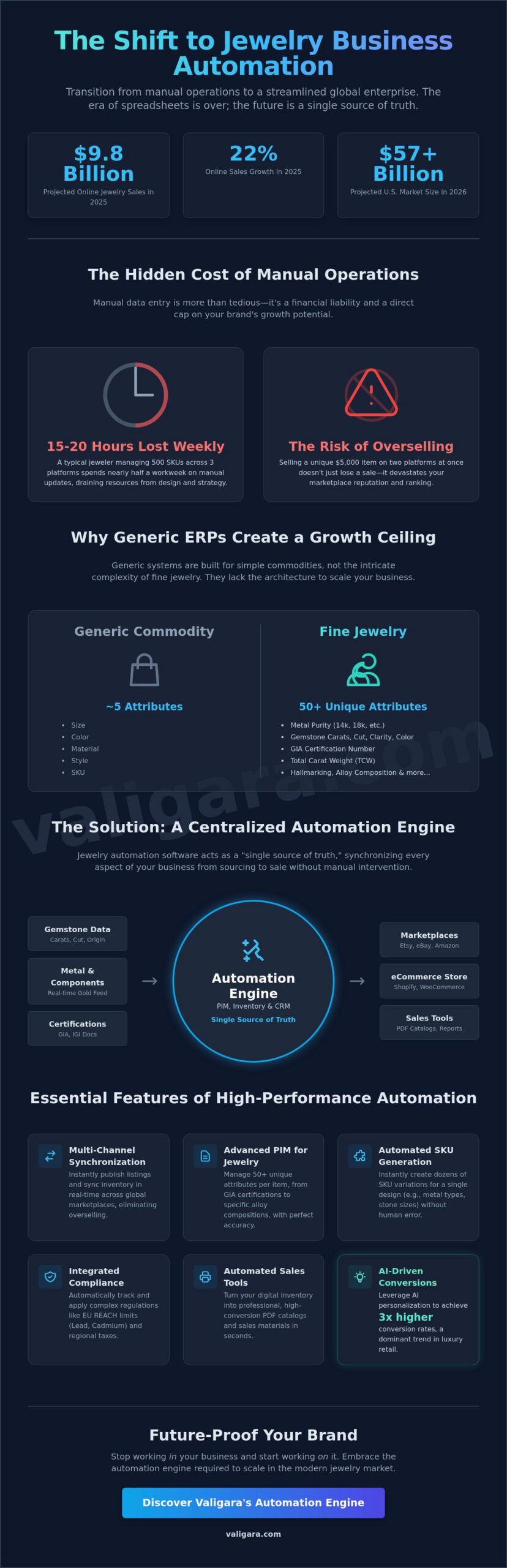
With online jewelry sales reaching $9.8 billion in 2025 and the U.S. market projected to exceed $57 billion in 2026, the era of manual data entry is officially over. You’ve likely felt the strain of managing complex SKU variations and gemstone certifications across three or more platforms while praying you don’t accidentally oversell a high-value item. It’s an exhausting cycle that keeps you working in your business rather than on it. Adopting specialized jewelry business automation software is no longer a luxury; it’s the central engine required to scale a sophisticated global enterprise.
This guide reveals how to transition from a manual seller to a streamlined powerhouse by centralizing your inventory, listings, and fulfillment into a single source of truth. You’ll learn to handle the latest regulatory shifts, including the January 2026 CSRD mandates for SMEs, while eliminating the labor-intensive tasks that stall your growth. We’ll preview the essential tools for real-time multi-channel synchronization and show you how to leverage AI-driven personalization to achieve the 3x higher conversion rates currently dominating the luxury retail sector.
Key Takeaways
- Learn why generic ERPs act as a growth ceiling and how to centralize your operations into a jewelry-specific single source of truth.
- Discover how to automate the management of complex gemstone data and GIA certifications directly within your product listings.
- Master multi-channel synchronization to publish listings across global marketplaces instantly while maintaining perfect inventory accuracy.
- Identify the essential features of high-performance jewelry business automation software, including the capacity to manage 50+ unique attributes per item.
- Explore how to turn your digital inventory into professional sales tools using automated PDF catalog generation and high-conversion eCommerce platforms.
Defining Jewelry Business Automation: Beyond Simple Management
Jewelry automation is the digital synchronization of inventory, pricing, and multi-channel listings across a global sales ecosystem. While many retailers confuse simple management with true automation, the difference lies in the level of manual intervention. Management tools require you to push buttons; automation builds the engine that drives itself. In the current market, where online sales grew by 22% in 2025, relying on spreadsheets or generic ERPs creates a growth ceiling that’s impossible to shatter without a specialized “centralized brain.”
Generic systems are designed for simple commodities like apparel. They lack the architecture to handle the 50+ unique attributes required for a single diamond ring, such as metal purity, gemstone carats, and GIA certifications. Implementation of Business process automation (BPA) within the jewelry sector ensures that your PIM, Inventory, and CRM operate as a single source of truth. When your gold feed syncs in real-time and your listings update across Etsy, eBay, and Amazon simultaneously, you move from reactive survival to proactive scaling.
The High Cost of Manual Jewelry Operations
Manual data entry isn’t just tedious; it’s a financial liability. A typical jeweler managing 500 SKUs across three platforms spends approximately 15 to 20 hours per week on manual updates. This “hidden” labor cost drains resources that should be spent on design or high-level strategy. Furthermore, manual lag creates a high risk of overselling. Selling a $5,000 unique sapphire ring on two platforms at once doesn’t just lose a sale; it destroys your marketplace reputation and ranking.
Generic automation also fails to account for shifting regulations. As of May 2026, jewelers must navigate strict EU REACH limits, such as the 0.05% weight limit for Lead and 0.01% for Cadmium. Tracking these compliance details manually across thousands of components is a recipe for legal and operational failure. High-performance jewelry business automation software integrates these technical specifications into the product’s DNA, ensuring every listing is compliant and accurate without human oversight.
Transitioning from Seller to Enterprise
The shift from a manual seller to a global enterprise requires a psychological and technical pivot. You must stop viewing your software as a digital filing cabinet and start treating it as the central engine of your brand. This transition allows you to scale SKU volume exponentially without increasing your headcount. When the system handles the heavy lifting of multi-channel synchronization and attribute management, your team can focus on the craftsmanship and customer relationships that define luxury retail.
By adopting jewelry business automation software, you gain the agility to enter new markets instantly. Whether it’s adjusting to the new 10% precious metals tax in Washington state or managing fluctuating duty rates for gold rope necklaces, an automated system applies these changes across your entire catalog in seconds. This level of precision and speed is what separates struggling manual brands from the streamlined, global enterprises dominating the 2026 jewelry landscape.
Automating the Jewelry Lifecycle: From Gemstone Sourcing to Sale
Scaling a luxury brand requires more than just listing items; it involves managing a complex chain of high-value components. True jewelry business automation software takes over at the sourcing stage, transforming a loose 1.5-carat diamond and a 14k gold mounting into a finished, market-ready SKU in seconds. By 2026, managing these variations manually has become a recipe for operational failure. A single ring design often requires 20 or more combinations of metal types, such as yellow, white, and rose gold, alongside varying stone sizes. Automation engines generate these SKUs instantly, populating technical data like hallmarking requirements and weight variations without human error.
Jewelry PIM (Product Information Management) serves as the engine of this lifecycle. It handles the 50+ attributes unique to each piece, from the total carat weight (TCW) to the specific alloy composition. When you introduce a new collection, the software doesn’t just create a listing; it creates a structured data set that translates across every marketplace’s unique requirements. This is a fundamental part of transforming jewelry retail with AI and sophisticated logic, ensuring that your data is as refined as your craftsmanship.
Gemstone and Diamond Data Automation
Certifications are the backbone of trust in the high-end jewelry market. Manually uploading GIA or IGI certificates for every stone is an inefficient use of your team’s time. Advanced automation systems digitize these documents, automatically attaching PDF certifications and specific lab data to the relevant listings. This keeps your loose stone inventory in sync with your finished pieces. By using carats, clarity, and cut as automated search filters, you significantly improve discoverability. Consumers expect this level of detail; currently, 68% of shoppers prefer AI-driven recommendations that rely on this granular gemstone data to make informed purchases.
Real-Time Gold Feed and Pricing Logic
Static pricing is a major margin killer in a volatile market. With gold prices fluctuating daily, a fixed price on your website can lead to selling at a loss or losing a sale to a more agile competitor. Automated pricing rules link your inventory directly to live market feeds. If the spot price of gold rises, your 18k gold collections update across all five or more sales channels within minutes. This protects your margins through cost-plus models that adjust for metal weight and current market value automatically. Implementing these automated jewelry management tools ensures you never lose a point of margin to market shifts while maintaining a competitive edge in a crowded global landscape.
This automated approach also handles the complexity of new regional taxes, such as the 10% tax on precious metals in Washington state effective January 1, 2026. Instead of manually recalculating prices for specific jurisdictions, the software applies these rules at the point of sale. This level of precision allows you to dominate the jewelry business automation software space by focusing on design rather than data entry.
Multi-Channel Mastery: Why Synchronization is the Heart of Automation
Synchronization is the central engine of a scalable brand. In 2025, online jewelry sales surged by 22%, proving that a single-store strategy is a relic of the past. To dominate the modern market, you must exist where your customers shop. High-performance jewelry business automation software allows you to “create once and publish everywhere,” but the real value lies in the technical translation. Each marketplace has unique requirements. Etsy demands specific handmade attributes, while eBay requires granular item specifics for high-value pieces. Generic tools often strip this data away, but a jewelry-specific engine maps these attributes perfectly. This ensures your 18k gold sapphire ring looks as professional on Amazon as it does on your boutique website.
Inventory sync is the primary safeguard of your brand’s reputation. Marketplaces like Amazon and eBay penalize sellers heavily for “Out of Stock” cancellations, often lowering search rankings or suspending accounts entirely. When you sell a one-of-a-kind emerald pendant on Etsy, your jewelry business automation software must delist that item from every other channel within seconds. This real-time synchronization prevents the nightmare of overselling high-value, non-replicable items. It provides the quiet confidence that your global operations are running with 100% accuracy while you sleep.
Listing Automation for Global Marketplaces
Transitioning from Etsy to Amazon usually involves a tedious manual re-mapping of categories. Automation simplifies this by using jewelry-specific templates that understand the nuances of carats, metal purity, and hallmarking. If you need to run a seasonal promotion, bulk editing tools allow you to update pricing or descriptions for 1,000+ listings in seconds. This same engine manages your private listings and B2B portals, keeping your wholesale and retail operations in perfect harmony. It allows you to expand into new territories without the need for a massive data entry team.
Centralized Order and Fulfillment Automation
Scaling to multiple channels shouldn’t mean managing multiple logins. Consolidating orders from eBay, Etsy, and your own site into a single dashboard provides a clear view of your business health. Automation takes it a step further by generating shipping labels and tracking updates specifically for high-value logistics. Once the sale is complete, CRM triggers handle post-purchase care. Automated emails can remind customers about jewelry cleaning services or suggest matching earrings based on their purchase history. This drives the repeat sales that companies with strong omnichannel strategies use to achieve 23% higher retention rates.
Key Features of High-Performance Jewelry Automation Systems
High-performance jewelry business automation software is defined by its ability to handle the granular complexities of the trade. While generic platforms offer basic inventory fields, a specialized PIM (Product Information Management) system manages 50+ unique attributes per item. This includes metal purity, alloy composition, gemstone carats, and specific certifications like GIA or IGI. In a regulatory environment where EU REACH limits for Lead (0.05%) and Cadmium (0.01%) are strictly enforced as of May 2026, having these data points integrated into your central engine is a necessity for global compliance. This precision ensures that every listing is not only marketable but legally sound.
Professional Jewelry PDF Catalogs
Automation eliminates the need for expensive graphic designers and long lead times for marketing materials. You can generate professional PDF catalogs for B2B clients or VIP buyers in minutes. These aren’t static documents. They’re dynamic sales tools linked directly to your B2B ordering portal. Whether you’re preparing for an international trade show or a private viewing, you can curate specific collections and export a branded catalog that reflects real-time stock levels and pricing. This speed allows you to respond to market opportunities while they’re still fresh, giving you a distinct advantage over slower competitors.
Barcoding and Physical-to-Digital Sync
Connecting the physical workshop to the digital storefront is where many brands lose efficiency. The “Quick Scan” workflow uses barcodes and RFID tags to move a piece from the jeweler’s bench to the online store instantly. During high-volume periods like Valentine’s Day or Black Friday, manual inventory counts are a liability. Automated barcoding ensures that every scan updates your multi-channel inventory, preventing the “Out of Stock” penalties discussed previously. Accuracy is paramount; it’s the difference between a satisfied customer and a cancelled order.
Analytics and insights turn your historical data into a predictive roadmap. By analyzing which gemstone variations or metal types are trending across different marketplaces, the software helps you forecast demand. You’re no longer guessing which collections to invest in. You’re making data-driven decisions that protect your margins and maximize ROI. To see these features in action, explore our jewelry automation engine and start scaling your brand with precision.
Future-Proofing Your Brand with Valigara’s Automation Engine
Scaling a jewelry brand in the 2026 landscape demands more than just aesthetic excellence; it requires a specialized digital infrastructure. Valigara stands as the expert insider choice because it was engineered specifically for the nuances of the gemstone and precious metal trade. While generic platforms force you to compromise your data structure, our jewelry business automation software respects the complexity of your inventory. Whether you’re managing 100 bespoke pieces or 100,000 SKUs, the system maintains the same level of precision and speed. This architectural integrity allows you to expand your global presence without the friction of manual data entry or the risk of inventory lag.
The Vite eCommerce platform is a core component of this engine. It’s not just a website builder; it’s a high-conversion environment optimized for luxury retail. Vite integrates directly with your central PIM, ensuring that every carat weight, metal variation, and GIA certificate is displayed with technical accuracy. This seamless connection between your “centralized brain” and your storefront is what drives the 3x higher conversion rates seen in AI-personalized jewelry experiences. As of May 2026, Valigara offers tailored pricing starting at $600 per month, providing a scalable entry point for brands ready to transition from manual chaos to automated dominance.
The Valigara Advantage: Jewelry-First Engineering
We understand that moving your entire business history is a significant undertaking. Our personalized onboarding process ensures that your legacy data, from hallmarking details to customer CRM history, transitions without loss. Valigara integrates seamlessly with your existing ERP or custom website through robust API access. This jewelry-first engineering means the software already speaks your language. You won’t spend months “teaching” the system the difference between a natural pearl and a cultured pearl; those distinctions are already baked into the logic. This deep industry expertise builds immediate rapport and allows for a faster implementation cycle.
Ready to Automate Your Jewelry Business?
The roadmap to precision starts with identifying the three processes that drain your resources most: inventory synchronization, multi-channel listing, and PIM management. Automating these first allows you to recover the 15 to 20 hours per week previously lost to manual updates. The ROI is immediate. You gain the freedom to focus on high-level design and strategic growth while the software handles the high-volume technical tasks. It’s time to stop working for your software and start letting your software work for you. Scale your jewelry brand with Valigara’s automation engine and secure your place as a leader in the global jewelry enterprise.
Dominate the Global Jewelry Market with Automated Precision
The transition from a manual seller to a global enterprise requires a fundamental shift in both strategy and technology. You’ve seen how centralizing your operations through a single source of truth eliminates the 15 to 20 hours of manual labor previously lost to SKU management each week. By leveraging jewelry business automation software, you ensure that complex gemstone data and real-time metal pricing are always accurate across your entire digital ecosystem. This level of technical precision is the only way to navigate the $57 billion U.S. jewelry market projected for 2026 while maintaining 100% inventory accuracy.
Valigara provides the specialized brain your business needs to scale without friction. Trusted by diamond exchange members, our platform offers a specialized PIM capable of managing 50+ jewelry-specific attributes and real-time synchronization across 10+ global marketplaces. You don’t have to struggle with the limitations of generic tools or manual spreadsheets anymore. It’s time to reclaim your time and focus on the artistry and high-level strategy that defines your brand. Schedule a personal demo of Valigara’s jewelry automation platform today. Your journey toward a streamlined, high-growth future starts with a single scan.
Frequently Asked Questions
What is jewelry business automation software?
Jewelry business automation software is a specialized digital engine that synchronizes your inventory, pricing, and multi-channel listings across global marketplaces. Unlike generic tools, it’s engineered to handle the 50+ unique attributes of high-value items like diamond rings and sapphire necklaces. It acts as the single source of truth for your brand, automating repetitive tasks like data entry and certificate management so you can focus on craftsmanship and strategic growth.
Can I use generic eCommerce software for my jewelry business?
Generic eCommerce software often acts as a growth ceiling because it doesn’t understand jewelry nomenclature. These platforms struggle with complex variations like metal purity or gemstone carats and can’t manage GIA certifications automatically. Relying on generic tools usually leads to manual workarounds and data errors that prevent you from scaling into a professional global enterprise. Only jewelry-specific architecture provides the precision required for high-end retail in 2026.
How does automation help with diamond and gemstone management?
Automation digitizes the management of loose stones and finished pieces by automatically attaching GIA or IGI certificates to relevant listings. It keeps your diamond feed in sync across all channels, ensuring that technical data like clarity, cut, and carat weight are always accurate. This improves search discoverability, as 68% of shoppers prefer the AI-driven personalized recommendations that rely on this granular gemstone data to make informed purchase decisions.
Will automation software prevent me from overselling on Etsy and eBay?
Yes, real-time synchronization is a core feature of high-performance jewelry business automation software. When a unique item sells on one platform, the system delists it from all other channels within seconds. This prevents the “Out of Stock” penalties and account suspensions common on marketplaces like eBay and Amazon. It provides the quiet confidence that your inventory is always accurate, even during high-volume periods like the 2026 Valentine’s Day rush.
Is it difficult to migrate my current jewelry inventory to an automated system?
Migration isn’t difficult when you use a platform designed for the jewelry trade. Specialized onboarding processes move your legacy data, including hallmarking details and customer history, without losing technical precision. Whether you’re moving from spreadsheets or an older ERP, the system integrates your existing data into a structured PIM. This ensures a seamless transition from manual chaos to a streamlined, automated workflow that supports thousands of SKUs.
Does jewelry automation software support real-time gold price updates?
The software includes gold feed sync capabilities that link your inventory pricing directly to live market feeds. If the spot price of gold fluctuates, the system automatically updates your prices across all sales channels based on pre-set pricing rules. This protects your margins in a volatile market and ensures you never sell a 14k or 18k piece at a loss due to outdated pricing data, which is critical for long-term profitability.
Can automation help with B2B jewelry sales?
Automation significantly enhances B2B operations by generating professional PDF catalogs and managing private wholesale portals. You can create custom catalogs for specific trade shows or VIP buyers in minutes, with every item linked to your ordering system. This eliminates the need for graphic designers and ensures your wholesale partners always see real-time stock levels and accurate B2B pricing, streamlining the entire sales cycle and increasing order frequency.
What is the ROI of implementing jewelry automation software?
The ROI of implementing jewelry business automation software is measured in both time recovery and revenue growth. Most jewelers save approximately 15 to 20 hours per week by eliminating manual data entry and listing tasks. Additionally, companies with strong omnichannel strategies see 23% higher customer retention rates. By providing the precision required for AI-personalized shopping, you can achieve up to 3x higher conversion rates compared to manual selling methods.