
Could a single extra letter really have the power to slash your international conversion rates by 30%? For many high-end sellers, the choice between jewellery or jewelry isn’t just a matter of grammar; it’s a strategic SEO decision that dictates whether your collections appear in a Londoner’s search or a New Yorker’s feed. You likely understand that precision is everything in this industry, from the clarity of a diamond to the hallmarking on a 14k gold band. When your spelling doesn’t match the local market’s expectations, you risk looking unprofessional and losing the trust of sophisticated buyers who value regional authenticity.
In this guide, you’ll discover how these spelling variations impact your global search visibility and learn how to automate localization for your brand. We’ll analyze regional search volume data, explore the branding implications of each spelling, and provide a clear strategy to sync your inventory across Amazon, eBay, and Etsy without the burden of manual editing. This article provides a roadmap to transform your manual operations into a streamlined, global enterprise with total control over your multi-channel presence.
Key Takeaways
- Understand the strategic branding implications of regional spelling to project authority and trust in major global jewelry markets.
- Learn how the decision to use jewellery or jewelry impacts your global visibility and helps you avoid the risks of keyword cannibalization.
- Master technical localization strategies, including Hreflang tags and the “Canadian Compromise,” to ensure your storefront resonates with local buyers.
- Discover how to automate regional terminology across your multi-channel inventory, transitioning from manual effort to high-tech global scaling.
- Leverage jewelry-specific automation to synchronize listings and maintain a single source of truth for your gemstone and diamond collections.
Beyond Grammar: Why the “Jewellery or Jewelry” Debate Matters for Your Brand
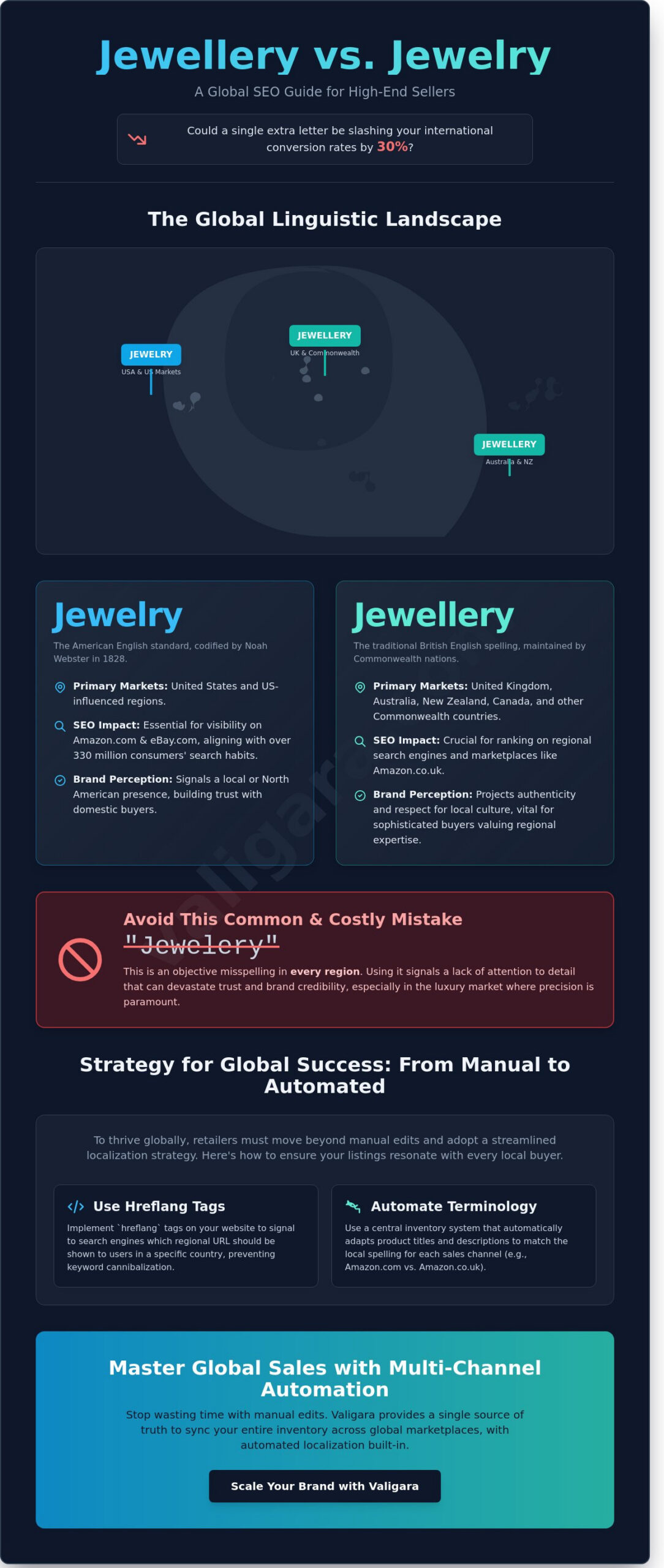
Success in the global luxury market requires more than just high-quality gemstones and intricate designs. It demands technical precision in every digital touchpoint. For retailers expanding across borders, the choice between jewellery or jewelry isn’t a minor linguistic quirk; it’s a strategic decision that dictates your search visibility and brand authority. American consumers predominantly search for “jewelry,” while the United Kingdom, Australia, and New Zealand adhere to the “jewellery” spelling.
This regional divide creates a significant challenge for multi-channel synchronization. If your inventory management system doesn’t account for these variations, you risk alienating high-net-worth clients who view spelling inconsistencies as a lack of professional expertise. Detailed records at Jewellery – Wikipedia show how the term’s etymology and regional evolution highlight how deeply these preferences are rooted in local culture. Ignoring these nuances leads to poor search intent localization, where your high-value collections fail to appear for the right audience. Consistency across your storefronts signals that your brand is an expert insider, regardless of the territory.
The Origin of the Spelling Split
The divergence began in 1828 when Noah Webster published his American Dictionary of the English Language. Webster aimed to simplify spelling for the new American identity, removing the extra “l” from the British standard. While the United States adopted this streamlined version, the Commonwealth nations maintained the traditional double-L. One trap global sellers must avoid is “Jewelery.” This version is an objective misspelling in every region. Using it in your product descriptions or metadata signals a lack of attention to detail that can devastate trust in a sector where hallmarking and certification accuracy are paramount. Precision in your jewellery or jewelry listings reflects the precision of your carats and metal purity.
The High Stakes of Brand Perception
Luxury retail operates on the strength of prestige and reliability. Using the “jewelry” spelling for a London-based storefront suggests a generic, non-local presence, which can lower conversion rates instantly. Industry data indicates that 75% of shoppers prefer to buy products in their native regional spelling. For a business scaling through automated inventory systems, ensuring your listings match local expectations is vital for building rapport.
Accuracy is particularly critical when dealing with gemstone certifications and legal hallmarking requirements. A brand that fails to localize its spelling often appears as a struggling manual seller rather than a streamlined, global enterprise. By mastering these linguistic nuances, you transition to a more authoritative position in the market. This choice transforms your brand into a sophisticated entity that respects traditional craftsmanship while utilizing high-tech automation to dominate the global trade.
Regional Variations: Mapping the Global Linguistic Landscape
Global inventory management demands linguistic accuracy. Deciding between jewellery or jewelry isn’t a matter of personal preference; it’s a strategic decision based on geography and search volume. The divergence began in the 19th century when Noah Webster codified American English, opting for the single ‘l’ to simplify the language. According to Grammar Monster, this distinction remains a primary marker between American and British publications today, influencing everything from the BBC’s style guide to The New York Times’ editorial standards.
United States and US-Influenced Markets
In the United States, “Jewelry” and “Jeweler” dominate the retail space. Major domestic marketplaces like eBay.com and Amazon.com default to the American variant because it aligns with the search habits of over 330 million consumers. For US-based retailers, using the double ‘l’ can signal a foreign origin, which occasionally creates a friction point for domestic buyers seeking local craftsmanship. High-performance US listing titles must use “Jewelry” as the primary noun to ensure maximum visibility within domestic search algorithms.
The UK, Australia, and the Commonwealth
The British standard remains “Jewellery” and “Jeweller.” This spelling holds nearly 100% market share in the UK, Australia, and New Zealand. Professional trade organizations, such as the National Association of Jewellers (NAJ) in the United Kingdom, maintain this as the industry benchmark for certification and hallmarking. In South Africa, while US influence is growing via social media, “Jewellery” remains the official trade preference for high-end retail and professional associations established since the early 20th century.
The Canadian Compromise and Global Hubs
Canadian retailers navigate a hybrid landscape. While “Jewellery” is the official government and editorial standard, the proximity to the US means “Jewelry” appears in approximately 42% of Canadian search queries. Sellers in this region often need a dual-spelling strategy to capture all local traffic. In global trade hubs like Singapore, India, and the UAE, British English remains the formal foundation for the gemstone trade. However, the heavy influence of US-centric e-commerce tech means sellers frequently encounter jewellery or jewelry variations in their backend systems.
Spelling Derivatives and Automation
The shift extends to every derivative of the word. You’ll use “Jeweled” and “Jeweler” in New York, but “Jewelled” and “Jeweller” in London. Managing these variations manually across a catalog of 1,000 SKUs is a recipe for operational drag. Sophisticated brands automate their multi-channel listings to ensure the correct regional spelling reaches the target audience without manual intervention. This level of precision builds immediate rapport with local buyers who value the nuances of their own dialect.
The SEO Impact: How Spelling Affects Search Volume and Visibility
Selecting jewellery or jewelry isn’t a matter of personal preference; it’s a strategic SEO decision that dictates your reach in specific markets. Global search data confirms that “jewelry” attracts approximately 1.8 million monthly searches in the US market. In contrast, “jewellery” remains the dominant term in the UK, generating roughly 165,000 monthly queries. If your digital storefront targets a global audience without a localized strategy, you risk losing half your potential traffic by choosing the wrong variant for your primary domain.
Mixing spellings on a single product page creates keyword cannibalization. This confuses Google’s indexing bots and dilutes your page authority. When you use both variants interchangeably, the algorithm struggles to determine if your gemstone collection targets a London boutique or a New York retailer. Google’s localized algorithms prioritize regional relevance. If your metadata uses British spelling, you will likely rank lower in US-based search results. This discrepancy also impacts paid search (PPC) performance. Ad copy that doesn’t match the landing page spelling can lead to a 15% drop in Quality Scores, directly increasing your cost-per-click and wasting your marketing budget.
Keyword Research for Global Jewelers
Effective keyword research requires more than just high-volume terms. You must identify where your customers live. A search for “Diamond Jewelry” yields massive volume in North America, but “Diamond Jewellery” is the essential term for ranking in Australia and India. These variations stem from American and British English spelling differences, which have influenced global commerce for over two centuries. Use Google Trends to track regional dominance. For example, localizing your long-tail keywords to include phrases like “Jewellery Quarter Birmingham” ensures you capture high-intent traffic that generic US spelling would miss entirely.
Spelling and Marketplace Algorithms
Internal search engines on Etsy and Amazon behave differently than Google. On Amazon.co.uk, the A9 algorithm heavily favors regional spelling for organic rankings. Using the British “Jewellery” helps you rank higher in UK search results, whereas using the American version might relegate your listings to the second or third page. Conversely, eBay.com is dominated by US buyers. Using British spelling on eBay’s US site can lead to a 20% loss in visibility. To dominate these platforms, your inventory management system must allow for multi-channel synchronization that adjusts titles and descriptions based on the specific marketplace’s geographic location. Deciding between jewellery or jewelry requires a platform-specific approach to ensure your high-value items reach the right eyes.
Localization Strategy: Best Practices for Multi-Channel Retailers
Scaling a high-end brand requires a definitive “Primary Market” spelling standard. If 65% of your revenue originates in the United States, “jewelry” becomes your core identity. However, ignoring the UK, Australian, or Canadian markets means losing visibility where “jewellery” is the norm. Deciding between jewellery or jewelry isn’t just a stylistic preference; it’s a structural decision for your product database. Successful retailers establish one master language and use technical layers to adapt for regional buyers.
Manual localization is the #1 bottleneck for scaling jewelry brands. Updating 500 SKUs across Etsy, eBay, and Amazon manually takes approximately 40 man-hours per update cycle. This inefficiency prevents rapid market entry and increases the risk of data mismatch. To solve this, implement Hreflang tags on your website. These tags tell search engines which regional version of a page to show. A user in London should see “jewellery” while a user in New York sees “jewelry,” even if the product remains the same 18k gold band.
Marketing automation and social media require similar precision. Segment your email lists by geography to ensure your subject lines resonate. A holiday campaign targeting the UK with US spelling can lead to a 15% drop in click-through rates because it signals a lack of local presence. Use localized content to build trust and signal that you understand the specific hallmarking and consumer protection laws of that region.
Platform-Specific Localization
On Shopify, use the “Markets” feature to create localized versions of titles and descriptions. WooCommerce users should utilize plugins like WPML to manage regional variations. Ensure your meta tags and image alt text reflect the local spelling; an image of a “1ct Diamond Engagement Ring” must use “jewellery” in its alt tag for the UK market to capture local search intent. For GIA certificate descriptions, always maintain the exact technical terminology used by the laboratory to preserve the integrity of the grading data.
The Role of PIM in Global Selling
A Jewelry PIM is essential for managing regional data without duplicating effort. It acts as a “Single Source of Truth,” allowing you to push different spellings to different channels from one central hub. This setup ensures that your jewellery or jewelry listings remain consistent with local SEO requirements while maintaining accurate gemstone weights and metal purity across all platforms. Automating the translation of specialized terminology ensures that technical specs like “milgrain” or “pavé” are localized correctly for every market. Centralized control turns a complex, multi-channel inventory into a streamlined global operation.
Mastering Global Sales with Valigara’s Multi-Channel Automation
Manual data entry is the primary cause of inventory discrepancies. Valigara eliminates this risk by centralizing your inventory management. When a 2.0-carat sapphire pendant sells on your US website, the system triggers a real-time update across all UK and European channels. This synchronization prevents the 15% loss in revenue often caused by overselling or outdated stock levels. By automating the technical specifications of your inventory, you focus on the creative aspects of your collections while the software handles the logistics of global distribution.
Jewelry-Specific Automation
Valigara is designed specifically for the unique complexities of jewelry SKUs. It manages intricate variations like metal purity, stone clarity, and ring sizing across diverse regional standards. The Gold Feed Sync feature is a critical tool for maintaining profitability. It automatically recalculates your retail prices across 20+ platforms based on live market fluctuations in gold and platinum. You don’t have to manually update hundreds of listings when metal prices shift; the system does it for you. This automation extends to fulfillment, streamlining the journey from the workbench to the international customer’s doorstep.
Scale Your Brand with Confidence
Transitioning from a local boutique to a global enterprise is a significant leap. Valigara provides the framework for this growth by offering a jewelry-specific CRM. This tool tracks the specific preferences of your international clientele, allowing you to segment your marketing by metal preference or gemstone interest. Scaling becomes a controlled process rather than a chaotic scramble. You gain the ability to dominate new markets with the precision of a seasoned expert. Precision is everything in this industry, and our tools ensure your data is as flawless as your diamonds.
Dominate the Global Market with Precision SEO
Navigating the nuances of jewellery or jewelry spelling is the first step toward building a dominant international brand. Your choice impacts local search rankings and consumer trust across diverse markets like the US, UK, and Australia. Effective global selling requires a sophisticated localization strategy that goes beyond simple grammar. It’s about building a technical infrastructure capable of managing complex SKU data and multi-channel synchronization without the risk of manual error. Since 2009, Valigara has served as the central engine for diamond and jewelry manufacturers looking to scale. By centralizing your operations, you ensure that every gemstone and hallmarked piece is accurately represented across eBay, Etsy, and Amazon. Our jewelry-specific PIM handles the intricate details of your inventory; this allows you to focus on growth rather than data entry. Transition your business from manual processes to a streamlined, high-tech enterprise that captures every global opportunity with confidence and precision. You have the craftsmanship; let us provide the automation to share it with the world.
Automate Your Global Jewelry Sales with Valigara
Frequently Asked Questions
Is it jewelry or jewellery in Canada?
Canada officially recognizes “jewellery” as the standard spelling in formal contexts and government publications like the Canadian Style guide. Data indicates that while “jewellery” dominates official documentation, nearly 40% of Canadian consumers use the American spelling in search queries. For brands scaling into the Canadian market, prioritizing the double “l” maintains professional credibility while localized SEO strategies should account for both variations to capture full search intent.
Which spelling should I use for my international jewelry website?
Match your primary spelling to the geographical location of your largest revenue-generating audience to ensure immediate brand trust. If 50% of your sales originate in the United States, adopt “jewelry” as your primary site language. For brands targeting the UK, Australia, or the Commonwealth, “jewellery” is the authoritative choice. Use a centralized inventory system to manage these regional variations across different localized storefronts without duplicating manual labor.
Does Google penalize you for using the “wrong” spelling of jewelry?
Google does not issue penalties for regional spelling variations because its 2019 BERT update allows the engine to understand context and intent. Searching for jewellery or jewelry yields similar results because the algorithm recognizes these as semantic synonyms. Your ranking depends on technical SEO factors and inventory depth rather than a single character difference. Focus on high-quality metadata and precise gemstone descriptions to signal authority to search crawlers.
How do you spell jewelry in Australia and the UK?
Australia and the United Kingdom exclusively use “jewellery” as the correct grammatical form. This spelling is standard across all Commonwealth nations and is required for professional listings on regional platforms like Amazon UK or eBay Australia. Maintaining this standard is essential for luxury branding. It ensures your rings and necklaces meet the expectations of local consumers who equate correct spelling with product authenticity and craftsmanship.
Does spelling affect my rankings on Etsy and Amazon?
Search rankings on Etsy and Amazon are heavily influenced by literal keyword matches within titles and backend tags. While Google is intuitive, marketplace algorithms often prioritize exact strings. If you list an engagement ring on Amazon.co.uk using the American spelling, you risk losing visibility to 90% of local shoppers. Automate your multi-channel listings to ensure each marketplace receives the linguistically correct version of your product data.
What is the correct way to spell jeweler or jeweller?
“Jeweler” is the accepted American English spelling, whereas “jeweller” is the standard in British, Australian, and Canadian English. This distinction extends to all related terms, including jewelry-making and jewelled. Professional sellers must remain consistent within their brand voice. Mixing these spellings on a single product page can signal a lack of attention to detail, which undermines the trust required to sell high-value gemstones and precious metals.
Should I use both “jewelry” and “jewellery” on the same page for SEO?
Avoid using both “jewelry” and “jewellery” in your customer-facing copy as it creates a disjointed brand experience. Instead, select one primary spelling based on your 2024 target demographic and use the alternative in backend metadata or image alt text. Deciding between jewellery or jewelry shouldn’t compromise your professional tone. Use automated synchronization tools to deploy the correct variant across specific international domains while keeping your core inventory data centralized.