
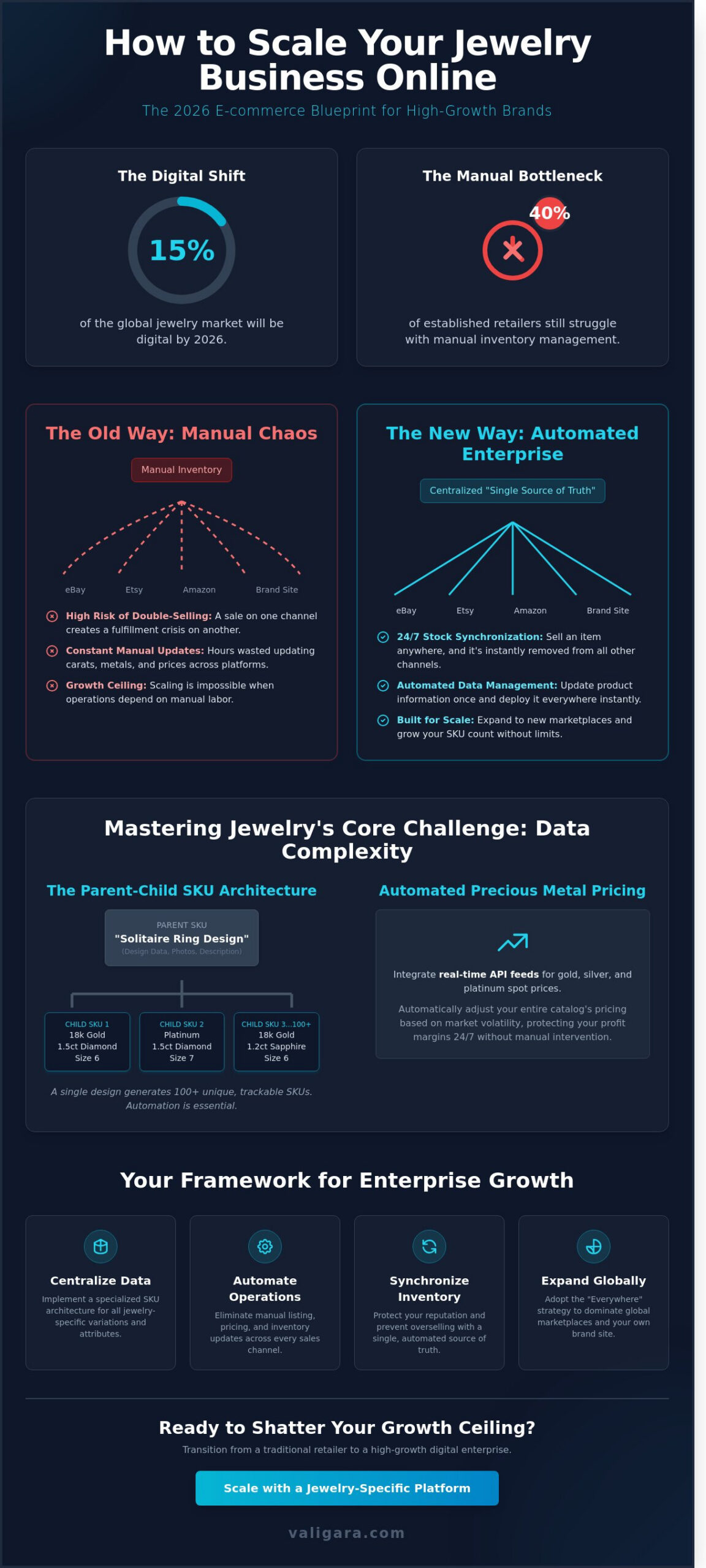
By 2026, the digital jewelry market is projected to reach 15% of total global sales, yet 40% of established retailers still struggle with the manual labor of inventory management. You know that mastering how to sell jewelry online involves far more than listing a few rings on a website. It’s a complex balancing act between maintaining a luxury brand image and managing the technical demands of multi-channel retail. You’ve likely faced the headache of updating carats and metal types across disparate platforms, or the constant fear that a single sale on Etsy might trigger a double-sell on eBay before you can manually sync your stock.
This guide provides a professional framework to transition your business from a traditional retail model to a high-growth digital enterprise. We’ll show you how to build a centralized system for all product data that handles complex SKU variations with ease. You’ll discover how automated stock synchronization protects your reputation while expanding your global reach. We’ll explore the specific tools required to dominate multiple marketplaces and ensure your jewelry brand scales with precision and speed through 2026.
Key Takeaways
- Adopt a multi-channel “Everywhere” strategy to dominate global marketplaces while maintaining total brand authority through your owned digital assets.
- Solve the data complexity of gemstones and metals by implementing a specialized SKU architecture designed for jewelry-specific variations and parent-child relationships.
- Master how to sell jewelry online by digitizing your inventory and aligning your multi-channel strategy with high-growth global buyer demographics.
- Protect your margins and mitigate fulfillment risk by centralizing high-value logistics through a single, automated source of truth.
- Shatter the manual growth ceiling and scale to an enterprise level by automating listing, pricing, and inventory updates across all sales platforms.
The 2026 Jewelry E-commerce Landscape: Marketplaces vs. Brand Sites
The era of the isolated digital boutique is over. By 2026, successful jewelry brands have pivoted to an “Everywhere” strategy. This multi-channel approach ensures your collections are visible wherever high-intent buyers browse. Learning how to sell jewelry online in this environment requires balancing the massive, ready-to-buy traffic of global marketplaces with the high-margin, data-rich environment of an owned flagship site. You can’t choose one or the other; you must dominate both.
Jewelry isn’t a generic commodity. It’s a complex category defined by carats, metal purity, gemstone certifications, and hallmarking requirements. Generic e-commerce logic fails here because it can’t handle the granular data needed for a single diamond ring that exists in multiple sizes or with various stone qualities. To scale, you need a centralized engine. This “single source of truth” synchronizes your inventory across every platform, ensuring a 1.5-carat sapphire sold on one channel is instantly removed from all others. This prevents the reputational damage of overselling and streamlines your global operations.
Marketplace Giants: eBay, Etsy, and Amazon
Marketplaces provide the immediate oxygen of traffic. Etsy remains the undisputed leader for artisanal and personalized jewelry. In 2026, its focus on “Human-Made” items makes it the primary destination for custom engagement rings and birthstone collections. For high-value assets, eBay has transformed the luxury sector. Its Authenticity Guarantee, which expanded significantly after 2021, now covers most high-end watches and jewelry over a specific price point, giving buyers the confidence to spend thousands on a single transaction.
Amazon presents a dual-track opportunity. Amazon Handmade allows smaller studios to leverage the Prime shipping machine, while Amazon Luxury Stores cater to established brands. Success on these platforms depends on your ability to map complex jewelry attributes to their specific search algorithms. If your data isn’t precise, your gemstones won’t appear in filtered searches. Beyond the major players, savvy jewelry sellers are also evaluating whether selling on Bonanza.com is still worth it in 2026 as a lower-competition alternative for reaching buyers of precious metals and gemstones.
Building Your Own Flagship: Shopify, Vite, and Beyond
While marketplaces bring the crowds, your brand site builds the legacy. Platforms like Shopify or the high-speed Vite framework allow you to own the customer relationship and the data that comes with it. A dedicated site is essential for building loyalty and implementing sophisticated retargeting campaigns. However, generic templates often struggle with the technical demands of jewelry. They don’t naturally support diamond grading reports or the complex variations inherent in precious metal jewelry.
Your flagship site must act as the heart of your identity. It’s where you tell the story of your craftsmanship and offer exclusive collections not found on marketplaces. The challenge is maintaining a consistent brand voice while managing the technical overhead. When you master how to sell jewelry online, your brand site and your marketplace listings work in a synchronized loop, fueled by a specialized backend that understands the jewelry trade better than a general-purpose tool ever could.
Mastering the Jewelry Data Challenge: SKUs, Metals, and Gemstones
Jewelry stands as the most complex e-commerce category because of its infinite variation potential. Unlike a standard consumer product, a single ring design can generate over 100 unique stock-keeping units (SKUs) when you account for metal types, stone qualities, and sizes. Managing this complexity requires a robust Parent-Child SKU architecture. In this framework, the Parent SKU holds the design data, while Child SKUs track the specific combinations of materials. This structure is vital for maintaining clean data across multiple sales channels.
Accurate pricing adds another layer of difficulty. Precious metal markets are volatile; gold and silver prices change by the minute. Professional retailers don’t update these prices manually. They integrate real-time API feeds that automatically adjust retail prices based on current market spot prices and pre-defined markup formulas. When you research how to sell jewelry online, you’ll find that technical inventory management is the primary barrier to scaling. Without automation, a 3% shift in gold value can erase your profit margins across your entire catalog overnight.
Managing Complex Variations and Attributes
Generic e-commerce tools often fail to capture jewelry-specific attributes like shank width, setting type, or metal fineness. You need a centralized “single source of truth” to manage these details. A dedicated Jewelry PIM software guide highlights how specialized systems sync these attributes across Etsy, eBay, and Amazon simultaneously. Implementing a PIM typically reduces data entry errors by 90% and cuts the time spent on product launches from days to minutes. This allows you to focus on design rather than spreadsheet management.
Digitizing Trust: GIA Certifications and Hallmarking
High-ticket sales depend on verifiable proof of quality. To build buyer confidence, you must automate the attachment of GIA, IGI, or HRD certificates to specific diamond and gemstone SKUs. When a customer views a high-value item, the certificate should be instantly accessible as a digital asset. This level of transparency is non-negotiable for items priced over $1,000. Mastering diamond and gemstone management means automating this entire certification workflow so every carat, cut, and clarity grade is precisely linked to the correct SKU across all your sales channels.
Compliance is equally critical when selling globally. Different regions have unique hallmarking requirements. For instance, the UK Hallmarking Act 1973 requires specific marks for silver items weighing more than 7.78 grams. Your system should track these weights and automatically flag items that need specific hallmarking before international shipment. Precision in your data ensures you remain compliant and professional in every market. You can easily streamline your jewelry data management to ensure every listing is accurate, certified, and ready for a global audience.
A Step-by-Step Multi-Channel Strategy for Jewelry Brands
Scaling a jewelry brand requires more than a beautiful collection; it demands a technical infrastructure that replaces manual spreadsheets with automated precision. Success in knowing how to sell jewelry online at a global scale involves mastering the flow of data across every digital touchpoint. You must first audit your current inventory and digitize every physical attribute. This includes high-resolution photography, metal weights, and gemstone specifications. Centralizing this data prevents the fragmentation that often stunts the growth of independent jewelers.
Phase 1: Inventory Digitization and PIM Setup
High-quality, 360-degree photography is non-negotiable for 2026. Interactive visuals allow customers to inspect the fire in a diamond or the setting’s craftsmanship from their mobile devices. These assets can reduce return rates by as much as 40 percent. Beyond photos, you must create a “Single Source of Truth” for your product descriptions. A dedicated Product Information Management (PIM) setup stores your carats, metal types, and hallmarking details in one central hub. This preparation allows you to bulk-list items across multiple platforms in minutes rather than days. It ensures your brand voice remains consistent whether a client finds you on a luxury marketplace or your private boutique.
Phase 2: Channel Integration and Stock Sync
Managing one-of-a-kind items across Etsy, eBay, and your own site presents a high risk of overselling. If a unique vintage ring sells on one channel, it must vanish from others instantly to avoid customer disappointment and marketplace penalties. Implementing a Multi-channel jewelry selling platform creates a real-time synchronization bridge. This automation protects your reputation and seller metrics by updating stock levels across all APIs simultaneously.
While expanding your reach, it’s vital to ensure you sell online, legally by adhering to FTC disclosure rules for treated gemstones and lab-grown diamonds. Once your channels are integrated, you can focus on jewelry-specific SEO. Use terms like “conflict-free” or “18k gold” to capture high-intent traffic. This strategy transforms a manual operation into a streamlined, global enterprise. Understanding how to sell jewelry online effectively means moving away from manual updates and embracing a system that works while you focus on design and acquisition.
- Audit: Identify which pieces are ready for immediate global listing.
- Sync: Connect your primary site with secondary marketplaces.
- Automate: Use jewelry-specific software to handle the heavy lifting of inventory management.
Operations, Logistics, and Global Jewelry Fulfillment
High-value inventory demands high-security protocols. When you master how to sell jewelry online at a global scale, logistics becomes the backbone of your brand reputation. Shipping a $5,000 engagement ring isn’t the same as shipping apparel. The risk of transit loss or customs delays can erase your margins instantly. Professional sellers move away from manual tracking and adopt centralized systems to manage the complex flow of gemstones and precious metals across borders.
Global expansion requires strict adherence to international regulations. For example, the UK Hallmarking Act 1973 requires specific purity stamps for gold and silver items over certain weights. If you’re shipping to the US, you must understand Section 321 de minimis entries, which allow duty-free imports for shipments valued under $800. Centralizing your order management ensures that every international sale includes the correct HS codes and customs documentation, preventing your luxury goods from being seized at the border.
Secure Shipping and Insurance Strategies
Standard postal services are insufficient for high-ticket jewelry. Use carriers that offer specialized luxury programs, such as FedEx Jewelry Shipping or UPS Capital. These services provide higher insurance limits, often covering up to $100,000 per package, whereas standard options cap coverage at much lower amounts. Automating your shipping labels through a dedicated platform reduces human error and provides customers with real-time, encrypted tracking updates. For high-ticket returns, always provide “blind” return labels that don’t list your brand name or the word “jewelry” on the exterior to mitigate theft risks.
Centralized CRM: Turning One-Time Buyers into Collectors
Jewelry is an emotional purchase. A generic CRM won’t track the specific data points needed to build a collection. You need to record metal preferences, ring sizes, and significant dates like the 10th or 25th wedding anniversaries. By 2024, data shows that personalized follow-ups based on purchase history increase repeat buyer rates by 22%. Automating post-purchase care instructions for specific gemstones, such as emeralds or opals, positions your brand as an expert insider rather than a transactional vendor. This precision builds the trust necessary to turn a one-time earring buyer into a lifelong collector.
- Double-Boxing: Place the jewelry box inside a small padded mailer, then place that mailer inside a larger shipping box.
- Tamper-Evident Tape: Use reinforced water-activated tape to make it impossible to open the box without leaving visible signs.
- Discreet Labeling: Never use words like “Diamonds,” “Gold,” or “Jewelers” on the return address. Use a personal name or an abbreviated business name.
- Internal Packing Slip: Always include a detailed invoice inside the inner box to prove ownership if the outer packaging is damaged.
- Insurance Verification: Confirm that your policy covers “Concealed Loss” and “Transit Theft” before the courier scans the package.
Managing these moving parts manually is a recipe for disaster. Professional automation is the only way to maintain the precision required for luxury retail. If you’re ready to move beyond manual spreadsheets and dominate the global market, it’s time to scale your jewelry business globally with a specialized management engine.
Scaling to Enterprise: The Power of Jewelry-Specific Automation
Every growing brand eventually hits the “Manual Ceiling.” This is the point where adding more products or sales channels requires an impossible amount of human labor. When your inventory includes thousands of unique SKUs, each with specific gemstone weights, metal purities, and laboratory certificates, manual management becomes a liability. To master how to sell jewelry online at an enterprise level, you must transition from manual entry to automated synchronization. A professional approach to diamond and gemstone management is the foundation of this transition, ensuring every high-value stone in your vault is tracked, certified, and synced across all channels in real time.
The ROI of Eliminating Manual Workloads
Automating your jewelry business delivers immediate, measurable returns. Consider the impact of bulk-listing 1,000+ items across five different marketplaces simultaneously. Doing this manually takes approximately 50 hours of meticulous data entry; Valigara completes the task in minutes. This speed eliminates the risk of human error in critical areas like metal pricing and carat weights, which can lead to significant financial losses if miscalculated.
- Inventory Sync: Real-time updates prevent overselling high-value items across Etsy, eBay, and Amazon.
- Dynamic Pricing: Automatic adjustments based on live gold and silver market feeds keep margins protected.
- Data Integrity: Direct integration with gemstone labs ensures technical specifications are 100% accurate.
Scalability in the jewelry sector means expanding your digital footprint and SKU count while keeping your operational team lean and focused on high-level strategy.
Why Valigara is the Expert Insider’s Choice
General e-commerce tools don’t understand the nuance of a halo setting or the difference between 14k and 18k gold. Valigara was built with a Jewelry-First philosophy, designed specifically to handle the complexities of the trade. It acts as the central brain of your operation, bridging the gap between the manufacturing floor and global sales channels through deep technical precision.
The platform integrates seamlessly with your existing ERP systems and live gold feeds. It even pulls data directly from gemstone labs to populate your listings with precise technical details. This level of automation prepares your business for the future of AI-driven e-commerce, where algorithms reward brands that provide the most accurate, structured data. If you’re ready to move beyond the limitations of spreadsheets, it’s time to scale your jewelry business with a free Valigara demo. You’ll discover how to sell jewelry online with the precision of a master jeweler and the speed of a global enterprise.
Dominating the 2026 Jewelry Market
Success in the next era of e-commerce requires a shift from manual listing to automated precision. Mastering how to sell jewelry online involves more than just beautiful photography; it demands a data-driven approach to managing complex SKUs, metal types, and gemstone certifications across every channel. By 2026, the brands that thrive will be those that centralize their operations and eliminate the human error inherent in multi-channel management. You’ve learned how to navigate the landscape from marketplaces to global logistics. Now, you need the engine to drive that growth.
Valigara has served the professional jewelry industry since 2009, providing the specialized infrastructure required for high-value retail. Our platform offers centralized management for 50+ global marketplaces, ensuring your inventory stays synced in real time. We’re trusted by the Israeli Diamond Exchange because we understand the technical nuances of the trade, from hallmarking to carat weights. Transitioning from a manual seller to a global enterprise is a significant leap, but with the right partnership, your brand is ready to lead the market. Ready to automate your jewelry empire? Start with Valigara today.
Your jewelry deserves a global stage. With these strategies and the right automation in place, your business is perfectly positioned to capture the luxury market’s next evolution.
Frequently Asked Questions
What is the best platform to sell jewelry online in 2026?
Shopify remains the leading storefront choice for 2026 because it powers 28% of global e-commerce sites and offers robust security. However, jewelry professionals should integrate Shopify with a specialized back-end like Valigara to manage complex gemstone attributes and metal variations. This combination allows you to automate 90% of your data entry while maintaining a high-end consumer experience. It’s the most effective way to scale a luxury brand across multiple global regions.
How do I manage jewelry inventory across multiple websites?
You manage multi-channel inventory through a centralized “single source of truth” that synchronizes your stock levels in real-time. When a 1-carat diamond ring sells on your website, the system immediately updates your listings on eBay and Amazon to prevent overselling. This automated approach reduces administrative labor by 70% for most jewelry retailers. It ensures your gemstone counts and precious metal stocks stay accurate across every digital touchpoint without manual counting.
Is it safe to sell high-value diamonds and gold online?
Selling high-value assets online is secure when you use specialized couriers like Malca-Amit or Brinks, which provide full liability coverage for luxury goods. Over 60% of luxury consumers now feel comfortable purchasing high-ticket jewelry online according to 2023 industry reports. You must implement 3D Secure 2.0 protocols on your checkout page to minimize fraudulent transactions. These layers of protection ensure that shipping a $15,000 engagement ring is as safe as a physical showroom sale.
Do I need a GIA certificate to sell jewelry online?
You don’t need a GIA certificate for every piece, but it’s mandatory for selling loose diamonds over 0.30 carats at full market value. Statistics show that certified stones sell 40% faster than uncertified ones because they provide objective proof of quality to the buyer. For gold-only pieces, a hallmark from a recognized assay office serves as your primary verification. Providing these digital certificates is a core part of learning how to sell jewelry online successfully.
How do I handle international shipping and customs for jewelry?
Handle global logistics by integrating automated customs documentation that applies the correct HS Code, such as 7113.19 for gold jewelry. You should collect duties and taxes at checkout to avoid the 25% abandonment rates caused by unexpected fees at delivery. Using a specialized jewelry management system generates commercial invoices automatically for every order. This process ensures your gemstones clear customs in 220 countries without manual intervention or costly shipping delays.
How can I automate my jewelry pricing based on gold market rates?
You automate pricing by connecting your inventory to a live gold spot price API that updates your retail prices based on current market fluctuations. This setup allows your prices for 14k or 18k gold items to adjust automatically whenever the market moves by a specific percentage. If the gold price increases, the system updates thousands of listings across your stores instantly. This precision protects your profit margins and eliminates the need for manual recalculations across your entire catalog.
Can I sell on Etsy and eBay at the same time without overselling?
You can sell on both platforms simultaneously by using a multi-channel sync engine that manages a shared inventory pool. When a customer buys a unique pair of sapphire earrings on eBay, the system delists the item from Etsy within 60 seconds. This automation is vital for how to sell jewelry online when dealing with one-of-a-kind or estate pieces. It removes the risk of double-selling and protects your seller ratings on every marketplace you use.
What are the most important SEO keywords for jewelry brands?
Focus on high-intent, long-tail keywords like “GIA certified oval diamond ring” or “18k gold handmade necklaces” rather than generic terms. Data from 2024 shows that 70% of jewelry searches are specific queries that include metal type, stone shape, or occasion. Include attributes like “conflict-free,” “lab-grown,” or “vintage-style” to capture targeted traffic. These precise terms lead to higher conversion rates because they match the exact search intent of luxury buyers looking for specific jewelry configurations. For sellers evaluating every available channel, understanding whether Bonanza.com delivers ROI for jewelry sellers in 2026 can help you make informed decisions about where to invest your listing efforts.