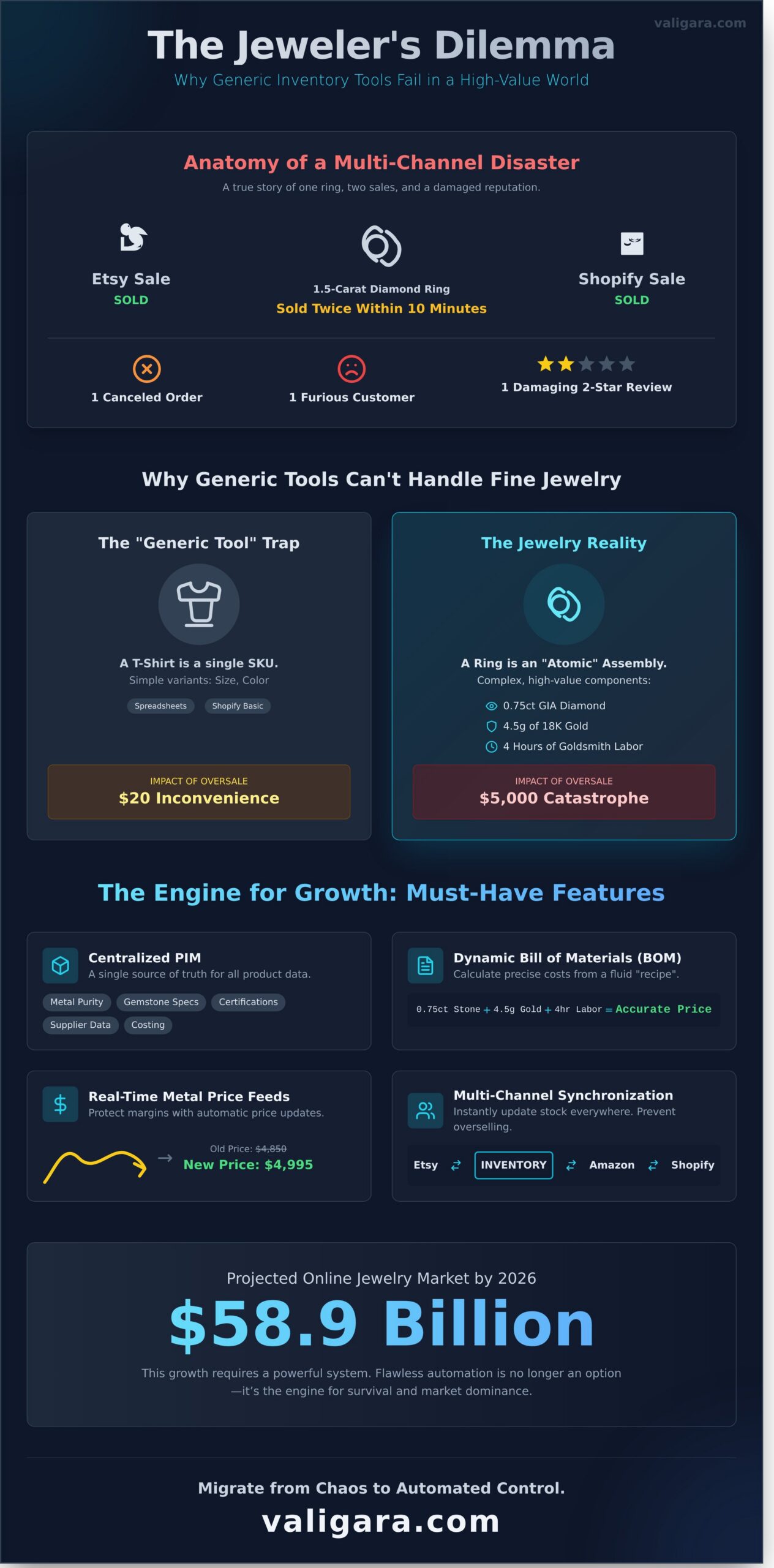
Last Monday, a jeweler sold the same 1.5-carat diamond ring on Etsy and their Shopify store within 10 minutes. The result? One canceled order, one furious customer, and a 2-star review that tanked their weekly sales. This multi-channel conflict isn’t a rare disaster; it’s a predictable outcome of managing high-value, one-of-a-kind items with spreadsheets and generic e-commerce tools. The manual data entry, the risk of overselling, the constant worry over fluctuating metal prices-it’s a system designed for failure.
This guide is your blueprint to eliminate these costly errors for good. You’ll gain a strategic framework to evaluate and implement a jewelry inventory management software that creates a single source of truth for your entire operation, from GIA certifications to real-time gold pricing. We will dissect the core features your business needs, compare the top platforms for 2026, and provide a clear roadmap to automate stock control across all the marketplaces you dominate.
Key Takeaways
- Understand why generic stock tools fail by learning to manage the “atomic” components of your jewelry-metals, gemstones, and labor-as individual assets.
- Discover the essential features, like a dynamic Bill of Materials (BOM), that enable you to track assembly costs and component stock with absolute precision.
- Learn how professional jewelry inventory management software prevents costly overselling on marketplaces like Etsy and Amazon, protecting your seller reputation.
- Get a clear framework for migrating from chaotic spreadsheets to a fully automated system, starting with a comprehensive audit of your product data.
Why Jewelry Inventory Management Requires a Specialized Solution
Selling jewelry isn’t like selling apparel or electronics. A t-shirt is a single unit with simple variants like size and color. A diamond ring, however, is an assembly of unique, high-value components. Each piece is an “atomic” entity built from precious metals, specific gemstones, and skilled labor. A single engagement ring isn’t just one SKU; it’s a dynamic combination of 4.5 grams of 18K gold, a 0.75-carat GIA-certified diamond with specific clarity and cut grades, and 4 hours of a master goldsmith’s time. Managing this level of complexity is impossible with generic tools.
The financial stakes are exponentially higher. An overselling mistake on a $20 t-shirt is an inconvenience. Overselling a one-of-a-kind $5,000 engagement ring is a business catastrophe, resulting in lost revenue, damaged client trust, and a permanent blow to your brand’s reputation. Your inventory is also a direct financial asset whose value fluctuates daily with the global markets. The gold in your vault changes value with every LBMA price fix, and your diamond stock’s worth shifts based on reports like the Rapaport Price List. A system that can’t track this dynamic value isn’t managing inventory; it’s obscuring your true net worth.
The “Generic Tool” Trap: Why Shopify and Spreadsheets Fail Jewelers
Many jewelers fall into the trap of using generic retail platforms or manual spreadsheets, believing they are saving money. This is a critical error. While basic inventory management software can track stock counts, it fundamentally lacks the architecture to handle the granular data of gemology. A platform like Shopify can’t differentiate between a VS1 and a VVS2 clarity diamond as anything more than a simple text variant. Manual spreadsheets are worse, creating disastrous data silos where your website, marketplace listings, and internal stock sheets are never in sync. The hidden cost of these “free” tools is the 10-15 hours per week your team wastes on manual data entry and error correction, time that a purpose-built system automates with 100% accuracy.
The 2026 Jewelry Market: Complexity at Scale
The global online jewelry market is projected to exceed $58.9 billion by 2026, driven by multi-channel selling and evolving consumer demands. Selling jewelry simultaneously on your website, marketplaces like Amazon or Etsy, and a physical storefront requires instant, flawless synchronization. A single sale must immediately update inventory levels across all locations to prevent overselling.
Furthermore, today’s luxury consumers demand absolute transparency. They expect to see GIA certificate numbers, detailed sourcing information, and high-resolution imaging for every component. This critical jewelry metadata must be intrinsically linked to your inventory. This is why a specialized jewelry inventory management software is no longer a luxury; it’s the central engine for growth. Jewelry inventory management is the centralized control of physical assets and their digital metadata.
Essential Features of Professional Jewelry Inventory Software
Generic inventory platforms can’t manage the intricate details of fine jewelry. They lack the specialized fields and dynamic calculations required to track high-value, component-based products. A dedicated jewelry inventory management software is built from the ground up to handle the unique physics of your business, transforming complex data into a powerful operational asset. These are the non-negotiable features that separate basic stock-counting tools from a true command center for your brand.
At its core, a professional system provides a centralized Product Information Managementt (PIM) hub. This isn’t just about names and prices; it’s a single source of truth for every critical attribute of your jewelry, including:
- Metal type, purity, and weight (e.g., 14K Gold, 4.2g)
- Gemstone specifications (type, carat, cut, clarity, color)
- Hallmarking and certification details
- Collection and style classifications
- Supplier and manufacturing data
This centralized data feeds into a dynamic Bill of Materials (BOM). For jewelers, a BOM isn’t a static list; it’s a fluid recipe. It calculates the precise cost of a finished piece by tracking the exact components used, from a 0.75-carat center stone and 12 melee diamonds to the platinum setting and clasp. This granular cost tracking is essential for accurate pricing and profitability analysis. To protect those margins, top-tier platforms integrate real-time metal price feeds. If the spot price of gold jumps 3% overnight, your system can automatically adjust the pricing across your entire gold collection before the market opens.
Advanced SKU & Variation Handling
A single engagement ring design can generate over 50 unique SKUs based on metal type, ring size, and center stone variations. Manually managing these is a direct path to errors and lost sales. A specialized system automates this entire process, creating and managing complex parent-child relationships required by marketplaces like Amazon and eBay. Mastering this is fundamental; you can learn more about how to manage complex jewelry SKUs & variations to build a scalable catalog.
Diamond & Gemstone Tracking
Not all stones are created equal. Your software must differentiate between serialized, high-value gems and fungible parcels. It should track an individual GIA-certified, 1.02-carat VVS1 diamond as a unique asset while managing a parcel of 200 calibrated 1.5mm sapphires by lot. This data is housed in a “digital vault,” linking each stone to its lab reports, high-resolution imagery, and 360-degree videos, which is critical for managing diamond & gemstone data for online sales.
Finally, all these features power the engine of modern jewelry e-commerce: multi-channel synchronization. With your PIM, BOMs, and stone data perfectly organized, the software pushes accurate, consistent listings to all your sales channels. When a necklace sells on your Shopify store, the inventory is instantly depleted on eBay, Etsy, and Amazon. This real-time sync eliminates overselling and unlocks your ability to scale across global marketplaces. The right jewelry-specific inventory solution makes this level of operational control achievable.
Inventory Control vs. Multi-Channel Growth: Finding the Balance
Expanding your jewelry brand to marketplaces like Etsy, eBay, and Amazon promises massive growth. It also introduces massive complexity. The core conflict every jeweler faces is maintaining precise control over jewelry while simultaneously pushing it to a global audience. Manual tracking isn’t just inefficient; it’s a direct threat to your brand’s reputation. A single engagement ring sold twice creates an operational crisis and a damaged customer relationship that is nearly impossible to repair.
This is where control enables growth. Effective inventory management isn’t a brake on your expansion, it’s the engine. By automating the flow of data, you can list a 2.5-carat diamond solitaire on three different channels with confidence, knowing that the moment it sells on one, it’s instantly removed from the others. This prevents overselling, which is critical for maintaining high seller ratings. On Amazon, for instance, a pre-fulfillment cancellation rate exceeding 2.5% can put your account at risk of suspension. The right jewelry inventory management software transforms this risk into a managed, automated process.
The solution lies in creating a single source of truth. Your inventory system becomes the central hub from which all sales channels operate. Key strategies to achieve this balance include:
- Buffer Stock Implementation: Automatically hold back one or two units of a specific item from your public-facing inventory count. This “buffer” provides a crucial safety net, absorbing any minute lag in synchronization between a sale and a stock update, effectively eliminating the risk of overselling popular items like gold chains or standard earring designs.
- Automated Listing Workflows: Enter a new piece into your central catalog once. Define its metal, gemstones, GIA certificate details, and images. The system then uses channel-specific templates to automatically create and publish optimized listings on every connected marketplace. You save hundreds of hours and eliminate copy-paste errors.
- Centralized Order Fulfillment: An order from Etsy, your Shopify store, or a wholesale partner all lands in the same dashboard. This unified view ensures your fulfillment team works from a single, accurate list, reducing shipping errors and improving dispatch times.
Real-Time Stock Synchronization
At the heart of multi-channel selling is a robust, two-way API connection. This isn’t a simple data dump; it’s a constant, near-instantaneous conversation between your inventory and every marketplace. A sale on one channel triggers an immediate update to all others. This immediate update is the core principle of Real-Time Stock Sync: The Key to Preventing Overselling. This system also intelligently manages complex situations like “Memo” or consignment stock, allowing you to list pieces you don’t own while keeping them separate from your internal asset accounting.
Barcode and Tag Printing for Physical Efficiency
A digital record is useless if you can’t locate the physical piece in your vault. Barcoding bridges this critical gap. A dedicated system generates a unique barcode or QR code for every item upon entry. This system enables powerful workflows like Barcode & Tag Printing for Efficient Jewelry Operations, turning your vault into a scannable warehouse. This technology revolutionizes stocktaking; what once took weeks of manual checklist verification can now be completed in hours with a mobile scanner, reducing time spent on audits by up to 85%.
Implementation Strategy: Moving from Chaos to Automation
Adopting a powerful inventory system isn’t a single event; it’s a strategic overhaul of your operations. The transition from scattered spreadsheets and manual counts to a centralized, automated engine requires a disciplined, step-by-step approach. This process transforms your business from reactive to predictive, laying the groundwork for scalable growth. The goal is to build a single, undisputed source of truth for your entire operation.
A successful implementation follows a clear five-step sequence:
- Step 1: Data Audit. Your first move is to sanitize existing records. Standardize every attribute, from gemstone clarity codes (e.g., VVS1, not “very very slightly included”) to metal types (“18K Rose Gold,” not “18KR”). This cleanup ensures the data powering your new system is 100% accurate from day one.
- Step 2: Define Your Bill of Materials (BOM). For every finished piece, you must define its core components. A single 1.2-carat diamond engagement ring’s BOM includes the GIA-certified center stone, 4.2 grams of platinum, 16 melee diamonds (0.01 ct each), and 1.5 hours of bench labor. This granular structure is the key to true cost analysis and production management.
- Step 3: Integrate Your Sales Channels. Connect your system directly to your marketplaces. A robust jewelry inventory management software uses dedicated APIs to sync stock levels across your website, Etsy, Amazon, and eBay in real-time. This eliminates the risk of overselling a one-of-a-kind piece.
- Step 4: Set Automated Pricing Rules. Link your product costs to live market data feeds like RapNet for diamonds and Kitco for precious metals. You can establish rules-for example, automatically updating a ring’s price when the spot price of gold fluctuates by more than 2%-ensuring your margins are always protected across thousands of SKUs.
- Step 5: Train Your Team. The final step is cultural. Your team must adopt a “Single Source of Truth” philosophy. From sales associates checking stock to jewelers logging component usage, every action must be recorded in the central system. This discipline makes the entire workflow transparent and efficient.
Overcoming the Migration Hurdle
Transitioning from decades of spreadsheets can feel daunting, but it doesn’t mean losing valuable history. A structured import process maps your old data fields to the new system, preserving every customer order and inventory adjustment. Success here depends on partnering with a dedicated onboarding specialist who understands the jewelry industry. A generic tech support agent won’t grasp the nuances of migrating GIA certificate numbers or complex BOMs. A precise data migration is the foundation of long-term scalability and operational integrity.
Security and Audit Readiness
A centralized system creates an immutable digital paper trail for every component and finished piece, which is invaluable for insurance claims and tax compliance. You can implement role-based access, ensuring your sales staff sees retail pricing and availability while your production manager is the only one who can modify raw material costs. This prepares you for physical stocktakes; the system can generate count sheets and deliver automated discrepancy reports, reducing a process that once took 3 days down to under 4 hours.
Ready to build your single source of truth and eliminate operational chaos? Schedule a consultation with a jewelry-specific implementation specialist.
Why Valigara is the Definitive Choice for Jewelry Professionals
Generic inventory platforms fail the jewelry industry. They don’t understand the intricate data points of a GIA-certified diamond, the weight-based pricing for the 18K gold jewelry, or the complexities of managing ring variations. They are not built for deeply detailed assets. Valigara was engineered from the ground up by jewelry industry veterans who experienced these frustrations firsthand. We built the solution we couldn’t find: a system that speaks jewelry, metals, carats, clarity, and collections as its native language.
This deep industry knowledge is the foundation of our all-in-one advantage. Valigara isn’t just a piece of software; it’s the central operational engine for your entire business. It fuses four critical systems into one unified dashboard:
- Product Information Management (PIM): Manage every attribute, from metal purity and gemstone cut to hallmarking and designer notes, in one central location.
- Inventory & Order Management: Achieve real-time, flawless synchronization across every sales channel, eliminating the risk of overselling a one-of-a-kind engagement ring.
- Client Relationship Management (CRM): Track client history and preferences to provide the high-touch service that defines luxury retail.
- Multi-channel Listing: Post and manage thousands of SKUs on marketplaces like Amazon, eBay, and RapNet, plus your own Shopify or WooCommerce store, from a single point of control.
- Jewelry-specific Analytics and Insigns: setting up an effective operations in jewelry is not possible without advanced catalog analytics. Deep dive and AI-based guidance are the keys to your business’s ability to scale.
This integrated approach creates a powerful, dedicated jewelry inventory management software that scales with your ambition. Whether you’re a boutique designer managing 100 unique pieces or a global wholesaler with over 100,000 SKUs, our architecture provides the stability and speed you need to dominate your market. Valigara is more than a tool; it’s your entry point into the global jewelry ecosystem, connecting you directly to the world’s leading diamond and gemstone trade networks.
Measurable ROI: Sell More, Work Less
Stop wasting time on manual data entry. Our clients reduce administrative labor by up to 80% through fully automated listing, updating, and order synchronization. This efficiency directly translates to your bottom line by eliminating the catastrophic cost of overselling and preventing marketplace account suspensions that can halt revenue overnight. Brands using Valigara have successfully scaled from local retailers to global enterprises, often increasing online revenue by over 300% within their first 24 months on the platform.
Future-Proofing Your Brand in 2026
The digital marketplace is constantly evolving. We ensure your business is always ahead of the curve with continuous platform updates that adapt to changing marketplace algorithms and e-commerce trends. For established brands with complex needs, our robust API provides seamless access for custom integrations with your existing ERP, accounting systems, or specialized logistics partners. Your technology should be an asset, not a limitation. Let us show you how to build a more profitable and resilient brand.
Schedule a personal demo to see how Valigara transforms your jewelry inventory management.
Master Your Inventory, Dominate Your Market in 2026
The landscape of jewelry e-commerce is evolving. Relying on manual data entry or generic systems isn’t a viable strategy; it’s a direct path to costly errors, stockouts, and missed opportunities. The unique complexities of your inventory-from metal weights and gemstone carats to intricate pricing structures-demand a purpose-built solution. The right jewelry inventory management software is the foundational decision that separates stagnant sellers from global powerhouses. It’s the central engine that transforms operational chaos into streamlined, automated growth across every channel.
This is the precision and power Valigara delivers. Our platform is the proven choice for 870+ specialized jewelry stores, acting as the single source of truth for businesses managing over $3B in combined inventory. It’s an all-in-one PIM, ERP, and multi-channel command center engineered specifically for the demands of high-value jewelry. Stop managing spreadsheets and start building your legacy. The tools to scale with precision and confidence are within your reach.
Transform your jewelry business with Valigara’s automated inventory management.
Frequently Asked Questions
What is the difference between generic inventory software and jewelry-specific software?
Generic software tracks simple SKUs. A dedicated jewelry inventory management software manages the complex attributes unique to fine jewelry: metal types, weights, gemstone carats, and the 4 Cs. It’s built to handle component-level details, manufacturing processes (BOMs), and dynamic pricing based on metal market feeds. This specialized approach provides the precision required to manage high-value, multifaceted inventory that generic systems simply can’t accommodate.
Can jewelry inventory management software track loose diamonds and gemstones?
Yes, specialized software tracks loose diamonds and gemstones with extreme precision. Each stone is entered as a unique inventory item with its own certificate number, such as a GIA report number, detailed specifications, and cost. You can then manage these stones as standalone inventory or assign them to a finished piece. This granular control is essential for accurate costing and managing your most valuable assets.
How does real-time gold feed integration affect my product pricing?
Real-time gold feed integration automates your pricing and protects your margins. When the LBMA spot price of gold fluctuates, the system automatically recalculates the cost and retail price of your entire gold inventory based on each item’s specific metal weight. This eliminates hours of manual repricing and prevents selling at a loss during market volatility, ensuring your pricing is always accurate and profitable.
Is it possible to sync my inventory across Etsy, eBay, and Amazon simultaneously?
Yes, you can sync your inventory across Etsy, eBay, and Amazon simultaneously. A centralized platform acts as the single source of truth for your stock. When a diamond ring sells on Etsy, the system automatically decrements the quantity and updates the listing on Amazon, eBay, and your own website in under 5 minutes. This automated synchronization prevents overselling and eliminates the risk of manual inventory errors.
What is a Bill of Materials (BOM) in jewelry manufacturing software?
A Bill of Materials (BOM) in jewelry manufacturing is the exact recipe for a finished piece. It itemizes every single component, from the 2.5-gram 18k gold setting and the 0.75-carat G/VS1 center diamond to the 12 melee stones and 30 minutes of bench jeweler labor. This detailed breakdown allows for precise cost-of-goods-sold (COGS) calculation, streamlined production orders, and accurate component inventory management.
How does specialized software handle jewelry repairs and custom orders?
Specialized software manages jewelry repairs and custom orders through dedicated job-tracking modules. It creates a unique work order, or “job bag,” for each project, allowing you to track the customer’s item, assign components from stock, monitor progress with your bench jeweler, and manage billing separately from standard sales. This provides complete visibility and control over non-retail workflows, ensuring no detail is lost.
Can I print jewelry tags and barcodes directly from the inventory system?
Yes, you can print professional jewelry tags, barcodes, and QRcodes directly from the inventory system. Advanced platforms allow you to design custom-branded tags that include critical data like the SKU, a high-resolution image, carat weight, metal purity, and price. Printing these on demand streamlines your point-of-sale operations and physical inventory audits, reducing data entry errors by more than 95% compared to manual processes.
Is cloud-based jewelry software secure enough for high-value inventory?
Yes, modern cloud-based jewelry software is exceptionally secure. Reputable systems protect your data using 256-bit AES encryption, the same security standard used by international banks. Your high-value inventory data is hosted on secure, redundant servers like Amazon Web Services (AWS) with continuous backups and role-based user permissions, giving you complete control over who can access sensitive business information.