
Scaling a jewelry brand in a global market projected to hit $85.72 billion this year requires more than a generic connection to Amazon or Etsy. If your current tools treat a GIA-certified diamond the same way they treat a mass-produced garment, you aren’t just losing data; you’re risking your reputation. Utilizing specialized jewelry marketplace integration software is the only way to maintain the technical precision that high-value inventory demands while expanding your digital footprint.
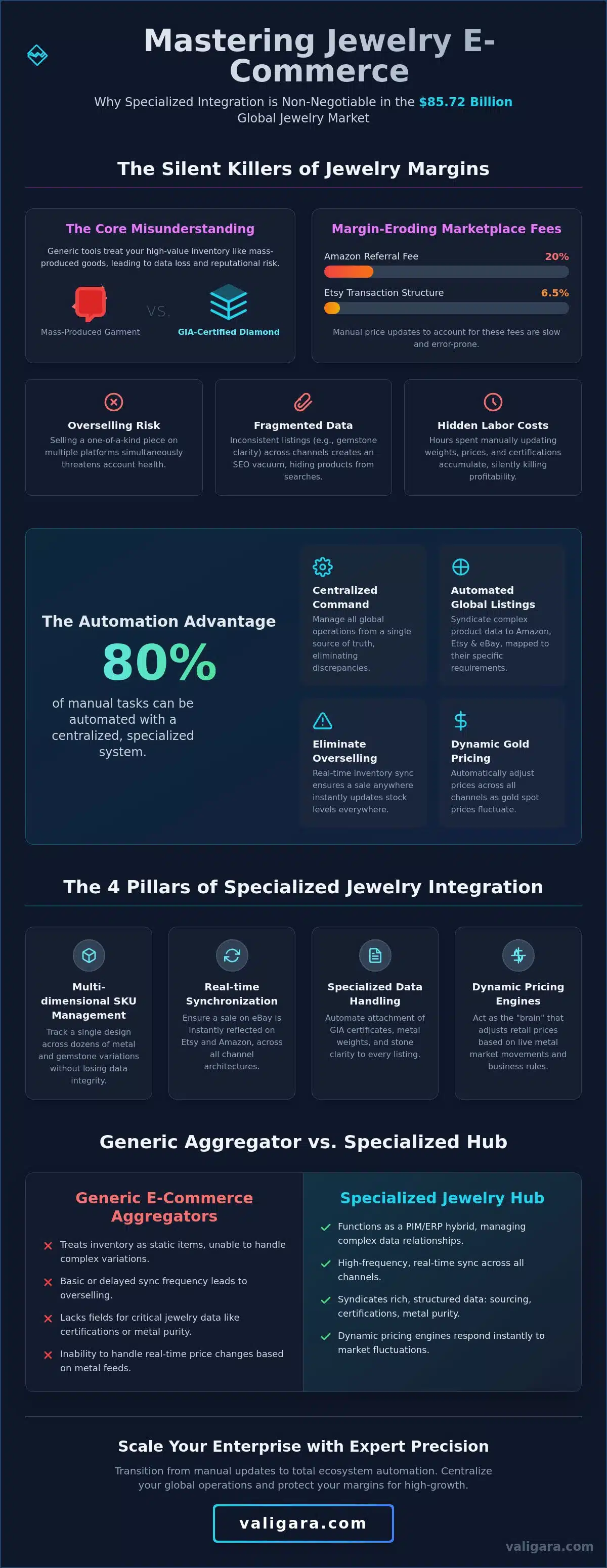
You understand the high stakes of inconsistent gemstone data and the costly errors that stem from manual price updates across multiple tabs. It’s exhausting to track fluctuating gold feeds while managing a 20% referral fee on Amazon or the complex 6.5% transaction structures on Etsy. We’ve designed this guide to help you master these multi-channel complexities and protect your margins through high-tech automation. You’ll learn how to implement real-time gold price syncing, centralize your inventory control, and automate global listings to transform your operations into a streamlined, high-growth enterprise. We will cover everything from PIM synchronization to the specific logistics of 2026 marketplace requirements.
Key Takeaways
- Transition from manual inventory updates to total ecosystem automation to protect margins and eliminate the risk of overselling unique, high-value pieces.
- Master the use of multi-dimensional SKU management to handle complex metal variations and gemstone specifications across all global sales channels.
- Learn to navigate the unique data requirements of Amazon, Etsy, and eBay by using specialized jewelry marketplace integration software for precise listing mapping.
- Evaluate technical requirements like API stability and sync frequency to distinguish between generic aggregators and jewelry-specific operational hubs.
- Centralize your global operations into a single command center to automate up to 80% of manual tasks and scale your enterprise with expert precision.
The Evolution of Jewelry Marketplace Integration in 2026
The year 2025 marked the definitive end of the manual era for jewelry e-commerce. Basic inventory syncing is no longer enough to stay competitive in a landscape where speed and precision are the primary currencies. Leading brands now treat their jewelry marketplace integration software as the central intelligence hub of their entire operation. This evolution has moved us from simple “copy-paste” tools to total ecosystem automation. Modern systems now utilize AI-assisted attribute mapping, which ensures that complex technical specifications for a sapphire necklace are translated into the specific data language of every global platform automatically. Your software isn’t just a bridge; it’s the brain that manages the logic of your business.
The Cost of Manual Multi-Channel Management
Manual data entry is a silent killer of jewelry margins. When your team spends hours manually updating metal weights or GIA certification numbers across multiple tabs, the hidden labor costs accumulate quickly. For businesses dealing in unique, high-value items, the manual approach carries a terminal risk. Overselling a one-of-a-kind (OOAK) diamond piece because your stock levels didn’t update fast enough between platforms is more than an inconvenience; it’s a threat to your account health. Fragmented data also creates an SEO vacuum. If your gemstone clarity is listed differently on Etsy than it is on eBay, search algorithms struggle to categorize your products. This inconsistency prevents your high-ticket items from appearing in filtered searches, directly impacting your conversion rates and brand authority.
2026 Marketplace Trends: What Jewelers Need to Know
The current landscape of online marketplaces demands a higher level of data sophistication than ever before. Algorithms now prioritize listings that feature rich, structured product data. This means your jewelry marketplace integration software must do more than just push a price. It must syndicate comprehensive details regarding gemstone sourcing, ethical certifications, and precise metal purity. Consumers in 2026 are highly informed. They won’t settle for “gold plated” when they’re looking for specific micron thickness or recycled metal origins. Real-time responsiveness has also become a non-negotiable ranking factor. Platforms reward sellers who can sync price changes instantly as gold spot prices fluctuate throughout the day. If your system can’t handle these micro-adjustments automatically, you’ll find your seller ratings slipping alongside your search placement. High-tech automation is no longer a luxury; it’s the operational foundation for any brand serious about global scaling.
The 4 Pillars of Specialized Jewelry Integration Software
General e-commerce aggregators treat your inventory as a list of static items. For a jeweler, this is a recipe for operational failure. True jewelry marketplace integration software functions as a specialized PIM/ERP hybrid, designed to handle the intricate relationship between metals, gemstones, and certifications. Research from Harvard Business School on integrated multichannel retailing strategies highlights that operational complexity is the primary barrier to scaling. In the jewelry trade, this complexity is managed through four specific technical pillars.
- Multi-dimensional SKU Management: Your system must track a single design across dozens of metal and stone variations without losing data integrity.
- Real-time Synchronization: Updates must happen simultaneously across diverse channel architectures, ensuring a sale on eBay instantly reflects on Etsy and Amazon.
- Specialized Data Handling: Automation must include the ability to attach GIA certificates, metal weights, and stone clarity to every listing without manual intervention.
- Dynamic Pricing Engines: Your software needs to be the “brain” that adjusts retail prices based on live market movements.
Managing Complex Jewelry Data and Variations
Jewelers often struggle with SKU chaos when trying to list thousands of variations across global channels. A specialized PIM acts as the single source of truth for all jewelry data, ensuring that every marketplace receives the exact specifications required for that platform’s unique algorithm. By automating the inclusion of gemstone specifications in every listing, you eliminate the risk of human error that often occurs during manual data entry. This level of centralized inventory control allows you to scale your catalog from 100 pieces to 10,000 without increasing your administrative headcount.
Gold Feed Sync and Dynamic Pricing
Market volatility shouldn’t eat your margins. Linking your catalog to live gold and silver spot prices is a necessity for maintaining profitability in 2026. Automated price rules allow you to protect your bottom line by adjusting retail prices the moment the market moves. You can set different pricing strategies for different marketplaces automatically, accounting for varying referral fees on Amazon versus Etsy while keeping your margins consistent. This dynamic approach ensures you’re never selling below your target profit margin, even during periods of extreme metal price fluctuation. It’s about building a resilient, automated enterprise that responds to market data in real-time.
Optimizing for Global Marketplaces: eBay, Etsy, and Amazon
Scaling a jewelry brand across global channels requires more than just pushing inventory. Each marketplace operates on a distinct data logic. Amazon’s rigid category requirements differ wildly from Etsy’s tag-based ecosystem. If you use a one-size-fits-all approach, your visibility will suffer. High-performance jewelry marketplace integration software solves this by utilizing marketplace-specific attribute mapping. This ensures your listings speak the right “language” to every algorithm. By translating your technical data into the specific fields required by each platform, you maximize your search share and reduce the risk of listing rejections.
Centralization is the key to maintaining high performance metrics. When you manage orders and customer inquiries from a single dashboard, you eliminate the friction of switching between tabs. This unified approach allows you to respond to buyers faster and process shipments with greater accuracy. Maintaining a high seller rating on eBay or Amazon depends on these micro-efficiencies. A specialized system ensures that your global operations remain organized, even as you expand into new territories with different shipping requirements and tax regulations.
Etsy vs. Amazon: Different Logic, One Inventory
Etsy buyers search for “handmade” or “custom.” They want to know about the artisan’s process and the story behind the piece. Amazon shoppers prioritize technical precision, looking for “14k gold” or “VVS1 clarity.” Your jewelry marketplace integration software must translate your core PIM data into these different formats automatically. It should map your “Creation Method” to Etsy’s handmade attributes while simultaneously fulfilling Amazon’s strict “Metal Stamp” and “Gemstone Shape” requirements. This dual-logic management allows you to maintain professional standards on Amazon without losing the “boutique” feel that drives sales on Etsy. Managing logistics across regional versions of these marketplaces becomes a background task rather than a manual burden.
Social Commerce and Luxury Niche Marketplaces
Discovery now happens on Instagram and TikTok Shop. Your 2026 strategy must include these social channels to capture younger demographics who prefer shopping within their social feeds. Social commerce requires a different pace than traditional marketplaces; it’s about visual storytelling backed by real-time inventory accuracy. Beyond social media, luxury niche platforms like 1stDibs or Chrono24 require even more granular data. Selling a vintage watch or a signed designer piece demands specific fields for “Condition,” “Original Box,” and “Provenance.” General-purpose tools rarely offer these specialized fields. A jewelry-first integration allows you to synchronize this high-end data across specialized platforms, ensuring your most valuable assets are presented with the authority and detail they deserve. This shift toward niche-specific selling is mirrored in other luxury sectors, where platforms like Bride2Bride have revolutionized how high-value items like designer wedding dresses are listed and sold.
How to Evaluate Jewelry Marketplace Integration Software
Choosing the right jewelry marketplace integration software is a high-stakes decision that determines your operational ceiling. General-purpose e-commerce aggregators are built for mass-produced goods with simple attributes; they lack the architectural depth to manage the multi-dimensional data of fine jewelry. To scale effectively, you must prioritize platforms that offer jewelry-specific logic. This means the system must recognize the difference between a mounting and a finished piece, while simultaneously managing the relationship between carats, clarity, and metal purity across every channel.
Technical requirements are the foundation of your evaluation. API stability is non-negotiable; a single break in the connection can lead to the disastrous overselling of a high-value diamond. You should also demand high sync frequency. In a market where gold prices shift by the minute, a “once-per-day” sync is a liability. Your software must handle your current SKU count with room to grow, ensuring that as your catalog expands from hundreds to thousands of variations, the system’s performance remains lightning-fast and reliable.
The onboarding phase is where many general tools fail. Jewelry data is inherently complex, often requiring custom mapping for GIA certificates or specific metal alloys. Look for a provider that offers a personal onboarding phase rather than a self-service “plug-and-play” model. This expert-led setup ensures that your unique business logic is correctly mirrored in the software from day one. To see how a specialized setup can transform your workflow, you can explore Valigara’s jewelry-first integration hub.
The Jewelry-Specific Feature Checklist
A robust evaluation requires a granular look at the features that impact your daily physical and digital operations. Use this checklist to verify the software’s industry relevance:
- Gemstone-Level Inventory: Does the system track individual stones and allow for GIA or IGI certificate uploads to specific SKUs?
- Sets and Bundles: Can it manage “build-your-own” ring sets or jewelry bundles without breaking your primary stock counts?
- Barcode and Tag Printing: Check for built-in capabilities to print jewelry tags directly from your PIM data to streamline physical inventory management.
- Technical Attribute Mapping: Ensure it can translate complex jewelry terminology into the specific field requirements of Amazon, Etsy, and eBay.
Integration Depth: Beyond the API
Distinguish between “surface-level” syncing and deep data integration. Surface-level tools only push price and quantity. Deep integration allows you to manage your Jewelry CRM, marketing automation, and multi-channel listings from a single source of truth. This centralized approach eliminates 80% of manual labor by automating the most repetitive parts of the sales cycle. API access is the backbone of future-proof jewelry businesses, allowing you to connect with emerging marketplaces and custom storefronts as the digital landscape evolves. By choosing a system with deep industry roots, you ensure that your software remains an asset rather than a bottleneck as you scale your global enterprise.
Scaling Your Enterprise with Valigara’s Centralized Hub
Scaling your enterprise requires a total departure from the fragmented workflows of the past. Valigara provides the centralized command center necessary to transition from a local retailer to a global multi-channel brand. By acting as the primary operational hub, this jewelry marketplace integration software allows you to manage listings, inventory, and fulfillment from a single interface. It eliminates the friction of data silos and replaces it with a streamlined path to international expansion. You’re no longer reacting to marketplace changes; you’re orchestrating them from a position of technical strength.
The platform eliminates 80% of manual labor through jewelry-first automation. This massive reduction in administrative overhead means your growth is no longer tied to your headcount. When your PIM, CRM, and marketing automation are synchronized, you move from a state of data chaos to a state of controlled, automated growth. This is how you protect your margins while capturing a larger share of the global online jewelry market. You transition from manual workflows to a streamlined, global enterprise with precision and ease.
The Valigara Advantage: Built for Jewelers, by Jewelers
Valigara isn’t a generalist tool; it’s a specialized environment built specifically for diamond and gemstone manufacturers. Our specialized PIM solves the “variation” headache permanently by allowing you to manage thousands of metal and stone combinations without losing data integrity. This industry-specific architecture is why brands can scale from 100 to 10,000 SKUs without adding extra staff to their e-commerce team. The software handles the technical heavy lifting, including:
- Automated Diamond and Gemstone Management for unique and calibrated stones.
- Real-time Gold Feed Sync to keep your pricing competitive and profitable.
- Multi-channel Listing Automation that respects the unique data languages of Amazon, Etsy, and eBay.
- Integrated Jewelry CRM to personalize the luxury buyer journey.
Getting Started with Professional Onboarding
We understand that high-value catalogs require a high-touch setup. That’s why we prioritize a personalized onboarding phase to align our software with your specific business logic. Personalized training ensures your team is empowered to use the command center to its full potential from day one. We recognize that data migration assistance is non-negotiable for jewelers with complex, multi-year inventories. Our experts guide you through the transition, ensuring your GIA certificates, high-resolution imagery, and technical attributes move into the hub without a single error. It’s time to stop fighting your tools and start using them to dominate your niche. Schedule your expert-led Valigara walkthrough today and see how the specialized brain of your business can drive your 2026 growth.
Take Command of Your Global Jewelry Expansion
The transition toward total ecosystem automation isn’t just a trend; it’s the new standard for luxury retail survival. You’ve seen how specialized jewelry marketplace integration software acts as the core intelligence of a scaling brand, managing everything from GIA certificate mapping to live gold feed synchronization. By moving away from fragmented spreadsheets and manual updates, you protect your high-value inventory from the terminal risks of overselling and data erosion. Centralization doesn’t just save time; it builds the structural integrity your brand needs to thrive on a global stage.
Transitioning to a centralized hub empowers you to scale your SKU volume while keeping operational costs flat. Valigara has been a trusted partner for jewelry brands since 2009, providing the specialized PIM and real-time sync capabilities across 20+ marketplaces that general tools simply can’t match. It’s time to stop managing data chaos and start leading a streamlined, global enterprise with the confidence of an expert insider. Automate your jewelry business with Valigara today. Your brand deserves a technical foundation as precise and enduring as the pieces you create.
Frequently Asked Questions
What is jewelry marketplace integration software?
Jewelry marketplace integration software is a centralized operational hub that synchronizes your product data, inventory levels, and orders across multiple global sales channels. It acts as the specialized brain of your business, ensuring that high-value technical data remains consistent across platforms like Amazon, eBay, and Etsy. This tool automates the listing process and eliminates the need for manual data entry across disparate systems.
How does integration software prevent jewelry overselling?
The software prevents overselling by providing real-time inventory synchronization across every connected marketplace. When a one-of-a-kind diamond piece sells on your website, the system instantly updates stock levels to zero on all other channels. This automated control is critical for high-value unique items where selling the same piece twice would result in reputational damage and marketplace penalties.
Can I sync my jewelry inventory with both Etsy and Amazon simultaneously?
You can sync your inventory with Etsy, Amazon, and numerous other global marketplaces simultaneously from a single dashboard. The software translates your core data into the specific language required by each platform, mapping Etsy’s handmade attributes and Amazon’s technical specifications at the same time. This ensures your brand maintains a professional presence across the global landscape without doubling your administrative workload.
Does jewelry integration software handle GIA certificates?
Specialized platforms include dedicated Diamond and Gemstone Management features that allow you to attach GIA certificates and stone-level data to your listings. This ensures every high-value item carries its necessary documentation through the entire sales cycle. Unlike general tools, this software treats certificates as critical data points, ensuring they are visible to customers on marketplaces that support technical document uploads.
Is it possible to automate jewelry pricing based on the current gold price?
It is possible to automate your retail pricing through a live Gold Feed Sync feature. This technology links your product catalog directly to current market spot prices for gold, silver, and platinum. When the market fluctuates, the system applies your pre-set margin rules to update your prices across all channels automatically. This protects your profitability during market volatility without requiring manual recalculations.
How long does it take to set up jewelry marketplace integration?
Setup time varies based on the complexity of your catalog and the number of channels you wish to connect. While basic technical connections can be established quickly, a professional onboarding phase typically takes a few weeks to ensure your business logic is perfectly aligned. This structured approach guarantees that your technical attributes and gemstone data are correctly migrated into the centralized hub for long-term stability.
Do I need a separate PIM if I have marketplace integration software?
You don’t need a separate PIM if you utilize a jewelry-specific platform that includes a built-in Jewelry PIM. The software serves as your single source of truth, managing complex variations, gemstone specifications, and metal weights in one place. This integrated approach is more efficient than using third-party PIM systems that aren’t designed to handle the specific data requirements of the jewelry trade.
What is the difference between general e-commerce software and jewelry-specific platforms?
General e-commerce software is designed for mass-produced items and lacks the architecture to handle gemstone-level data or fluctuating metal prices. Jewelry-specific platforms are built with industry-first logic, offering features like barcode and tag printing and multi-dimensional SKU management. This specialized jewelry marketplace integration software understands the nuances of the trade, allowing you to manage high-value assets with a level of precision that general tools cannot provide.