What if the most valuable asset in your vault isn’t the 18k gold or the four-carat emerald, but the data tethered to them? In a global market projected to reach $408.64 billion this year, the difference between a scaling enterprise and a struggling boutique often comes down to the integrity of your jewelry order fulfillment workflow. You already know that a single manual entry error or a delayed inventory sync doesn’t just cost a sale; it erodes the trust of a high-net-worth client who expects perfection.
This guide will show you how to master these complexities by building an automated, multi-channel system designed for high-value precision. You’ll learn how to centralize your operations to eliminate overselling, manage GIA certificates across platforms with ease, and navigate 2026 packaging regulations like California’s SB 343. We’re providing the blueprint to transition from manual labor to a streamlined, global operation that prioritizes accuracy and builds lasting brand loyalty through a professional unboxing experience.
Key Takeaways
- Understand why high-value luxury items require a specialized, data-first approach to protect brand integrity and operational security.
- Master the five stages of the fulfillment lifecycle to move orders from multi-channel ingestion to secure delivery with zero manual friction.
- Learn to manage thousands of micro-SKU variations and complex parent-child relationships using a dedicated Jewelry PIM for absolute inventory accuracy.
- Solve the overselling crisis by implementing a real-time jewelry order fulfillment workflow that synchronizes eBay, Etsy, and Amazon inventory in under 60 seconds.
- Transition from fragmented spreadsheets to a centralized intelligence hub that integrates seamlessly with major carriers like FedEx and UPS.
Why Jewelry Order Fulfillment Requires a Specialized Workflow
Generic e-commerce platforms often fail because they view products as interchangeable units. In the jewelry trade, an item isn’t just a SKU; it’s a unique combination of high-value materials, certifications, and emotional weight. A standard order fulfillment process might work for consumer electronics, but it lacks the granular data integrity required for precious metals and gemstones. When you’re dealing with items that carry four or five-figure price tags, “close enough” isn’t an option. You need a system that understands the specific nuances of your inventory.
The “Micro-SKU” challenge is a primary differentiator. A single engagement ring design might exist in three different metals, five center stone types, and twelve different sizes. This creates hundreds of variations for a single “parent” product. Managing these without a specialized jewelry order fulfillment workflow leads to “ghost inventory.” This is where items appear in stock on Etsy but are actually sold out on your Shopify site. For an enterprise handling thousands of carats and high-value metals, this level of inaccuracy is a recipe for operational collapse.
The High Cost of Manual Errors in Luxury Retail
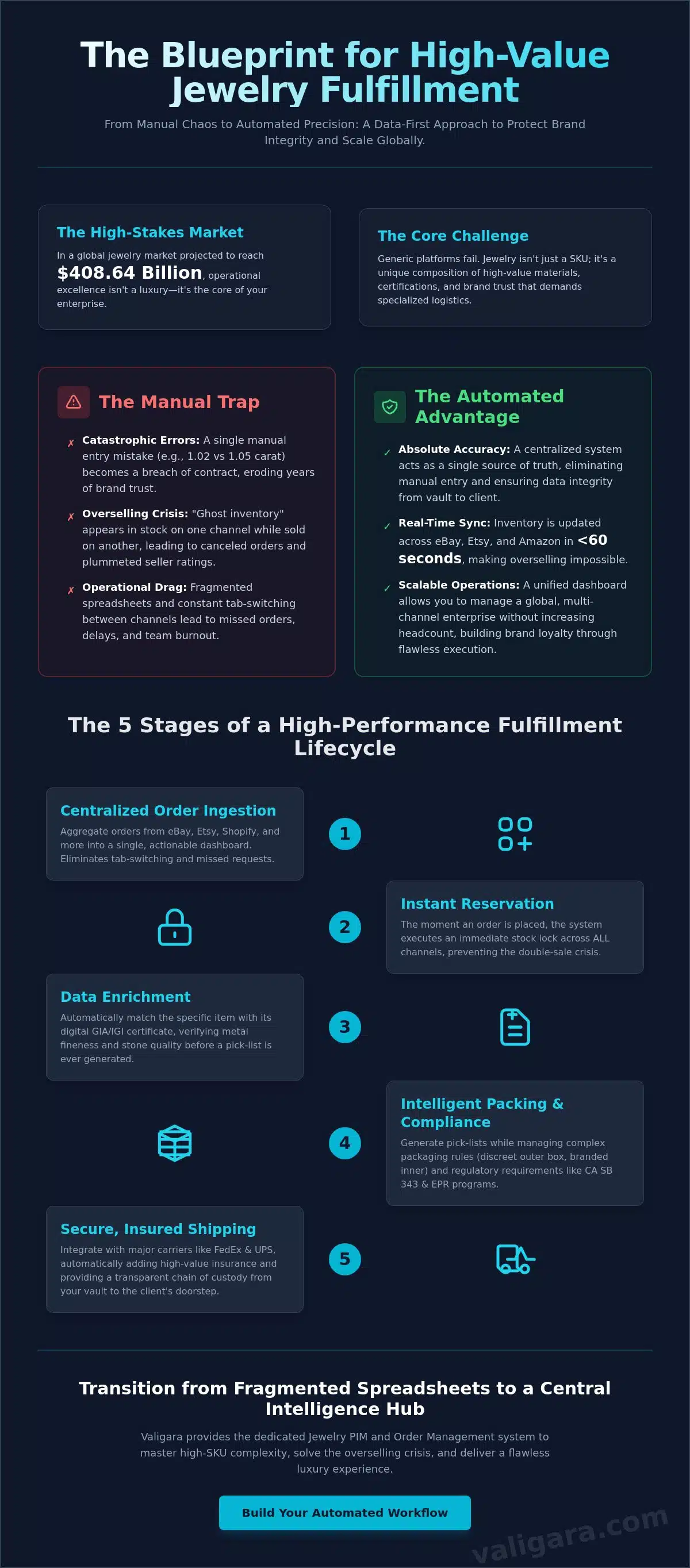
In luxury retail, a single mis-shipment is a catastrophic failure. If a client receives a 1.02-carat diamond instead of the 1.05-carat stone they purchased, you haven’t just made a shipping error. You’ve committed a breach of contract that erodes years of brand building. Manual data entry is the enemy of precision. Every time an employee re-types a certificate number or a shipping address, the risk of a high-ticket loss increases. Beyond the immediate financial hit, incorrect inventory data triggers overselling. This leads to canceled orders and plummeted seller ratings on marketplaces like Amazon and eBay, where recovery can take months.
Security and Insurance: Beyond Standard Shipping
Jewelry logistics demand a chain of custody that standard carriers don’t provide by default. An automated workflow must integrate high-value shipping insurance directly into the label generation process. It’s not enough to just ship; you must track the item from the vault to the doorstep with absolute transparency. This includes managing new regulatory hurdles, such as the Colorado and Oregon Extended Producer Responsibility (EPR) programs active as of 2026, which require precise reporting on packaging materials. Your workflow should also support packaging strategies that deter theft by using discreet outer boxes while maintaining a professional, branded unboxing experience inside. By automating these security layers, you protect your margins and your reputation simultaneously.
This dedication to precision and high standards is essential for any high-value asset, including luxury real estate. For property owners and holiday home hosts who require the same level of hotel-standard care for their residences, they can find out more about specialized property maintenance services.
The 5 Stages of a High-Performance Jewelry Fulfillment Lifecycle
Scaling a luxury brand requires a shift in perspective. You aren’t just moving boxes; you’re managing a complex information stream. A high-performance jewelry order fulfillment workflow functions as the central intelligence of your business, ensuring that every digital interaction translates into a flawless physical delivery. Unlike generic 3PL processes that begin at the warehouse shelf, a specialized jewelry lifecycle starts the moment a customer clicks “buy.”
Stage 1: Centralized Order Ingestion
Managing disparate sales channels like eBay, Etsy, and Shopify individually is a recipe for operational fatigue. Tab-switching leads to overlooked messages and delayed shipments. A centralized hub aggregates these orders, normalizing varied data formats into a single, actionable dashboard. This unified view allows for real-time alerts on high-priority items or custom designs, ensuring your team never misses a time-sensitive request. By consolidating your Orders & Fulfillment Management, you gain the oversight needed to maintain a global enterprise without increasing your headcount.
Stage 2 & 3: Reservation and Data Enrichment
In the world of one-of-a-kind gemstones, milliseconds matter. The moment an order is placed, the system must execute an immediate stock lock across all channels. This prevents the “double-sale” crisis that plagues multi-channel retailers. Once reserved, the order undergoes data enrichment. This isn’t just about SKU numbers; it’s about matching the specific item with its digital GIA or IGI certifications. Verifying metal fineness and stone quality at this stage ensures compliance with the industry code of professional practices before the pick-list even hits the floor. This digital verification layer protects your brand from the high cost of manual errors and mis-shipments.
Stage 4 involves precision pick-and-pack. High-value goods require specialized handling to prevent damage and ensure security. Finally, Stage 5 focuses on post-purchase engagement. Automated tracking updates and CRM integration turn a single transaction into a long-term client relationship. This complete lifecycle ensures that your logistics are as refined as the jewelry you sell, providing a foundation for aggressive, scalable growth. It’s about building a system that values time and accuracy as much as the precious materials you handle.
Overcoming High-SKU Complexity and Variation Tracking
Generic inventory tools fail when they encounter the exponential complexity of jewelry variations. A single necklace design can branch into dozens of SKUs based on chain length, metal purity, and gemstone quality. Managing these “Parent-Child” relationships manually is a recipe for operational gridlock. To scale, your jewelry order fulfillment workflow must rely on a specialized Jewelry PIM (Product Information Management) system. This central intelligence hub stores every granular detail, from the exact gram weight of 18K gold to the specific GIA certificate number linked to a center stone.
Ensuring that every variation is tracked correctly isn’t just about logistics; it’s a critical component of supply chain due diligence. This is particularly vital when verifying the provenance of gemstones and high-risk precious metals. A robust workflow distinguishes between “Ready-to-Ship” finished goods and “Made-to-Order” pieces that require specific component allocation. By automating this distinction, you ensure that your production team and your fulfillment team are always in sync, preventing the accidental sale of components already reserved for a custom build.
Variation Management: The Jeweler’s Secret Weapon
Automating variation selection eliminates the risk of a picker grabbing a 14K white gold band when the customer paid for platinum. The system should automatically identify the correct child SKU from a single marketplace listing, regardless of whether the order originated on Etsy or a private B2B portal. SKU normalization for jewelry is the process of standardizing product identifiers to reflect precise metal purities, such as distinguishing 14K from 18K gold across thousands of unique variations. Clear, variation-specific labels generated directly from your PIM data ensure that the physical item matches the digital record with 100% certainty.
Integrating Barcodes and Tags into the Workflow
Transitioning from manual visual checks to digital barcode verification eliminates the “human error tax” that plagues growing brands. Your workflow should include integrated Barcode and Tag Printing that pulls technical specifications directly from your Diamond and Gemstone Management module. These tags do more than just display a price; they serve as a digital passport for the item. Scanning a barcode during the pick process can trigger automated status updates in your Jewelry CRM, notifying the customer that their specific stone is being prepared for shipment. This level of technical precision builds the “expert insider” reputation that high-net-worth clients demand.
Multi-Channel Synchronization: Solving the Overselling Crisis
“Ghost inventory” is the silent killer of luxury jewelry brands. If you sell a one-of-a-kind sapphire pendant on Etsy, that item must vanish from eBay, Amazon, and your private website instantly. General-purpose e-commerce tools often rely on slow “polling” intervals that check for updates every 15 or 30 minutes. In the high-velocity world of online retail, that’s an eternity. A specialized jewelry order fulfillment workflow eliminates this vulnerability by using direct API connections to lock inventory the moment a payment is authorized. This prevents the dreaded “out of stock” cancellation, which damages your reputation and triggers marketplace penalties that can take months to resolve.
Strategic inventory management also requires buffer stock logic. During high-traffic seasons like Valentine’s Day or Black Friday, you can’t afford to let your last few units of a popular item be sold twice. By setting automated “safety levels,” you can withdraw items from secondary marketplaces when stock runs low, reserving the remaining units for your highest-margin channels. This level of control ensures you always fulfill the brand promise of reliability and precision that high-net-worth clients expect.
The Mechanics of Real-Time API Sync
Valigara functions as the core intelligence of your operation, communicating directly with marketplace APIs to adjust quantities in near real-time. When you reach a “Last Item” scenario across five different sales channels, the system executes a global stock-lock to prevent double-sales. To maintain peak performance, high-volume jewelry sellers require technical latency of less than 60 seconds to ensure marketplace data remains perfectly synchronized with physical vault availability. This speed is the foundation of a truly scalable enterprise.
Global Fulfillment and Multi-Warehouse Logic
Expansion into international markets demands a sophisticated approach to logistics. Your system should automatically route orders to the nearest fulfillment point, whether it’s an in-house vault in New York or a specialized partner in London. Managing cross-border tax, duty data, and regional regulations within the fulfillment flow is essential to avoid customs delays. By utilizing a multi-channel jewelry selling platform, you centralize this control, ensuring that global growth doesn’t lead to operational fragmentation. This centralized oversight allows you to manage multiple regional warehouses with the same precision as a single local shop.
Don’t let manual sync errors cap your growth. Automate your multi-channel inventory sync with Valigara today and stop the overselling crisis for good.
Implementing Valigara: Your Central Intelligence for Jewelry Logistics
The transition from manual spreadsheets to an automated Command Center represents the final evolution of a scaling jewelry brand. If you’re still re-typing customer addresses or manually updating tracking numbers, you aren’t running a global enterprise; you’re managing a bottleneck. Valigara serves as the specialized brain of your operation, transforming a fragmented jewelry order fulfillment workflow into a streamlined, high-velocity engine. By centralizing your Orders & Fulfillment Management, you gain the ability to scale from 10 to 1,000 orders per day without compromising the surgical precision your products demand.
Automation handles the repetitive administrative tasks that drain your team’s time. Valigara integrates seamlessly with major carriers like FedEx, UPS, and DHL, as well as specialized jewelry shippers who understand high-value security. The system automatically generates shipping labels, populates complex customs forms for international shipments, and triggers branded tracking emails. This ensures that your logistics are as polished as the diamonds you ship, providing a reliable foundation for aggressive market expansion.
The Valigara Advantage: Built Specifically for Jewelers
General-purpose ERPs often fail because they don’t account for jewelry-specific nuances like gold weight fluctuations, gemstone treatments, or GIA certificate linkages. Valigara was engineered to bridge this gap, allowing you to customize your workflow specifically for diamonds, high-end watches, or fine jewelry collections. You can schedule a demo to see the Valigara fulfillment engine in action and discover how industry-specific logic outperforms generic software every time.
From Order to Unboxing: A Seamless Journey
Digital precision must match the physical beauty of the piece to build lasting brand loyalty. Valigara’s Insights and Analytics allow you to identify bottlenecks in your current fulfillment flow, such as delays in certificate matching or label generation. The journey doesn’t end when the box is taped shut. By syncing your fulfillment data with your Jewelry CRM, you turn every successful delivery into a data point for future marketing automation. This final step transforms a single transaction into a lifelong customer relationship, powered by the intelligence of a system that values accuracy above all else.
Architect Your Global Jewelry Enterprise
Precision in the jewelry trade is non-negotiable. You’ve seen how a specialized jewelry order fulfillment workflow serves as the core intelligence of a luxury brand, bridging the gap between digital sales and physical vault security. By centralizing your PIM data and automating multi-channel synchronization, you eliminate the operational friction that prevents aggressive growth. You’re no longer just managing inventory; you’re building a scalable, high-tech enterprise that respects the traditional craftsmanship of the trade.
Valigara is the partner of choice for professionals who value time and accuracy above all else. Trusted by 1,000+ jewelry brands worldwide, our platform offers real-time sync across 20+ marketplaces and specialized diamond and gemstone data management. It’s time to transition from manual spreadsheets to a streamlined command center that empowers your brand to reach its full international potential. The path to a more efficient, profitable future starts with a single automated step.
Automate Your Jewelry Fulfillment with Valigara
Frequently Asked Questions
What is the best way to handle jewelry order fulfillment for multiple marketplaces?
The most efficient method is to centralize all orders from platforms like Etsy, eBay, and Amazon into a single, specialized dashboard. Using a dedicated jewelry order fulfillment workflow allows you to normalize data from different sources, ensuring your team processes every order through a consistent, high-precision pipeline. This approach eliminates the need to switch between multiple tabs and reduces the risk of overlooking time-sensitive customer requests.
How do I prevent overselling high-value jewelry items online?
Preventing double-sales requires real-time, API-driven inventory synchronization across all your sales channels. When a unique piece or a specific gemstone sells on one marketplace, your management platform must instantly lock that stock and update availability on all other listings. This automated “stock-lock” happens in under 60 seconds, protecting your seller ratings and ensuring you never have to cancel a high-ticket transaction due to inventory lag.
Can I integrate GIA certificates into my automated shipping workflow?
Yes, a specialized Jewelry PIM allows you to link digital GIA or IGI certificate data directly to specific gemstone SKUs. During the fulfillment process, the system can automatically retrieve these digital files for inclusion in shipping documentation or trigger the printing of physical certificate labels. This ensures that the correct diamond data always stays tethered to the physical piece throughout the logistics journey.
What is the difference between a 3PL and a jewelry management platform?
A Third-Party Logistics (3PL) provider focuses on the physical storage and shipping of goods from a warehouse. In contrast, a jewelry management platform acts as the “central intelligence” or technical hub of your business. It manages the complex data, multi-channel synchronization, and order logic that a 3PL lacks. While the 3PL handles the box, the platform ensures the data inside the jewelry order fulfillment workflow is accurate and secure.
How does barcode tagging improve jewelry fulfillment accuracy?
Barcode tagging replaces unreliable visual inspections with digital verification. By scanning a jewelry-specific tag during the pick-and-pack phase, your team confirms that the physical item’s metal purity, stone quality, and size exactly match the order record. This digital handshake eliminates the “human error tax” associated with manual checks, ensuring that a 14K gold band is never mistaken for an 18K version during a busy shift.
Is it possible to automate custom “made-to-order” jewelry fulfillment?
Automating custom workflows is possible by using a system that distinguishes between “Ready-to-Ship” inventory and production-based orders. The software can automatically route custom requests to your production queue while reserving specific gemstones or components from your current stock. This ensures that materials for a bespoke piece aren’t sold as loose stones while the order is being processed, keeping your manufacturing and fulfillment teams in perfect sync.
How do I manage international shipping and customs for fine jewelry?
Managing global logistics requires an automated system that integrates directly with carriers like FedEx and DHL to generate accurate customs declarations. By pulling technical specifications from your Diamond and Gemstone Management module, the system populates harmonized tariff codes and metal purity data automatically. This precision prevents costly customs delays and ensures compliance with regional regulations, such as the packaging reporting requirements active in Oregon and Colorado as of 2026.
What security measures should be included in a jewelry fulfillment workflow?
A secure workflow must include integrated high-value insurance, end-to-end chain-of-custody tracking, and discreet packaging protocols. Your system should automatically calculate insurance premiums based on the item’s value and generate tracking numbers that provide real-time transparency for the client. These measures protect your margins from loss or theft while providing the ” Expert Insider” level of reliability that luxury consumers expect when purchasing high-value items online.