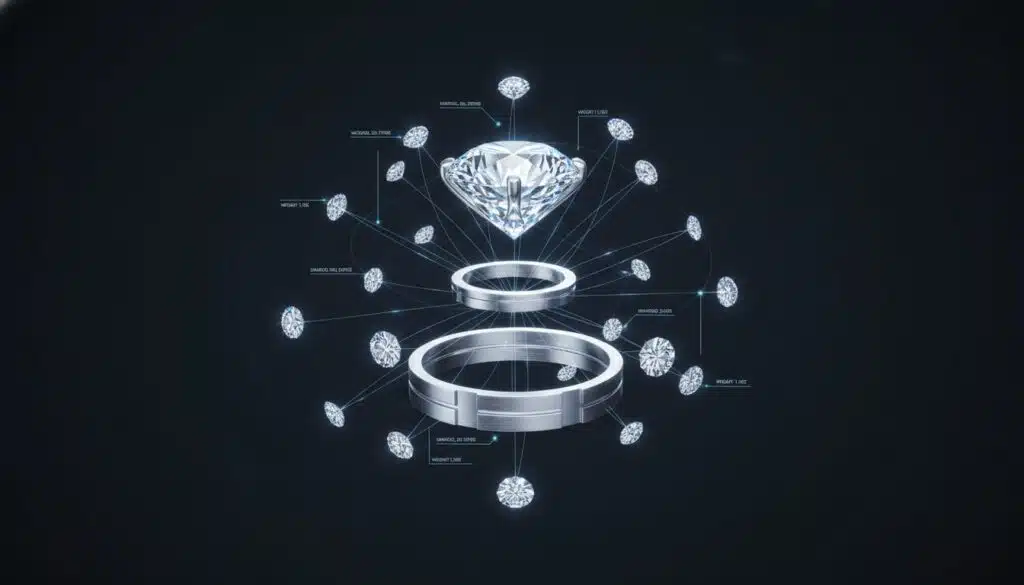
Most luxury retailers treat their online catalog like a digital showroom, but the most successful global brands in 2026 treat it like a high-precision engineering database. Effective jewelry product variation management is no longer about simply filling out a spreadsheet; it’s about building a centralized intelligence hub that understands the relationship between a single GIA-certified diamond and five different potential settings. If you’ve struggled with generic platform limits like Shopify’s 100-variant cap or the recurring nightmare of manual data entry for metal weights, you already know that standard e-commerce tools aren’t built for the intricacies of fine jewelry.
We understand the pressure of scale in a digital market projected to reach $85.7 billion this year. You shouldn’t have to risk your reputation by overselling a unique gemstone just because it was listed as a variant across multiple channels. This guide will show you how to master SKU complexity without losing inventory integrity or your peace of mind. We will explore how to implement component-level logic, automate price updates based on live gold market fluctuations, and maintain a professional, clean customer experience. It is time to stop managing individual listings and start mastering your entire inventory architecture through high-tech automation.
Key Takeaways
- Learn how to navigate the “SKU Explosion” by synchronizing materials, designs, and certifications beyond the limits of generic e-commerce platforms.
- Implement a sophisticated variation matrix using metals, stones, and sizes to create scalable, made-to-order listings through virtual SKU logic.
- Master jewelry product variation management by adopting component-based inventory to ensure one-of-a-kind gemstones are never oversold across different settings.
- Automate the translation of complex jewelry attributes for Etsy, Amazon, and eBay to maintain listing integrity across all global sales channels.
- Centralize your operations with a specialized Jewelry PIM that serves as the primary intelligence hub for every metal, stone, and certification in your catalog.
The Complexity of Jewelry Variations: Why Generic Tools Fail
Jewelry product variation management is the high-stakes synchronization of raw materials, specific designs, and grading certifications. It is a technical challenge that goes far beyond selecting a color or size from a dropdown menu. In the luxury sector, a variation isn’t just a different version of a product; it is a unique combination of financial assets. Unlike apparel, where a “Large Blue” shirt has the same intrinsic value as a “Small Red” one, jewelry components like gold and diamonds have fluctuating, high-value costs that must be tracked with surgical precision.
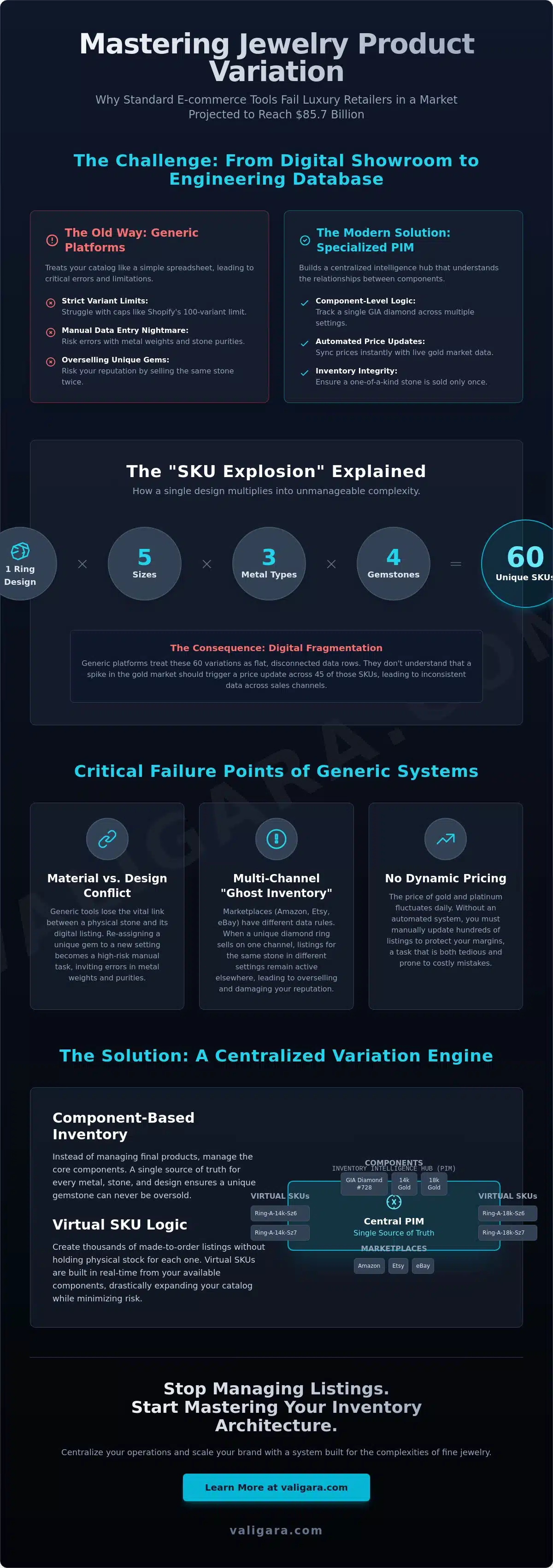
The primary hurdle for most retailers is the “SKU Explosion.” Consider a single ring design. If you offer that design in five sizes, three metal types, and four gemstone options, you have instantly created 60 unique Stock Keeping Unit (SKU) profiles. Generic e-commerce platforms treat these 60 items as flat data rows. They don’t understand that a spike in the gold market should trigger a price update across 45 of those variations simultaneously. This lack of specialized logic leads to “Digital Fragmentation,” where your data becomes siloed and inconsistent across different sales channels.
The Material vs. Design Conflict
A “Blue Sapphire Ring” is a complex assembly, not a static item. It represents a specific gemstone paired with a specific mounting. Generic tools fail because they lose the vital link between the physical gemstone and the digital listing. You must track the “Parent” design as a blueprint while managing “Child” variations as physical manifestations. Without this distinction, you can’t easily re-assign a unique stone to a different setting without risking manual data entry errors that misrepresent metal weights or stone purities to your customers.
The Multi-Channel Challenge
Marketplaces speak different technical languages. Amazon enforces rigid Parent-Child hierarchies, while Etsy and eBay utilize their own proprietary variation themes. Managing these manually across multiple tabs is a recipe for “Ghost Inventory.” This happens when a one-of-a-kind diamond sells in a 14k gold setting on one channel, but the listing for that same stone in an 18k setting remains active on another. Manual jewelry product variation management can’t keep pace with 24/7 global sales. When synchronization fails, you risk overselling unique pieces, which leads to canceled orders and permanent damage to your seller ratings.
The Jewelry Variation Matrix: Metals, Stones, and Sizes
Scaling a luxury brand requires a shift from flat product lists to a multidimensional matrix. Successful jewelry product variation management relies on three primary axes: metal type, gemstone quality, and size. When these attributes intersect, they create a complex web of data that generic platforms simply cannot parse. A professional operation manages these as a “Hybrid” model, where the core design remains fixed while variable attributes like ring size or metal purity adjust the final product in real-time.
To handle this complexity without ballooning physical stock, industry leaders utilize the “Virtual SKU” concept. This allows you to create digital listings for made-to-order items based on available components. By centralizing these attributes in a Jewelry PIM, you ensure that every variation inherits the correct specifications from the parent design. Modern retailers are increasingly turning to tech for inventory management to bridge the gap between creative design and technical data accuracy.
Metal Variations and Dynamic Pricing
Metal type is more than a cosmetic choice; it is a financial variable. The price gap between 14k gold, 18k gold, and Platinum must be reflected accurately to protect your margins. Automated variation management calculates these differences based on metal weight and purity. To maintain precision, high-volume sellers use a Gold Feed Sync to trigger real-time price adjustments across all variations whenever the market fluctuates. This eliminates the need for manual recalculations and ensures your global listings always reflect current material costs.
Gemstone and Diamond Attributes
Managing gemstone variations requires a granular understanding of the “4 Cs”: Cut, Color, Clarity, and Carat weight. Each variation must be linked to its specific gemstone attributes and, where applicable, its GIA or IGI certifications. Effective jewelry product variation management ensures that when a customer selects a “VVS1, F Color” diamond variant, the system instantly displays the corresponding certificate and high-resolution imagery. This level of detail transforms a simple product page into a professional sales tool that justifies the premium value of your pieces.
Solving the “One-of-a-Kind” Variant Inventory Problem
A common friction point for high-end retailers is the “One Stone, Many Settings” dilemma. You have a single, high-value GIA-certified emerald. You want to offer it as a solitaire ring, a halo pendant, or even a custom-mount option. On generic platforms, you’re forced to choose one listing or risk the nightmare of selling the same stone twice. Professional jewelry product variation management solves this by decoupling the physical component from the digital listing.
Instead of creating static variants, you implement Component-Based Inventory Management. This system treats your unique gemstones as individual assets with their own unique IDs. These assets are then mapped to multiple “Virtual Products” across your sales channels. This architecture allows your inventory to remain fluid while your listings stay expansive. It’s the difference between a rigid spreadsheet and a dynamic relational database that understands the physical reality of your workshop.
The Unique Stone Logic
Managing high-value stones requires treating them as individual assets rather than generic stock. When you map a single stone to three different settings, you aren’t duplicating inventory; you’re multiplying opportunities. A centralized PIM ensures that specific data, such as a GIA certificate or high-resolution macro photography, is tethered to that stone regardless of which setting a customer chooses. This logic must be respected across eBay, Etsy, and your own website simultaneously. If a customer buys the stone in a platinum setting on your site, the listings for that stone in gold settings on Etsy must disappear instantly.
Preventing Overselling in High-Value Retail
The “Kill Switch” mechanism is the most critical technical workflow in jewelry e-commerce. When a unique component is sold, the system must trigger a real-time stock sync that delists every related variation across all channels. Standard retail “buffer stock” strategies fail here. You can’t keep a buffer for a one-of-a-kind 2-carat diamond. Failing to sync in real-time creates massive reputational and legal risks. Professional jewelry product variation management eliminates the human error inherent in manual updates, ensuring you never have to make a “difficult call” to a client explaining that the diamond they just purchased was sold ten minutes earlier on another platform. Precision is the only way to scale without sacrificing integrity.
Multi-Channel Synchronization: Etsy, Amazon, and eBay
Marketplaces are distinct ecosystems with conflicting data requirements. Effective jewelry product variation management requires a system that acts as a linguistic bridge between your internal PIM and the specific technical demands of global channels. Without this, your brand risks “Variation Fragmentation,” where a ring appears differently on Amazon than it does on Etsy. This inconsistency confuses customers and dilutes the perceived value of your luxury pieces. Centralized control is the only way to maintain a professional, unified brand image across the fragmented digital landscape.
Centralized Listing Automation ensures your core product data remains the single source of truth. When you update a gemstone’s carat weight or a metal’s purity in your central hub, that change propagates across all channels instantly. This is particularly vital for dynamic pricing. If the spot price of gold shifts, your system should trigger an update via a Gold Feed Sync. This ensures that a 14k gold variant on eBay and the same 14k gold variant on Amazon reflect the new market reality without any manual intervention. To secure your brand’s presence across these platforms without the manual overhead, explore our Multi-channel Listing Automation tools today.
Amazon Jewelry Variation Rules
Amazon is notoriously rigid. Its “Variation Relationship” guidelines require a strict Parent-Child structure where the Parent SKU is a non-purchasable entity that holds the variations together. If your variation table isn’t perfectly compliant, Amazon will suppress your listing, hiding your high-value items from search results. Automating this process removes the risk of suppression. A specialized system generates Amazon-compliant tables that map your specific jewelry attributes, such as metal stamp or stone shape, directly into Amazon’s predefined fields. This precision is essential given Amazon’s referral fees, which as of April 2026, sit at 20% for jewelry items up to $250.
Etsy and eBay: Flexibility vs. Structure
Etsy and eBay offer different challenges. Etsy often relies on “Personalization” fields for nuances like ring sizing, which can lead to data silos if not managed correctly. In contrast, eBay utilizes Multi-SKU (mSKU) listings that allow for a more structured approach to metal types and gemstone sets. Managing these disparate formats manually is impossible at scale. You need a system that syncs not just the listing data, but also the order details associated with specific variations. Whether you’re navigating Etsy’s 6.5% transaction fee or eBay’s 15% final value fee, maintaining variation integrity is the only way to protect your margins and your seller rating.
Scaling Your Brand with Valigara’s Variation Engine
Valigara acts as the specialized brain of your operation, transforming chaotic data into a streamlined global enterprise. It replaces the fragmented workflows discussed in previous sections with a unified architecture. By utilizing a dedicated Jewelry PIM, you establish a single source of truth for every metal purity, gemstone weight, and GIA certification in your vault. This centralized control ensures that your jewelry product variation management remains precise, whether you’re managing 100 SKUs or 100,000.
The platform’s capability for “Mass-Actions” is a game-changer for high-volume retailers. You can update 1,000 variations across five different sales channels with a single click. Whether you need to adjust prices due to a gold market shift or update shipping templates for a holiday rush, automation handles the heavy lifting. Integrating your variations with our Jewelry CRM and Insights and Analytics allows you to move beyond basic tracking. You can finally see which specific metal and stone combinations are your actual profit drivers, enabling data-backed inventory decisions.
The Valigara Advantage for Manufacturers
Manufacturers often find themselves trapped in a cycle of manual spreadsheets and repetitive data entry. Transitioning to high-tech automation allows you to reclaim your time and focus on craftsmanship. Industry professionals using our platform report reducing manual labor by up to 80% through automated listing creation. Generic e-commerce tools simply cannot handle the granular specifications required for fine jewelry. Specialized software is the only viable path to reaching a global enterprise scale without compromising the accuracy that luxury buyers demand.
Implementation and Next Steps
Moving from a manual system to an automated hub doesn’t have to be disruptive. Valigara’s onboarding process is designed to help you structure existing, messy SKU data into a clean, hierarchical format. For businesses with established infrastructures, our API Access allows for seamless synchronization with your current ERP or accounting software. This ensures that your variation management is fully integrated into your broader business logic. Precision and scalability are no longer mutually exclusive.
Scale your jewelry business with Valigara’s automation tools and take command of your multi-channel operations.
Future-Proof Your Jewelry Inventory Architecture
Scaling a luxury brand in a digital market requires more than just a presence on multiple channels; it demands a sophisticated technical foundation. You’ve seen how component-level logic prevents the risk of overselling unique gemstones and how a specialized PIM maintains listing integrity across Amazon, Etsy, and eBay. Moving beyond the limitations of generic e-commerce platforms allows you to treat your inventory as a dynamic asset rather than a static list. Mastering jewelry product variation management is the definitive step toward operational maturity and global expansion.
By centralizing your control, you gain the agility to respond to market shifts instantly. Features like Real-time Gold Feed Sync and Multi-channel Listing Automation ensure your margins are protected and your brand remains consistent 24/7. It’s time to retire the manual spreadsheets and embrace the precision of high-tech automation. Your craftsmanship deserves a system that is as refined as the pieces you create.
Master Your Jewelry Variations—Book a Valigara Demo and take the first step toward a streamlined, automated future. We are ready to help you transform your complex SKU data into a powerful engine for growth.
Frequently Asked Questions
What is the difference between a product variation and a unique SKU in jewelry?
A variation is a customer-facing choice, whereas a unique SKU is the specific identifier for a physical item in your inventory. In jewelry, a single design might have 50 variations but only use five core components. Professional jewelry product variation management ensures that these digital options map correctly to your physical stock. This prevents data fragmentation and ensures that your internal records always match your online listings.
How many variations can I have for a single jewelry design on Amazon?
Amazon typically permits up to 2,000 child ASINs under a single parent, but jewelry categories require strict adherence to approved variation themes. You must use valid attributes like MetalType or RingSize to avoid listing errors. If your variation structure is too complex for Amazon’s flat files, automation tools can translate your internal data into compliant formats. This keeps your listings active and searchable for high-value shoppers.
Can I link one GIA certificate to multiple variations of a ring?
You can link one GIA certificate to multiple variations by treating the stone as a unique, trackable asset within a PIM. This setup allows you to present the same stone in various settings without duplicating the inventory record. When a customer selects a specific variation, the system automatically pulls the correct certificate data. This maintains professional transparency and builds trust with buyers looking for certified luxury items.
How do I update the price of all my gold variations when the market price changes?
Use a Gold Feed Sync to automate price adjustments across your entire catalog based on live market fluctuations. The system calculates the new price for each variant by multiplying the current gold rate by the specific metal weight of that piece. This removes the need for manual spreadsheets and protects your margins instantly. It’s an essential tool for any brand dealing with high-purity metals like 18k gold or platinum.
What happens to my variations on Etsy if I sell the main stone on eBay?
When a unique stone sells on eBay, your multi-channel automation system immediately delists all related variations on Etsy and other platforms. This real-time kill switch is vital for one-of-a-kind items that are offered in multiple settings. It eliminates the risk of selling the same gemstone twice, which could lead to canceled orders and negative seller ratings. Automation ensures your inventory integrity remains flawless across the global market.
Is it better to list variations as separate products or one multi-option listing?
Multi-option listings are usually superior because they consolidate traffic, sales history, and customer reviews into a single high-performing page. This structure improves your search rankings and provides a cleaner shopping experience. However, separate listings can be effective for targeting very specific keywords or niche audiences. A specialized system allows you to test both strategies to see which drives better conversion rates for your specific collections.
How does a Jewelry PIM handle ring size variations differently than a regular CMS?
A Jewelry PIM treats ring sizes as dynamic data points that affect metal weight and cost, while a standard CMS treats them as static labels. This means your PIM can automatically adjust the price for larger sizes that require more material. It also ensures that size-specific stock levels are synced accurately across all channels. This level of technical precision is necessary for maintaining professional standards in high-end retail and manufacturing.
Can I manage jewelry variations for both B2B and B2C sales in one system?
You can absolutely manage B2B and B2C variations in a single system to maintain a unified source of truth. This centralized approach allows you to set wholesale-specific pricing and variation themes that are hidden from retail customers. It simplifies your jewelry product variation management by letting you update product details once and have them reflect across both your B2B portals and B2C marketplaces. Efficiency is the key to scaling a global jewelry enterprise.