
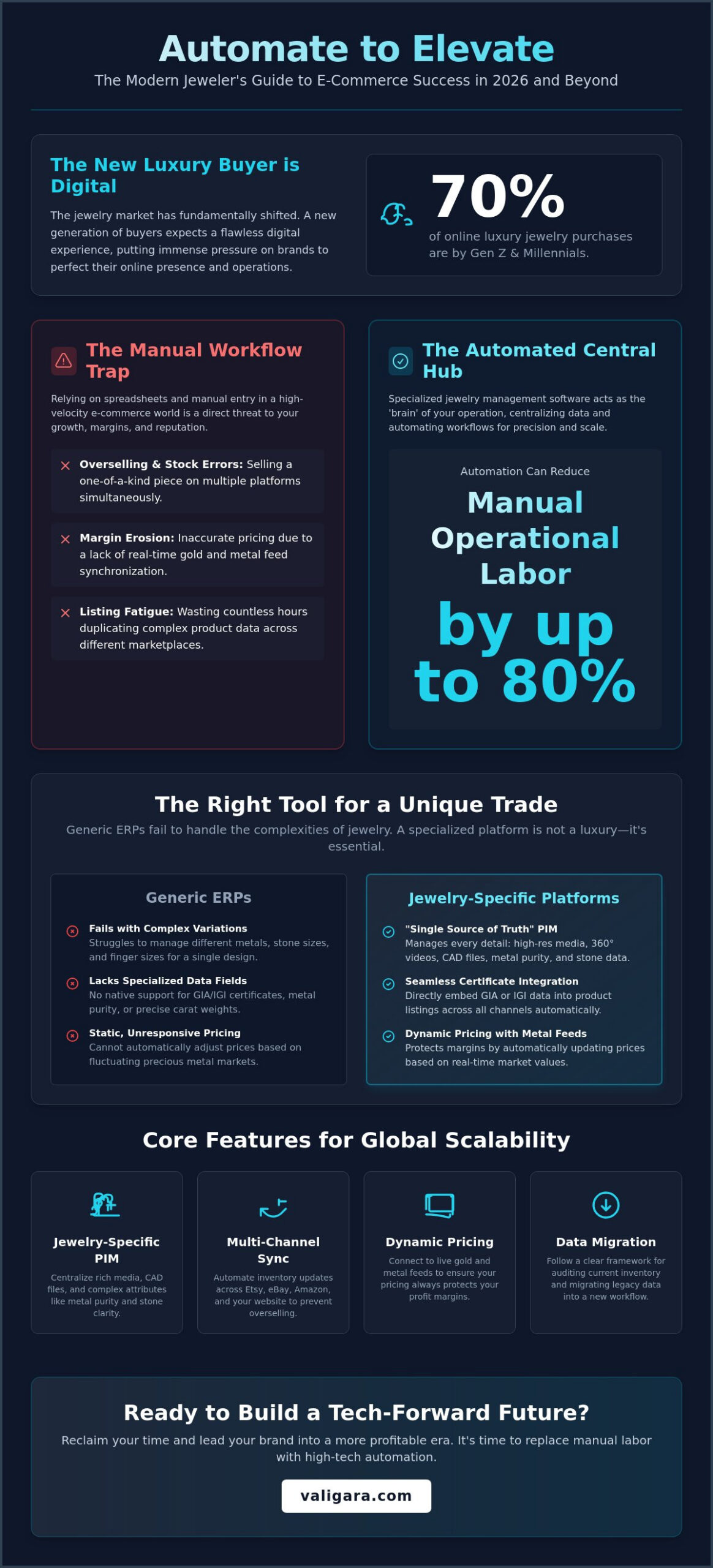
With Gen Z and Millennials now accounting for 70% of online luxury jewelry purchases, the pressure to maintain a flawless digital presence has never been higher. You’ve likely felt the sting of overselling a high-value piece because your stock didn’t sync fast enough across Etsy, eBay, and your own site. Using generic retail software often fails when you need to track specialized data like GIA certificates or precise metal weights. This is why professional online jewelry business management tools have become the essential intelligence behind successful brands. They act as a central hub, replacing manual labor with high-tech automation to protect your reputation and your margins.
It’s a common struggle to feel buried under the weight of multi-channel listing and inventory discrepancies. You deserve a system that works as hard as you do. This guide promises to reveal how specialized tools transform manual jewelry operations into automated, global enterprises. We will walk through the specific features that drive scalability, from gold feed synchronization to navigating new 2026 compliance standards. By the end, you’ll understand exactly how to reclaim your time and lead your brand into a more profitable, tech-forward future.
Key Takeaways
- Understand why specialized online jewelry business management tools are essential for transitioning from local retail to high-velocity global e-commerce in 2026.
- Learn how a centralized Jewelry PIM creates a single source of truth for complex specifications, including metal weights and dynamic gemstone data.
- Avoid the “hidden tax” of generic ERPs by implementing platforms designed to handle the unique requirements of one-of-a-kind jewelry items.
- Discover a clear framework for auditing your current inventory and migrating legacy data into an automated, multi-channel sales workflow.
- Identify strategies to reduce manual operational labor by up to 80% through specialized listing and synchronization automation.
Beyond the Bench: Why Online Jewelry Business Management Tools are Essential in 2026
The traditional jeweler’s bench remains the heart of craftsmanship, but in 2026, the digital hub is the heart of the business. Online jewelry business management tools represent a specialized category of software designed to centralize inventory, Product Information Management (PIM), and global sales into a single, synchronized intelligence. While a standard Enterprise resource planning (ERP) system might handle general accounting or logistics, it often lacks the granular precision required to manage a luxury jewelry catalog. These specialized tools act as the “brain” of your operation, ensuring that every carat, gram, and certification is accounted for across every digital storefront you operate.
The shift from local retail to global multi-channel selling has reached a tipping point. Online sales now account for 25-30% of all jewelry purchases globally. For a scaling brand, this means managing a high-value inventory that leaves zero margin for error. Manual spreadsheets are the number one killer of growth in this environment. They are static, prone to human error, and incapable of communicating with five different marketplaces at once. Relying on manual entry in a world of high-velocity e-commerce isn’t just slow; it’s a liability that can lead to lost margins and damaged reputations.
The Complexity of Modern Jewelry eCommerce
Managing a jewelry catalog is significantly more complex than standard retail. A single ring design can result in dozens of variations when you factor in different precious metals, stone sizes, and finger sizes. Generic e-commerce platforms often fail to handle these specific data fields, forcing you to simplify your listings and lose the technical nuances that luxury buyers demand. High-performance online jewelry business management tools maintain a “Single Source of Truth.” They allow you to manage complex variations and integrate GIA or IGI certifications directly into your listings, ensuring that your data remains rich and accurate across every global marketplace.
Identifying the Bottlenecks in Manual Workflows
Listing fatigue is the first sign that your manual workflow is failing. Spending hours duplicating technical specifications on eBay, Etsy, and Amazon is a drain on your creative and strategic resources. Even more dangerous is the risk of overselling. If a one-of-a-kind pendant sells on your website, but the listing remains active on Amazon for another hour, you face marketplace penalties and a frustrated customer. Inaccurate pricing also poses a constant threat. Without a direct gold feed sync, your prices won’t reflect the real-time market value of your materials, potentially erasing your profit margins in an afternoon. Automation eliminates these bottlenecks, replacing manual labor with reliable, tech-forward precision.
Core Features of High-Performance Jewelry Management Software
High-performance jewelry operations rely on more than just basic inventory tracking. They require an integrated architecture that understands the unique DNA of a luxury product. Integrating specialized online jewelry business management tools into your workflow ensures that every technical specification remains consistent from your vault to the customer’s screen. By centralizing your operations, you eliminate the fragmentation that leads to data errors and lost sales. This centralized approach acts as the core intelligence of your brand, providing a robust foundation for identifying and implementing essential e-commerce tools that drive growth.
Jewelry-Specific PIM (Product Information Management)
A standard PIM isn’t built for the nuances of high-end jewelry. A specialized Jewelry PIM allows you to store and manage high-resolution media, 360-degree videos, and CAD files in one secure location. It handles complex attributes that general software ignores; think metal purity, stone clarity, and precise carat weights. This system doesn’t just store data; it puts it to work. You can generate professional PDF catalogs and line sheets for wholesale clients instantly, using the exact same data that powers your online listings. This level of consistency ensures that your brand’s sophistication is reflected in every document you produce.
Dynamic Diamond and Gemstone Data Integration
Managing loose stones and set jewelry requires a system that can track individual components with surgical precision. Leading online jewelry business management tools digitalize GIA and IGI certificates, allowing them to appear on your product pages automatically. This builds immediate trust with high-intent buyers. These systems also bridge the gap between market volatility and your retail prices. By integrating a live gold feed sync and diamond market trends, the software adjusts your pricing in real time. Automating these complex workflows is why brands choose specialized jewelry listing automation platforms over generic alternatives that require manual price adjustments.
The final pillar of a high-performance system is the ability to push products to global marketplaces with a single click. Multi-channel listing automation removes the friction of expanding to eBay, Amazon, or Etsy. When a sale occurs on one platform, real-time inventory synchronization updates your stock levels across every other channel instantly. This prevents the operational nightmare of the “out of stock” refund, protecting your seller ratings and ensuring that your most valuable pieces are always available where the buyers are, without the risk of double-selling a one-of-a-kind item.
Generic ERPs vs. Jewelry-Specific Platforms: Making the Right Choice
Choosing the right technical foundation is the most critical decision for a scaling brand. While general-purpose platforms might seem accessible, they often impose a “hidden tax” through custom development and fragile plugin ecosystems. Online jewelry business management tools are built to handle the industry’s specific complexities from day one. Generic software is designed for high-volume, identical products. It fundamentally lacks the logic required to manage one-of-a-kind pieces or the nuances of stone clarity and metal purity variations. Relying on “jewelry-adapted” tools instead of “jewelry-born” platforms leads to operational friction that slows your global expansion.
Industry-specific support and onboarding are equally vital. When you’re migrating thousands of SKUs or setting up a complex gold feed sync, you need a partner who understands the London Fix and GIA grading scales. General software providers offer generic help desks that don’t grasp the high stakes of luxury retail. A specialized partner ensures that your transition from manual workflows to an automated enterprise is seamless, protecting your data integrity and your brand reputation during the most critical phases of growth. This expertise acts as a force multiplier for your internal team, allowing you to focus on strategy rather than troubleshooting software limitations.
The Hidden Costs of Non-Specialized Tools
General inventory tools struggle with the unique nature of jewelry SKUs. They aren’t programmed to recognize that a single design might use stones of slightly different weights, each requiring a unique certification. This forces you into manual workarounds, which are the primary source of data errors and listing inconsistencies. Generic stock sync also fails to account for the high-value, low-velocity nature of the trade. If a plugin takes ten minutes to update your inventory across five channels, you’ve already created a window for a double-sale. These delays don’t happen with specialized online jewelry business management tools that prioritize real-time synchronization above all else.
The Scalability Factor: Multi-Channel Listing Automation
True scalability depends on your ability to reach international markets without increasing your headcount. Valigara automates the distinct listing requirements of global marketplaces like eBay, Etsy, and Amazon. It doesn’t just push data; it optimizes it. For example, the system can automatically adjust regional spelling, switching between “Jewelry” for US buyers and “Jewellery” for UK markets to improve local SEO. By centralizing customer communications from every channel into a dedicated Jewelry CRM, you maintain a consistent, luxury-grade service level regardless of where the sale originated. This specialized approach ensures that as your SKU count and channel volume grow, your manual workload remains flat and your operations stay lean.
Implementing an Automated Workflow for Global Sales
Transitioning from manual workflows to a streamlined, global enterprise requires a structured implementation strategy. It’s not just about installing software; it’s about re-engineering your business logic to support rapid, automated growth. High-performance online jewelry business management tools serve as the primary operational hub, but their effectiveness depends on how you configure the initial data flow. By following a modular implementation path, you move from fragmented spreadsheets to a centralized intelligence that handles the heavy lifting of multi-channel management for you.
- Step 1: Audit current inventory and data quality. Before migrating, verify your technical specifications. Ensure every SKU has accurate metal weights, stone clarities, and high-resolution media.
- Step 2: Migrate legacy data into a centralized Jewelry PIM. This creates your “Single Source of Truth.” Once your data is in the PIM, you never have to enter it manually again.
- Step 3: Connect your primary sales channels. Integrate your eBay, Etsy, Amazon, and Shopify accounts. This establishes the bi-directional sync needed for real-time updates.
- Step 4: Set up automated marketing and CRM triggers. Configure your system to recognize repeat buyers and high-value clients for personalized follow-ups.
- Step 5: Train your team on automated fulfillment. Shift your staff’s focus from data entry to quality control and logistics management.
Execution is everything in luxury retail. If you’re ready to transition to a more efficient model, you can start your jewelry automation journey today and eliminate the friction of manual multi-channel selling.
Synchronizing Real-Time Stock Across Global Marketplaces
Inventory synchronization is the pulse of your digital storefront. Within your online jewelry business management tools, you can establish “Master Inventory” rules that prioritize specific channels during high-traffic periods. For example, you might reserve your last two units of a popular silver pendant for your own website while delisting them from marketplaces to avoid high commission fees. The system also handles “Last Piece” logic with surgical precision. It creates genuine urgency for buyers without the risk of overselling, automatically removing the item from all five platforms within seconds of a confirmed transaction.
Automating Marketing and CRM for Jewelry Brands
Generic tools often stop at the sale, but specialized jewelry software focuses on the lifetime value of the client. By centralizing purchase history, you can trigger automated marketing campaigns based on specific milestones. The system can send personalized anniversary or birthday offers featuring items that complement a customer’s previous purchases. It also streamlines your communication by centralizing eBay messages, Etsy inquiries, and website chats into a single dashboard. This ensures no high-value lead is ever missed. For wholesale operations, specialized B2B sales tools and portals allow your partners to place orders directly, further reducing the need for manual intervention.
To further enhance the luxury experience during these special moments, some jewelers are pairing their pieces with other bespoke elements; for example, you can learn more about The Songai by Songai Media to discover how custom musical compositions can turn a jewelry gift into a multi-sensory memory.
Scaling Your Brand with Valigara’s All-in-One Solution
Valigara represents the final evolution in online jewelry business management tools. While generic software attempts to adapt to the jewelry trade, Valigara was built by industry insiders specifically for global manufacturers and high-volume retailers. This platform doesn’t just manage your data; it transforms your entire operation into a high-tech, automated hub. By replacing fragmented manual processes with a centralized intelligence, you can reduce manual operational labor by up to 80%. This efficiency allows your team to pivot from data entry to strategic growth, focusing on design and market expansion rather than troubleshooting inventory discrepancies.
As you focus on this strategic growth, you may find that additional capital is required to support your expanding operations. For business owners looking to leverage assets for quick liquidity, V8Loans offers secured vehicle loans that can provide the necessary funding to invest in new inventory or high-tech management systems.
Scaling a brand also requires a high-performance digital storefront. Valigara Vite provides a specialized jewelry eCommerce website solution that integrates directly with your PIM and inventory systems. Unlike standard website builders, Vite is optimized for the technical nuances of luxury retail, ensuring your high-resolution media and certification data load with surgical precision. This creates a seamless transition for the user, moving from a global marketplace listing to your dedicated brand environment without any loss in data integrity or visual quality. It’s a professional, tech-forward approach to building long-term brand equity.
Streamlining Manufacturing and Fulfillment
The path from the jeweler’s bench to the customer’s box is often where growth stalls. Valigara eliminates these bottlenecks by integrating physical logistics with digital management. Using built-in Barcode and Tag Printing, you can track every piece of inventory as it moves through your facility. If you already use a legacy system, Valigara’s robust API Access allows you to connect with existing logistics providers or ERPs effortlessly. This centralized control extends to your wholesale operations as well. You can manage B2B and wholesale orders alongside your D2C channels, ensuring that your bulk buyers have access to the same real-time stock levels as your retail customers.
Future-Proofing Your Business with Data-Driven Insights
True scalability is impossible without clear visibility into your performance. Valigara’s Insights and Analytics allow you to know your margins to the gram, identifying which products and channels drive the most profit. In a volatile market, protecting these margins is a constant challenge. The system’s automated Gold Feed Sync adjusts your prices across all platforms instantly as market rates fluctuate, removing the risk of selling high-value items at outdated prices. This level of automation ensures your business remains resilient and profitable regardless of market shifts. If you’re ready to transition from manual workflows to a streamlined enterprise, you can scale your jewelry business today with Valigara’s all-in-one platform and secure your place in the global market.
Lead Your Brand into the Future of Digital Luxury
The transition from manual inventory tracking to a streamlined, global enterprise is no longer optional for brands aiming to lead the market in 2026. By implementing specialized online jewelry business management tools, you replace the friction of manual labor with a centralized intelligence that understands carats, clarities, and certifications. We’ve explored how a dedicated PIM and multi-channel synchronization protect your reputation and your margins across every global marketplace. As you manage these international operations, you can learn more about Ellicash to discover how to simplify the cross-border financial transfers that fuel global growth. Your craftsmanship deserves a system that’s as precise as your finest pieces.
Valigara was founded by jewelry industry veterans in 2009 to solve these exact complexities. Our platform provides specialized tools for GIA and diamond management, earning the trust of manufacturers and retailers worldwide. You don’t have to navigate the technical hurdles of international expansion alone. It’s time to reclaim your time and focus on the artistry of your trade while our software handles the operational heavy lifting.
Book a Personal Demo to See Valigara in Action
Take control of your operations and start your journey toward a more efficient, automated future today. Your brand is ready to scale; ensure your technology is ready to lead the way.
Frequently Asked Questions
What are the best management tools for a small online jewelry business?
The best management tools for a small online jewelry business prioritize scalability and industry-specific data fields. While entry-level retailers often start with basic spreadsheets, transitioning to a specialized platform like Valigara allows you to manage carats, metals, and multi-channel listings from a single interface. This prevents the operational bottlenecks that occur when a small brand begins to grow rapidly across global marketplaces and requires more than just basic inventory tracking.
Can I use generic inventory software like QuickBooks for my jewelry business?
You can use generic software for basic accounting, but it fundamentally lacks the architecture to manage complex jewelry inventory. Tools like QuickBooks don’t recognize specific jewelry attributes like stone clarity, metal purity, or GIA certificate links. This forces you into manual workarounds that increase the risk of data errors. For high-performance operations, you need a system designed for the technical nuances of the trade that can handle one-of-a-kind items efficiently.
How do I sync my jewelry inventory across Etsy, eBay, and Amazon?
Syncing inventory across multiple platforms requires a centralized hub that offers real-time bi-directional communication. High-performance online jewelry business management tools automate this process by updating stock levels across Etsy, eBay, and Amazon within seconds of a sale. This synchronization eliminates the risk of double-selling one-of-a-kind items and protects your seller ratings by ensuring your digital storefronts are always accurate across every global channel you operate.
What is a Jewelry PIM and why do I need one?
A Jewelry PIM (Product Information Management) is a specialized database that stores all technical specifications, high-resolution media, and certifications for your collection. You need one to maintain a “Single Source of Truth” across your global sales channels. Instead of manually updating every marketplace, the PIM pushes consistent, rich data to every storefront. This ensures your brand sophistication remains uniform regardless of whether a customer is shopping on your website or a third-party marketplace.
How much does jewelry management software typically cost in 2026?
In 2026, most specialized jewelry management platforms are priced between $99 and $399 per month per location for basic setups. Comprehensive cloud-based systems for larger retailers can range from $550 to $800 or more, depending on the volume of SKUs and integrated channels. These costs reflect the value of the automation provided, though hardware and specialized implementation fees are often handled separately from the monthly subscription. It’s an investment in scaling your brand with precision.
Can jewelry management tools help with GIA and diamond certifications?
Specialized online jewelry business management tools are designed to digitalize and link GIA and IGI certifications directly to your product listings. This automation allows certificates to appear on your product pages instantly, building buyer trust without manual uploads. The system can also track loose stones versus set jewelry in a unified inventory system, ensuring that every individual diamond remains traced and accounted for throughout the entire manufacturing and fulfillment lifecycle.
How long does it take to migrate my jewelry data to a new system?
The timeline for migrating jewelry data depends on the quality and volume of your existing records. A typical transition for a mid-sized brand usually takes between two to six weeks. This period includes auditing your technical specifications, migrating legacy data into the new Jewelry PIM, and testing the bi-directional sync with your sales channels. A structured implementation plan ensures your operations remain active and your data integrity stays intact during the move.
Is it possible to automate gold price updates for my online store?
You can automate pricing adjustments by integrating a real-time gold feed sync into your management platform. This feature automatically recalculates your retail prices based on the current market value of the precious metals used in each piece. It’s an essential tool for protecting your margins in a volatile market, ensuring that your online store reflects accurate pricing without the need for constant manual intervention. This automation allows you to maintain profitability while focusing on growth.