
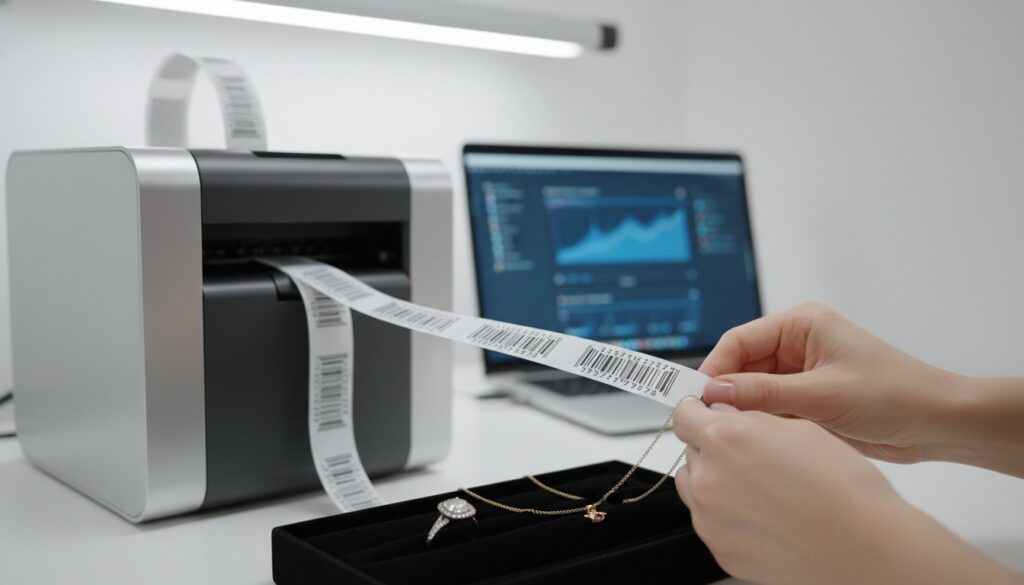
A barcode is more than a simple sticker; it’s the physical manifestation of your digital product information. If your physical tag doesn’t synchronize perfectly with your digital data, your inventory is already failing you. You’ve likely felt the frustration of finding a discrepancy between your Etsy listings and your physical vault, or watched a customer handle a tag that is faded and peeling. These manual errors don’t just look unprofessional, they actively prevent your business from scaling.
We understand that maintaining 100% accuracy across global sales channels is the only way to protect your brand’s reputation. This guide will show you how to master barcode and tag printing for jewelry to bridge the gap between your vault and your storefront. You’ll learn to automate your printing workflows directly from your product data, ensuring every piece is tracked with surgical precision. We’ll explore the hardware required for durable, high-resolution tags and the software strategies that turn your inventory into a streamlined, global enterprise.
Key Takeaways
- Learn why thermal transfer printing is the industry standard for tags that must survive harsh ultrasonic cleaning and steam.
- Discover how to synchronize your physical stock with global marketplaces by using professional barcode and tag printing for jewelry as your operational source of truth.
- Eliminate manual data entry errors by connecting your Jewelry PIM directly to your printing hardware for automated tag generation.
- Master the anatomy of jewelry tags, from rat-tail to butterfly styles, to ensure a high-end customer experience that matches your brand’s luxury status.
- Implement a centralized workflow that prevents SKU drift and ensures your eBay, Etsy, and physical vault inventory remain perfectly aligned.
Beyond the Price Tag: Why Barcode Systems are Critical for Jewelry Scalability
In high-end retail, the tag is often the first physical touchpoint a customer has with your brand. If that tag is a smudged, hand-written sticker, the perceived value of a $5,000 diamond drops instantly. Professional barcode and tag printing for jewelry transforms this small piece of plastic into a sophisticated data hub. It establishes a definitive, unbreakable link between the physical item in your hand and its complex digital profile. This is the difference between a hobbyist and a global enterprise.
A barcode acts as the primary key for your entire operation. It doesn’t just store a price; it anchors the item’s weight, clarity, metal purity, and certification data to its physical presence. This level of precision is non-negotiable when handling high-value gemstones. A single digit error in a SKU during manual entry can lead to thousands of dollars in lost margin or a disastrous shipping mistake. By automating this process, you eliminate the human element that leads to costly discrepancies.
The Cost of Manual Inventory Tracking
Manual tracking is a silent profit killer. Every minute an employee spends handwriting tags or searching through spreadsheets for a SKU is a minute stolen from high-value sales activities. The inventory gap is the discrepancy between vault stock and digital listings. When this gap widens, you risk the ultimate e-commerce penalty: overselling on platforms like Etsy or Amazon. These errors don’t just lose sales; they trigger account flags and erode the trust you’ve worked years to build with your customer base.
Barcodes as the Foundation for Global Growth
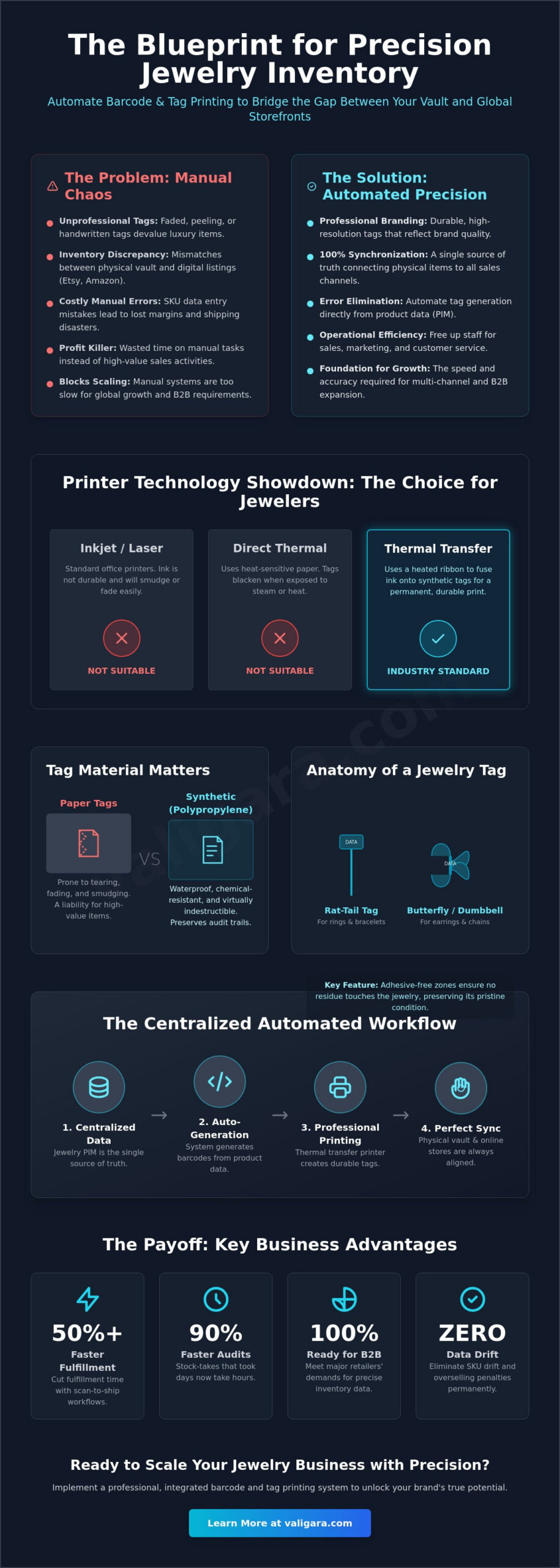
Scaling a jewelry brand requires operational speed that manual systems can’t support. Implementing barcode and tag printing for jewelry enables scan-to-ship workflows that can cut fulfillment time by 50% or more. Instead of manual verification, a simple scan confirms the correct item is in the box before the shipping label is even generated. This infrastructure also revolutionizes internal audits. Stock-taking that used to take days of manual counting now happens in hours through rapid, handheld scanning. For B2B and wholesale operations, standardized labeling is the ticket to entry for major retailers who demand precise, system-ready inventory data as a condition of doing business.
Choosing Your Hardware: Thermal vs. Inkjet and Tag Styles
Selecting the right hardware for barcode and tag printing for jewelry is a decision that impacts your entire operational workflow. Most standard office printers use inkjet or laser technology, which are insufficient for the jewelry trade. These tags must endure harsh environments, including ultrasonic cleaners, steam treatments, and constant handling. For professional results, thermal transfer printing is the only viable standard. Unlike direct thermal printing, which uses heat-sensitive paper that blackens when exposed to steam, thermal transfer uses a heated ribbon to fuse ink onto synthetic materials.
Material science plays a critical role in tag longevity. Paper tags are prone to tearing and fading, making them a liability for high-value inventory. Professional jewelers utilize synthetic materials like polypropylene. These are chemical-resistant, waterproof, and virtually indestructible. Maintaining clear, legible records is also a matter of regulatory compliance. Tracking material origins to ensure you are Complying with the Made in USA Standard requires durable tagging that remains readable throughout the item’s lifecycle. If your tag fades, your audit trail disappears with it.
Tag Shapes and Their Specific Use Cases
The geometry of your tag should match the jewelry it identifies. Rat-tail tags feature a long, non-adhesive tail that wraps securely around ring shanks or thick bracelets. Butterfly and dumbbell tags are the preferred choice for earrings and delicate chains. These designs provide a larger surface area for data while maintaining a slim profile. It’s essential to use tags with adhesive-free zones. This ensures that no sticky residue touches the metal or gemstones, preserving the pristine condition of your pieces for the showroom floor.
Hardware Recommendations for Professional Jewelers
Industry leaders like Zebra and TSC dominate the market for a reason. Their desktop thermal printers are engineered for the precision required in barcode and tag printing for jewelry. When selecting a printer, resolution is the most critical specification. A resolution of at least 300 DPI is mandatory to ensure that high-density 2D barcodes remain scannable on the limited surface area of a jewelry tag. Lower resolutions often result in “bleeding” that renders barcodes unreadable by scanners. To achieve smudge-proof results, pair your printer with high-quality wax-resin or full-resin ribbons. Valigara’s centralized platform supports these hardware standards natively, allowing you to trigger high-precision print jobs directly from your product PIM without manual configuration errors.
The Data Connection: Integrating Printing with Multi-Channel Inventory
A standalone printing app is a liability for a growing jewelry brand. While these apps allow you to design a label on a smartphone, they force you into a manual workflow that is disconnected from your actual inventory. If you update a gemstone weight in your vault or change a price on Etsy, a standalone app won’t know. This results in data silos where your physical tags contradict your digital reality. Professional barcode and tag printing for jewelry demands a direct integration with your Jewelry PIM (Product Information Management) system.
When your printing hardware is an extension of your PIM, data flows automatically. You don’t type in a SKU; the system pulls it. You don’t manually enter a GIA certificate number; it’s already mapped to the product record. This level of automation is essential for handling complex jewelry specifications like metal purity and total carat weight. It also enables dynamic pricing. As gold and diamond feeds fluctuate, an integrated system allows you to identify which items need re-tagging and generates the new labels instantly. Your physical showroom stays as current as your digital storefront.
To take this a step further and stay ahead of market fluctuations, you can explore Digital Label Tags to automate your price monitoring and response strategies.
Eliminating the ‘Double Entry’ Problem
Double entry is the primary source of human error in jewelry management. Entering data once for your website and a second time for a tag design software doubles your risk of a mistake. A centralized system ensures that the information you use for your multi-channel listings on eBay and Etsy is identical to what’s printed on the tag. This synchronization guarantees that every scan of a barcode leads to a live, accurate digital record. It creates a seamless loop where the physical piece and its digital twin are always in perfect alignment, regardless of where the sale happens.
Advanced Data Points for Jewelry Tags
Modern tagging goes beyond simple text. Integrated systems allow you to incorporate advanced data points that enhance the customer experience and operational efficiency. Consider these high-tech additions:
- QR Codes: Provide customers with instant access to digital certificates, 360-degree videos, or detailed care instructions by scanning the tag with a smartphone.
- RFID Integration: For high-volume environments, RFID-enabled tags allow for non-line-of-sight inventory scans, enabling you to audit an entire tray of rings in seconds.
- Brand Consistency: Automatically include high-resolution logos and metal hallmarks on every tag to reinforce your brand’s authority and luxury status.
This technical precision ensures that your tags are not just price markers; they are professional tools for business intelligence. By removing the manual labor from the process, you empower your team to focus on sales rather than data management.
Step-by-Step Guide: Setting Up Your Automated Jewelry Tagging Workflow
Transitioning from manual tagging to an automated system requires a structured approach to ensure your physical labels mirror your digital intelligence. The process begins within your Jewelry Inventory Management software. Before you even connect a printer, you must define the operational logic that will govern your inventory. This setup phase is where you transform raw product data into a scannable, professional asset that facilitates global commerce.
Automated barcode and tag printing for jewelry relies on a clean data architecture. Every attribute you’ve meticulously recorded in your Jewelry PIM, from the total carat weight of a center stone to the specific metal hallmark, can be mapped to your tag layout. This eliminates the need for manual data entry at the point of printing, ensuring that the tag attached to a physical piece is always a perfect reflection of its digital record.
Template Design and Attribute Mapping
Effective template design balances brand aesthetics with technical scanability. You must select the specific fields to display based on the intended use case. Retail tags often prioritize the price, SKU, and a brief description, while wholesale tags may require more technical data like gemstone certifications or internal lot numbers. Using conditional formatting within your software allows you to automate these variations. For example, the system can automatically swap logos if you’re printing for different sub-brands or collections. High-contrast printing is essential here; black ink on a white synthetic background ensures that scanners can read your barcodes instantly, even under the harsh lighting of a showroom floor.
Calibrating for Precision
Jewelry tags are non-standard shapes. Whether you’re using rat-tail or dumbbell styles, your printer must be calibrated to recognize the gaps between labels. Adjust your sensor settings to “transmissive” or “black mark” depending on your tag material to prevent alignment drift. Ribbon tension is another critical factor. On the small surface area of a jewelry tag, even a minor wrinkle in the thermal ribbon can render a barcode unreadable. Troubleshooting alignment issues early prevents wasted material and ensures that every print job, whether it’s a single replacement tag or a bulk run for a new collection, is executed with surgical precision.
Once your hardware is calibrated, the final step is to close the loop by testing scan-to-order functionality. Scan a freshly printed tag to ensure it immediately pulls up the correct product record in your fulfillment system. This verification step confirms that your physical-to-digital bridge is secure. To implement this level of automation in your own vault, explore Valigara’s integrated barcode and tag printing solutions to streamline your entire jewelry operation.
Scaling with Valigara: Professional Barcode and Tag Printing Integrated
Valigara functions as the operational hub for your jewelry enterprise, treating barcode and tag printing for jewelry as a core component of your data ecosystem rather than an afterthought. When your printing capabilities are a native feature of your PIM, you eliminate the friction of data synchronization. There’s no need to export CSV files or manage fragile connections between separate software platforms. This centralized control ensures that the information on your physical tags is always an exact mirror of your digital inventory, whether you’re selling on eBay, Etsy, or your own Vite-powered website.
One of the most significant risks in multi-channel retail is SKU drift. This occurs when product data becomes fragmented across different sales channels, leading to inventory discrepancies and fulfillment errors. Valigara prevents this by maintaining a single source of truth. By transitioning to automated batch printing, industry professionals have reported reducing their tagging time by as much as 70%. This efficiency allows your team to move from manual labor to strategic growth, knowing that every piece in your vault is accurately identified and ready for global sale.
Native Integration vs. Third-Party Plugins
Standalone printing apps and third-party plugins create data silos that inevitably lead to mistakes. Valigara’s built-in printing tool is more reliable because it accesses your product data in real time. If you update a gemstone weight or adjust a price based on a gold feed fluctuation, you can print the updated tag instantly without leaving the platform. This seamless support extends to complex jewelry variations and sets, ensuring that every component of a high-value item is tracked with technical precision. You don’t have to worry about whether your printer “talks” to your inventory software; they speak the same language by design.
Future-Proofing Your Inventory
As your brand scales, your tracking needs will evolve. Valigara’s flexible data architecture is designed to grow with you, supporting global jewelry standards and multi-currency pricing for international showrooms. This infrastructure also prepares your business for the next wave of technology, such as RFID adoption. By integrating barcode and tag printing for jewelry into your broader order fulfillment and shipping processes, you create a lean, automated workflow that minimizes human error. This systematic approach transforms your inventory from a liability into a high-performance asset. Optimize your jewelry operations with Valigara’s integrated tagging to ensure your business is built for precision and global expansion.
Master Your Inventory for Global Expansion
Precision in jewelry inventory isn’t just about the physical tag; it’s about the data architecture behind it. You’ve seen how selecting 300 DPI thermal transfer hardware ensures your labels survive the rigors of the showroom and the cleaning tank. More importantly, establishing a direct connection between your Jewelry PIM and your printer is the only way to eliminate the manual labor that leads to costly SKU drift. Transitioning to an automated system secures a perfect physical-to-digital bridge as you scale across global marketplaces.
Mastering barcode and tag printing for jewelry turns your inventory into a high-performance asset. It allows you to move with the speed and accuracy required to compete on the international stage. By removing the burden of manual data entry, you empower your team to focus on brand growth and customer relationships rather than tracking down discrepancies. Accuracy is the foundation of luxury retail; don’t leave it to chance.
Streamline your jewelry inventory with Valigara’s automated tagging tools. Our platform provides native support for Zebra and TSC printers, ensuring automatic data synchronization across 10+ marketplaces and specialized management for your most complex jewelry SKUs. It’s time to trade manual workflows for surgical precision and build a business that’s ready for the future.
Frequently Asked Questions
What is the best printer for jewelry tags?
Zebra and TSC thermal transfer printers are the industry standards for jewelry. These devices offer the durability and precision required to handle synthetic materials and small label formats. Unlike consumer printers, they’re engineered for high-volume environments where reliability and technical accuracy are paramount for professional operations.
This emphasis on durability and precision is mirrored in other heavy industries; for example, in the petrochemical and power sectors, companies visit OG VALVES LTD. to source specialized valves that ensure operational safety and efficiency.
Do I need special software for jewelry barcode printing?
Specialized Jewelry Inventory Management software is essential to prevent data silos. While basic drivers exist, a PIM system ensures your barcode and tag printing for jewelry is synchronized with your live digital inventory. This automation eliminates manual entry errors and ensures every physical tag reflects current product data across all channels.
What is the difference between rat-tail and butterfly jewelry tags?
Rat-tail tags feature a long, non-adhesive tail designed to wrap securely around ring shanks or thick bracelets. Butterfly or dumbbell tags provide a wider surface area for data, making them the preferred choice for earrings and delicate chains. Both styles should include adhesive-free zones to ensure no sticky residue touches the metal.
Can I print GIA certificate numbers on my jewelry tags?
You can print GIA certificate numbers and other technical specifications directly on your tags. By mapping these attributes in your Jewelry PIM, the system automatically pulls the data into your tag layout. This provides instant verification for your staff and builds immediate trust with customers during the sales process.
Will ultrasonic cleaning damage my jewelry barcodes?
Ultrasonic cleaning won’t damage your tags if you use thermal transfer printing with a full-resin ribbon on synthetic materials. These materials are chemical-resistant and waterproof. Direct thermal or paper labels will fail instantly in a cleaning tank, leading to lost inventory data and smudged, unreadable barcodes.
How do I sync my printed tags with my Shopify or Etsy inventory?
Syncing physical tags with Shopify or Etsy requires a centralized inventory hub. Professional barcode and tag printing for jewelry connects your physical vault to your digital storefronts via a shared SKU. A simple scan then updates your stock levels globally, preventing overselling and maintaining perfect accuracy across every channel.
What DPI resolution is needed for small jewelry labels?
A resolution of at least 300 DPI is necessary for small jewelry labels. Because jewelry tags have limited surface area, they require high-density barcodes that stay legible. Lower resolutions like 203 DPI often cause ink bleeding; this makes barcodes unreadable by standard scanners and ruins the professional aesthetic of your brand.
Can I use a regular office printer for jewelry tags?
Regular office printers are unsuitable for jewelry tags. Inkjet and laser printers can’t handle the specialized synthetic materials or the small, non-standard shapes used in the trade. Additionally, standard office ink smudges easily and won’t survive the cleaning and handling processes inherent in professional luxury retail.