
What if your inventory system functioned as the central intelligence of your global enterprise rather than a manual administrative burden? You know the specialized nature of your trade requires more than a generic retail solution. The best way to track jewelry inventory in 2026 isn’t found in a static spreadsheet, but in a dynamic hub that connects raw materials, loose diamonds, and finished pieces across every sales channel simultaneously.
It’s frustrating to face overselling on Etsy or eBay because your stock levels didn’t update in time. You shouldn’t have to manually cross-reference GIA certifications or calculate metal price fluctuations daily just to keep your listings accurate. This guide will show you how to transition from fragmented workflows to a streamlined, automated system designed specifically for the jewelry industry. You’ll discover how to maintain a single source of truth for your entire collection, synchronize real-time stock, and leverage live gold feed sync to ensure your pricing remains accurate and profitable without the manual labor. It is time to move from manual counting to precision scaling.
Key Takeaways
- Understand why generic retail systems fail to handle jewelry-specific complexities like carats, clarity, and metal purity.
- Identify why the best way to track jewelry inventory requires a centralized PIM rather than fragmented spreadsheets to maintain a single source of truth.
- Protect your brand reputation by using real-time synchronization to prevent overselling across marketplaces like Etsy, eBay, and Amazon.
- Learn to automate your pricing strategies with live gold feed integration, ensuring your margins stay protected as market values fluctuate.
- Follow a proven five-step implementation plan to cleanse your data and build a scalable SKU architecture for complex product variations.
Why Jewelry Inventory Management is a Unique Business Challenge
Jewelry is a complex hybrid of raw commodities and high-value artistry. It’s not just a simple retail product. Unlike apparel or electronics, a single ring represents a culmination of casting grain, solder, side stones, and a center gem. Standard inventory management principles often fall short here. They can’t account for the granular attributes that define luxury value. To scale effectively, you need a system that understands these nuances.
Generic systems fail because they treat every SKU as a simple unit. In jewelry, carats, clarity, and metal purity aren’t just descriptions. They’re the primary drivers of cost and price. If your system can’t distinguish between a 1.01ct VVS1 diamond and a 0.98ct VS2 stone, your margins are at risk. The best way to track jewelry inventory requires a specialized system that speaks the language of the trade and manages these variables with precision.
The cost of inaccuracy is staggering. Losing track of a single loose diamond or miscalculating the gold weight in a production run leads to immediate financial loss. In 2026, the industry has shifted toward “Live Inventory.” Your stock levels must update across global marketplaces instantly. A de-synced listing on a high-ticket item doesn’t just lose a sale. It damages your professional reputation and platform standing.
Raw Materials vs. Finished Pieces
Jewelry production involves a complex journey. You aren’t just moving boxes; you’re managing casting grain, loose stones, and findings. Tracking this journey requires a Bill of Materials (BOM) for every piece. You must monitor Work-in-Progress (WIP) inventory as materials transform into finished SKUs. Without this visibility, you can’t accurately calculate your true cost of goods sold or manage your workshop’s efficiency. Precision at this stage is what separates a hobbyist from a global enterprise.
The High-Value Asset Factor
Security and traceability are non-negotiable. Every high-value asset must be linked to its digital certification, whether it’s GIA, IGI, or HRD. Your inventory system should act as a secure vault for these documents. High-resolution imagery is equally vital. In professional jewelry tracking, a photo isn’t just for marketing. It’s a critical tool for identification and verification during the fulfillment process. This ensures that the exact stone promised is the one delivered.
The Best Way to Track Jewelry: From Spreadsheets to Specialized PIM
Many brands start their journey with Excel or Google Sheets. It feels accessible and familiar. However, as you scale across multiple global marketplaces, the best way to track jewelry inventory shifts from static lists to automated intelligence. While implementing essential inventory management techniques like ABC analysis is a professional starting point, manual data entry simply cannot keep pace with the 2026 digital landscape. You need a system that acts as the core intelligence of your business.
Why Spreadsheets are a Risk to Your Scalability
Spreadsheets are inherently static. They don’t communicate with your sales channels. When you sell a sapphire pendant on Etsy, your spreadsheet won’t update your eBay or Amazon listings. This synchronization lag creates a constant risk of overselling high-value items. Human error is another significant factor. A single misplaced decimal in a gold weight field or a typo in a diamond’s clarity grade can distort your entire valuation and lead to costly customer disputes. Security is also a major concern. High-value stock data shouldn’t live in a shared file where version control is easily compromised and access is difficult to audit.
Scalability demands real-time synchronization. If you’re managing hundreds of SKUs across multiple platforms, manual updates become a full-time administrative burden. This hidden cost is significant. You’re essentially paying for manual labor that could be automated, diverting resources away from design and business growth.
The Power of Jewelry-Specific PIM
A Product Information Management (PIM) system is the operational hub of a modern jewelry enterprise. It centralizes every technical detail: gemstone specifications, metal weights, labor costs, and high-resolution imagery. Using specialized Jewelry PIM software allows you to establish a “Single Source of Truth.” When you update a product detail or a price in the PIM, it pushes that change to every connected sales channel instantly, ensuring total consistency across your global brand.
This architecture is vital for handling complex product variations. Consider a single ring design available in five sizes and three metal types, such as 14k white, yellow, and rose gold. A generic inventory system sees 15 separate, unrelated items. A jewelry-specific PIM understands the parent-child relationship. It manages these variations as a single logical entity while tracking the specific components and certifications for each sub-SKU. This level of technical precision is why professional brands are moving away from general-purpose e-commerce tools. You can centralize your operations to ensure every diamond and every gram of gold is accounted for with total accuracy.
Essential Components of a Modern Jewelry Tracking System
A high-performance inventory hub is more than a digital ledger; it’s the core intelligence of your operation. While a PIM organizes your data, the functional components of the system execute the daily heavy lifting. The best way to track jewelry inventory in 2026 requires a suite of specialized tools that bridge the gap between market fluctuations and multi-channel sales. These components ensure that your high-value assets are never mismanaged or undervalued.
Real-time multi-channel synchronization is the first line of defense against operational chaos. In a global marketplace, a sale on Amazon must trigger an immediate stock reduction on Etsy, eBay, and your own e-commerce website. This isn’t just about convenience. It’s about protecting your professional reputation. Overselling a unique, high-ticket item leads to cancellations and platform penalties that can take months to rectify. Automation eliminates this risk by maintaining a live, accurate count across every touchpoint.
Automated Pricing and Gold Feed Sync
Market volatility in precious metals can erode your margins in hours. Relying on manual price adjustments is a reactive strategy that leaves money on the table. A professional system integrates live metal feeds to adjust your retail prices automatically based on current market values. This ensures your global pricing rules remain profitable regardless of gold or platinum fluctuations. Implementing a gold feed sync eliminates manual price recalculations, allowing you to focus on strategy rather than arithmetic. It’s a critical tool for maintaining healthy margins across thousands of listings simultaneously.
Advanced Gemstone Tracking
Loose stones require a different management logic than finished SKUs. Your system must handle both individual certified diamonds and large parcels of melee stones with equal precision. Dedicated fields for the 4Cs, cut, color, clarity, and carat weight, are essential for accurate identification. Beyond the technical specs, modern consumers demand transparency. Digitizing and linking GIA or IGI certificates directly to the inventory record allows you to display these assets to online buyers instantly. This builds immediate trust and streamlines the fulfillment process by ensuring the correct stone is paired with the correct setting every time.
Finally, bridging the physical and digital worlds requires robust barcode and RFID compatibility. Tagging your stock allows for rapid audits and secure transfers. When a physical item moves, its digital twin should move with it. This level of traceability is non-negotiable for high-value luxury assets. It allows you to transition from manual workflows to a streamlined, global enterprise with total confidence in your data.
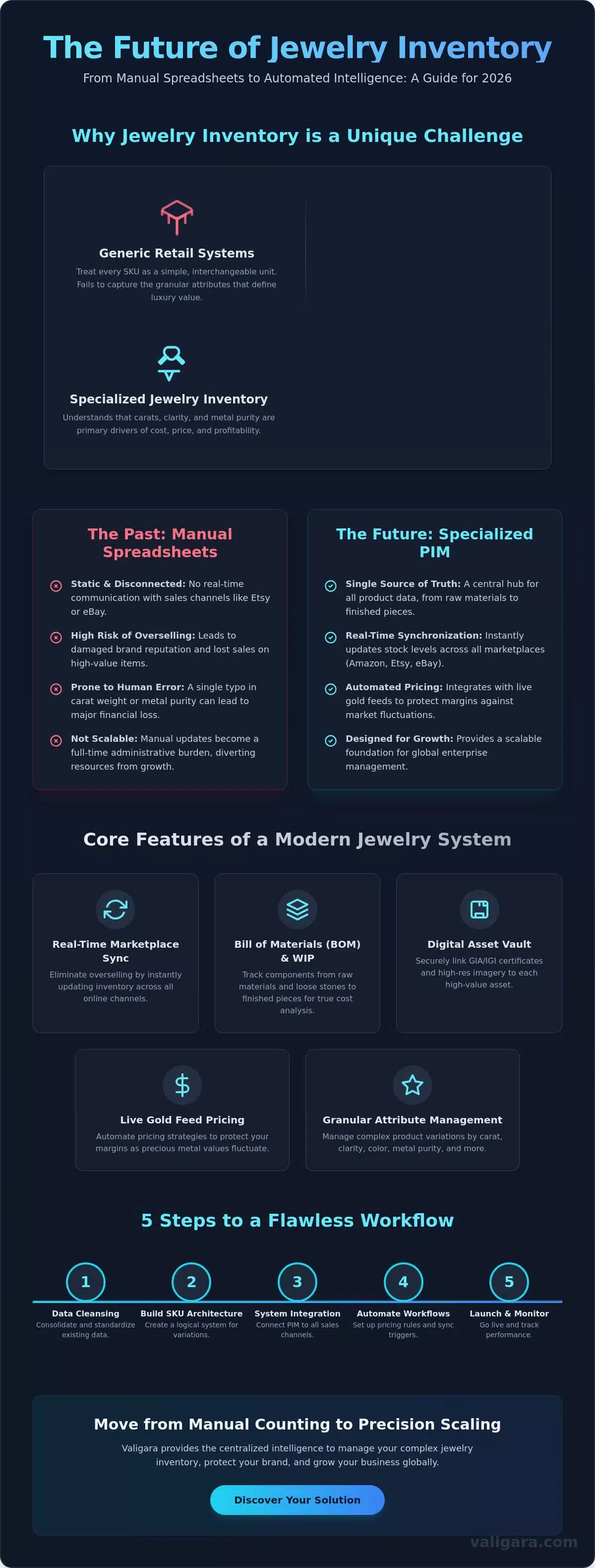
5 Steps to Implementing a Flawless Jewelry Inventory Workflow
Implementation begins with a shift in mindset. Transitioning from manual tracking to an automated system requires a structured approach to ensure your data remains clean and your operations stay efficient. The best way to track jewelry inventory is to build a foundation that supports global scaling without increasing your administrative workload. Follow these five steps to establish a professional workflow.
- Step 1: Audit and Cleanse Existing Data. Data hygiene is your first priority. Standardizing your nomenclature ensures that “14k White Gold” isn’t recorded as three different materials across your sales channels. It’s about compliance too. On July 1, 2026, new AML/CTF reforms take effect in Australia, requiring dealers in precious stones and metals to maintain impeccable records. Clean data is the first step toward meeting these global standards.
- Step 2: Define Your SKU Architecture. Your SKU logic should be intuitive and scalable. A well-structured SKU allows your team to identify the metal, stone type, and size at a glance. This architecture serves as the DNA of your inventory system.
- Step 3: Implement Barcoding and Tagging. Physical tracking must mirror your digital records. Using specialized jewelry tags ensures that your stock remains identifiable through every stage of the retail process, including ultrasonic cleaning.
- Step 4: Integrate Sales Channels. Connect your centralized hub to eBay, Etsy, Amazon, and your own website. This step activates the real-time synchronization that prevents overselling and protects your brand reputation.
- Step 5: Establish a Regular Cycle Count. Shift away from the traditional, once-a-year “big” stocktake. Implementing regular cycle counts allows you to verify small sections of your inventory weekly, ensuring total accuracy without shutting down operations.
Setting Up Your SKU Logic
Your architecture should distinguish between simple SKUs and configurable SKUs. A simple SKU represents a unique, one-of-a-kind piece, such as a specific GIA-certified diamond. Configurable SKUs manage variations, like a signature ring setting available in multiple gold purities and finger sizes. Effective naming conventions improve internal search speed and enhance your SEO by providing clear, descriptive identifiers that search engines can index. Avoid random strings of numbers. Instead, use logical blocks that describe the item’s core attributes.
Physical Organization with Barcodes
Generic retail tags don’t survive the jewelry environment. You need thermal or ultrasonic cleaning resistant tags that maintain legibility after professional servicing. Implementing barcode and tag printing for jewelry directly from your inventory system eliminates manual data entry errors during the labeling process. When an order arrives, a quick scan verifies the item, pulls the correct certificate, and updates your stock levels across all platforms instantly. This level of physical-to-digital cohesion is essential for high-volume fulfillment. You can optimize your jewelry workflow by centralizing these operations into a single, high-tech hub.
Scaling Your Jewelry Brand with Valigara’s Centralized Intelligence
Scaling a luxury brand requires a partner that understands the technical precision of the trade. Valigara functions as an Expert Insider, providing the specialized brain your business needs to transition from manual workflows to a global enterprise. By centralizing your operations, you adopt the best way to track jewelry inventory while simultaneously expanding your digital footprint across eBay, Etsy, Amazon, and beyond. This isn’t just a software solution; it’s a strategic hub designed for the intersection of high-tech automation and traditional craftsmanship.
The marketplace-first approach ensures that your complex variation sets, gemstone certifications, and metal weights are managed in one place. Valigara integrates Jewelry Inventory Management, PIM, CRM, and multi-channel listing automation into a single source of truth. This eliminate the need for disconnected tools that fail to communicate. You gain the power to manage your entire collection with quiet confidence, knowing that your stock levels and pricing are synchronized with pinpoint accuracy. This centralized control allows you to focus on design and growth rather than administrative data entry.
The ROI of Automation for Jewelers
Think about the administrative hours lost to manual stock updates across five or more sales channels. Automation reclaims this time. When you eliminate manual labor, you reduce the risk of human error that leads to costly de-synced stock. Preventing a single oversold incident on a high-value diamond ring often pays for the software subscription by avoiding marketplace penalties and protecting your professional reputation. Professional brands use Valigara to scale from 100 to 10,000 SKUs without increasing their headcount. The system handles the granular technical features, allowing the business owner to maintain a fast-paced, efficient rhythm of international expansion.
Ready to Master Your Jewelry Inventory?
The transition from simply tracking items to managing a global enterprise requires professional tools built for 2026. You shouldn’t be limited by generic e-commerce software that doesn’t understand carats, clarity, or live gold markets. It is time to empower your brand with a system that values accuracy and time above all else. Transition your workflow to a streamlined, automated hub that serves as the core intelligence of your business. Book a demo with Valigara to see our jewelry inventory management in action and discover the path from manual labor to precision scaling.
Modernize Your Jewelry Operations for Global Growth
The transition from manual spreadsheets to a centralized intelligence hub is no longer optional for brands aiming to compete in 2026. You’ve learned that the best way to track jewelry inventory involves more than simple counting; it requires a specialized system that synchronizes real-time stock across global marketplaces while managing complex gemstone certifications. By establishing a single source of truth, you eliminate the risks of overselling and manual pricing errors that drain your profitability.
Expertise matters when handling high-value assets. Valigara has been specialized for jewelry and diamonds since 2009, providing the technical precision needed to manage GIA and IGI certificates alongside your physical stock. Our platform offers real-time synchronization for eBay, Etsy, Amazon, and Shopify, ensuring your brand remains reliable across every sales channel. It’s time to move beyond administrative labor and reclaim your time for design and strategic expansion.
Scale your jewelry business with Valigara’s automated inventory management and lead your brand into a more efficient, automated future. You have the tools and the strategy; now take the step toward precision scaling.
Frequently Asked Questions
What is the best way to track jewelry inventory for a small business?
The best way to track jewelry inventory for a small business is to implement a centralized, automated system from day one. Relying on manual processes creates a technical debt that becomes expensive to fix as you grow. By using a platform that combines PIM and multi-channel synchronization, you ensure that your data remains clean and your stock levels stay accurate across every sales channel you choose to enter.
Can I use Excel for jewelry inventory management?
You can use Excel, but it isn’t recommended for professional growth. Spreadsheets lack the real-time connectivity required to manage a modern e-commerce brand. They don’t update your Etsy or eBay listings when a sale occurs; they also can’t handle complex attributes like live gold market fluctuations or GIA certificate linking. For high-value assets, the risk of human error in a spreadsheet is simply too high to justify the initial cost savings.
How do I track loose diamonds and gemstones with their certificates?
Tracking loose diamonds requires a system with dedicated gemstone management fields. You should link digital GIA, IGI, or HRD certificates directly to the stone record in your database. This ensures that technical specifications follow the stone from its arrival as a loose asset to its final setting in a finished piece. It provides total traceability and makes it easy to display certifications to potential buyers online instantly.
What is the difference between jewelry inventory software and a PIM?
Inventory software focuses on stock levels and locations, while a Jewelry PIM manages the rich technical data of your products. A PIM serves as the brain that stores metal weights, gemstone grades, and high-resolution imagery. While inventory tools tell you what you have, a PIM prepares that information for global distribution across marketplaces, ensuring that every listing is technically accurate and consistent across all your sales channels.
How does real-time stock sync prevent overselling on Etsy and eBay?
Real-time stock synchronization functions as the central intelligence of your operation. When an item sells on Etsy, the system immediately sends a command to eBay, Amazon, and your website to reduce the available quantity. This automated loop happens in seconds, effectively eliminating the risk of overselling a unique or low-stock item. It protects your seller rating and ensures you never have to cancel a high-value order due to de-synced data.
Do I need special hardware for jewelry barcode and tag printing?
Professional jewelry tracking requires specialized thermal printers and labels. Standard paper tags won’t survive the harsh chemicals used in ultrasonic cleaning or the rigors of professional display. You need high-durability, non-adhesive tail tags specifically designed for the trade. Professional software allows you to print these barcodes directly from your product records, ensuring the physical tag always matches the digital data in your system.
How often should a jewelry business perform a stocktake?
You should move away from the traditional annual stocktake in favor of regular cycle counting. Performing small, localized audits on a weekly or monthly basis allows you to maintain high data accuracy without halting your business operations. This modular approach identifies discrepancies early; it makes it easier to resolve issues with high-value stock before they impact your financial reporting or cause fulfillment delays during peak sales periods.
Is it possible to automate jewelry pricing based on the current gold market?
Yes, you can automate your pricing through live gold feed integration. The system pulls current market rates for precious metals and recalculates your retail prices based on your specific recipe for each piece. This ensures that your profit margins remain protected during periods of market volatility. It eliminates the need for manual recalculations, allowing your global pricing to remain competitive and accurate across all marketplaces without constant human intervention.